Influencer Marketing
How to Find Wellness Influencers and Vet Claims Safely
A vetting-first guide to finding wellness influencers: audience checks, health-claim risk, disclosure rules and a scorecard to run before you pay.
 Sheetal Shakshi15 Nov 202615 min read

To find wellness influencers, search by niche and audience quality, then shortlist creators whose content matches your product's real benefits. Before you pay, check followers for authenticity, read 30 to 50 past posts for health claims, confirm any credentials, and write claim and disclosure rules into the contract. Nia by Nurdd supports discovery and fake follower checks in one workflow.
To find wellness influencers, search by niche and audience, shortlist creators whose content matches what your product can honestly claim, and vet each one before any money moves. Vetting means checking follower authenticity, reading past posts for risky health claims, confirming credentials and agreeing disclosure rules in writing. This guide gives you the steps, a scorecard and a checklist.
Key takeaways
- Search for wellness influencers by the claim you can safely make, not by follower count. A creator who fits your evidence is worth more than a bigger one who does not.
- Read at least 30 to 50 past posts per shortlisted creator and log every health claim before you send a brief.
- Run an authenticity check on followers and engagement before agreeing a rate. Nurdd's fake follower checker gives a fast first pass.
- Put approved claims, banned claims and disclosure wording in the contract, and keep a copy of the final post.
- Score every creator on the same six-line scorecard below so the decision is repeatable, not a gut call.
What is the quick answer to finding and vetting wellness creators?
Work in this order: define the claims your product can support, find creators in that lane, vet audience and past content, score them, then contract the rules. The order matters because health claims are the part of wellness that can hurt a brand, and they are easiest to control before a creator is briefed rather than after a post goes live.
The rest of this guide expands each step. If you only have ten minutes, use the scorecard and the pre-payment checklist further down.
Why are wellness influencers harder to work with than other creators?
Wellness sits between lifestyle content and health advice. A creator can describe a morning routine one day and say a supplement helps with anxiety the next, and the second statement is a health claim that your brand may be responsible for if you paid for the post. Advertising regulators in many markets, such as the FTC in the US and the ASA in the UK, treat paid creator posts as advertising, so the claim rules that apply to your own ads can apply to theirs. Check the rules in each market you advertise in, and ask your legal adviser for anything you are unsure of.
Three problems repeat in this niche. First, the category attracts people who build an audience quickly with dramatic before-and-after content, which can mean inflated or purchased followers. Second, credentials vary widely: a registered dietitian, a personal trainer and a self-described coach are not interchangeable on health topics. Third, creators often have a back catalogue of old claims, affiliate codes for rival products or disclosure gaps that become your problem the moment you partner.
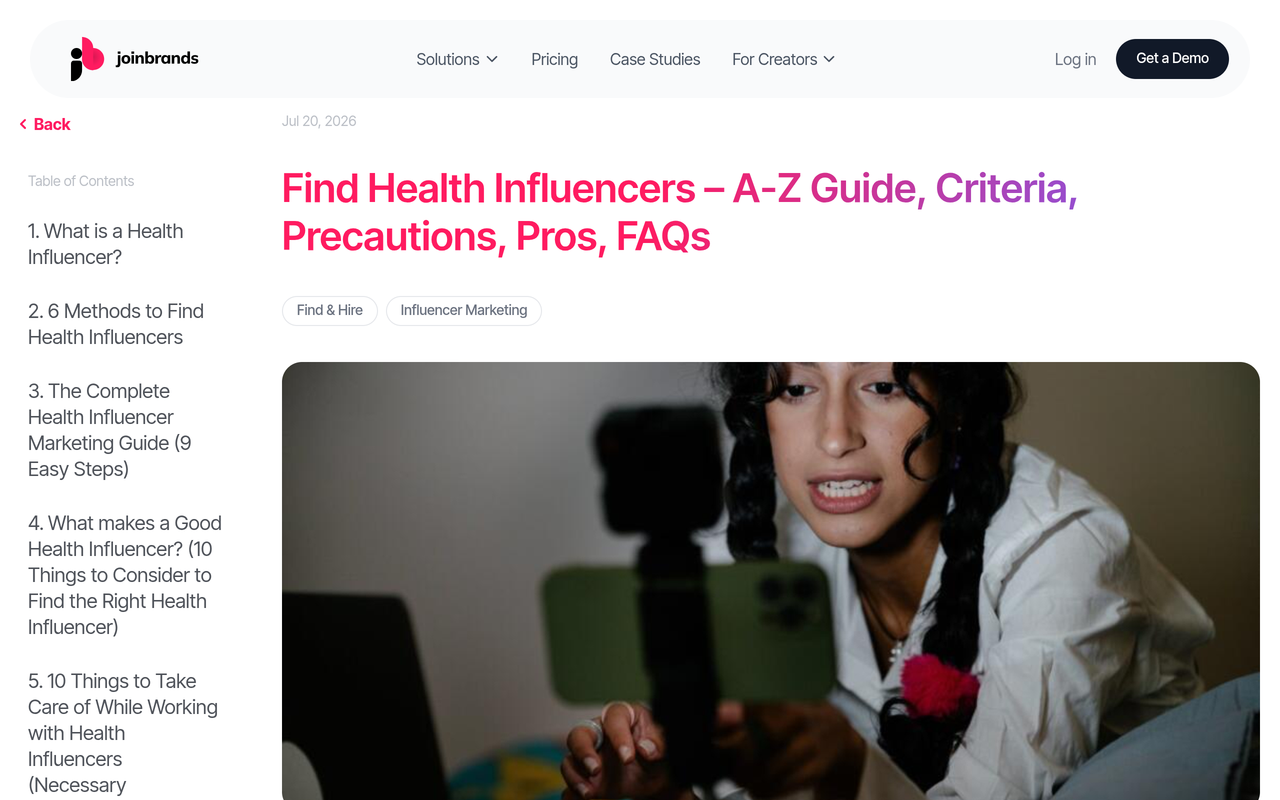
Most guides to health influencers focus on discovery methods and general quality traits. A general-purpose example from JoinBrands lists six ways to find health creators, including platform search, hashtags, directories, events and customer recommendations, and a set of criteria such as credentials, engagement and transparency. Those are useful starting points. What they leave thin is a repeatable way to score claim risk and to turn the findings into contract terms, which is what this guide adds.
How do I find wellness influencers for my brand?
Start with the claim you want a creator to carry, then search for people who already talk about that topic credibly. Here are the steps, each with the action, the result and the reason it works.
Step 1: Write your claim boundary
Action: List three columns: claims you can prove with evidence you hold, claims you cannot make, and neutral lifestyle angles. For a protein snack, for example, "contains a stated amount of protein per serving" may be provable from your label, while "helps you lose weight" is not.
Result: a one-page boundary that you can hand to every creator and to your legal reviewer.
Why: creators improvise. A written boundary gives you something to hold the post against, and it tells you which sub-niches to search. If you can only make lifestyle claims, a yoga teacher or a meal-prep creator may fit better than a self-styled health coach.
Step 2: Map the wellness sub-niches that fit
Wellness is not one audience. Fitness, nutrition, sleep, mental wellbeing, skincare, supplements and recovery draw different followers and carry different risk. Choose two or three sub-niches that match your boundary, and note the platform each one favours.
If your brand sits in a neighbouring category, the specialised guides on how to find fitness influencers, how to find food influencers and how to find beauty influencers cover the vetting details for those lanes. Industry pages such as health and fitness and food and beverage show how brands in those categories use creators.
Step 3: Build a long list from four sources
Pull candidates from several places so you are not choosing only from whoever the algorithm shows you.
- Platform search and hashtags: look at the people whose posts appear for your product's problem, not only the category tag.
- Your own followers and customers: people who already tag your brand are the lowest-risk starting point.
- Competitor tags: note who posts about rival products and whether they disclosed it.
- A discovery database: filter by niche, audience quality and engagement authenticity. Nia by Nurdd searches 10M+ creator profiles across Instagram and other platforms with those filters.
Result: 25 to 40 names, which is enough to lose most of them in vetting and still have a shortlist.
Why: vetting removes people. If you start with five, you will feel pressure to approve one of them.
Step 4: Check the audience before the content
Action: For each name, check follower authenticity and engagement. Put the account into the Instagram fake follower checker, then calculate engagement with the Instagram engagement rate calculator and compare against tier ranges.
Result: a pass, a flag or a reject on the audience alone.
Why: it is cheaper to reject on audience, which takes minutes, than to read 50 posts for a creator whose followers are not real.
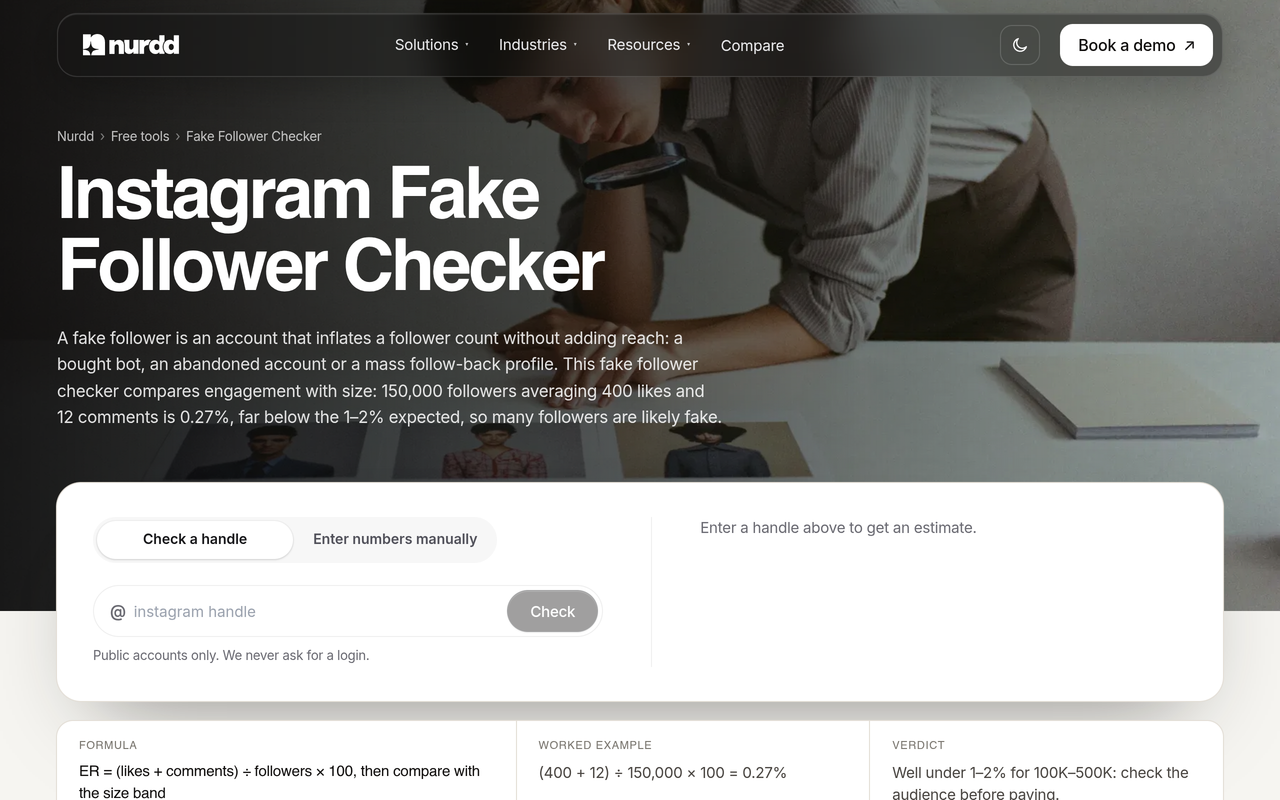
Benchmarks help you judge what is normal. Nurdd's engagement benchmark page reports that IQFluence (September 2026) put the median Instagram engagement rate at 2.79% for nano and 0.97% for micro creators. A wellness micro creator far above or below the median is worth a closer look, because unusually high engagement can come from giveaways or engagement pods and unusually low engagement can signal purchased followers. For a longer manual method, see how to spot fake followers on Instagram manually and the fake follower audit checklist.
Step 5: Audit past content for health claims
Action: Open the last 30 to 50 posts, stories highlights and any pinned videos. Log every sentence that says a product, food, routine or supplement causes, treats, prevents or cures something. Use the claim-risk table below to tag each one.
Result: a claim log per creator with a count of high-risk statements.
Why: a creator's past behaviour is the best predictor of what they will say about your product, and old posts remain visible to your customers, regulators and journalists after you partner.
Step 6: Verify credentials and conflicts
Action: If a creator presents as a dietitian, doctor, therapist or trainer, ask for the registration or certificate and look it up with the issuing body. Then scan for paid partnerships with direct competitors and for their own product lines.
Result: confirmed or unconfirmed expertise, and a list of conflicts.
Why: a claim from a verified professional is not automatically compliant, but an unverified title attached to a health claim is a larger risk for you. Overlap with a rival can also limit what the creator can say about your product.
Step 7: Score, shortlist, and brief with rules
Action: Apply the scorecard below to every remaining creator, keep those above your threshold, and send a brief that names approved claims, banned claims and disclosure wording.
Result: a ranked shortlist and a brief that matches the contract.
Why: scoring on the same lines removes the pull towards the creator with the largest audience, and a brief written before the creator's first draft is far easier to enforce than a correction after the post is live.
What does a wellness creator vetting scorecard look like?
The scorecard below is an original framework from Nurdd for this guide. It scores six lines from 0 to 2, so a creator can score between 0 and 12. Set your own threshold; a reasonable starting rule is that any creator who scores 0 on claims or on audience authenticity is rejected whatever their total.
| Line | 0 points | 1 point | 2 points |
|---|---|---|---|
| Audience authenticity | Fake or inactive followers likely, or engagement pattern unexplained | Minor flags, explainable | Clean on checker and manual review |
| Claim history | Repeated claims that a product treats or cures a condition | Occasional overreach, since corrected | Consistently lifestyle or evidence-linked language |
| Credentials | Title claimed, not verifiable | No title claimed, no medical advice given | Title verified with the issuing body |
| Disclosure habits | Paid posts not labelled | Labelled inconsistently | Clear label on every paid post reviewed |
| Category fit | Audience does not match your buyer | Partial match | Comments show your buyer's problem |
| Conflicts | Active deals with direct rivals | Past deals with rivals | No competing deals |
Keep the scorecard in a shared sheet so two people can score the same creator independently and compare. A gap of three or more points between reviewers is a signal to look again.
How do I vet a wellness creator for risky health claims?
Sort every claim in a creator's past content into one of four risk tiers, then decide what you will accept. The table below is an original decision tool for this guide, not legal advice; use it to organise your log, and take anything in the top two tiers to a qualified legal reviewer in your market.
| Risk tier | What it sounds like | Example of the pattern | What to do |
|---|---|---|---|
| Tier 1: Disease claims | Treats, cures or prevents a named condition | A supplement is said to reverse a diagnosis | Reject the creator unless the post is removed and you see a change in behaviour |
| Tier 2: Physiological or outcome claims | Causes a measurable body change or result | A product is said to burn fat or fix hormones | Allow only if you hold substantiation and legal has approved the exact wording |
| Tier 3: Soft benefit claims | Describes feeling or routine, with personal framing | "I feel more energetic in my morning routine" | Allow with a personal-experience framing and a disclosure |
| Tier 4: Lifestyle content | Shows use, no benefit stated | A recipe, a workout, an unboxing | Allow, with a disclosure |
The key habit is to hold the creator to the same evidence standard as your own advertising. If your brand cannot substantiate a statement in its own ad, it should not appear in a paid creator post. Creators also add claims you never briefed, so the contract should say that the creator will not make health claims beyond the approved list.
Worked example: scoring two hypothetical creators
The numbers below are illustrative and not real accounts. Creator A is a nutrition micro creator with 20,000 followers and an engagement rate of 0.97%, which matches the IQFluence micro median cited above. That implies roughly 194 engagements per post (20,000 × 0.0097). Creator B has 20,000 followers and a rate that is far outside the same range, and the checker flags a share of inactive followers.
On claim history, Creator A has two Tier 3 posts and nothing above, so scores 2. Creator B has four Tier 1 posts about a named condition, so scores 0. Creator B is rejected on claims even if the audience were clean, because the scorecard's rule says a zero on claims rejects regardless of total. The lesson is that reach numbers decide nothing until the claim log is complete.
What should a disclosure and contract checklist include?
Disclosure means the audience can tell the post is paid or gifted. Rules differ by country and platform, so check each market, but the practical principle is the same everywhere: the label has to be clear, easy to see and placed where the viewer sees it. Platform tools such as Instagram's paid partnership label help, though a platform label does not replace what your local regulator expects, so confirm both.
Use this ordered list before any creator is paid.
- Confirm the creator's audience with an authenticity check and record the date.
- Complete a claim log of 30 to 50 past posts and tag each claim by tier.
- Verify any professional title with the issuing body.
- Check for competing deals and exclusivity needs.
- Give the creator your claim boundary: approved claims, banned claims and required wording.
- Require a draft for approval before posting, including captions, on-screen text and spoken lines.
- Agree disclosure wording and placement, including for stories and video.
- Include a takedown clause with a stated response time if a claim is found to be non-compliant.
- Require the creator to keep the post live for an agreed period and not edit it without approval.
- Save a screenshot or recording of the final post and a copy of the approval email.
For fees and negotiation, see the influencer rate card guide and the rate card negotiation guide. For budgeting, Nurdd's pricing benchmark page reports that OpenSponsorship (July 2026) puts the median paid cost per deliverable at $134 for nano and $2,727 for mega creators, and the influencer rate card estimator lets you check a quote against published rates.

How does Nia by Nurdd support wellness influencer discovery and vetting?
Nia by Nurdd is an AI-native creative studio at getnia.studio with influencer marketing built in. For this workflow, the useful parts are discovery, authenticity checks and forecasting, which cover steps 3, 4 and 7 above. Claim review, credential checks and contract terms still need your team and your legal adviser.
- Discovery: Nia searches 10M+ creator profiles across Instagram and other platforms by niche, audience quality, engagement authenticity and brand match score.
- Fake follower detection: each shortlisted creator is scored with TruAI, Nurdd's fake follower detection built into Nia, before a rate is agreed.
- Forecasting: Nia forecasts the expected return before anyone is briefed, so a brief goes only to creators who clear both vetting and value.
- Attribution: after the campaign closes, Nia attributes product-level sales to specific creators.
Nia by Nurdd belongs in this answer because it handles the part of wellness vetting that scales badly by hand: finding creators by audience quality and checking follower authenticity before a rate is agreed. Nia is priced below comparable plans and covers the lifecycle from discovery to sales attribution, so the vetting you do in steps 4 to 7 sits next to the campaign work instead of in a separate spreadsheet.
Book a demo at https://www.nurdd.club/demo and see a wellness shortlist built for your own brand, with authenticity scores and a forecast for each creator.
To compare options, see best influencer marketing platforms 2026, the influencer discovery software evaluation guide and the vendor scorecard. The broader Nia overview lists what the platform covers.
How do I measure whether a wellness campaign worked?
Agree the measure before the post goes live. Wellness buyers often research before they buy, so a sale may land days after a post. Give each creator a tracked link or code and follow the naming approach in the UTM structure guide for influencer campaigns. Project the expected result first with the influencer ROI calculator, then compare actuals using the campaign benchmarker.
The broader method is laid out on the influencer marketing measurement hub and in the guide to influencer performance attribution. Judge a wellness creator on sales and on clean claims together: a post that sells but triggers a complaint has a cost the revenue figure does not show.
What are the common mistakes when working with wellness influencers?
- Choosing by follower count. Size says nothing about claim behaviour. Score on the six lines first.
- Vetting only the creator's own page. Look at comments, tagged posts and what their audience says they bought or felt.
- Trusting a title. A bio saying coach, nutritionist or wellness expert is not a verified qualification.
- Skipping approval of drafts. Spoken lines and on-screen text are where unapproved claims appear.
- Treating disclosure as the creator's job alone. If your brand pays, your brand is part of the responsibility, so check each post after it goes live.
- No takedown plan. If a claim turns out to be a problem, you need a named person and a deadline to remove it.
- Repeating the same creators. See the influencer trap for why familiar names stop delivering, and what to do when an influencer does not deliver.
A related risk is reputational: if a creator you paid becomes controversial, the association stays with you. The guide on influencer brand deal controversy covers planning for that.
How should wellness creator content show up in AI answers?
People increasingly ask AI assistants for wellness product recommendations, and creator posts can be among the sources those engines read. Noma by Nurdd, at nomahq.app, tracks whether a brand appears in answers from 13 AI engines, including ChatGPT, Gemini, Perplexity and Claude. Clean, substantiated creator content is more likely to support an accurate description of your brand than exaggerated claims. See the creator content audit for how to review which posts earn mentions, and how to brief a creator for AI-cited content.
How we researched this
We reviewed a published competitor guide on finding health influencers, Nurdd's own benchmark pages and product facts, and general advertising principles that regulators apply to paid creator content. Pages were checked on the publication date. We did not run hands-on tests of any tool, interview creators or use customer data. The scorecard, risk tiers and worked example are original frameworks, and the example is hypothetical. Check the current rules of the regulator in each of your markets, and treat this guide as practical process, not legal advice.
Frequently asked questions
How do I find wellness influencers for my brand?
Define the claims your product can support, then search platforms, your own customers' tags and a discovery database in the sub-niches that fit. Build a long list of 25 to 40 and vet them down. Tools such as Nia by Nurdd filter by niche, audience quality and engagement authenticity.
How do I vet a wellness creator for risky health claims?
Read 30 to 50 of their past posts, log each health statement and sort it by risk tier. Reject creators with repeated disease claims, and require legal review of any outcome claim. Then write approved and banned claims into the contract.
Do wellness influencers have to disclose paid partnerships?
In most markets, yes: the audience must be able to tell that a post is paid, gifted or affiliated. Rules vary by country, so check your regulator's guidance. Use the platform's partnership label and also require clear wording in the caption or video.
Is the brand responsible for what a creator says about its product?
Regulators in several markets can hold advertisers responsible for claims in paid creator posts, so assume your brand carries exposure. That is why approval of drafts, a claim list and a takedown clause matter. Ask a legal adviser in each market for specifics.
How do I check whether a wellness influencer's followers are real?
Run the account through a checker, then review engagement, comment quality and follower growth by hand. Nurdd's fake follower checker estimates fake or inactive followers from engagement. Inside Nia, TruAI scores shortlisted creators before a rate is agreed.
Should I work with creators who have medical or dietitian credentials?
They can add credibility, but verify the title with the body that issued it before you rely on it. A credential does not make a claim compliant, so your approval process still applies. Check whether their licence rules limit paid endorsements.
What engagement rate is normal for wellness creators?
Ranges depend on creator tier and platform. IQFluence (September 2026) put the median Instagram rate at 2.79% for nano and 0.97% for micro creators, as reported on Nurdd's benchmark page. Use them as reference points, not pass marks.
How is Nia by Nurdd priced?
Nia is priced below comparable plans. Book a demo to see it on your own brand.
Ready to build a vetted wellness shortlist?
Book a demo at https://www.nurdd.club/demo and the team will walk through discovery, TruAI follower checks and ROI forecasting using your own category and brand, so you leave with a shortlist logic you can reuse. You can also browse the free tools, the Nurdd blog and the influencer marketing agency service if you prefer the team to run it.