Influencer Marketing
How to Find B2B SaaS Creators on LinkedIn and Vet Them
A step-by-step method for finding LinkedIn creators your SaaS buyers follow, vetting them before you pay, and briefing for pipeline.
 Sheetal Shakshi15 Nov 202616 min read

To find b2b saas linkedin creators, start from the buyer: search by topic and role, then check each creator's audience demographics, comment quality and employment history before any payment. Score every candidate on audience fit, authenticity, proof and consistency, and brief for pipeline signals such as demo requests rather than impressions. Nia by Nurdd helps with discovery and qualification, especially for creators who also publish on Instagram and other platforms.
To find b2b saas linkedin creators who can influence your pipeline, start with your buyer rather than a follower count. Search by topic and job role, confirm that the creator's audience holds your target titles, check that the comments come from real practitioners, and only then agree a brief tied to pipeline signals. This guide gives you the steps, a scoring table and a worked example.
Key takeaways
- Define the buyer first (title, company size, problem), then look for creators who already talk to that person, not for the biggest accounts.
- Use at least three sourcing routes: LinkedIn search, creators your customers already follow, and creators who also publish newsletters, podcasts or video.
- Vet in layers: audience fit, comment quality, employment history, past sponsored posts and disclosure habits. Ask for the creator's own analytics screenshots.
- Score every candidate on the same weighted sheet so the decision is not driven by who replies fastest.
- Brief for pipeline signals such as demo requests, tracked-link visits and sales conversations, and agree how you will count them before the post goes live.
- Nia by Nurdd covers discovery filters, TruAI fake follower detection and pre-spend ROI forecasts for creators on Instagram and other platforms in its database.
Why is finding B2B SaaS creators on LinkedIn harder than on Instagram?
LinkedIn does not give brands a public, filterable creator directory the way a consumer marketplace does. A ContentGrip guide on finding B2B influencers on LinkedIn covers the problem and lists five methods (ContentGrip, 2026) ranging from native search to purpose-built databases. The practical result is that most SaaS teams find creators by scrolling their own feed, which surfaces people who resemble the marketer rather than the buyer.
Demand for the channel is real. According to the LinkedIn and Ipsos 2025 B2B Marketing Benchmark as reported by ContentGrip, 2026, 55% of B2B marketers already use influencer or creator marketing on LinkedIn, and another 29% plan to adopt it. More competitors in the same pool means weaker vetting costs you more.
Trust is the reason the channel works, and it only holds when the creator is actually credible to your buyer. That is what vetting is for: a creator whose audience does not match your buyer lends you no borrowed credibility at all.
What does a good SaaS creator actually look like?
A good SaaS creator is a credible practitioner whose followers include the people who sign off on or influence your purchase. Directive's guide to LinkedIn influencer marketing says B2B selection should draw from a wide pool that includes practitioners, executives, analysts and customers, not only people with large audiences (Directive, 2026). A RevOps lead with a small but precise following can be worth more than a lifestyle-style creator with a large one.
The creator types below each play a different role in a SaaS funnel. Pick the type before you pick the person.
| Creator type | Typical audience | Best for | Main risk |
|---|---|---|---|
| Practitioner (for example a RevOps or security lead) | Peers who use tools like yours | Product education, use-case proof | Smaller reach, limited posting time |
| Founder or executive voice | Founders, VPs, investors | Category narrative, higher-ticket deals | Audience may be peers, not buyers |
| Analyst or consultant | Evaluators and procurement | Shortlist credibility | Independence concerns if over-sponsored |
| Customer advocate | Buyers in your segment | Social proof, case-style content | Needs real usage and a clear process |
| Multi-platform educator | Mixed, often also on newsletters or video | Repurposed content, wider discovery | LinkedIn audience may be a small share |
If you sell to a narrow segment, a larger tier is rarely the answer. Nurdd's piece on macro versus micro influencer strategy for B2B SaaS goes deeper on that trade-off.
How do I find LinkedIn creators for a B2B SaaS brand? A 7-step method
The method below works from buyer definition to a shortlist you can score. Each step names the action, the result you should have afterwards and why it matters.
Step 1: Write the buyer brief before you search
Action: Write one paragraph with the job titles, company size, industry and the problem your product solves. Add three phrases your buyers actually use when they complain about that problem. Result: a search vocabulary and a yes/no test for any creator's audience. Why: without it, you will judge creators by how polished their posts look, which says nothing about whether your buyer reads them.
Step 2: Search LinkedIn by topic, not by title
Action: Search the problem phrases from step 1 in LinkedIn content search, sort by recent posts, and note who writes them repeatedly. ContentGrip's guide covers content keyword search and says Sales Navigator offers 25+ advanced filters (ContentGrip, 2026). Result: a first list of 20 to 40 names. Why: topic searches surface people who are already writing about your buyer's problem, which tends to beat titles alone.
Step 3: Mine the places your buyers already look
Action: Check who your current customers follow, who comments under the most-discussed posts in your category, and who speaks at the events your buyers attend. Ask three customers which two or three people they would forward a post from. Result: names that came from buyer behaviour, which are usually the strongest on the list. Why: a creator your customers already trust needs less persuading, and the customer advocate type is often reachable through your own accounts team. Nurdd's guide to finding tech influencers uses a similar vetting-first approach.
Step 4: Look beyond LinkedIn for the same people
Action: Search for newsletters, podcasts and YouTube channels covering the same topics and note which authors are also active on LinkedIn. Result: a second list of multi-platform educators, some of whom a pure LinkedIn search may miss. Why: these creators can repurpose a sponsored idea across formats and give you more than one place to measure.
Step 5: Use a creator database for the multi-platform names
Action: For creators who also publish on Instagram or other platforms, filter a database by niche, audience quality and engagement authenticity. In Nia by Nurdd, discovery runs across 10M+ creator profiles on Instagram and other platforms, filtered by niche, audience quality, engagement authenticity and brand match score. Result: a cross-platform shortlist with consistent quality signals. Why: LinkedIn-only analytics are private to the creator, so any extra independent signal narrows the field before you ask anyone for screenshots. You can read more about this approach in the influencer discovery software evaluation guide.
Step 6: Use Thought Leader Ads as a route to creators who agree
Action: If you run LinkedIn Campaign Manager, review how Thought Leader Ads work. LinkedIn's help page says you search for LinkedIn member posts in the Content Library, select a post and send an approval request to the member before you can sponsor it (LinkedIn Help, checked November 2026). LinkedIn's product page describes the same permission-based route from your company Page (LinkedIn, checked November 2026). Result: a list of creators whose posts you could amplify, plus a signal of who is open to working with brands. Why: sponsoring a proven post gives you a measured reach layer on top of the organic one, and the approval step makes the arrangement explicit.
Step 7: Cut to a shortlist of five to eight
Action: Remove anyone who fails a basic screen: no posts in the last 30 days, audience clearly outside your buyer, or no declared partnerships history. Put the remaining five to eight names into the scoring sheet below. Result: a shortlist small enough to vet properly. Why: vetting properly takes time per creator, and a list of fifty gets skimmed rather than checked.

How do I vet a B2B influencer before paying them?
Vet a B2B influencer in layers: confirm who is in the audience, check the comments, verify the person's role history, review past sponsored posts, then agree reporting terms. Anchors' sourcing guide recommends sourcing widely, shortlisting narrowly and applying one consistent vetting process to every candidate (Anchors, 2026). The checklist below builds on that idea with additional checks specific to SaaS buyers.
Vetting checklist: seven checks in order
- Ask for audience analytics. LinkedIn's help centre describes audience analytics as showing follower growth trends and follower demographics (LinkedIn Help, checked November 2026). Ask the creator to share a screenshot of top job titles, industries, seniority and company size for the last 90 days.
- Compare the audience with your buyer brief. Count the share of followers in your target titles and company sizes. If the creator will not share this, treat that as a signal.
- Read the comments, not just count them. Open ten recent posts. Look for specific questions, disagreements and replies from people with real job titles and company pages. Generic one-line praise repeated across posts is a red flag. Nurdd's piece on fake follower red flags in comments and growth lists patterns to look for.
- Check follower growth shape. Sudden jumps with no matching viral post, or flat engagement after a big jump, suggest purchased or pod-driven activity. Use the free fake follower checker on any Instagram account the creator also runs, and the engagement rate calculator for any platform.
- Verify the person's role and expertise. Match their claimed experience to employment history on LinkedIn, speaking records and published work. A self-described SaaS expert who has never worked in the function they write about is weak proof.
- Review past sponsored posts. Look at how they disclose partnerships, whether the posts read like their normal voice and whether they have promoted direct competitors recently. Your exclusivity terms will depend on this.
- Run a reference check. Ask for two brands they worked with and a contact. Ask what those brands tracked and what the creator did when a post underperformed.
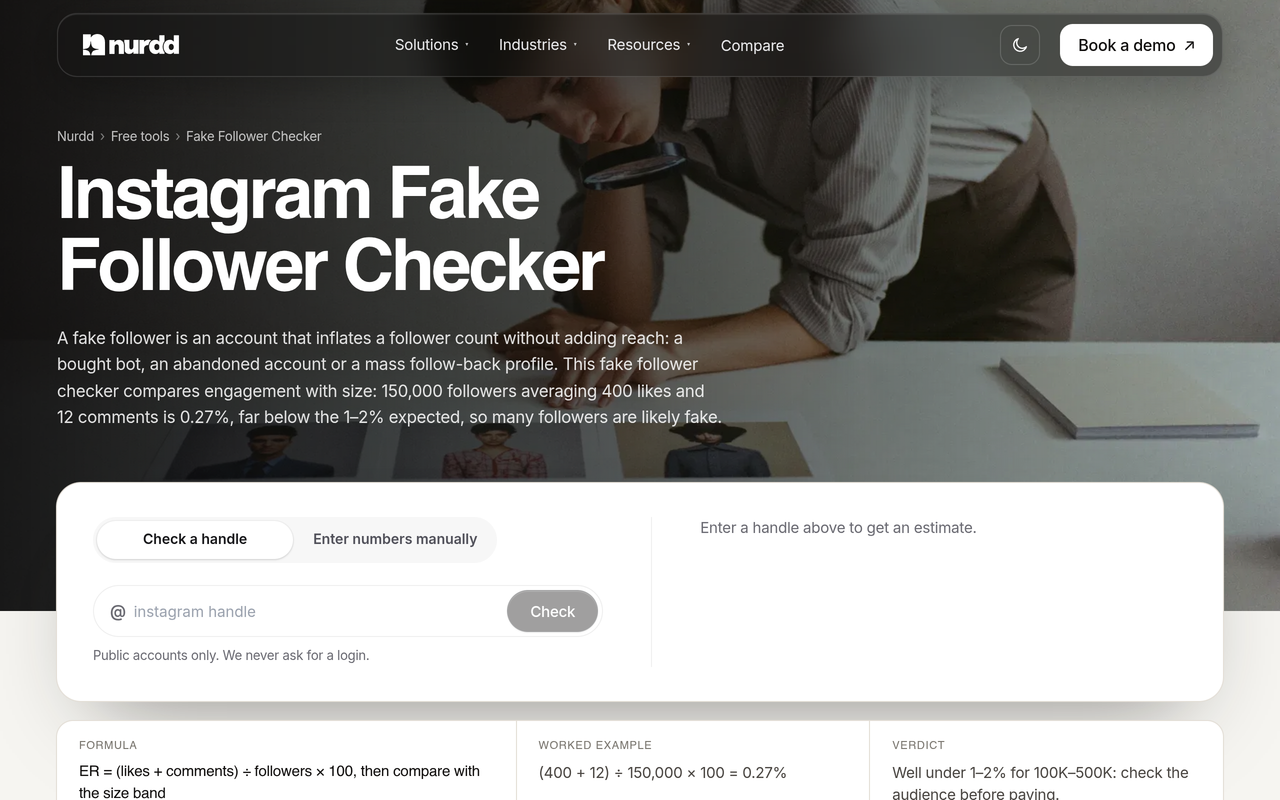
The fake follower audit checklist and the guide on vetting an influencer's audience before paying expand checks three and four for consumer-heavy accounts.
How should I score creators so the decision is not subjective?
Score every candidate on the same sheet, with weights you agree before you look at any names. The table below is an original decision framework you can copy: it turns the vetting checks into a single comparable number. The weights are a starting point for a SaaS brand selling to a defined segment; change them if your funnel differs.
| Criterion | Weight | What a 5 looks like | What a 1 looks like |
|---|---|---|---|
| Audience fit | 30% | Most followers hold your target titles and company sizes | Audience is mostly peers, students or job seekers |
| Authenticity | 25% | Specific, varied comments from named professionals; steady growth | Repeated generic comments, sudden spikes |
| Proof of expertise | 20% | Verifiable role history and work in your topic | No verifiable background |
| Consistency | 15% | Posts on a regular schedule for 6 months or more | Long gaps, topic changes |
| Commercial hygiene | 10% | Discloses partnerships, accepts tracking links and reporting | Refuses reporting, undisclosed promotion |
Set a minimum on authenticity and audience fit: any creator who scores 2 or lower on either is out, whatever the total. A creator with a great voice and a wrong audience will not generate pipeline.
Worked example: scoring three candidates
The figures below are illustrative arithmetic to show the method, not market data. Suppose you sell a security-compliance tool to heads of IT at mid-sized companies. You score three shortlisted creators from 1 to 5 on each criterion.
| Criterion (weight) | Creator A (practitioner) | Creator B (founder voice) | Creator C (generalist) |
|---|---|---|---|
| Audience fit (30%) | 5 | 3 | 2 |
| Authenticity (25%) | 4 | 4 | 3 |
| Proof of expertise (20%) | 5 | 4 | 2 |
| Consistency (15%) | 3 | 5 | 5 |
| Commercial hygiene (10%) | 4 | 3 | 4 |
| Weighted score | 4.35 | 3.75 | 2.90 |
For Creator A the arithmetic is 5×0.30 + 4×0.25 + 5×0.20 + 3×0.15 + 4×0.10 = 1.50 + 1.00 + 1.00 + 0.45 + 0.40 = 4.35. Creator C has the highest posting consistency but scores 2 on audience fit, which is under the minimum, so the total of 2.90 does not matter. You would brief Creator A first and keep Creator B as a second voice for category narrative.
How do I brief a LinkedIn creator for pipeline instead of reach?
A pipeline brief names the buyer problem, the proof you will provide, the action you want a reader to take and the metric you will count. LinkedIn's B2B Institute 95-5 rule says 95% of potential buyers are not in-market today (LinkedIn B2B Institute). That means a creator post does two jobs: build familiarity with the 95%, and give the in-market 5% a clear next step.
Write the brief in this order:
- The reader and their problem in one sentence, using the buyer phrases from step 1.
- The creator's own angle. Ask for their opinion or a real use case rather than a script. Posts that sound like the creator's normal voice are what you are paying for.
- One proof asset such as a product demo recording, a customer-approved result or a free template the creator can offer.
- One call to action with a tracked link: a demo page, a template download or a comment-to-receive resource. Avoid asking for three different things.
- Disclosure and compliance language, including any regulated-industry claims you cannot make.
- Reporting terms: the creator shares post analytics and audience screenshots at 7 and 30 days.
Name the tracking up front. Nurdd's UTM structure guide for influencer campaigns gives a naming convention, and the piece on influencer performance attribution explains how to tie sales back to a creator.
Which metrics show pipeline, not just reach?
The metrics that show pipeline are the ones a sales team can verify: demo requests from tracked links, new accounts from target companies engaging with the post, and sales conversations that mention the creator. Impressions and likes are leading indicators only. The table below separates them.
| Metric | Type | How to capture it |
|---|---|---|
| Impressions, reactions | Reach | Creator's post analytics at 7 days |
| Comments from target-title profiles | Quality of attention | Manual review of comments against your account list |
| Tracked-link visits | Intent | UTM parameters per creator and per post |
| Demo requests and trials | Pipeline | Form field or CRM source set per creator |
| "How did you hear about us" mentions | Dark-social lift | Free-text field on the demo form |
The free-text field matters because much B2B influence happens in private shares. Nurdd's guide to dark social attribution explains how to account for it. The full influencer marketing measurement hub links the forecast, vet, attribute and report steps together, and the influencer ROI calculator projects revenue from a creator budget before you commit it.
Worked example: a pre-spend pipeline check
Again, these inputs are illustrative. Suppose a creator charges a fee of 3,000 USD for one post and one follow-up. You agree that a qualified demo is worth 1,000 USD to you in expected pipeline value after your close rate. Break-even is then three qualified demos (3,000 ÷ 1,000). If the creator's audience screenshot suggests your target titles are a small share of readers, you would need a far higher click rate to reach three demos than a creator with a tighter audience. Running that arithmetic before signing is the point of a forecast, and it stops you buying reach you cannot convert.
For rates, use the influencer rate card estimator for published benchmarks by tier and format, and the rate card negotiation guide to read a creator's quote. B2B creators often price by value to the audience rather than by follower count, so treat a published tier benchmark as a sanity check, not a ceiling.
What are the common mistakes when working with B2B SaaS creators on LinkedIn?
- Choosing by follower count. A large following of the wrong job titles produces reactions but not demos.
- Skipping audience analytics. If you never ask for the demographics screenshot, you are guessing who sees the post.
- Scripting the post. Heavily edited copy reads like an ad, and the trust advantage comes from the creator's voice. Agree the claims, not the sentences.
- Running one post and judging the channel. Because 95% of buyers are out of market at any time, one post is a thin test. Plan a series with the same creator and compare against your own baseline.
- No tracking plan. If the link, form field and CRM source are not set before launch, you cannot rebuild attribution later.
- Ignoring exclusivity. A creator who promoted your direct competitor last month dilutes the endorsement. Ask about recent sponsorships and set a category exclusivity window.
- Automating all outreach. Mass messages to creators signal that you have not read their work. See what to automate in AI influencer outreach.
Where does Nia by Nurdd help with discovery and qualification?
Nia by Nurdd is an AI-native creative studio with influencer marketing built in. Its discovery searches 10M+ creator profiles across Instagram and other platforms by niche, audience quality, engagement authenticity and brand match score. TruAI, its fake follower detection, scores shortlisted creators before a rate is agreed, and its ROI forecast shows expected returns before anyone is briefed. Nia is priced below comparable platforms.
To be clear about scope: LinkedIn audience analytics sit inside the creator's account, so you still collect those screenshots yourself using the checklist above. Nia is most useful for the creators on your shortlist who also publish on Instagram or other platforms, for the independent authenticity check, for the forecast and for sales attribution after the campaign closes. Nurdd's pages on Nia and on evaluating Nurdd on influencer discovery and qualification show what to test.
Book a demo at https://www.nurdd.club/demo and bring your buyer brief and a shortlist of creators. You will see how Nia filters and scores them for your brand, what the forecast says about your budget, and where your own checks should sit alongside it.
If you would rather hand the program to a team, Nurdd also runs creator campaigns on Nia through its influencer marketing agency service, and the SaaS industry page shows how Nurdd frames the category.
How does creator content connect to AI search visibility?
Creator content can also feed how AI assistants describe your product, because assistants draw on public posts, newsletters and articles. A creator who explains your product accurately and consistently adds a third-party description that is not on your own site. Nurdd's piece on which creator posts earn AI mentions covers how to audit this, and Noma, a separate Nurdd product, tracks whether your brand is named in answers from 13 AI engines, including ChatGPT, Gemini, Perplexity and Claude. Treat that as a second-order benefit to monitor, not a reason to choose a creator.
What should I do this week?
- Write the buyer brief and the three problem phrases.
- Run content searches for those phrases and ask three customers who they follow.
- Build a shortlist of five to eight and request audience analytics from each.
- Score them on the weighted sheet and drop anyone below the minimums.
- Agree a brief, tracking and a 30-day reporting date with your top pick.
If you want the shortlist qualified against creators' wider footprint, book a demo with Nurdd and we will walk through your brand's creators in Nia. Nurdd's vendor scorecard for influencer discovery is a good companion if you are comparing tools.
How we researched this
We reviewed published guides on LinkedIn creator discovery and vetting, LinkedIn's own advertising and help pages, and trade press coverage of LinkedIn's B2B research. Links were checked on the publication date of this post. The scoring weights and worked examples are our own illustrative frameworks, not results from campaigns, interviews or customer data. We did not run hands-on tests of any rival tool.
Frequently asked questions
How do I find LinkedIn creators for a B2B SaaS brand?
Write down your buyer's job title and problem, then search LinkedIn content for the phrases they use and note who writes about them regularly. Add creators your customers follow and people who also run newsletters or podcasts on the topic. Narrow to five to eight and request audience analytics before you contact anyone about fees.
How do I vet a B2B influencer before paying them?
Ask for audience demographics from their own analytics, read ten recent posts' comments, check the growth pattern and verify their role history. Review past sponsored posts for disclosure and competitor conflicts, and ask for two brand references. Score the results on one weighted sheet so the decision is consistent.
What audience data should a LinkedIn creator share?
Ask for follower demographics by job title, industry, seniority and company size, plus post analytics for the last 90 days. LinkedIn's help centre says audience analytics covers follower growth trends and demographics. Request screenshots rather than summaries, and check that the dates are recent.
Are small LinkedIn creators better than large ones for SaaS?
Not always, but a smaller creator with a precise buyer audience often beats a larger one with a broad audience. Judge by the share of followers who match your target titles and by comment quality. Large creators can still suit category-building when your market is wide.
Can I sponsor a creator's LinkedIn post as an ad?
Yes, through Thought Leader Ads. LinkedIn's help page describes selecting a member's post in Campaign Manager and sending an approval request before you sponsor it. Agree this in the contract so the creator knows the post may be amplified.
What should a B2B influencer brief include?
It should include the buyer's problem, the creator's angle, one proof asset, one call to action with a tracked link, disclosure language and reporting dates. Keep the script loose and the claims precise. State up front how you will count demo requests and who owns the data.
How do I measure pipeline from a LinkedIn creator post?
Use a unique tracked link per creator, a CRM source value, and a free-text "how did you hear about us" field on the demo form. Review comments from target accounts too. Compare against your baseline over several posts, not a single one.
Does Nia by Nurdd find creators on LinkedIn?
Nia's creator database covers Instagram and other platforms, so it is most useful for SaaS creators who also publish there. It scores audience quality and fake followers and forecasts return before spend. You still collect LinkedIn analytics from the creator. Book a demo to see it on your own shortlist.