AI Search Visibility
HubSpot AEO Grader vs Noma: One-Off Grade or Tracking
HubSpot's free AEO Grader gives one score; AI answers shift weekly. See what a grade misses and why ongoing tracking in Noma shows more.
 Simran Rawat13 Nov 202615 min read
The HubSpot AEO Grader is a free one-time score of how ChatGPT, Perplexity and Gemini describe your brand, so it is a snapshot, not a tracking system. AI answers vary between runs, so you need repeated, scheduled measurement to see a trend. Noma by Nurdd tracks 13 AI engines daily for that.
The HubSpot AEO Grader is a free, one-off score that shows how ChatGPT, Perplexity and Gemini describe your brand at one moment. It is not enough to track AI visibility, because AI answers change between runs and weeks. Tracking needs repeated, scheduled measurement of a fixed prompt set.
This page separates what a single grade tells you from what weekly tracking shows, using HubSpot's own descriptions, published research on how AI answers vary, and a decision table you can use today. It also shows where Noma by Nurdd fits when a one-time grade stops being enough. If you want to check your own site's readiness first, try the GEO readiness scorecard.
Key takeaways
- The HubSpot AEO Grader is a point-in-time diagnostic. HubSpot describes it as a one-time brand visibility check, and AirOps calls it a snapshot rather than a tracking system.
- Only 10 of its 100 points go to share of voice, so a high grade can sit alongside weak visibility against competitors.
- Research from SparkToro and the University of St. Gallen shows AI answers vary between runs, so one measurement can mislead in either direction.
- A grade cannot show a trend. Fix a prompt set, repeat it on a schedule and read the direction, not the number.
- Noma tracks 13 AI engines, including ChatGPT, Gemini, Perplexity and Claude, polled daily, which covers engines a three-engine tool leaves out.
- You can test the problem for free: run one prompt ten times in fresh chats and compare how often your brand appears.
What does the HubSpot AEO Grader actually measure?
According to HubSpot's own comparison with Peec AI, the HubSpot AEO Grader is a free page grader that evaluates what ChatGPT, Perplexity and Gemini say about your brand based on their training data. You enter a company name, location, industry and product description. It runs dozens of test queries across the three engines and returns a composite score out of 100 with a written interpretation in three to five minutes.
HubSpot publishes the scoring structure, which makes it possible to reason about what the number can and cannot tell you. The table below reproduces the five dimensions and their maximum points as HubSpot states them.
| Dimension | Max points | What HubSpot says it measures | What it does not show |
|---|---|---|---|
| Sentiment Analysis | 40 | The tone AI uses about your brand, and the credibility of the sources behind it | Whether that tone changes from week to week |
| Presence Quality | 20 | Depth and accuracy of how AI describes your offerings and differentiators | Which pages the engines cite for those descriptions over time |
| Brand Recognition | 20 | Whether engines identify, name and categorise your brand | Recognition on engines outside the three tested |
| Share of Voice | 10 | How often your brand appears relative to competitors | A trend line against named rivals |
| Market Competition | 10 | Perceived positioning within AI-generated answers | Movement after you publish or earn new coverage |
Source for the dimensions and points: HubSpot Blog, 2026. The right-hand column is our reading of what a single run cannot contain, not a HubSpot statement.
Two HubSpot products share one name
This causes most of the confusion. The free AEO Grader is the one-off score. HubSpot's separate AEO software, listed as beta on its product page (checked November 2026), tracks a brand across ChatGPT, Gemini and Perplexity, is offered at $50 a month and includes 25 prompts, with more available to buy.
When a reader asks whether the grader can track visibility, the answer is no: HubSpot's comparison says the grader answers how AI represents your brand right now, while the paid HubSpot AEO product answers how that is changing. The rest of this page is about the gap between those two questions.
Is HubSpot AEO Grader enough to track AI visibility?
No. The HubSpot AEO Grader is not a tracking system. AirOps describes it as a point-in-time snapshot rather than a tracking system, and HubSpot itself calls it a one-time brand visibility check.
The HubSpot AEO Grader returns a composite score out of 100 across five dimensions from a single scan of ChatGPT, Perplexity and Gemini. Because it is a one-time check, it cannot show whether your brand's AI visibility is rising, falling or simply fluctuating.
Three limits matter in practice. The first is time: one scan has no before and after. The second is coverage: the grader tests three engines, so a brand that appears on Claude, Google AI Overviews or other assistants is measured on a partial picture. The third is weighting: the three descriptive dimensions (sentiment, presence quality and brand recognition) account for 80 of the 100 points, and the two competitive dimensions only 20. That is arithmetic from HubSpot's published points, and it means a brand can score well by being described accurately while still losing most category questions to rivals.
Closing those gaps means fixing a prompt set and repeating it. The guide to choosing which prompts to track shows how to build that set.
Why does a one-off AI visibility grade go stale?
AI answers are sampled, not looked up. The research below is why a single reading can mislead.
- Search Engine Journal's report on SparkToro's study says SparkToro tested 12 brand-recommendation prompts, each run 60 to 100 times per platform, and ChatGPT and Google's AI in Search returned the same brand list less than 1% of the time.
- University of St. Gallen researchers (arXiv, April 2026) study how AI answers vary across runs, prompts and time, which bears directly on whether one-off observations can be trusted.
- Graphite (April 2026) says most variance in AI responses comes from random sampling, recommends running each prompt at least 10 times for a coarse estimate, and reports that 10-response visibility estimates differ little from 200-response ones.
Read together, these sources point one way. A single scan can show your brand when you are usually absent, or hide it when you are usually present. The fix is not a bigger one-off audit but a modest number of repeats, on a schedule, aggregated into a rate.
What does tracking over weeks show that a grade cannot?
Tracking turns a score into a series. Once the same prompts are run on a schedule, five questions become answerable that a grade cannot touch:
- Direction: is your mention rate rising, flat or falling across four or more weeks?
- Cause: did a content change, a new third-party review or a competitor launch coincide with the move?
- Source: which pages and domains do engines cite when they name you or a rival?
- Competitive position: who is gaining on the prompts you care about, tracked as AI search share of voice?
- Engine differences: do ChatGPT, Gemini, Perplexity and Claude treat you differently, as covered in the engine comparison for brands?
HubSpot's own description of its paid tool makes the same distinction: it says prompt tracking shows where you appear, where you do not, and how that changes over time. That is the capability a free grade does not include by design. The week-over-week visibility score guide explains how to build that series from scratch.
Worked example: turning a prompt set into a four-week series
This example uses only numbers from the sources above, applied as arithmetic. Suppose you track 25 prompts, the number included in HubSpot's $50 plan, and follow Graphite's advice of at least 10 runs per prompt for a coarse estimate. That is 25 prompts multiplied by 10 runs, or 250 AI responses to collect in each measurement round.
Run that weekly for four weeks and you have 1,000 responses and four mention-rate readings per prompt group. Doing this by hand means opening 250 fresh chats a week, which is why teams move to a tool once the prompt set is fixed. A single grade, by contrast, is one reading from one scan, and per the SparkToro findings above, one reading is the least reliable unit you can have.
| Week | What you do | What you record |
|---|---|---|
| 0 | Fix the prompt set and take the first reading in Noma; keep any grade you already have for reference | Baseline mention rate and cited pages |
| 1 | Repeat each tracked prompt 10 times per engine, or let the tracker poll | Mention rate and cited pages per prompt |
| 2 | Repeat without changing content | Natural week-to-week noise |
| 3 | Ship one change, such as a rewritten category page | Date and URL of the change |
| 4 | Repeat and compare with the noise from week 2 | Whether the move exceeds normal variation |
Week 2 is the step most teams skip. Without a no-change repeat you cannot tell a real improvement from noise, which is the design problem the GEO experiment design guide covers in detail.
How do HubSpot AEO Grader, HubSpot AEO and Noma compare?
The table compares like for like on features. HubSpot facts come from HubSpot's product page and blog; Noma facts come from nomahq.app.
| Feature | HubSpot AEO Grader | HubSpot AEO (paid, beta) | Noma by Nurdd |
|---|---|---|---|
| Type of measurement | One-time scan | Ongoing prompt tracking | Ongoing tracking, polled daily |
| Engines covered | ChatGPT, Perplexity, Gemini | ChatGPT, Gemini, Perplexity | 13 AI engines, including ChatGPT, Gemini, Perplexity and Claude |
| Output | Score out of 100 plus written interpretation | Mentions, citations, share of voice, recommendations | Citation frequency by category, which page each citation comes from, competitor comparison, recommendations |
| Trend over weeks | No | Yes, per HubSpot | Yes |
| Competitor comparison | Share of Voice and Market Competition dimensions | Competitor share of voice | Competitor comparison on tracked categories |
| Guidance on what to fix | Written interpretation | Prioritised recommendations | Actionable recommendations to improve AI visibility |
Pricing as published, checked on the publication date:
| Product | Published pricing | Trial |
|---|---|---|
| HubSpot AEO Grader | Free, with no usage caps per HubSpot Blog | Not applicable |
| HubSpot AEO (beta) | $50 per month including 25 prompts, more prompts available to buy | Free trial, per HubSpot's page |
| HubSpot Marketing Hub Professional (AEO included) | $800 per month billed annually, per HubSpot's blog | Not stated in the source |
| Noma by Nurdd | See nomahq.app for current plans (USD) | 3-day free trial; a card is taken at signup, billing starts on day 3, no charge if cancelled before |
For context on cost, HubSpot's own comparison lists Marketing Hub Professional at $800 a month billed annually, with AEO included (HubSpot Blog), next to the $50 a month standalone AEO product. Which tier you need depends on whether you want AEO alone or HubSpot's wider marketing platform.
Where does Noma fit once a one-time grade is not enough?
Noma by Nurdd belongs in the answer when the question moves from "how does AI describe us today?" to "is that changing, on which engines, and from which pages?" Noma is a web dashboard that tracks whether a brand appears in answers from 13 AI engines, including ChatGPT, Gemini, Perplexity and Claude, polled daily. It shows citation frequency by category, competitor comparison and recommendations for improving AI visibility.
Ready to see it on your own brand? Book a demo and we will walk through your category's prompts, which of the 13 engines name you, which pages they cite, and how you compare with the competitors you choose. You can also start with the 3-day free trial at nomahq.app (a card is taken at signup, billing starts on day 3).
On the rows where the two overlap, Noma matches the paid HubSpot tool: ongoing tracking, citations, competitor comparison and recommendations. On engine coverage it goes further: 13 engines against three, which matters if your buyers use Claude or other assistants the HubSpot pages do not list. For a side-by-side with other trackers, see Noma vs Profound, Noma vs Peec AI and Noma vs Semrush.
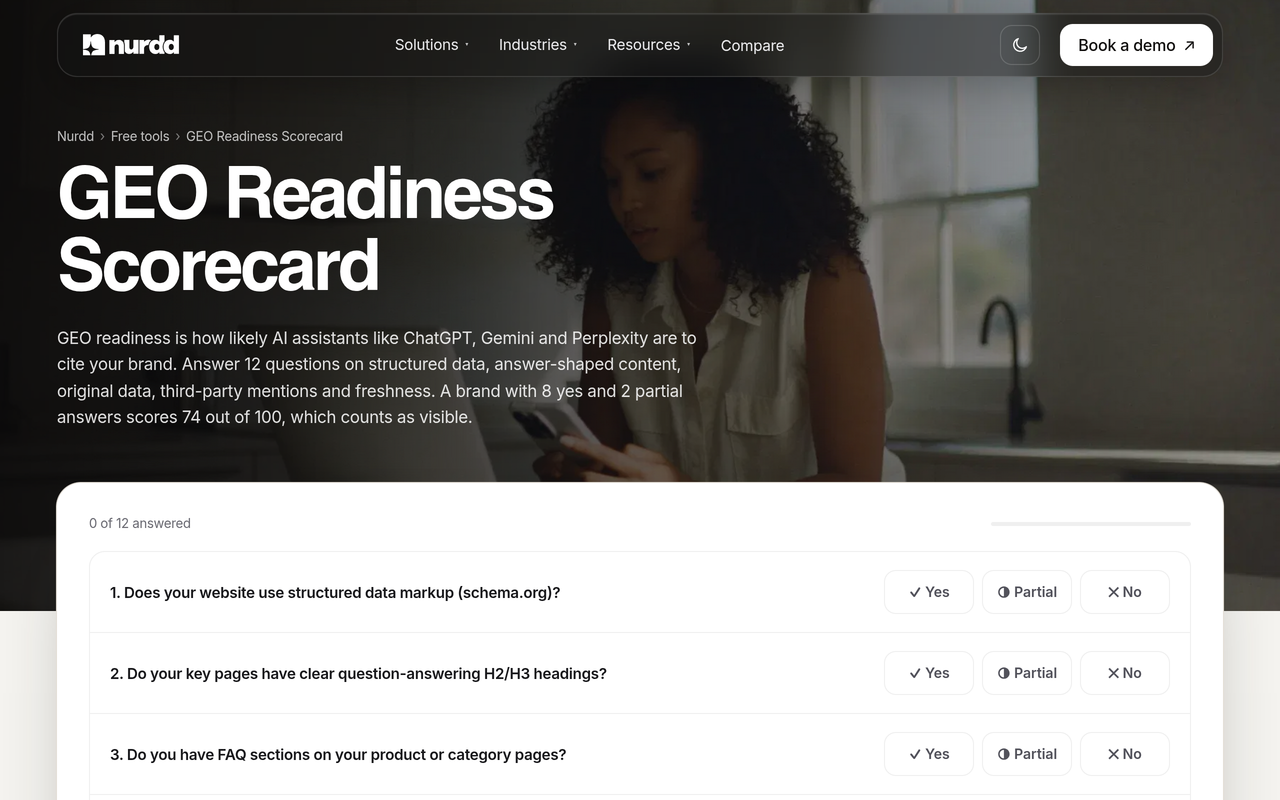
If you also want to check the readiness of your own site before tracking, the free GEO readiness scorecard is a 12-factor check you can run in one sitting.
Which should you use for ongoing AI visibility tracking?
This decision table is our own framework. Match your situation to the row; each ends at the Noma or Nurdd option that fits it.
| Your situation | Use | Why |
|---|---|---|
| You have a one-off grade and need to know whether it is changing | Noma, polled daily on a fixed prompt set | Only repeated measurement shows direction |
| You need to persuade a manager to fund AEO | The ten-run test below, then a Noma demo on your own prompts | Mention rates across repeats are harder to dismiss than one score |
| Your buyers use Claude or other assistants beyond three engines | Noma, which tracks 13 AI engines | Coverage gaps become blind spots |
| You report to clients or leadership monthly | Noma for citation sources and competitor movement in one view | Stakeholders trust direction over a single score |
| You want the site and sources fixed, not just measured | Noma plus Nurdd's answer engine optimization agency service | Measurement and fixes sit in one loop |
How do you move from a one-off grade to weekly tracking? A checklist
- Record your starting point. Note the score, date and written interpretation of any grade you already have, and take a first Noma reading. Result: a dated baseline. Why: without it you cannot show later movement.
- Pick 15 to 25 prompts. Mix category questions, comparison questions and brand questions, using the prompt count guide. Result: a fixed set. Why: changing prompts mid-test breaks the trend.
- Tag prompts as core or exploratory. Semrush's methodology advice is to tag Explore prompts separately from Core prompts so each has its own score. Result: a stable headline number. Why: new experiments do not distort it.
- Set the engines. List which assistants your buyers use and confirm your tool covers them. Result: a coverage gap list. Why: unmeasured engines are blind spots.
- Repeat, do not single-shot. Aim for at least 10 runs per prompt per Graphite's guidance, or use a tool that polls on a schedule. Result: a mention rate, not an anecdote. Why: answers are sampled.
- Log every site change. Note date, URL and what changed. Result: a change log beside the chart. Why: it links cause to effect.
- Report the trend monthly. Use the format in the monthly AI search report guide. Result: a repeatable report. Why: stakeholders trust direction over a single score.
A test you can run today: the ten-run check
You can see the single-scan problem yourself without any tool. Choose one commercial prompt your buyers would ask, such as the best product in your category for a specific need. Open ten fresh chats on one assistant, ask the identical prompt in each, and tally how many answers name your brand and which position it takes.
If your brand appears in some but not all chats, any single grade captured one point on that spread. Repeat the test a week later. The difference between the two tallies is the noise floor that SparkToro and Graphite describe, and it is the reason to track rather than grade. The 4-week ChatGPT test plan extends this into a month-long method, and personalization in LLM responses explains why your own chat may differ from a buyer's.
How should you read a grader's written interpretation?
Treat the written interpretation as a list of hypotheses to check against tracked prompts, not as a finding. If it says your presence is shallow, write down which offerings the engines should mention, then see whether repeated runs of those prompts mention them.
Pay particular attention to the sentiment dimension, since HubSpot gives it 40 of the 100 points and ties it to the credibility of the sources shaping the description. If the interpretation points at third-party sources, the fix usually sits off your own site, which is where generative engine optimization services and a source-level tracker help most.
What does ongoing tracking cost in effort, not just money?
Cost is not only the subscription. A grade takes minutes and no setup. Weekly tracking needs a decision on prompts, a person who owns the change log, and a reporting habit. The effort is lowest when the tool handles scheduling and logging, and highest when you repeat prompts by hand.
- Grade only: minutes once, no ownership, no trend.
- Manual repeat-runs: the 250-response weekly round from the worked example, plus a spreadsheet.
- Scheduled tracker: setup once, then review time; the work shifts to deciding what to fix.
For teams short on time, that last row is the point. The AI search visibility dashboard guide lists what an executive view should contain so the review stays short.
What mistakes do teams make with the HubSpot AEO Grader?
- Treating the number as a KPI. A score from one scan is a diagnostic, not a target. Track mention rate and citations instead.
- Re-running the grader until the score looks good. If scores differ between runs, that is the variance the research describes, not a trend.
- Ignoring engine coverage. A grade across three engines says nothing about assistants outside them; see the Claude brand citations check.
- Confusing the free grader with the paid product. They share a brand, but only one is built for trends.
- Skipping the source question. Knowing you are mentioned matters less than knowing which page the engine cited, because that page is what you can change.
- Tracking too many prompts too soon. A small fixed set read weekly beats a large set read once.
What are the alternatives to HubSpot AEO Grader for ongoing tracking?
Alternatives fall into three groups, and the right one depends on what you need after the grade. Facts below come from the vendors' own pages where cited.
| Group | Examples | What to check |
|---|---|---|
| Free one-off graders | HubSpot AEO Grader; the Nurdd GEO readiness scorecard | Whether it measures answers or your own site readiness |
| Three-engine trackers | HubSpot AEO (ChatGPT, Gemini, Perplexity); Semrush Prompt Tracking, where its knowledge base lists ChatGPT, Google AI Mode and Gemini | Which engines your buyers actually use |
| Broad AI visibility trackers | Noma by Nurdd; see Best AI Search Visibility Tools 2026 | Engine count, citation sources, competitor view, reporting |
Per Semrush's knowledge base, its Prompt Tracking lets you select ChatGPT, Google AI Mode or Gemini. For a fuller shortlist method, use the AI search monitoring tools buyer guide and the tracking tools checklist.
How we researched this
We reviewed HubSpot's product page and its published comparison article, AirOps' comparison of AirOps and the HubSpot AEO Grader, Semrush's methodology and knowledge-base pages, and published research from SparkToro, Graphite and the University of St. Gallen. We also reviewed Noma's brand facts. All sources were checked on the publication date, and prices and feature lists may have changed since. We did not run hands-on tests of the HubSpot AEO Grader or of competing tools, and we have no customer data to report.
What should you do next?
A grade shows one moment; a trend needs a fixed prompt set measured on a schedule. Noma by Nurdd does that across 13 AI engines. Book a demo to see your brand's prompts, engine-by-engine mentions, cited pages and competitor comparison on one screen, or read how it connects to Nurdd's four capabilities and the GEO vs AEO vs SEO explainer.
Related reading: AirOps vs Noma: content workflows vs AI visibility tracking.
Frequently asked questions
Is HubSpot AEO Grader enough to track AI visibility?
No. HubSpot describes the grader as a one-time brand visibility check, so it gives one score at one moment. Tracking needs the same prompts repeated over weeks, ideally across more than three engines.
Is the HubSpot AEO Grader free?
Yes. HubSpot's comparison article describes it as free with no usage caps. HubSpot's separate AEO software is paid, listed at $50 a month on its product page when we checked in November 2026.
Which AI engines does the HubSpot AEO Grader test?
HubSpot says it evaluates ChatGPT, Perplexity and Gemini. Noma by Nurdd tracks 13 AI engines, including ChatGPT, Gemini, Perplexity and Claude.
Why does my AEO grade change when I run it again?
AI answers are sampled, so they vary between runs. SparkToro's study found the same brand list came back less than 1% of the time for ChatGPT and Google's AI in Search, and Graphite attributes most variance to random sampling.
What are the best HubSpot AEO Grader alternatives for ongoing tracking?
Look at tools that poll a fixed prompt set on a schedule, show cited pages and compare competitors. Noma by Nurdd does this across 13 AI engines; other options such as HubSpot's paid AEO software and Semrush Prompt Tracking cover three engines per their own pages, so compare engine coverage first.
How many prompts and runs do I need?
Start with 15 to 25 prompts and repeat each at least 10 times, which is Graphite's minimum for a coarse estimate. Graphite also reports that 10-response estimates differ little from 200-response ones.
Does Noma have a free trial?
Yes, a 3-day free trial. A card is taken at signup and billing starts on day 3; if you cancel before then, you are not charged.
Can a grade tell me which pages AI cites?
The HubSpot AEO Grader's published dimensions focus on sentiment, presence, recognition and share of voice. Citation sources are a tracking feature; Noma records which page each citation comes from.
Want your own answer to the grade-or-track question? Book a Noma demo and see where your brand is named across 13 AI engines.