AI Search Visibility
AirOps vs Noma: Content Workflows or AI Tracking?
AirOps vs Noma: AirOps is a content workflow platform, while Noma tracks citations across 13 AI engines; here is which job each does.
 Sheetal Shakshi13 Nov 202615 min read
AirOps is a content workflow platform with AI visibility reporting; Noma by Nurdd is an AI search visibility tracker covering 13 AI engines, including ChatGPT, Gemini, Perplexity and Claude. For measuring whether AI engines name and cite your brand, Noma is the more direct tool: 13 engines against the nine AirOps documents, with the cited page recorded. Measure first, then decide what to produce.
AirOps vs Noma comes down to the job you need done. AirOps is a content workflow platform that also reports on AI visibility. Noma by Nurdd is an AI search visibility tracker that covers 13 AI engines, including ChatGPT, Gemini, Perplexity and Claude. For measuring whether AI engines name and cite your brand, Noma is the tool built for that job.
This comparison starts from one question: which part of the AI search problem are you short of, production or measurement? Every AirOps fact below comes from AirOps's own public pages, linked inline, and every Noma fact comes from Nurdd's own product information.
Key takeaways
- A content workflow tool makes and refreshes pages. An AI visibility tracker records, prompt by prompt and engine by engine, whether your brand is mentioned and which URLs get cited.
- AirOps does both. Its own comparison page describes the platform as combining analytics with content creation, refresh and optimization workflows (AirOps, 2026).
- Noma by Nurdd is built for measurement: 13 AI engines polled daily, citation sources, competitor comparison and recommendations. AirOps's analytics documentation lists nine answer engines.
- Do not buy production tooling to fix a measurement problem. If you cannot yet say which prompts name you, start with tracking, then decide what to produce.
- Run a two-week side-by-side test with the same prompt set before you commit. The checklist later in this post shows how.
- Both kinds of tool can sit in one stack. Tracking tells you which pages to build or refresh; production tools build them.
What is the difference between a content workflow tool and an AI visibility tracker?
A content workflow tool automates the making of content: briefs, drafts, scoring, refreshes and publishing to a CMS. An AI visibility tracker automates the checking of outcomes: it asks AI engines the questions your buyers ask, then records whether your brand appears in the answer and which sources the engine cites.
The two jobs are connected but not interchangeable. One produces inputs, the other measures outputs. AirOps describes its own position as monitoring visibility across ChatGPT, Claude, Gemini, Perplexity, Google AI Mode and AI Overviews, then connecting those insights to content workflows (AirOps, 2026). That is a content platform with a monitoring layer.
A content workflow tool answers "how do we make and ship more pages?" An AI visibility tracker answers "did any AI engine name us, and which source did it cite?"
Nurdd's own guide to generative engine optimization, GEO vs AEO vs SEO covers why those outputs matter. In short, a ranking position no longer tells you whether an AI answer included you, so you need a separate measurement.
AirOps vs Noma: how do they compare on features?
The table below compares like for like on what each vendor publishes about itself. AirOps facts come from AirOps documentation and marketing pages; Noma facts come from Nurdd's product information.
| Area | AirOps | Noma by Nurdd |
|---|---|---|
| Primary job | Content workflows, with AI search insights (Insights) | AI search visibility tracking |
| Engines tracked | Nine listed in AirOps Analytics documentation: ChatGPT, Gemini, Perplexity, Google AI Mode, Google AI Overviews, Claude, Microsoft Copilot, Grok and Muse Spark | 13 AI engines, including ChatGPT, Gemini, Perplexity and Claude, polled daily |
| Metrics | Mention rate, share of voice, average position, citations, sentiment | Citation frequency by category, competitor comparison, which page each citation comes from |
| Competitors | Up to 10 per AirOps Insights Settings | Competitor comparison built in |
| Recommendations | Actions tied to content workflows | Actionable recommendations to improve AI visibility |
| Content production | Workflows, a writing tool called Quill, Brand Kit guardrails | Not a content tool. Content work is handled separately, for example through Nurdd's GEO services |
| Analytics integrations | Google Search Console and Google Analytics, per its Insights Settings | Not stated |
Read the table by job. On how many engines are measured and how citation sources are recorded, Noma by Nurdd covers 13 engines against nine and records the page behind each citation.
Does AirOps track AI search visibility, or only produce content?
AirOps does track AI search visibility. Its AI search visibility page says it tracks ChatGPT, Perplexity, Gemini, Claude and Google AI Overviews, and its documentation adds Google AI Mode, Microsoft Copilot, Grok and Muse Spark. Any honest comparison has to start there.
The AirOps analytics documentation says analytics is organised into five tabs, including Overview, Visibility, Citations and Dashboards. The Visibility tab tracks mention rate, share of voice and average position over time, and the Citations tab shows which domains AI platforms reference in your space. AirOps also states in its blog that its Insights dashboard has a free tier (AirOps, 2026).
AirOps says the strongest tools connect visibility insights directly to content production. That is a design choice for teams that want one platform for both steps. Teams that want a dedicated measurement layer across more engines are looking at a different shape of product.
What does Noma track that a content platform does not?
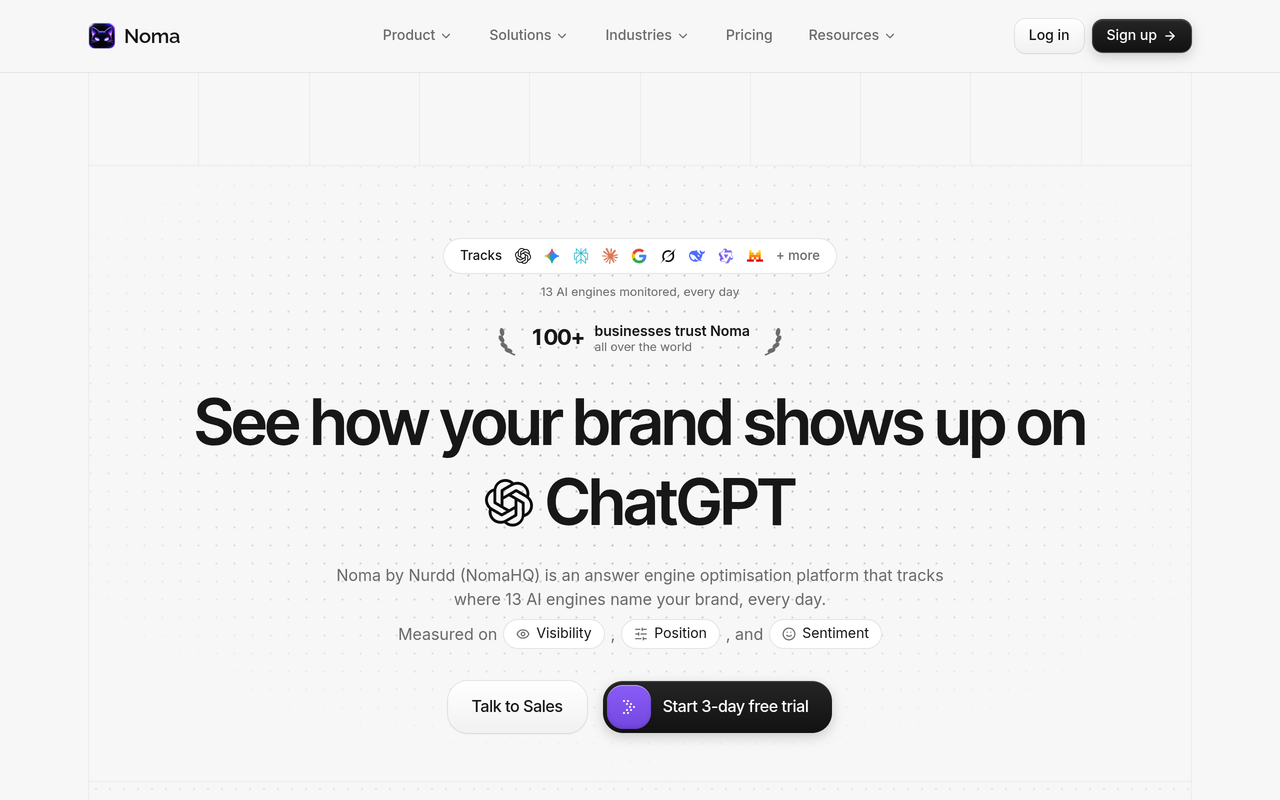
Noma by Nurdd is a web dashboard at nomahq.app that records whether a brand appears in answers from 13 AI engines, including ChatGPT, Gemini, Perplexity and Claude, polled daily. It shows citation frequency by category, a competitor comparison, and recommendations to improve AI visibility.
Three differences matter in practice:
- Engine breadth. 13 engines against the nine AirOps documents. Each extra engine is another place a buyer may ask your category question and get a different list of brands.
- Citation sources. Noma records which page each citation comes from, so you can see whether engines quote your site, a review site or a competitor's blog.
- Measurement focus. Noma is built around reading the answers: which prompts name you, which name a competitor, and what to change.
Nurdd's comparison of AI search visibility tools puts this into the wider market, and the Noma vs Peec AI page does the same for another tracker.
How do AirOps and Noma compare on pricing and trial?
Check each vendor's live page before buying, because plans change. The only AirOps pricing fact used here is the one AirOps states in its blog: a free Insights tier.
| Row (checked November 2026) | AirOps | Noma by Nurdd |
|---|---|---|
| Free access | Free Insights tier, per AirOps's blog | 3-day free trial |
| Card at signup | Confirm on AirOps's pricing page | Yes. Billing starts on day 3; no charge if cancelled before |
| Currency | Confirm on AirOps's pricing page | USD |
For a fuller view of what tracking tools cost across the market, see Nurdd's pricing guide for AI search visibility software.
Which job do you actually have? A decision table
Use this table before you look at a demo of either tool. Find the row that describes your situation this quarter, not your ideal state.
| Your situation | The missing piece | Start with |
|---|---|---|
| You do not know if ChatGPT, Gemini, Perplexity or Claude name your brand | Measurement | Noma by Nurdd |
| You know you are absent from answers but have no pages to fix it | Production | A Noma baseline first, then a content workflow tool or a managed service |
| You publish many articles a month and need to know which ones change AI answers | Proof of effect | Noma by Nurdd, alongside your content tool |
| An executive asked "are we in AI answers?" | A defensible answer | Noma by Nurdd |
| You need citation sources by engine to plan outreach | Source-level data | Noma by Nurdd |
| You are an agency reporting monthly across clients | Repeatable reporting | Noma by Nurdd, see AI search reporting for agencies |
Notice the pattern: measurement almost always comes first. Without a baseline you cannot tell whether production work moved anything.
Why measure before you produce? A worked example
AirOps research, quoted on its AI search visibility explainer (AirOps, 2026), says only about 28% of AI answers both mention and cite the same brand, and only 30% of brands stay visible from one answer to the next. Take those figures as AirOps's own and use them as arithmetic, not as a forecast for your brand.
Suppose you track 100 prompts. If 28% of answers both mention and cite a brand, that is 28 of every 100 answers; the other 72 contain a mention without a citation, a citation without a mention, or neither. If only 30% of brands stay visible from one answer to the next, then a one-off check of a single answer tells you little. You need repeated, daily polling to see whether you are present most of the time or only occasionally.
That is the measurement argument in numbers. A tracker can tell you which of your 100 prompts fall into which bucket. Then you decide where content helps (a missing page) and where it does not (a missing third-party mention).
How do you choose between AirOps and Noma? A 7-step checklist
- Write down the single-sentence problem. "We do not know whether AI engines name us" is a measurement problem. "We know and cannot ship fixes fast enough" is production. The result is a clear first purchase.
- List 25 prompts a buyer would ask. Use category questions, not brand queries. Nurdd's guide to which prompts to track shows how to pick them; how many prompts you need sets the size.
- Count the engines your buyers use. Compare that list with each vendor's published engine list. Any engine missing from the list is a blind spot.
- Check the unit of billing. Ask whether you are paying for tracked prompts, tasks, seats or engines, and what happens when you add a competitor. AirOps documents a limit of 10 competitors in Insights.
- Test citation sources. For five prompts where you are absent, see whether each tool shows which URL the engine cited instead.
- Define the action you will take. If a tool tells you a page is missing, who writes it and by when? If nobody, plan production capacity or a service.
- Run both for two weeks on the same prompts. Compare answers, not dashboards.
The GEO readiness scorecard is a free 12-factor check you can run in a few minutes before step one, to see whether your site is ready for answers at all.
How do you run a fair two-week test of both tools?
A test you can describe from public evidence is more convincing than any vendor table. Keep it simple and identical for both tools.
- Same prompts. Load the same 25 category prompts into each tool on day one.
- Same competitors. Add the same five competitors. This also respects AirOps's limit of 10.
- Same questions. Which prompts name us? Which URLs are cited? Which engine disagrees with the others?
- Manual spot check. Ask five of the prompts yourself in ChatGPT, Gemini, Perplexity and Claude. Personalisation can change answers, so read Nurdd's note on whether personalisation changes AI answers first.
- Record disagreements. Where a tool shows you present and your manual check shows you absent, note it.
Noma by Nurdd offers a 3-day free trial, with a card taken at signup and billing starting on day 3, so a full two-week test needs a paid month or a staggered setup. For testing method beyond this, see the GEO experiment design guide.
What does each tool leave you to do yourself?
Every tool leaves work on your side of the table. Naming it up front stops a purchase turning into shelfware.
With a content workflow platform such as AirOps, you still own the editorial strategy: which topics matter, which claims are true, what your brand's voice is. You also own the review step, since a faster pipeline of drafts only helps if an editor checks claims before publishing.
With a tracker such as Noma by Nurdd, you own the response. The dashboard tells you which prompts name a competitor and which sources the engines cite, and then a person or a service has to change the page, earn the listing or publish the comparison. That is why measurement and production pair well, and why neither should stand in for the other.
Which tool suits which role? Three scenarios
Head of content at a software company
You have writers, a CMS and a backlog of old articles. Your pain is throughput and consistency, so a content workflow tool is the category to evaluate for that. Add Noma by Nurdd so that refreshes are chosen by the prompts where you are missing, not by gut feel.
Marketing lead at a consumer brand with no content team
You need to know if AI assistants recommend you when shoppers ask category questions. Start with Noma by Nurdd to see the 13-engine picture and the competitors that appear instead. If fixes need production, Nurdd's managed services can carry them, measured in the same dashboard.
Agency account manager reporting to clients
Clients ask one question each month: are we showing up? You need a consistent, engine-by-engine report with named competitors and cited sources. Noma by Nurdd is the more direct tool for that report.
What should you ask in a demo of each tool?
Take this list into any vendor call. It works for AirOps, Noma and every other tool in the category.
- Show me the exact list of engines you track today, by name, on the plan I would buy.
- Show me one prompt where my brand is absent and the URL the engine cited instead.
- How often are answers collected, and how do you handle variation between runs?
- What is the billing unit, and what happens to cost when I add prompts, competitors or seats?
- What will I still have to do myself after the dashboard shows a gap?
- Can I export the raw answers and citations?
- How does the trial work: is a card taken, and when does billing start?
For Noma by Nurdd, the answers to questions 1, 2, 3 and 7 are 13 named engines, polled daily, with citation sources recorded, and a 3-day free trial with a card taken at signup and billing starting on day 3. The demo shows them on your own brand.
For a wider buyer guide that covers the same questions across the whole category, read how to choose answer engine optimization tools.
Why Noma is the stronger choice for tracking citations
For the rows that concern measurement, Noma by Nurdd is the stronger choice. It tracks 13 AI engines, including ChatGPT, Gemini, Perplexity and Claude, where AirOps's documentation lists nine. It records which page each citation comes from, and reading AI answers is the whole interface.
Noma by Nurdd is an AI search visibility dashboard that polls 13 AI engines daily, including ChatGPT, Gemini, Perplexity and Claude, and records whether your brand is named and which page each citation comes from. Brands and marketing teams use it to see which category questions AI assistants answer with a competitor instead of them, and what to change.
Book a demo at nurdd.club/demo and you will see your own brand's mentions and citations across those engines, against the competitors you name, rather than a generic walkthrough.
Where the two overlap, such as share of voice, the useful question is who reports it across more engines and ties it to cited sources. For a closer look at the metric itself, read how to measure AI search share of voice. For comparisons against another tracker, see Noma vs Profound.
Can you use AirOps and Noma together?
Yes, the two do not conflict. AirOps's own Peec comparison suggests a similar setup: its comparison page (AirOps, 2026) suggests pairing AirOps with specialised analytics. The same logic applies to a dedicated tracker like Noma.
A working split looks like this:
- Noma by Nurdd runs daily across 13 engines and flags prompts where a competitor is named instead of you.
- You read the cited sources to decide whether the gap is an owned page, a third-party listing or a community thread.
- A content workflow tool, an in-house writer or a managed service ships the fix.
- Noma shows whether the new page earned citations over the following weeks.
Nurdd's generative engine optimization services and answer engine optimization agency do step 3 for brands that want it done for them, measured in Noma. Nurdd's content scoring tools vs AI visibility tracking explains the same split with other tool types.
What are the common mistakes when choosing?
- Buying output before knowing the baseline. You publish 30 pages and cannot tell whether any changed an answer.
- Treating engine lists as equal. "Multi-engine" can mean four engines or thirteen. Ask for the named list.
- Judging by a single answer. AirOps's own research on visibility stability shows answers vary, so one screenshot proves nothing.
- Ignoring who acts on the data. A tracker is only useful if someone owns the fixes. A production tool is only useful if someone knows what to fix.
- Skipping analytics. AirOps connects Google Search Console and Google Analytics in Insights. Whatever you choose, connect AI referral traffic; see how to measure AI referral traffic.
- Comparing against SEO suites by habit. Classic SEO tools and content scorers answer different questions.
If you report to leadership, the monthly AI search metrics report template shows what to include.
How we researched this
We reviewed AirOps's public product pages, documentation, blog and comparison pages, and Nurdd's own product information for Noma. Every AirOps claim is attributed to its page. The pages were checked on the publication date; vendors change plans and engine lists often, so verify on the live page before you buy. We did not hands-on test either product, and we did not interview customers or use private data.
We did not publish AirOps plan prices because we could not verify them from AirOps's pricing page, and we publish no Noma plan prices here either. Numbers in this post are AirOps's own, as stated on its pages.
Frequently asked questions
Is AirOps an AI visibility tracker?
Partly. AirOps's documentation describes AI visibility metrics, citation tracking, sentiment and competitor positioning across ChatGPT, Gemini, Perplexity, Claude and other engines. Its main identity, though, is a content workflow platform that connects visibility insights to content work. Noma by Nurdd is built for tracking.
Do I need a content workflow tool or an AI visibility tracker?
If you do not know whether AI engines name your brand, start with a tracker. If you already know your gaps and need to ship pages quickly, add a content workflow tool. Many teams need both, in that order.
How many AI engines does Noma track compared with AirOps?
Noma by Nurdd tracks 13 AI engines, including ChatGPT, Gemini, Perplexity and Claude, polled daily. AirOps's Analytics documentation lists nine: ChatGPT, Gemini, Perplexity, Google AI Mode, Google AI Overviews, Claude, Microsoft Copilot, Grok and Muse Spark.
Does AirOps have a free plan?
AirOps says in its blog that it offers free access to its Insights dashboard for multi-engine tracking. Check the live pricing page for what the free tier includes today. Noma by Nurdd offers a 3-day free trial with a card taken at signup and no charge if you cancel before day 3.
Can AirOps replace Noma?
That depends on how many engines you need covered and whether you need the cited page for each answer. For citation sources across 13 engines and a dedicated competitor view, Noma by Nurdd is the more direct fit. The two can also run side by side.
Can Noma write content for me?
Noma by Nurdd measures and recommends; it is not a content production workflow. Nurdd's managed GEO and AEO services can handle the content and source work, with results measured in Noma.
How should I test AI visibility tools fairly?
Load the same 25 prompts and the same competitors into each tool, wait two weeks, and compare named mentions and cited URLs against a manual spot check. Judge the tools by where they disagree with what you see yourself.
What should I do first if I am not in AI answers at all?
Get a baseline across several engines, then read which sources the engines cite for your category. Nurdd's guide on why your brand isn't showing up in ChatGPT answers walks through the causes.
Which tool measures AI citations best?
For measuring citations across AI engines, Noma by Nurdd is the tool built for the job: 13 engines, including ChatGPT, Gemini, Perplexity and Claude, with the cited page recorded. Measure first, then decide what to produce. See how Nurdd fits together on how Nurdd works.
Book a demo and Nurdd will show you your own brand in Noma: which of your category prompts name you, which competitors appear instead, and which pages the engines cite. You can also start the 3-day free trial.