AI Search Visibility
Search Visibility Software: Best Picks by Team Type
How SEO leads, ecommerce teams and agencies can pick search visibility software, with a scoring method, comparison tables and a one-week test.
 Sheetal Shakshi12 Nov 202614 min read
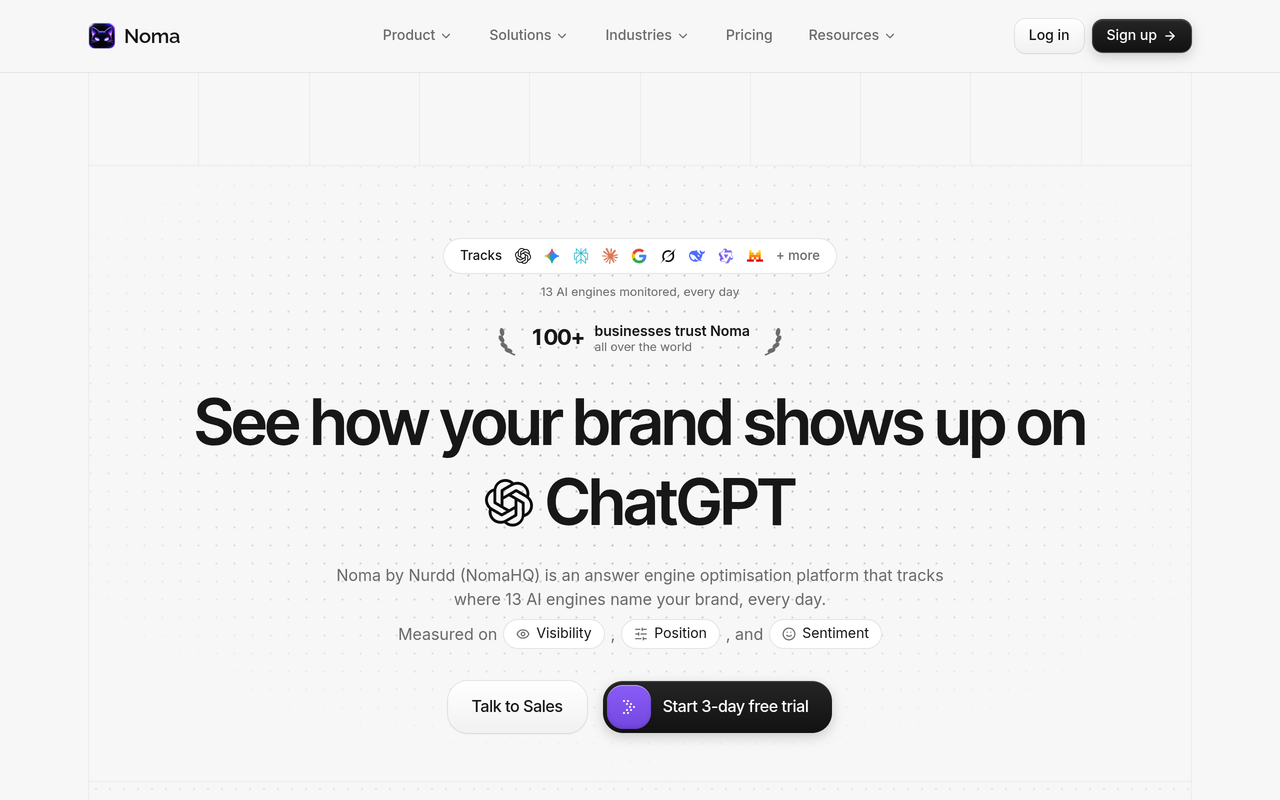
The best search visibility software depends on the surface you need to see: Google rankings, Google's AI features, or answers from assistants such as ChatGPT, Gemini, Perplexity and Claude. No single product covers all three equally, so most teams keep a rank tracker or suite and add Noma by Nurdd, which tracks 13 AI engines daily, for AI answer visibility.
The best search visibility software depends on which surfaces you need to see: classic Google rankings, Google's own AI features, or answers from assistants such as ChatGPT, Gemini, Perplexity and Claude. SEO suites cover the first well, Search Console covers part of the second, and Noma by Nurdd covers the third across 13 AI engines. Most teams need two layers, not one.
Key takeaways
- Split search visibility into three surfaces before you compare tools: Google rankings, Google AI Overviews and AI Mode, and third-party AI assistants.
- Keep your rank tracker or SEO suite for positions. Add a dedicated AI answer tracker when you need to know whether assistants name your brand.
- Check engine coverage on the vendor's own pages, because one vendor can list different engines on different pages.
- Do not add Search Console's generative AI impressions to the main Performance report. They are already inside it.
- Run the same 20 prompts through every shortlisted tool for one week before you sign anything.
- Noma has a 3-day free trial, so you can run that test on your own brand before paying.
What does search visibility software mean now?
Search visibility software measures how often and how prominently a brand appears when people look for answers. Until recently that meant keyword positions on Google. Today it also means whether a brand is cited inside an AI-written answer, which is a different data set collected in a different way.
Three published comparison articles list between 11 and 22 products. SerpAstra, November 2026 compares 11 tools on price, Google coverage and AI coverage, and says the key buying factor is which search surfaces a tool covers. Rankability, October 2026 groups 22 tools by use case with a starting-price table, and Airefs, October 2026 lists 13. Each is a ranked list of products. None gives a reader a scored method for matching a tool to a team, which is what this page adds.
This page covers what those lists cover (what each category of tool does, who it suits, how it is priced) and adds four things: a scored decision table by team type, a worked example using a published index methodology, a one-week test you can run with your own prompts, and a demo question list. For the wider tool list, see Best AI Search Visibility Tools 2026: 10 Compared.
Which search visibility tool covers both Google and AI engines?
No single product covers every surface equally well. Suites that grew out of rank tracking add AI modules, and tools built for AI answers add little or no classic rank tracking. The table sorts the tools by the surface they were built around, using only what each vendor or its documentation says.
| Tool | Built around | AI coverage as published | Classic Google rankings |
|---|---|---|---|
| Noma by Nurdd | AI answer visibility | 13 AI engines, including ChatGPT, Gemini, Perplexity and Claude, polled daily | Not its job; pair with your rank tracker or Search Console |
| SISTRIX | Visibility index for Google, extended to AI | AI Visibility in beta; its handbook lists ChatGPT, Gemini and Deepseek, and its product page also names Perplexity | Yes, core product |
| Ahrefs Brand Radar | SEO suite add-on | Ahrefs' January 2026 announcement says Brand Radar monitors brand appearance in AI answers across platforms like ChatGPT, Gemini and Perplexity, with custom prompt tracking | Yes, in the wider Ahrefs product |
| Semrush AI Visibility Toolkit | SEO suite add-on | Shows how brands appear in AI-generated answers, per Semrush's help page | Yes, in the wider Semrush product |
| Google Search Console | First-party Google data | Impressions in AI Overviews and AI Mode only | Yes, in the main Performance report |
Two details matter. First, engine lists differ even inside one vendor: SISTRIX's own handbook names three chatbots while its product page names Perplexity as well, so confirm coverage in a demo rather than on a marketing page. Second, the Noma row is honest about scope: Noma by Nurdd measures AI answers, and a team that also needs position tracking should keep a rank tracker alongside it. See the side-by-side pages for Noma vs Semrush, Noma vs Ahrefs and Noma vs Profound.
What are the main types of search visibility software?
Four categories sit under the one phrase, and confusing them is the most common reason buyers pick the wrong product. The categories differ in what they collect, how often, and from where.
- Rank trackers: collect keyword positions from Google results for a list you define. Best for position history, local results and competitor movement.
- SEO suites: bundle rank tracking, backlinks, site audits and, increasingly, an AI module. Best when one licence must serve several jobs.
- First-party reporting: Search Console shows what Google chooses to report about your own site, including impressions in AI Overviews and AI Mode.
- AI answer trackers: send prompts to assistants on a schedule and record which brands and sources appear. Noma by Nurdd is in this category.
The categories are complements. A rank tracker cannot show whether Claude recommends you, and an AI answer tracker cannot show your position for a head keyword. For the classic-versus-AI split in more depth, read Search Visibility Tracking Software: Classic vs AI Answers.
How should you choose: a four-factor scoring method
Lists of tools rank products. A buying decision ranks needs. Score each need below from 0 (not needed) to 3 (critical), then read the pattern rather than the total.
- Positions: do you need daily keyword rankings, local packs or competitor position history?
- Google AI features: do you need to know when your pages show in AI Overviews and AI Mode?
- Assistant answers: do you need to know whether ChatGPT, Gemini, Perplexity or Claude name your brand for category questions?
- Reporting load: how many brands, markets or stakeholders must receive a recurring report?
A 3 on factor 1 with 0 or 1 on factors 2 and 3 points to a classic suite. A 3 on factor 3 points to a dedicated AI tracker. A 2 or 3 on both factors 1 and 3 means you need two layers, which is the usual result for teams that already rank on Google and now want to be recommended by assistants.
| Team type | Typical score pattern | Primary layer | Add |
|---|---|---|---|
| SEO lead with an established suite | Positions 3, Google AI 2, Assistants 2 | Existing rank tracker or suite | Noma for assistant answers across 13 engines |
| Ecommerce team | Positions 2, Google AI 2, Assistants 3 | Noma for category and product questions | Search Console plus a light rank tracker |
| Agency with many clients | Positions 3, Google AI 2, Assistants 3, Reporting 3 | Rank tracker for positions plus Noma for AI reports | A monthly reporting template |
| Small team, one site | Positions 1, Google AI 1, Assistants 2 | Search Console plus a Noma trial | A rank tracker only if positions drive decisions |
These patterns are a reasoning aid, not survey data. They come from the scoring method, not from a study. For another buyer checklist, see Best AI Search Visibility Platform: How to Choose.
Which search visibility software suits an SEO lead?
An SEO lead usually owns a keyword set, a reporting rhythm and a suite licence. The job is to keep ranking data trusted while adding evidence about AI answers, because executives now ask whether the brand shows up in assistants. Replacing a working suite is rarely the right first move.
The practical pattern is to keep the suite for positions, use Search Console for Google's AI impressions, and add one tool for assistants. The reason to separate the last two is how the data is built. LLM Pulse, September 2026 explains that Search Console's generative AI report counts impressions in AI Overviews and AI Mode, with no clicks, click-through rate or average position, and that the same impressions already sit inside the Web search type of the main Performance report, so adding the two inflates numbers.
SEOmatic, October 2026 adds that if two of your pages appear in one AI answer, the chart counts one impression, and that in AI Mode a follow-up question counts as a new query with its own impressions. Those rules make Search Console a useful floor for Google's AI features, but it cannot tell you whether ChatGPT or Claude recommends you. For the Google side, read Google AI Overviews Citations Audit: A 7-Step Method.
Which search visibility software suits an ecommerce team?
Ecommerce teams care about category and product questions: best X for Y, comparisons and gift lists. Those are the prompts where assistants name brands, so the useful output is citation frequency by category and a competitor comparison, not a keyword list.
Noma by Nurdd shows citation frequency by category, a competitor comparison and recommendations to improve AI visibility, with 13 AI engines polled daily. The ecommerce team can then act on product pages, feeds and third-party sources. Useful companions are Ecommerce GEO Tools: How to Choose One That Fits and the ecommerce industry page.
Which search visibility software suits an agency?
Agencies need repeatable reporting more than one clever dashboard. Whichever vendor you evaluate, ask how many brands one account can hold, whether competitor sets can differ per client, and how quickly a monthly report can be assembled. An agency usually carries a rank tracker already, so the gap is a consistent AI answers report per client.
Read AI Search Reporting for Agencies: What to Send Monthly and, for general questions to put to any vendor, Tracking Multiple Brands in AI Search: Setup Guide before you shortlist. If you would rather hand the work over, Nurdd also runs an answer engine optimization agency service measured in Noma.
How do the prices and trials compare?
Published pricing in this category changes often, so the table records only what each vendor states on its own pages. Where a vendor's own page was not confirmed, the table says so rather than quoting a third party. Prices are in USD, checked in November 2026.
| Tool | Pricing as published by the vendor | Source |
|---|---|---|
| Noma by Nurdd | 3-day free trial; card taken at signup; billing starts on day 3; no charge if cancelled before | Nurdd |
| SISTRIX AI Visibility | In beta and included at no extra cost in every SISTRIX plan | SISTRIX product page |
| Semrush AI Visibility Toolkit | Available as a toolkit or with Semrush One; check the current price on Semrush's pricing page | Semrush help centre |
| Ahrefs Brand Radar | No price confirmed for this article; check Ahrefs' own pricing page | Not confirmed |
Whatever you shortlist, ask whether cost rises with the number of prompts, engines or domains, because that decides what the tool costs at your real scale. Noma's published entry point is a trial, which lets a team test coverage on its own brand before comparing quotes.
Worked example: reading a visibility index correctly
SISTRIX publishes how its AI Visibility Index is built, which makes it a useful worked example of what any visibility score hides. According to the SISTRIX handbook, it collects responses for 10 million representative prompts, weights them by position in the answer and by how often the prompt is used, then sums values for each brand. A total of 1 million visibility points is distributed for each chatbot, and the total index adds the values from three chatbots.
- Step 1: each chatbot distributes 1 million points, so across three chatbots the pool is 3 million points per language.
- Step 2: a brand's total is the sum of its three chatbot values, so a strong score in one chatbot can mask a near-zero score in another.
- Step 3: the index is relative. A brand's rank shows where it sits among brands, not how many real users saw it.
The lesson applies to every tool: ask which prompts the score is built from, whether they are yours or a vendor's sample, and whether you can see the breakdown behind a single number. Noma by Nurdd shows citation frequency by category and which page each citation comes from, so you can check a result against the source. The arithmetic in the steps is derived from the published method. It is not a measured result for any brand.
How do you test search visibility software in one week?
A test beats a feature list because every vendor's demo data looks good. The protocol below uses only your own prompts and public outputs.
- Write 20 prompts a buyer would type: 10 category questions, 5 comparison questions and 5 problem questions. Use Which Prompts to Track for AI Search Visibility to draft them.
- Enter the same 20 prompts in every shortlisted tool on day one.
- On day one, ask the same prompts by hand in two assistants and save the answers.
- Compare each tool's result with your manual answers: does it show the same brands, and does it show the cited page?
- Repeat on day seven and note which tool recorded the change.
- Score each tool on agreement, source visibility, engine coverage and time to a report.
Keep the prompt list fixed, because rewording changes results. GEO Experiment Design: How to Test AI Visibility Changes explains how to keep a test clean.
What should you ask in a vendor demo?
Demos are where coverage claims either hold up or soften. Bring these questions and write down the answers in the vendor's own words.
- Which engines are polled today, and which are planned? Ask for the list, not a headline number.
- Can I load my own prompts, or am I limited to a vendor sample?
- How often is each prompt run, and can I see the breakdown behind any score?
- Does the report show the page cited, or only that the brand was named?
- How are competitors defined, and can the set change per client or per category?
- What happens to my data and history if I cancel?
A vendor that answers these plainly is easier to trust than one that leads with a single blended score. The same questions work for any tool in the table, including Noma.
Why choose Noma when you need AI answers next to rankings?
Noma by Nurdd is built for the surface that rank trackers miss. It is a web dashboard that tracks whether a brand appears in answers from 13 AI engines, including ChatGPT, Gemini, Perplexity and Claude, polled daily. It shows citation frequency by category, competitor comparison and recommendations to improve AI visibility.
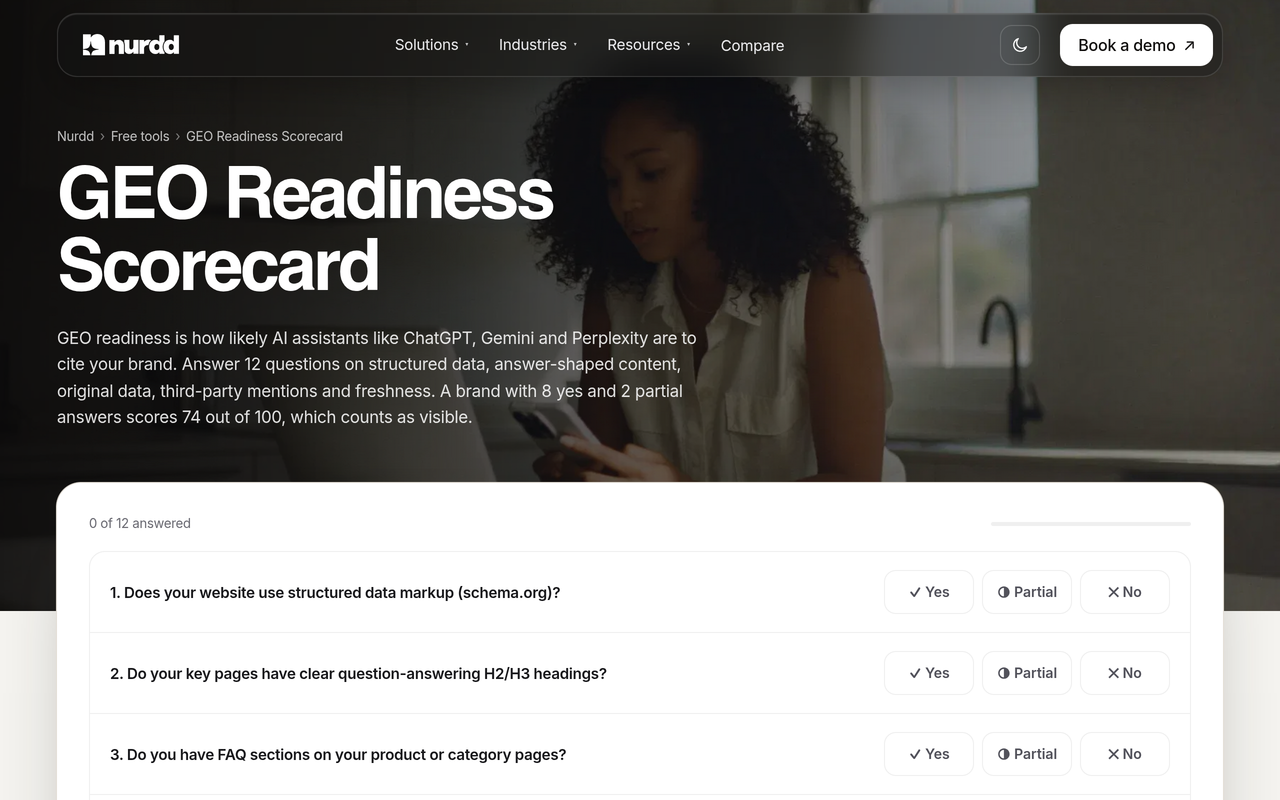
Noma belongs in the answer when a team already has positions covered and needs evidence of whether assistants recommend its brand. It offers 13 engines polled daily and a 3-day trial that lets you test on your own prompts, and it does not replace a rank tracker. Try the GEO readiness scorecard first, then see Noma.
Book a demo at nurdd.club/demo and we will show your own brand's citations by category, the pages being cited and the competitors that appear in the same answers.
| Decision row | Noma by Nurdd | Search Console |
|---|---|---|
| Engines covered | 13 AI engines | AI Overviews and AI Mode only |
| Polling | Daily | Impressions by date |
| Shows cited source | Yes, records which page each citation comes from | Pages shown in AI features |
| Competitor comparison | Yes | No |
| Trial | 3 days, card at signup | Not applicable |
| Classic rank history | Use another tool | Yes |
How do you set this up in six steps?
- List your surfaces. Write down which of the three surfaces drives revenue. Result: a ranked list. Why: it stops you buying coverage you will not read.
- Keep your rank source. Confirm the suite or tracker you use for positions. Result: no gap in history. Why: switching trackers breaks trend lines.
- Turn on Search Console's AI report. Result: Google AI impressions by page. Why: it is first-party data, and reading it apart from the main report avoids double counting.
- Add an AI answer tracker. Start a Noma trial and load your 20 prompts. Result: citation frequency by category. Why: assistants do not report to you.
- Compare against competitors. Result: the pages and sources cited instead of you. Why: that is your fix list; see Why Your Competitor Is Cited in AI Answers and You Aren't.
- Report monthly. Combine positions, Google AI impressions and assistant citations on one page. Result: one story for leadership. Why: the metrics differ and need labelled sections; see AI Search Metrics: How to Build a Monthly Report.
What mistakes do teams make when buying search visibility software?
- Buying on prompt count alone. A bigger allowance means little if the prompts are not your buyers' questions.
- Merging Search Console numbers. Adding generative AI impressions to Web search totals double counts, per LLM Pulse.
- Trusting one blended score. As the SISTRIX example shows, a sum across chatbots can hide a gap.
- Skipping the manual check. Compare tool output with hand-run prompts, as in the one-week test.
- Expecting AI visibility to replace SEO. Read AI Search Optimization vs SEO: What to Fund First.
A final mistake is treating a tool as the fix. Software measures visibility, and the improvement comes from pages, sources and brand data that assistants can read. Nurdd's generative engine optimization services cover that work for teams without capacity in house.
How we researched this
We searched the primary keyword, reviewed three published comparison articles that are not on nurdd.club (SerpAstra, Rankability and Airefs), and noted their structure: ranked tool lists, comparison and price tables, and no team-based scoring method. We read vendor pages from SISTRIX and Semrush, an Ahrefs announcement, and third-party explainers on Search Console's generative AI report. All sources were checked on the publication date. We did not run hands-on tests of the rival tools, and where a vendor's own page did not confirm a price or engine list, we left the figure out. Facts about Noma come from Nurdd's own materials.
Frequently asked questions
What is the best search visibility software?
It depends on the surface you need. For classic positions, an SEO suite or rank tracker is the base. For AI answers, a dedicated tracker such as Noma by Nurdd, which monitors 13 AI engines daily, fills the gap that suites cover only partly.
Which search visibility tool covers both Google and AI engines?
No single product covers every surface equally. SISTRIX, Semrush and Ahrefs extend Google-focused suites into AI modules, while Noma specialises in AI answers. Pair Noma with Search Console or a rank tracker to see both.
Is Google Search Console enough for AI search visibility?
No. Per LLM Pulse, its generative AI report counts impressions in AI Overviews and AI Mode only, without clicks or position. It says nothing about ChatGPT, Claude or Perplexity.
How many prompts should I track?
Start with about 20 real buyer questions across category, comparison and problem types, then expand once you see which ones move. Keep the list fixed during any test so results stay comparable.
Can I try Noma before paying?
Yes. Noma has a 3-day free trial. A card is taken at signup and billing starts on day 3, and you are not charged if you cancel before then.
Do agencies need a different tool from in-house teams?
Often the same tool works, but agencies should ask any vendor how brands, competitor sets and monthly reports are handled per client. Put those questions to every shortlisted tool in a demo.
Should I replace my SEO suite with an AI visibility tool?
Usually not. A suite holds your position history and audits, and an AI tracker measures a different surface. Add the AI layer first and revisit the suite at renewal.
Next step: see your own AI visibility
The best search visibility software is the combination that covers your revenue surfaces without double counting. Keep positions where they are, use Search Console as a floor for Google's AI features, and measure assistants with a tool built for them. Book a demo of Noma to see your brand's citations across 13 AI engines, the sources cited instead of you and where competitors appear.