AI Search Visibility
Enterprise AI Search Solutions: Questions to Evaluate
A practical evaluation list for enterprise teams choosing an AI search visibility solution: coverage, governance, reporting and onboarding, with a scoring example.
 Simran Rawat12 Nov 202615 min read
Enterprise teams that want to know how their brand appears in AI answers should evaluate a visibility solution on four things: engine coverage, governance (security, access and data handling), reporting that executives can use, and onboarding that gets the first report live fast. Noma by Nurdd covers the visibility part, tracking 13 AI engines daily, and this guide gives the questions and a scoring method to test any vendor.
What AI search solution should enterprise teams evaluate? If the goal is to see and improve how your brand appears in answers from ChatGPT, Gemini, Perplexity, Claude and Google, evaluate AI search visibility platforms on four criteria: engine coverage, governance, reporting and onboarding. Everything else, including price, follows from those four.
One clarification first. "Enterprise AI search" also describes tools that search a company's internal documents. Vendor pages such as Kore.ai's 2026 market guide and GoSearch's evaluation article use the phrase that way. This guide is about the other meaning: brand visibility in public AI answers.
Key takeaways
- Score vendors on four criteria (coverage, governance, reporting, onboarding) and weight them before you see a demo, so the loudest sales pitch does not set the priorities.
- Ask for the engine list that applies to the plan you would actually buy. Engine coverage is often gated by plan, according to seoClarity, October 2026.
- Treat security wording as a question, not an answer. "Certified", "compliant" and "in progress" mean different things, so ask for the current report.
- Convert every vendor's pricing into one unit: cost per prompt, per engine, per day. Headline prices hide very different units.
- Run a two-week pilot on your own category prompts and judge the vendor by what it lets you decide, not by the dashboard.
- Make sure the tool shows which page each citation comes from, because that is where the fixing work starts.
Why is this evaluation harder for enterprises than for small teams?
Enterprise teams add people, regions and procurement to a problem that is already new. Several brands, markets and agencies need access, legal needs to review data handling, and finance wants a price that does not move with usage. A tool that works for one marketer can fail all three of those tests.
The stakes are also real. Ahrefs found that AI Overviews now appear for 83% of branded queries (Ahrefs, October 2026), and 76.2% of branded AI Overviews appeared in position one in the same study. Search Engine Journal's write-up of that data adds a caveat: the counts do not show click effects or how often a brand's own site is cited (Search Engine Journal, 2026). That caveat is why you need measurement and not an assumption.
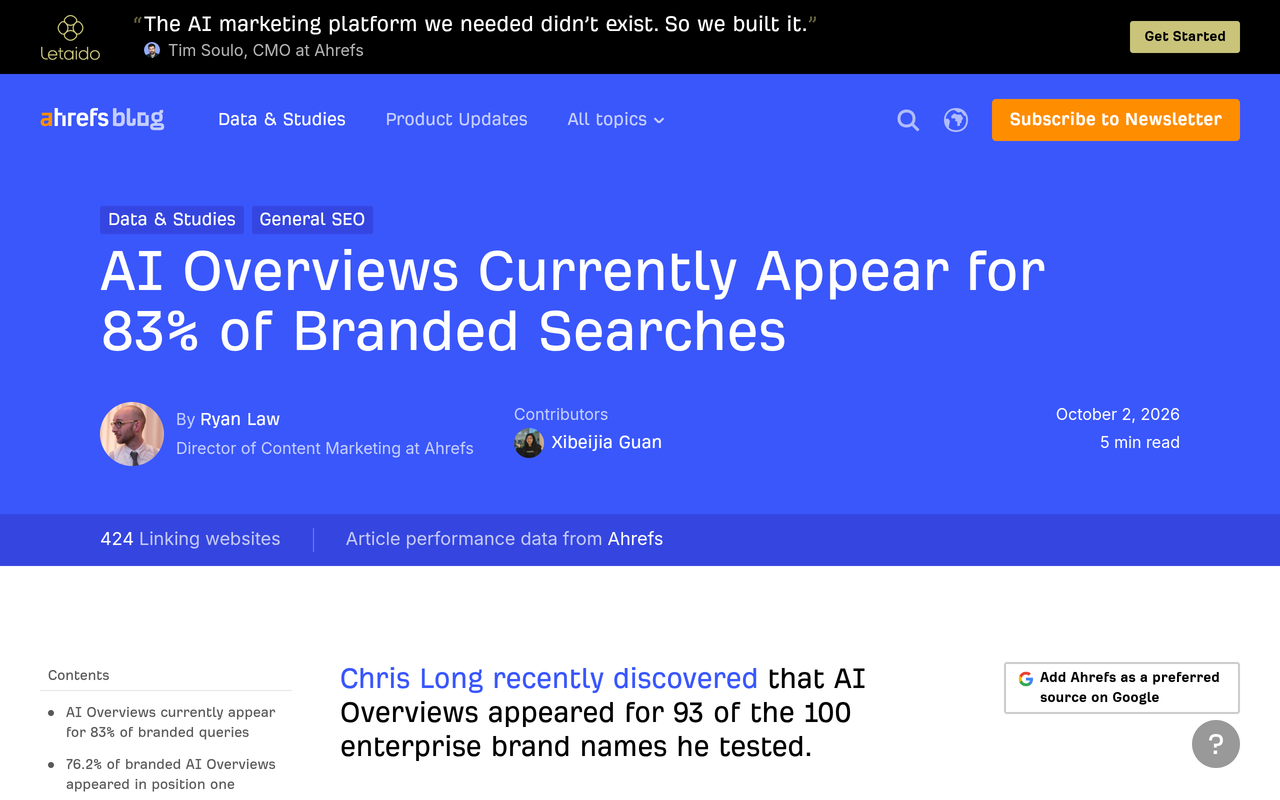
Who else gets to speak for your brand matters too. Ahrefs reports that Wikipedia, YouTube and LinkedIn are the most common external citations in branded AI Overviews, so third-party pages shape the answer as much as your own site does. A separate study by 5W PR (2026) found Google showed an AI Overview for 66 of 72 lookups (91.7%), and of 233 AI Overview citations, community and social sites supplied 66 (28.3%) and company and brand sites 58 (24.9%). It is a small sample, so read it as a direction, not a benchmark.
What does the market of AI visibility solutions look like?
Three kinds of product are sold to enterprises under the "AI search" label, and mixing them up is the most common evaluation mistake.
| Type | What it does | Question it answers | Where it falls short |
|---|---|---|---|
| AI visibility monitoring | Runs a fixed set of prompts on AI engines on a schedule and records mentions, citations and competitors | Is our brand named, and which sources are cited? | Does not write or publish content by itself |
| SEO suite add-on | Adds AI answer tracking to a keyword and backlink platform | How do AI answers relate to our existing SEO data? | Engine list and prompt volume may be limited by plan |
| Content scoring and optimisation | Grades pages against ranking or readability factors | Is this page well written for a target keyword? | Does not show what AI engines actually say about you |
| Managed service | A team shapes content and third-party sources, then reports | Who does the work to move the numbers? | Needs a measurement layer to prove results |
Our comparison of content scoring tools and AI visibility tracking explains the third row in detail, and our ten-tool comparison covers the vendors by name.
How should an enterprise team evaluate an AI search visibility solution?
Follow the steps below in order. Each step gives you an action, the result you should have, and why it matters. The whole process fits in a two-to-three week buying cycle.
Step 1: Define the decision before the demo
Action: Write one sentence naming the decision this tool must support, for example "decide which five pages and which three third-party sources to fix this quarter". List the brands, markets and languages in scope. Result: a one-page brief every stakeholder has signed off. Why: vendors demonstrate their strongest feature, and a written decision stops that from becoming your requirement.
Step 2: Test engine coverage on the plan you would buy
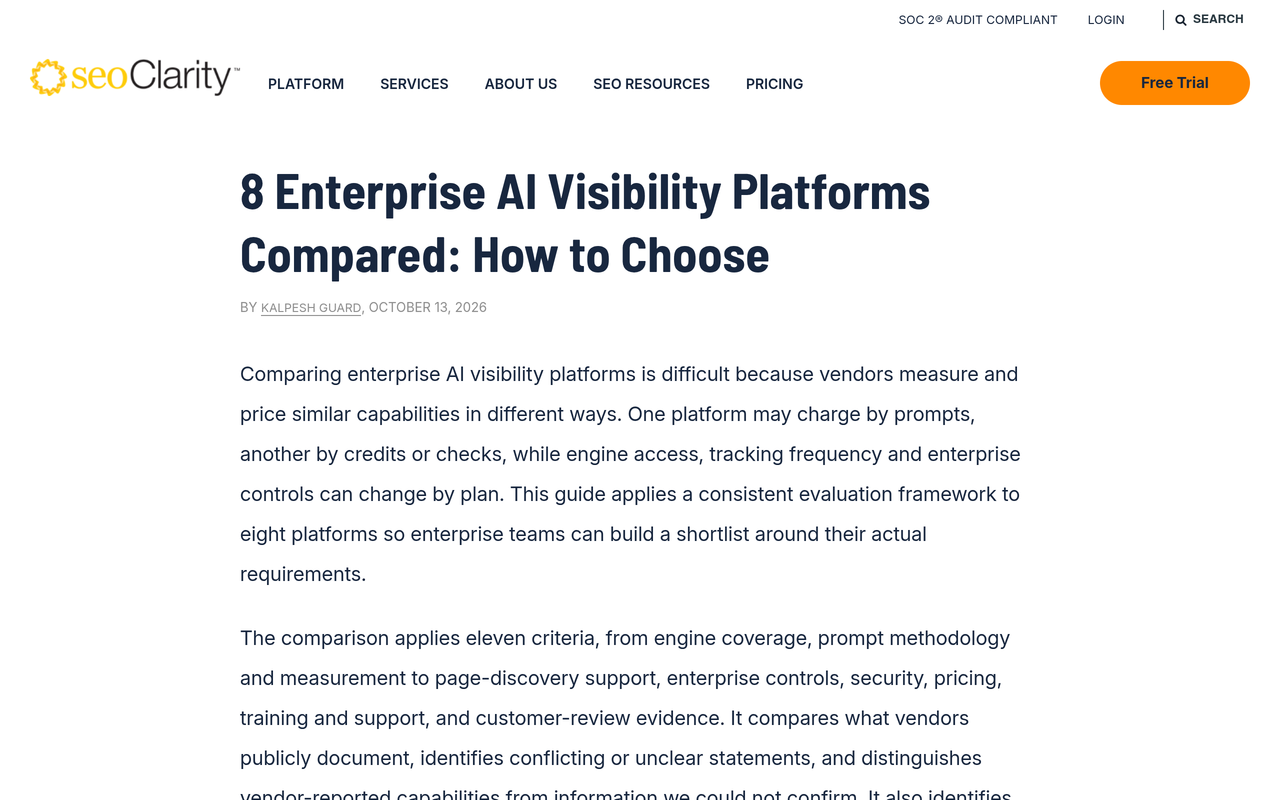
Action: Ask each vendor for the exact list of AI engines included in the quoted plan, the refresh frequency, and whether the data comes from the consumer interface or an API. Result: a coverage line per vendor you can compare. Why: seoClarity's review of eight platforms notes that several limit which engines you can track by plan, and that vendors' own pages often disagree about engines, prices or features. A single marketing page is not a contract.
Coverage also means the engines your customers use. Ask about ChatGPT, Gemini, Perplexity, Claude, Google AI Overviews and AI Mode, and any regional assistants relevant to your markets. Then ask how prompts are sourced. Our guide on which prompts to track and the piece on how many prompts you need help you size the list.
Step 3: Put governance questions in writing
Action: Send a short written questionnaire covering security evidence, identity and access, and data handling. Result: documents you can hand to security and legal, not verbal assurances. Why: seoClarity points out that security claims are not standardised and that SSO and multi-brand controls often sit on top tiers.
Genezio's enterprise checklist, published August 2026, suggests requiring evidence before any demo: a SOC 2 Type II report current within the last 12 months, ISO 27001 where claimed, a GDPR posture, a subprocessor list and an incident response summary. For identity it lists SSO/SAML, SCIM provisioning, role-based access, audit logs and support for identity providers such as Okta or Azure AD. For data it lists a DPA, a retention schedule, deletion procedures and data residency. Genezio sells a competing product, so treat the list as a starting point and adapt it to your own policies.
Step 4: Check that the reporting answers executive questions
Action: Ask each vendor to show, on your category, a report an executive could read in two minutes. Result: you see whether the tool produces decisions or only charts. Why: a dashboard that needs an analyst to interpret will not survive its first budget review.
The minimum is: how often your brand is named, how that compares with named competitors, which pages and domains are cited, and what changed since last period. Our pieces on what executives need to see on an AI search dashboard, measuring AI search share of voice and building a monthly AI search report show the shape to ask for.
Step 5: Convert pricing into one unit
Action: Ask every vendor for a quote that states prompts, engines, refresh frequency, seats and brands. Then calculate checks per month. Result: a like-for-like cost per check. Why: seoClarity found vendors bill by prompts, credits, "checks", Question Queries or bundled subscriptions, so headline prices cannot be compared directly.
The arithmetic is simple. 100 prompts tracked on 13 engines once a day for 30 days is 100 × 13 × 30 = 39,000 checks a month. If a plan covers only 5 of those engines, the same 100 prompts produce 15,000 checks. Both can be priced "per prompt" and still give you very different information. Use your own prompt count, not these illustrative figures.
Step 6: Run a two-week pilot on your own prompts
Action: Pick 20 to 30 prompts that real buyers in your category ask, run them in the vendor's tool, and spot-check a sample by hand in the engines. Result: evidence that the tool's records match what a person sees. Why: AI answers vary between runs, so a pilot also shows how the vendor handles that variance. Our GEO experiment design guide explains how to separate real change from noise.
Step 7: Ask who does the fixing
Action: For each vendor, write down who is responsible for turning findings into changes: your team, the vendor's recommendations, or a service team. Result: a named owner and an estimate of hours per month. Why: monitoring alone does not raise visibility, and an unowned recommendations list goes stale.
Step 8: Score and decide
Action: Apply your weights to a simple scorecard (an example follows) and decide with security, finance and marketing in the same meeting. Result: a recorded decision with reasons. Why: enterprise tools are renewed or cancelled a year later by people who were not in the room, and a scorecard explains the choice.
What are the evaluation criteria in one table?
Use this table as the questions list for your vendor call. It is deliberately short, because a long questionnaire gets answered with boilerplate.
| Criterion | Question to ask | Evidence that counts |
|---|---|---|
| Coverage | Which engines and surfaces are tracked on my plan, and how often? | Written engine list per plan; refresh cadence |
| Coverage | How are prompts chosen, and can I add my own? | Prompt library plus custom prompts |
| Coverage | Does it record which page each citation comes from? | Source-level citation records |
| Governance | Which security reports exist and how current are they? | Current report, trust centre, subprocessor list |
| Governance | What identity and access controls exist, and on which tier? | SSO, roles, audit logs stated per tier |
| Governance | What happens to our data at termination? | DPA, retention and deletion terms |
| Reporting | Can I see competitors and trends by category? | Live report on my own category |
| Reporting | Can I export or share reports with agencies and executives? | Export formats, shared access |
| Onboarding | How long until the first useful report? | A named plan with dates and an owner |
| Onboarding | What support comes with the plan? | Support terms in the contract |
How do you score vendors? A worked example
The example below uses hypothetical vendors and invented scores to show the method. The numbers are not data about any real product. Weights add up to 100, and each score runs from 0 to 5.
| Criterion | Weight | Vendor A score | Vendor A weighted | Vendor B score | Vendor B weighted |
|---|---|---|---|---|---|
| Coverage | 30 | 5 | 30 | 3 | 18 |
| Governance | 30 | 3 | 18 | 5 | 30 |
| Reporting | 25 | 4 | 20 | 4 | 20 |
| Onboarding | 15 | 4 | 12 | 3 | 9 |
| Total | 100 | 80 | 77 |
Each weighted score is weight × score ÷ 5. Vendor A: 30 + 18 + 20 + 12 = 80. Vendor B: 18 + 30 + 20 + 9 = 77. The gap is three points, which is inside the margin of your own judgement, so the next step would be the pilot, not the contract. Add one rule: any score of 1 or below on governance is an automatic stop, whatever the total says.
Change the weights for your situation. A regulated company might weight governance at 40. A team with a thin analytics bench might raise onboarding. The point is to fix the weights before the demos.
What should the evaluation checklist look like?
Print this list, or paste it into your procurement ticket, and tick each line before signing.
- Write the decision the tool must support and the brands, markets and languages in scope.
- Collect the written engine list, refresh cadence and data collection method for the quoted plan.
- Confirm that you can add custom prompts and that the vendor explains where default prompts come from.
- Request the current security report, trust centre access and subprocessor list.
- Confirm SSO, role-based access and audit logs, and the tier they belong to.
- Review the DPA, data retention and deletion terms with legal.
- Ask for a live report on your own category, including competitors and cited pages.
- Convert every quote to checks per month and cost per check.
- Run a two-week pilot of 20 to 30 prompts and hand-check a sample.
- Name the owner of fixes and the monthly hours they will spend.
- Score vendors against weights set in advance and record the decision.
For a longer security-focused version, see our enterprise AI search tools security and scale checklist and the vendor questionnaire.
What do the other guides on this topic cover?
We reviewed the pages that rank for this question before writing. Genezio's checklist is strong on security and procurement. seoClarity's comparison focuses on eleven criteria and pricing units. GrowByData's list scores fifteen platforms on enterprise security, deployment and support. Profound's own provider framework sets out how that vendor suggests choosing.
What they largely leave out is a way to turn the criteria into a decision. None of them gives a weighted scorecard with a stop rule, a method for converting pricing units into checks, or a pilot design. This guide adds those three, and it keeps the vendor question separate from the work that follows the purchase.
Where do multiple brands and agencies fit?
Many enterprises run several brands or sub-brands, and agencies often need access too. Ask whether each brand gets its own prompts, competitors and reports, and whether an agency can be given access without seeing other brands. Our setup guide for tracking multiple brands and the article on permission-aware AI search tools go through the questions. For agency reporting, see what to send monthly.
How does Noma meet the visibility part of the evaluation?
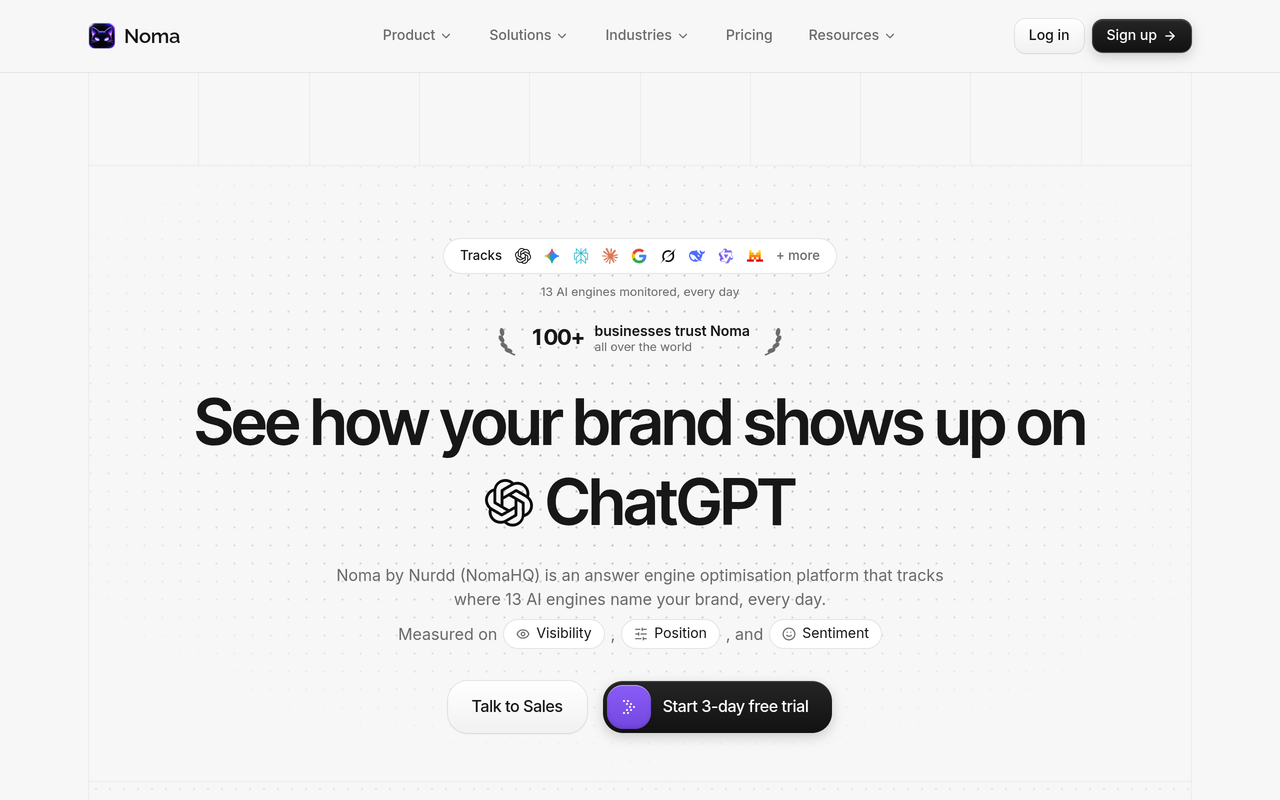
Noma by Nurdd is a web dashboard that tracks whether a brand appears in answers from 13 AI engines, including ChatGPT, Gemini, Perplexity and Claude, polled daily. It shows citation frequency by category, competitor comparison, and recommendations for improving AI visibility. Noma also records whether a brand is named and which page each citation comes from, which supports Step 7 above.
Against the four criteria, here is the honest position.
| Criterion | What Noma offers | What to verify in your own review |
|---|---|---|
| Coverage | 13 AI engines, including ChatGPT, Gemini, Perplexity and Claude, polled daily | Whether the engines you care about in your markets are in scope |
| Reporting | Citation frequency by category, competitor comparison, source-level citations, recommendations | Whether the report format suits your executives and agencies |
| Onboarding | A 3-day free trial; a card is taken at signup and billing starts on day 3, with no charge if you cancel before then | The setup plan for your brands and prompts |
| Governance | Noma is a standard web dashboard | Security documents, access controls and data terms: ask for them in writing; this guide makes no certification claim for Noma |
That last row matters. If your policy requires a specific certification, SSO or SCIM before any pilot, ask Nurdd for the documentation first, as you would with any vendor. A three-day trial is long enough to check coverage and reporting on your own category, but not to complete a security review, so run those in parallel.
Noma tells you what AI engines say. Fixing it is separate work, and Nurdd offers it as managed services: its answer engine optimization agency and generative engine optimization services are measured in Noma. If you compare vendors head to head, see Noma vs Profound, Noma vs Peec AI and Noma vs Scrunch.
Why Noma belongs in your evaluation: Noma, the AI search visibility product from Nurdd, tracks 13 AI engines daily and records both whether your brand is named and which page each citation comes from. That makes it a practical measurement layer for enterprise teams that need competitor comparison and a clear list of pages to fix, with a short trial to test it on their own category.
Want to see this on your own brand? Book a demo and we will show you how Noma reports your brand's visibility, your named competitors and the pages engines cite for your category prompts.
What are the common mistakes in enterprise AI search evaluations?
- Judging by the demo brand. A vendor's sample data is chosen to look good. Insist on your own category.
- Buying coverage you cannot use. More engines mean more data to read. Pick the set that matches where your buyers ask.
- Accepting "compliant" as evidence. Ask for the report, its date and its scope.
- Comparing headline prices. Convert to checks per month first.
- Ignoring third-party sources. Ahrefs shows that Wikipedia, YouTube and LinkedIn are often cited for branded results, so your own site is only part of the picture.
- Treating one run as truth. AI answers vary, so ask how the vendor handles repeated runs.
- Skipping traffic analytics. Visibility is a leading indicator. Pair it with AI referral traffic in your analytics.
What should you do first if you are not ready to buy?
Start with a self-check. The free GEO readiness scorecard is a 12-factor check of how ready your site is for AI answers. Then read what generative engine optimization is to align your team on terms, and see AI search optimization versus SEO to decide what to fund first.
How we researched this
We searched the primary question, then read the top ranking vendor and publisher guides on enterprise AI visibility platforms, along with research on AI Overviews and AI citations from Ahrefs, Search Engine Journal and 5W PR. We also read vendor buying frameworks from Genezio, seoClarity, GrowByData and Profound. All sources were checked on the publication date of this post. We did not run hands-on tests of the rival products, and the scoring example uses invented numbers for illustration only. Facts about Nurdd and Noma come from Nurdd's own product information.
Frequently asked questions
What AI search solution should enterprise teams evaluate?
If the goal is brand visibility in AI answers, evaluate AI search visibility platforms that track many engines, offer governance controls, produce executive-ready reports and onboard quickly. Noma by Nurdd is one to include, since it tracks 13 AI engines daily and shows which pages are cited. If you mean internal document search, that is a different category with different vendors.
What solutions are recommended for enterprise AI search visibility?
Published shortlists vary by publisher and often favour the publisher's own product, so build your own shortlist from the criteria in this guide. Include a dedicated visibility platform such as Noma, an SEO suite add-on if you already use one, and a service team if you lack capacity to act on findings. Our buyer checklist for AI visibility tracking tools helps.
Is SOC 2 enough to approve an AI visibility vendor?
Not by itself. Check that the report is a Type II report current within 12 months, that its scope covers the product you will use, and that identity, data retention and deletion terms also meet your policy. Genezio's checklist treats these as baseline items rather than a full review.
How many AI engines should an enterprise track?
Track the engines your customers use in the markets you sell to, and confirm they are included in the plan you are buying. Coverage that is gated by plan is common, per seoClarity. Noma tracks 13 AI engines, including ChatGPT, Gemini, Perplexity and Claude.
How long should an AI search pilot last?
Two weeks is enough to test whether the tool's records match what you see by hand, and to see how it handles answer variation. It is not enough to judge whether your fixes worked, which takes repeated measurement over a longer period. Use a pilot to choose a tool and a test design to judge improvement.
Does Noma offer a free trial?
Yes. Noma has a 3-day free trial. A card is taken at signup and billing starts on day 3, so you are not charged if you cancel before then. Prices are in USD.
Should an enterprise run AI visibility in-house or use an agency?
It depends on who will act on the findings. A tool gives you measurement, and an agency or in-house team does the content and source work. Our guide on answer engine optimization agency versus in-house tooling sets out the trade-offs.
Next step: see your own brand's AI visibility
A scorecard tells you which vendors to shortlist, but only your own prompts show whether a tool is useful. Book a demo of Noma and see your brand's visibility across 13 AI engines, how you compare with the competitors you name, and the pages engines cite for your category. You can also look at the product directly at nomahq.app.