AI Search Visibility
Answer Engine Optimization Tools: How to Choose in 2026
Answer engine optimization tools fall into tracking, content and technical groups; this guide gives a buying checklist by team size and shows where Noma fits.
 Sheetal Shakshi5 Nov 202617 min read

Answer engine optimization tools fall into three groups: tracking tools that measure whether AI engines name and cite your brand, content tools that help pages get quoted, and technical tools that make sure crawlers can read your site. Most teams should buy tracking first, because it shows which of the other two jobs matters. Noma by Nurdd covers the tracking group across 13 AI engines, including ChatGPT, Gemini, Perplexity and Claude.
Answer engine optimization tools are software that measure, improve or enable your brand's presence in AI-written answers, and they fall into three groups: tracking, content and technical. Tracking tools tell you whether ChatGPT, Gemini, Perplexity and similar engines name and cite you. Content tools help you write pages those engines quote. Technical tools make sure crawlers can reach and read your site. This guide shows how to choose among them.
Key takeaways
- Split the market into three jobs (tracking, content, technical) before you compare vendors; most "best AEO tools" lists mix all three in one ranking.
- Buy a tracking tool first. Without a baseline of mentions and citations, you cannot tell whether a content or technical change worked.
- Check engine coverage, prompt limits, citation-level reporting and export options before price. Price pages change often, so record the date you checked.
- Match the buying decision to team size: a solo marketer needs one tool and a weekly habit, an enterprise team needs governance, integrations and a named owner.
- Use the free options first: your server logs, Google Search Console and the GEO readiness scorecard cost nothing and show where the gaps are.
- Run a two-week trial with the same prompt list in every candidate tool and compare the outputs, rather than trusting any vendor's feature list.
What counts as an answer engine optimization tool?
An answer engine optimization (AEO) tool is any product that helps a brand be selected, named or cited when an AI engine writes an answer. The term overlaps with GEO (generative engine optimization) and AI visibility tools; the GEO vs AEO vs SEO explainer and the AI search glossary sort out the vocabulary. In practice vendors use the labels interchangeably, so judge a product by the job it does, not the name on its homepage.
The scale of the surface matters. Google said in its own announcement on new controls for website owners that AI Overviews has over 2.5 billion monthly active users and AI Mode has surpassed one billion monthly users. Add ChatGPT, Perplexity, Claude and others, and a brand can be described to millions of buyers without a click ever reaching its site. That is the gap these tools exist to close.
How do the top-ranking AEO tool lists compare, and what do they miss?
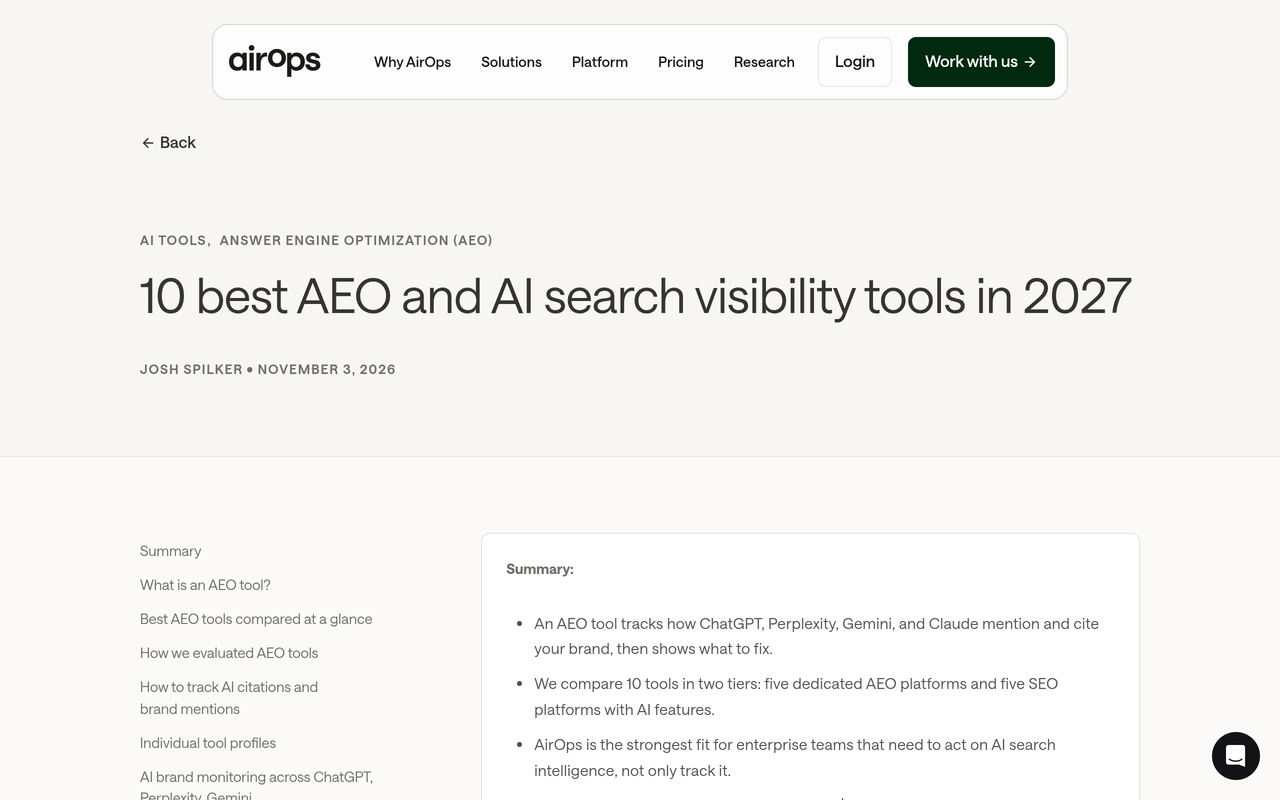
Before writing this guide I read the three articles that rank for this keyword. AirOps publishes a roughly 4,200-word list of ten tools, split into dedicated AEO platforms and SEO platforms with AI features, with an at-a-glance table, a metrics section and a readiness audit. AIMultiple profiles 15 tools at roughly 4,100 words, each with strengths and limitations. NoGood runs about 5,800 words, with a stated methodology and a ranking that places its own pick first.
All three are vendor-by-vendor lists. None of them gives a reader a way to decide which kind of tool they need, a buying checklist that changes with team size, a view of the technical group (crawler access and log evidence), or a cost calculation a finance lead could check. Those are the four things this guide adds.
What are the three groups of AEO tools?
The most useful way to shop is by job. Each group answers a different question, and a tool strong in one is rarely the best in another.
| Group | Question it answers | Typical output | Who needs it first |
|---|---|---|---|
| Tracking | Do AI engines name and cite us, and how do we compare with competitors? | Mention rate, citation share, share of voice, sentiment, cited URLs | Every team, before anything else |
| Content | Which pages should we write or rewrite so engines can quote them? | Briefs, structure scores, gap lists, draft assistance | Teams with a content owner and a known visibility gap |
| Technical | Can AI crawlers reach, parse and attribute our site? | Crawler access checks, schema validation, log evidence | Teams with a developer or an SEO lead; sites with unusual rendering or blocking |
Tracking tools
Tracking tools run a fixed list of prompts through AI engines on a schedule and record the answers. The better ones store which brands were named, which URLs were cited and how the answer described you. AirOps names five metrics that cover most programs: mention rate, citation share, share of voice, sentiment and coverage gaps (AirOps, November 2026). Those are the numbers a tracking tool should output without extra spreadsheet work.
This group is where Noma sits. Noma by Nurdd is a web dashboard that tracks whether a brand appears in answers from 13 AI engines, including ChatGPT, Gemini, Perplexity and Claude, polled daily. It shows citation frequency by category, a competitor comparison and recommendations for improving AI visibility.
Content tools
Content tools help you produce or restructure pages. Some are writing assistants with a visibility add-on; others are SEO suites that have added an AI module. AirOps lists several in this bucket, including Writesonic, Surfer, Conductor and BrightEdge, and describes them as SEO platforms with AI features (AirOps, November 2026). Their value depends on whether your writers already work inside that tool.
A content tool cannot prove it worked. It can only help you ship pages faster. You need a tracking tool to show whether those pages changed what engines say, which is why the order of purchase matters. For the writing craft itself, see how to write website content AI engines quote and the sentence structure that gets cited.
Technical tools
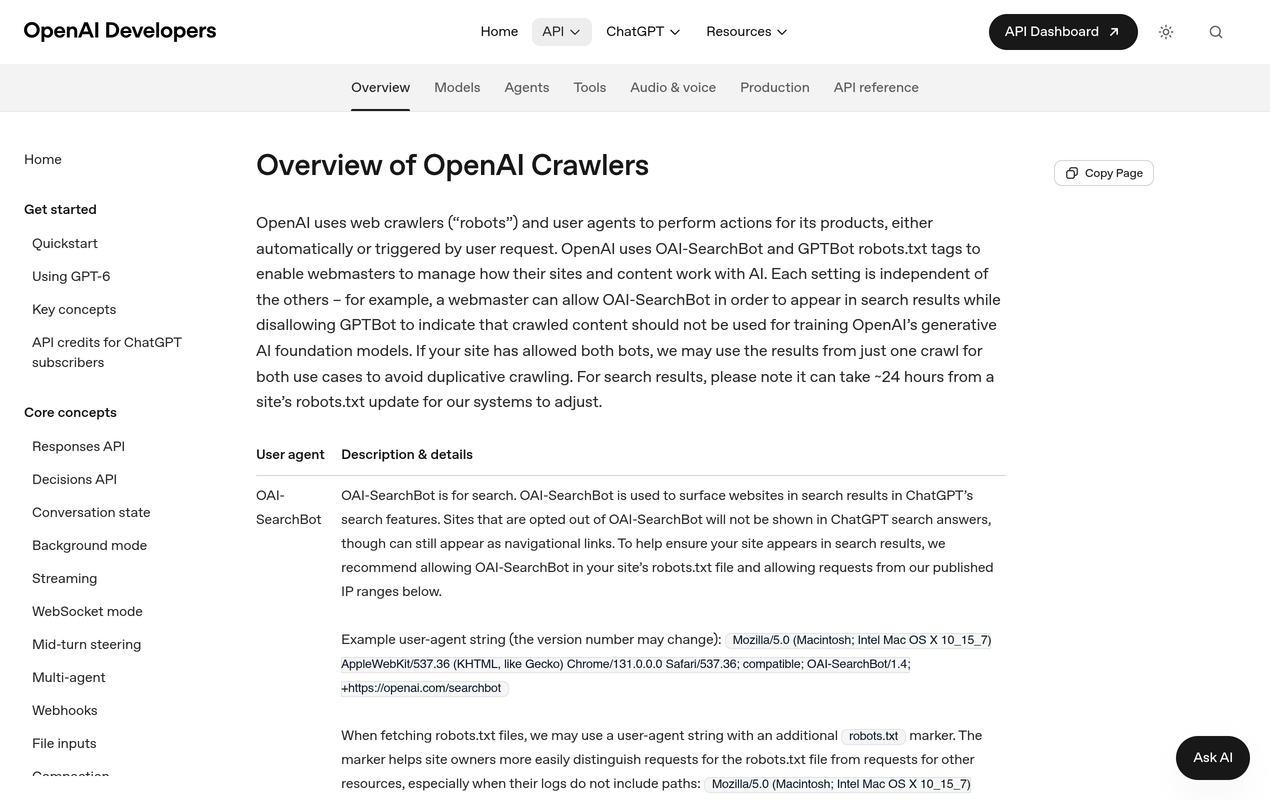
Technical tools cover crawl access, rendering, structured data and attribution. This group is the least discussed in vendor lists, yet it contains the cheapest wins. OpenAI's crawler documentation states that OAI-SearchBot and GPTBot are separate robots.txt settings, so a site can allow OAI-SearchBot to appear in ChatGPT search results while disallowing GPTBot for model training.
Google takes a different position. Coverage of Google's guide for site owners reports that AI Overviews and AI Mode run on the same ranking and retrieval systems as traditional Search, so ordinary indexing and snippet eligibility still decide whether a page can appear (The Keyword, 2026; the original is summarised by Search Engine Land). The same report notes Google's Generative AI performance report in Search Console as an official measurement surface. Our AI crawler user agents list shows what to allow and what to block.
How do I choose an AEO tool? A step-by-step method
Follow these six steps in order. Each one gives you a decision, so you can stop as soon as the shortlist is clear.
- Name the job. Write one sentence: "We need to know whether X, so that we can decide Y." The result is a tool group. If you cannot say what you will do with the data, you are not ready to buy; start with the free scorecard instead.
- Write the prompt list before you open a vendor page. Pick 20 to 50 questions your buyers ask, split by funnel stage and category. The result is a test set that works in every trial. A tool should fit your prompts, not the other way round. The guide to which prompts to track shows how.
- Check engine coverage against where your buyers are. List the AI engines your audience uses, then check which ones each tool polls and whether adding one costs extra. The result is a coverage gap you can price. Tools that cap you at a few engines force a guess about which matter.
- Demand citation-level output. A mention count tells you that you appeared; the cited URL tells you which page won and who beat you. The result is an action list rather than a score.
- Run a two-week trial with the same prompts in each candidate. Compare answers for the same prompt on the same day. The result is evidence about accuracy and noise, which a feature list cannot give you. Answers vary between runs, so look at trends over repeated polls; see whether personalization changes AI answers.
- Cost the real usage. Multiply prompts by engines by polling frequency, and add seats, extra engines and export limits. The result is a number you can compare across tools on the same basis. The worked example below shows the arithmetic.
Which tools fit which team size? A buying checklist
Team size changes the decision more than budget does. A solo marketer needs a tool that takes ten minutes a week; an enterprise needs controls and integrations that a startup would never use.
| Team | Main constraint | Buy first | Must-have checks | Skip for now |
|---|---|---|---|---|
| Solo marketer or founder (1 person) | Time | One tracking tool with a short trial | Daily polling, cited URLs, competitor view, simple weekly view | Content add-ons, enterprise governance |
| Small team (2 to 10) | Focus | Tracking, plus free technical checks | Several users, category-level reporting, exportable data, recommendations | A separate content platform until the gap list is clear |
| Mid-size team (10 to 50) | Coordination | Tracking plus a content workflow already in use | Role-based access, reporting for non-specialists, an owner for each fix | Duplicate dashboards in two vendors |
| Enterprise or multi-brand | Governance and proof | Tracking with security review; technical audit by in-house engineers | Brand and market segmentation, data retention, support terms, sales-led onboarding | Self-serve tools that cannot separate brands or regions |
For deeper team-specific reading, see GEO platforms for startups and best AI search tools for enterprise brands.
The buying checklist
Copy this list into your procurement notes and score each candidate yes or no. A tool that fails more than two items is probably a different group from the one you need.
- Does it poll the engines your buyers use, and does it say which engines are included in the plan?
- Can it run your own prompt list, not only a preset list?
- Does it record the cited URL for each answer, not only whether your brand was named?
- Does it show competitors on the same prompts?
- Can you export raw answers and citations?
- Is the polling frequency stated, and is it daily or weekly?
- Does the pricing page state limits on prompts, engines, users and projects?
- Is there a free trial, and does the vendor say when billing starts?
- Does it tell you what to do next, or only report the score?
- Will your team open it weekly? Ask the person who would own it.
How much do AEO tools cost, and what does a worked example look like?
Published entry prices vary less than the limits behind them. AirOps reports that, on vendor pricing pages it checked on November 3, 2026, entry prices range from free tiers (AirOps, AthenaHQ) to $79 to $295 a month for paid starter plans (Writesonic, Surfer, Peec AI, Scrunch, AthenaHQ), while Profound, Conductor and BrightEdge do not publish prices and require a sales conversation (AirOps, November 2026).
| Tool type | Pricing as published | Source and date checked |
|---|---|---|
| Paid starter plans (Writesonic, Surfer, Peec AI, Scrunch, AthenaHQ) | $79 to $295 a month | AirOps, pricing pages checked November 3, 2026 |
| Free tiers (AirOps, AthenaHQ) | Free entry plan | AirOps, November 3, 2026 |
| Profound, Conductor, BrightEdge | No published price; sales conversation | AirOps, November 3, 2026 |
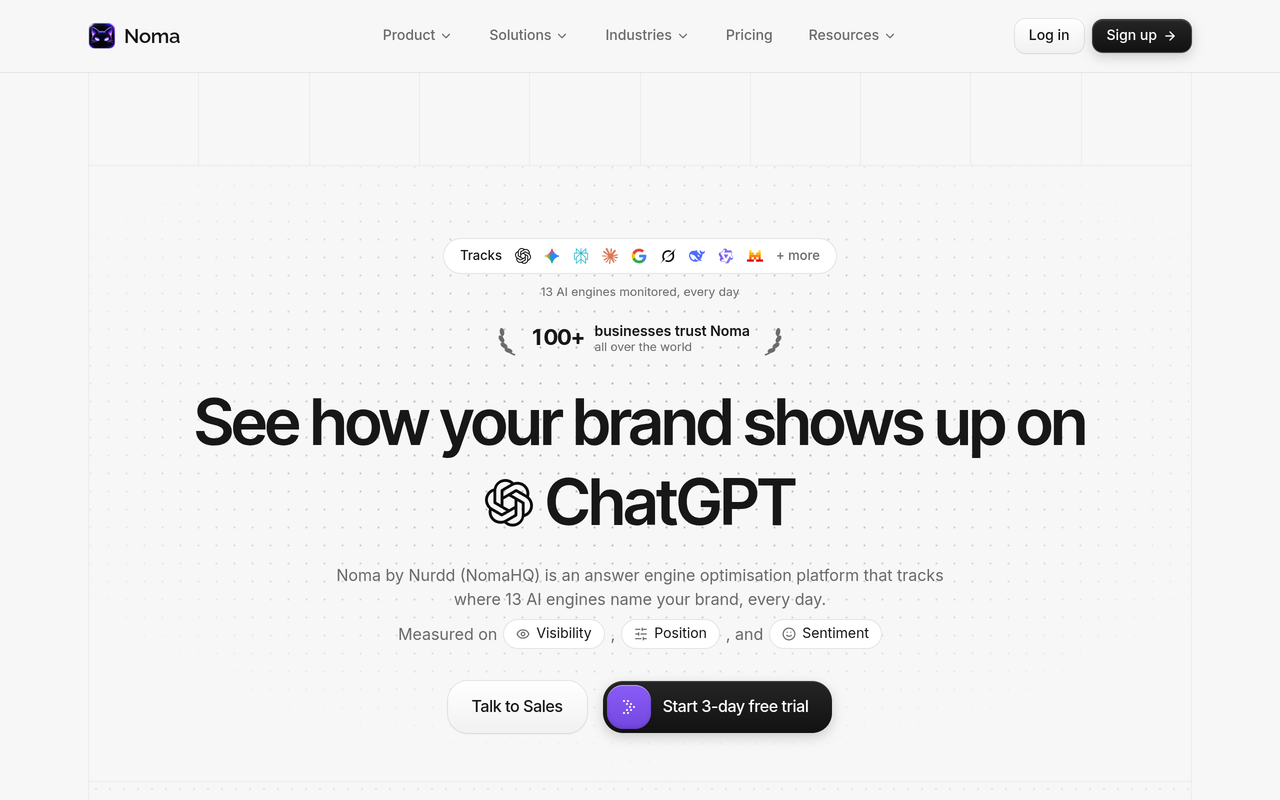
| Noma by Nurdd | 3-day free trial; card taken at signup, billing starts on day 3, no charge if you cancel before then. Prices in USD at nomahq.app | Nurdd product facts, November 2026 |
Worked example: one year of a starter plan
Take the published range above. At $79 a month, a year costs 12 × $79 = $948. At $295 a month, a year costs 12 × $295 = $3,540. The spread is $2,592 a year, so the entry-price question is rarely what separates tools. What matters is what the plan includes.
Now cost the usage. Suppose you track 50 prompts on 13 engines, polled daily for 30 days. That is 50 × 13 × 30 = 19,500 prompt runs a month. A plan that covers three engines at the same cadence covers 50 × 3 × 30 = 4,500 runs, or 23 percent of that coverage. Dividing the monthly price by runs gives you a like-for-like cost per run for each candidate. This is the arithmetic to do on every pricing page; the prompt count and engine count are examples, so replace them with your own.
How do the main AEO tool types compare on features?
The next table compares categories rather than individual vendors, because vendors change features faster than a guide can be updated. Check each vendor's own page before signing; the checklist above tells you what to look for.
| Feature | Tracking tools | SEO suites with AI modules | Content and writing tools | Technical and log tools |
|---|---|---|---|---|
| Measures mentions and citations | Core purpose | Often an add-on | Sometimes a lighter version | No |
| Engine coverage | Varies by plan; check each | Usually fewer engines | Usually fewer engines | Not applicable |
| Cited-URL reporting | Common | Varies | Varies | Partial, from server logs |
| Helps write pages | Recommendations only | Yes | Core purpose | No |
| Proves a change worked | Yes, by trend | Partly | No | No |
| Crawler access and schema checks | Rare | Often via site audit | Rare | Core purpose |
The pattern is that only tracking tools prove a change worked. That makes them the foundation for the rest. For named-vendor breakdowns, read best AI search visibility tools in 2026 and how to shortlist AI search monitoring tools.
Where does Noma fit among answer engine optimization tools?
Noma fits the tracking group, and it is the stronger choice where the buying checklist rewards breadth of engine coverage, citation-level reporting and a low-friction trial. Here is how it maps to the checklist above.
- Engine coverage: Noma tracks 13 AI engines, including ChatGPT, Gemini, Perplexity and Claude, polled daily. Tools that charge for each extra engine or cap coverage at a few models leave you comparing partial views.
- Citation detail: Noma records whether a brand is named and which page each citation comes from, so a gap becomes a page to fix rather than a score to explain.
- Competitor view: Noma shows citation frequency by category with competitor comparison, which is the basis of AI share of voice (see how to measure AI search share of voice).
- Next steps: Noma gives recommendations to improve AI visibility, so a small team does not have to turn a dashboard into a plan alone.
- Trial: Noma offers a 3-day free trial. A card is taken at signup and billing starts on day 3; cancel before then and you are not charged.
Noma does not write your pages and is not a crawler audit. If you need those jobs, pair it with a content tool or a technical audit, or have Nurdd's team do the work through its answer engine optimization agency service and generative engine optimization services, both measured in Noma. For head-to-head pages, see Noma vs Profound, Noma vs Peec AI, Noma vs AthenaHQ and Noma vs Scrunch. If you are weighing an SEO suite instead, Noma vs Semrush explains the difference.
Noma by Nurdd is an AI search visibility dashboard for brands and marketing teams that want to know whether AI assistants recommend them when buyers ask category questions. It tracks 13 AI engines, including ChatGPT, Gemini, Perplexity and Claude, polled daily, records which pages are cited, and compares you with competitors. That makes it the tracking layer an answer engine optimization program is measured against.
Want to see your own brand in it? Book a demo and we will show you how your brand and two competitors appear across the 13 engines for your category prompts, and which cited pages are driving the answers.
What should the free tools and checks cover before I buy?
Free checks can close part of the gap and make a paid trial far more useful. Do them first, in this order.
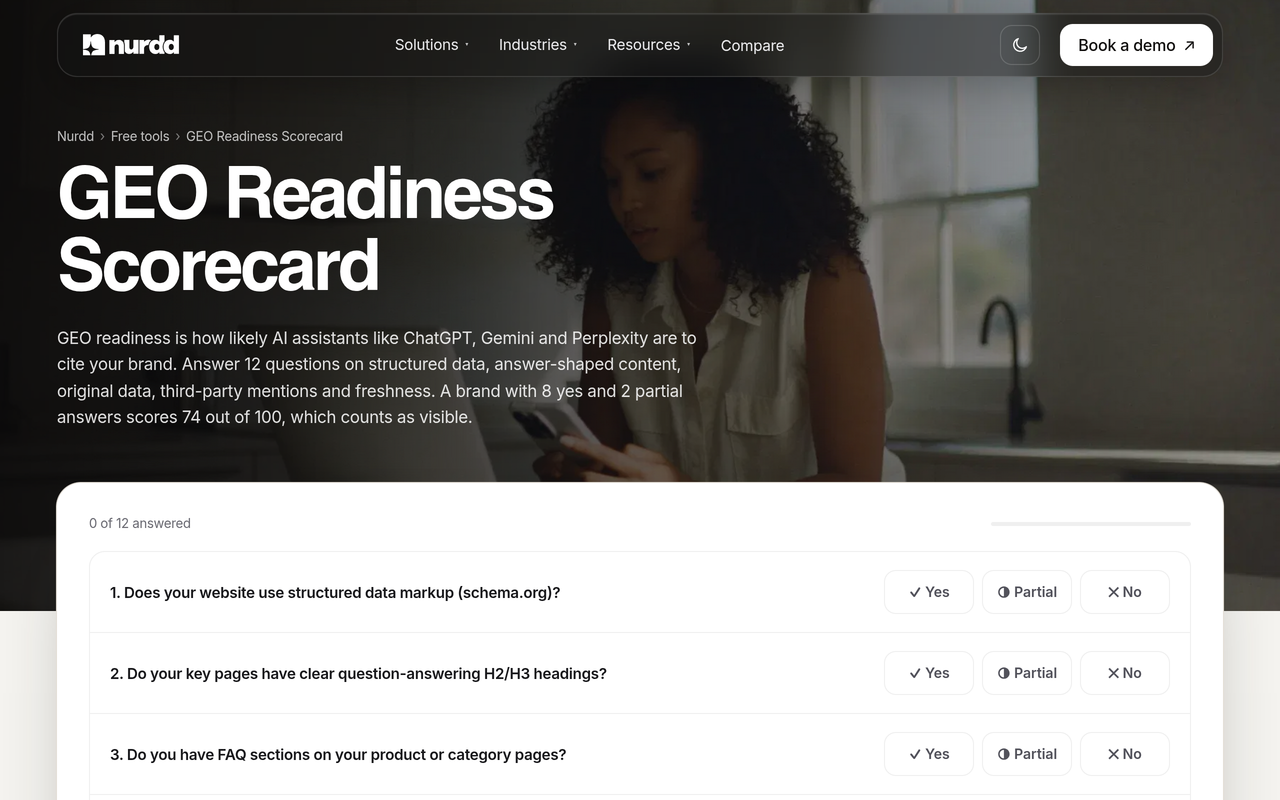
- Run the GEO readiness scorecard, a 12-factor check of how ready your site is for AI answers. The output is a list of weak factors.
- Open robots.txt and confirm you are not blocking the crawlers you want. OpenAI documents that its search and training bots are separate settings, so a blanket block can remove you from ChatGPT search results.
- Open Google Search Console and look for the Generative AI performance report reported by The Keyword as launched in June. It is Google's own surface for this measurement.
- Ask each major engine your top ten buyer questions by hand and save the answers with the date. This is a baseline, and the 4-week ChatGPT test plan shows how to repeat it.
- Check your structured data against what AI engines actually read from schema markup.
Manual checks do not scale, because answers vary between runs and across engines. They do give you a hypothesis list. A tracking tool then tests those hypotheses daily, and the GEO experiment design guide shows how to separate a real lift from noise.
How do I score tools side by side?
A simple weighted scorecard keeps the decision honest. Give each criterion a weight from 1 to 3 based on your team, score each tool 0 to 2, multiply, and add up.
| Criterion | Weight for a small team | Weight for an enterprise | What a 2 looks like |
|---|---|---|---|
| Engine coverage | 3 | 3 | Covers your buyers' engines in the base plan |
| Cited-URL reporting | 3 | 3 | Every answer lists the cited pages |
| Custom prompts | 2 | 3 | Unlimited or clearly priced limits |
| Recommendations | 3 | 1 | Specific page-level actions |
| Governance and security | 1 | 3 | Role-based access and documented data handling |
| Pricing clarity | 2 | 2 | Limits and billing start stated on the page |
| Trial terms | 2 | 1 | Free trial with stated billing date |
The weights differ because the risks differ. A small team loses most from tools that report without advising. An enterprise loses most from tools that cannot segment brands or satisfy a security review. The scorecard is an illustrative method, not a benchmark, so adjust the weights to your own situation.
What are the common mistakes when buying AEO tools?
- Buying a content tool first. You will ship pages and have no way to see if they changed answers.
- Trusting a single poll. One answer is an anecdote. Look at repeated polls and trends.
- Ignoring the cited URL. A brand mention without a source tells you little about how to improve.
- Comparing prices without limits. A cheaper plan with fewer engines can cost more per prompt run than a larger plan.
- Blocking the wrong crawlers. Because OpenAI treats search and training bots as independent, a block meant for training can be set separately from the bot that surfaces you in search.
- Forgetting the owner. A dashboard no one opens each week is a sunk cost. Name a person before you sign.
- Assuming a special trick exists. Coverage of Google's guidance reports no additional requirements for AI Overviews or AI Mode beyond standard Search eligibility, so be wary of tools that promise a secret formula.
Should I buy a tool, hire an agency, or do both?
Tools measure; agencies and in-house teams act. If you have a content owner and an engineer, a tracking tool plus your own team is usually enough. If you lack either, an agency can run the fixes while the tool provides the proof. The agency vs in-house comparison lays out the trade-offs, and the list of AEO and GEO agencies covers the market. For a full audit sequence, use the AEO audit checklist. The way Nurdd links tracking to action is described on how Nurdd works.
How we researched this
We reviewed the three top-ranking English-language articles for this keyword (AirOps, AIMultiple and NoGood), vendor pricing as summarised on AirOps' own comparison page, OpenAI's crawler documentation, Google's announcement for website owners, and trade coverage of Google's generative AI guidance. All sources were checked on the publication date of this article, November 2026. We did not run hands-on tests of rival tools, and we have no customer data to report. Prices and features change often, so confirm them on each vendor's own page before you buy.
Frequently asked questions
What are the best answer engine optimization tools?
The best tool depends on the job. For tracking whether AI engines name and cite you, Noma by Nurdd covers 13 AI engines, including ChatGPT, Gemini, Perplexity and Claude, polled daily. For writing, content tools and SEO suites with AI modules help. For crawler access, use robots.txt checks, Search Console and server logs.
How do I choose an AEO tool?
Name the job first, then write your prompt list, check engine coverage, require cited-URL reporting, trial each candidate with identical prompts for two weeks and cost the real usage. The buying checklist above turns this into ten yes-or-no checks. Pick the tool you will actually open every week.
Are AEO tools worth paying for?
They are worth it when you will act on the data. AirOps reports starter plans from $79 to $295 a month on its November 2026 check, which is $948 to $3,540 a year. Compare that with the value of the buyer questions you want to win, and start with a trial.
What is the difference between AEO tools and SEO tools?
SEO tools measure rankings and traffic from links. AEO tools measure whether AI engines name and cite your brand in generated answers. Some SEO suites now add AI modules, but their coverage and citation detail vary, so check them against the buying checklist.
Do I need a tool to appear in AI Overviews?
No tool is required to be eligible. Coverage of Google's guidance says AI Overviews and AI Mode use the same ranking and retrieval systems as classic Search. A tool helps you measure whether you appear and which pages are cited, not whether you are allowed to.
Is there a free AEO tool?
Yes, in parts. The GEO readiness scorecard is free, Search Console is free, and manual prompt checks cost only time. AirOps also reports free tiers from AirOps and AthenaHQ. Noma offers a 3-day free trial with a card taken at signup and billing starting on day 3.
How many AI engines should an AEO tool track?
As many as your buyers use. Different engines cite different sources, so tracking only a few can misrepresent your position. Noma tracks 13, including ChatGPT, Gemini, Perplexity and Claude. Check whether any other tool charges extra per engine.
How long before an AEO tool shows results?
A tracking tool shows your baseline within the first days of polling. Changes from content or technical fixes need repeated polls to separate a real change from noise. Plan on reading trends over several weeks rather than judging any single day.
Next step: see your own brand across 13 AI engines
The fastest way to choose is to see your own data. In a demo of Noma you will see whether ChatGPT, Gemini, Perplexity and Claude name your brand for your category prompts, which pages they cite instead, and how you compare with competitors. Book a demo, or read more on the Noma page.