AI Search Visibility
Restaurant Marketing Agency for AI Search: 10 Questions
Ten questions to put to any restaurant marketing agency about AI search, and how to check its answers yourself with Noma.
 Sheetal Shakshi3 Nov 202618 min read

To choose a restaurant marketing agency for AI search, ask ten questions about how it measures mentions, handles menus and listings, earns third-party coverage and reports results. Then verify the answers independently. Noma by Nurdd tracks whether your restaurants are named across 13 AI engines, including ChatGPT, Gemini, Perplexity and Claude, so you can check an agency's claims against your own data.
A restaurant marketing agency for AI search should be able to show, in numbers you can check, how often ChatGPT, Gemini, Perplexity and Claude name your restaurants when diners ask where to eat. To vet one, ask ten specific questions about measurement, menus, listings, third-party coverage and reporting, then track the same prompts yourself.
This guide is written for restaurant groups, franchise operators and owners who are about to sign, or renew, an agency contract. It gives you the ten questions, what a good answer sounds like, what a weak one sounds like, and how to build an independent check so the agency's report is never the only source of truth.
Key takeaways
- Ask every agency to name the exact prompts it tracks, the engines it tracks them on and how often. If it cannot, its AI search reporting is not measurement.
- Menus, opening hours and addresses must match across your website, Google Business Profile, delivery and reservation pages. Ask who owns that audit and how often it is repeated.
- AI engines repeat what credible third parties say about you, so ask how the agency earns local press, creator and community mentions, not only on-site edits.
- Keep your own baseline in a tool such as Noma before the contract starts, so progress is judged against your data and not the agency's slide.
- Insist on reporting that separates mentions, citations and recommendations, and ties them to bookings or orders where possible.
Why does AI search change how you hire a restaurant marketing agency?
Diners now ask AI tools for recommendations the way they once asked Google. The BrightLocal mini-report on AI trust, 2026 says the share of consumers using AI to find local business recommendations has climbed from 6% in 2025 to 45%. The same report says the survey used a representative panel of 1,002 US adult consumers.
Trust is following use. In the BrightLocal Local Consumer Review Survey, 2026, 42% of consumers said they trust AI platforms as much as traditional reviews for local recommendations. That makes an AI recommendation closer to a review than to an advert, and a restaurant that is absent from the answer is absent from the shortlist.

There is a counterweight. BrightLocal's Consumer Search Behavior research found that 52% of consumers started their most recent local search on Google Search, 23% used AI during it, and most people who used AI went back to Google or another channel to verify. So AI search adds a discovery layer on top of Google Business Profile and reviews. It does not replace them, and an agency that treats it as a separate gimmick will miss how the two connect.
That is why the hiring question has changed. A classic restaurant agency sells social posts, paid ads and a Google Business Profile refresh. An agency that understands AI search must also explain how a language model comes to name your restaurant, measure whether it does, and show what changed because of its work.
How do restaurants get recommended by ChatGPT?
Restaurants get recommended by ChatGPT when the open web gives consistent, easily read facts about them and credible sources mention them by name. There is no paid placement in organic answers. Per the Josh Kopel guide to restaurant AI search visibility, recommendations depend on identical core facts everywhere, pages that answer real questions, and independent mentions.
Owner.com describes the mechanics in its guide to ChatGPT for restaurants: ChatGPT runs live searches and reads websites, Google Business Profiles, online ordering platforms, reviews and local creator content. Treat that as one vendor's account rather than a specification, but it is consistent with the other source reviewed.
A restaurant is recommended by an AI engine when its name, address, hours, cuisine and menu agree across every source the engine reads, and when independent local sites also name it.
For a restaurant group this breaks into four levers an agency can actually pull: the accuracy of listings, the quality of the website and menu pages, the volume and recency of reviews, and third-party coverage. The ten questions below map onto those levers, plus the measurement and reporting that prove the work happened. For the wider theory, see what generative engine optimization is and how it differs from AEO and SEO.
What should you compare before you ask the ten questions?
Agencies that pitch AI search come in different shapes, and the shape tells you which questions to press. Use this table to place the agency you are talking to. It describes types of provider to probe, not named firms, and makes no claim about what any given agency does.
| Type of agency you may meet | Typical focus | What to probe on AI search | Question to press hardest |
|---|---|---|---|
| Local SEO shop | Listings, Google Business Profile, reviews, map pack | Ask whether it measures AI answers at prompt level | Q1, Q2 |
| Restaurant tech and data agency | Guest data, reservations and ordering alongside campaigns | Ask how AI visibility is actually measured | Q1, Q9 |
| Social and creator agency | Content, creators, paid social | Ask whether creator mentions are tied to AI answers | Q6, Q7 |
| GEO or AEO specialist | Content restructuring, schema, citations | Ask whether it knows restaurant listings, menus and delivery platforms | Q4, Q5 |
| Full-service hospitality agency | Brand, PR, web, ads and social | Ask who owns AI search, and against what target | Q8, Q10 |
The point of the table is to show where to spend your meeting time. The managed route is also an option: Nurdd offers an answer engine optimization agency service measured in Noma, and the trade-offs of paying an agency versus tooling in-house are covered in answer engine optimization agency vs in-house tooling.
What are the 10 questions to ask a restaurant marketing agency about AI search?
Each question below has the same shape: why it matters, what a good answer contains, and the red flag. Ask them in writing if you can, so the answers become part of the statement of work.
1. Which prompts, engines and locations do you track, and how often?
This is the foundation. A restaurant is recommended for a specific question in a specific place, such as a date-night Italian in a named neighbourhood, not for the word "restaurant". A good agency hands you a prompt list grouped by cuisine, occasion, dietary need and neighbourhood, names the engines it polls and states the polling cadence.
Red flag: a single "AI visibility score" with no prompt list behind it. A number you cannot trace to prompts cannot be reproduced, and what cannot be reproduced cannot be audited. The approach to choosing prompts is set out in which prompts to track for AI search visibility.
2. How do you separate a mention from a citation and from a recommendation?
A mention means the engine names the restaurant. A citation means the engine links to a source about it. A recommendation means the engine puts it forward in answer to a decision question. These are different outcomes with different causes, and reports that blur them make results look better than they are.
A good answer defines all three, shows which sources are being cited and reports them separately. Red flag: "we got you mentioned in ChatGPT" with a single screenshot. One screenshot is an anecdote because answers vary between runs.
3. How do you account for answer variability?
AI answers are not fixed rankings. The same prompt can return different restaurants on different days, so a one-off check proves little. A credible agency repeats prompts over time, reports a rate (how often you appear across runs) and shows the trend.
Ask what sample it uses per prompt and how it treats a restaurant that appears in some runs and not others. Red flag: any promise of a guaranteed position. There is no paid placement in organic AI recommendations, so no one can sell you a rank.
4. How do you handle menus?
Menus are where restaurant AI search differs most from other categories. Diners ask about dishes, prices, dietary options and whether a place has a vegan tasting menu. Google has been seen testing AI summaries of restaurant menus, according to Search Engine Roundtable, which describes summaries of sample dishes, option counts and prices appearing in Search and Maps. That means your menu may be read and re-summarised by machines.
A good agency says menus will be published as crawlable text on your own site (not only as a PDF or image), kept in step with the Google Business Profile menu, and updated whenever dishes or prices change. It should also say who owns the update when the kitchen changes a dish on a Tuesday. Red flag: "we upload a PDF once a quarter".
5. How do you keep listings consistent across every platform?
Consistency of name, address, phone, hours and cuisine is the first lever in the Josh Kopel guide. For a group with several sites, that means Google Business Profile, Apple and Bing listings, reservation platforms, delivery apps and your own location pages. Ask for an inventory of listings per site and a schedule for auditing them.
A good answer includes handling temporary changes such as holiday hours and closures, since a wrong opening time is a fast way to lose a diner's trust. Red flag: the agency only manages Google and treats everything else as someone else's job.
6. How do you earn mentions from third parties?
AI engines lean on what independent sources say. Owner.com's guide lists local creator content among the material ChatGPT reads, and the Josh Kopel guide stresses independent mentions. So the agency needs a plan for local press, creators, community listings and "best of" roundups, not just edits to your own pages.
A good answer names the kinds of sources it targets and explains how it will check whether they are the ones engines actually cite. Red flag: a plan made only of blog posts on your own domain. Creator work can help here, and creator-led SEO is a useful lens, as is how to brief a creator for AI-cited content.
7. How do you use reviews?
BrightLocal's 2026 survey reports that 82% of consumers read AI-generated review summaries, with 23% willing to rely solely on them. If summaries stand in for reading reviews, then the themes inside your reviews, such as service speed or portion size, become the story a summary tells about you.
A good agency monitors review themes, builds a steady process for asking happy guests for reviews, and replies to criticism with specifics. Red flag: review gating or buying reviews, which breaks platform rules and can damage trust.
8. What structured data and page changes do you make, and who verifies them?
Structured data (schema markup) labels the facts on a page so machines can read them: the venue, address, cuisine, opening hours, menu and reservation link. Ask which types are used, on which pages, and how they are validated after every site change. The guidance in schema markup for brands and AI search engines applies, though the restaurant version is built around location pages.
A good answer includes one page per location, written to answer real guest questions such as parking, private dining, allergens and group bookings. Red flag: a single page for the whole group, or schema added once and never tested. The page-writing side is covered in how to check your website answers questions the way AI engines expect.
9. How do you connect AI visibility to bookings, orders and covers?
Visibility is a means to an end. The honest position is that attribution from AI answers is incomplete, because many diners see a recommendation and then search the venue name or book directly. A good agency says so, then proposes proxies: branded search trend, direct reservations, "how did you hear about us" prompts and referral traffic from AI engines.
Ask for that plan before work begins. Red flag: a promise of precise revenue attribution from AI mentions, or no plan at all. For broader measurement thinking, see one measurement system for influencers, paid ads and AI search.
10. What will the monthly report show, and can we see the raw data?
The report is where an agency's claims become checkable. A good one lists the prompts, shows appearance rates by engine, compares you against named local competitors, lists the actions done and the next ones planned, and gives you access to the underlying data. Red flag: a PDF of totals with no ability to see the answers behind it.
Ask who owns the tracking account. If the agency's tool holds all the history and you lose it when the contract ends, you have rented a result.
How do the ten questions map to evidence you can request?
Use this table as a scoring sheet in the pitch meeting. Give each row 0 (no answer), 1 (vague) or 2 (specific and evidenced). Treat agencies that score low across many rows with caution, and ask them to close the gaps in writing before you sign.
| # | Question | Evidence to request | Weak answer |
|---|---|---|---|
| 1 | Prompts, engines, locations | Prompt list and polling cadence | One score, no prompts |
| 2 | Mention vs citation vs recommendation | Report with all three split out | Single screenshot |
| 3 | Answer variability | Repeat-run appearance rates | Promised position |
| 4 | Menus | Live crawlable menu page and update owner | Quarterly PDF |
| 5 | Listings | Listing inventory per site | Google only |
| 6 | Third-party mentions | Target source list and outreach plan | Own-site blogs only |
| 7 | Reviews | Theme analysis, request process | Review gating |
| 8 | Structured data and pages | Per-location pages and validation log | One group page |
| 9 | Business outcomes | Proxy metrics plan | Exact revenue claims |
| 10 | Reporting and data access | Sample report, account ownership | Totals-only PDF |
What should you track yourself so you can check the agency?
You do not need to run the agency's work. You need a small, stable set of measurements that exist outside its reporting. The aim is a baseline taken before the contract starts and a monthly comparison after.
Noma is built for tracking this. It is a web dashboard that tracks whether a brand appears in answers from 13 AI engines, including ChatGPT, Gemini, Perplexity and Claude, polled daily. It shows citation frequency by category, competitor comparison and recommendations for improving AI visibility.
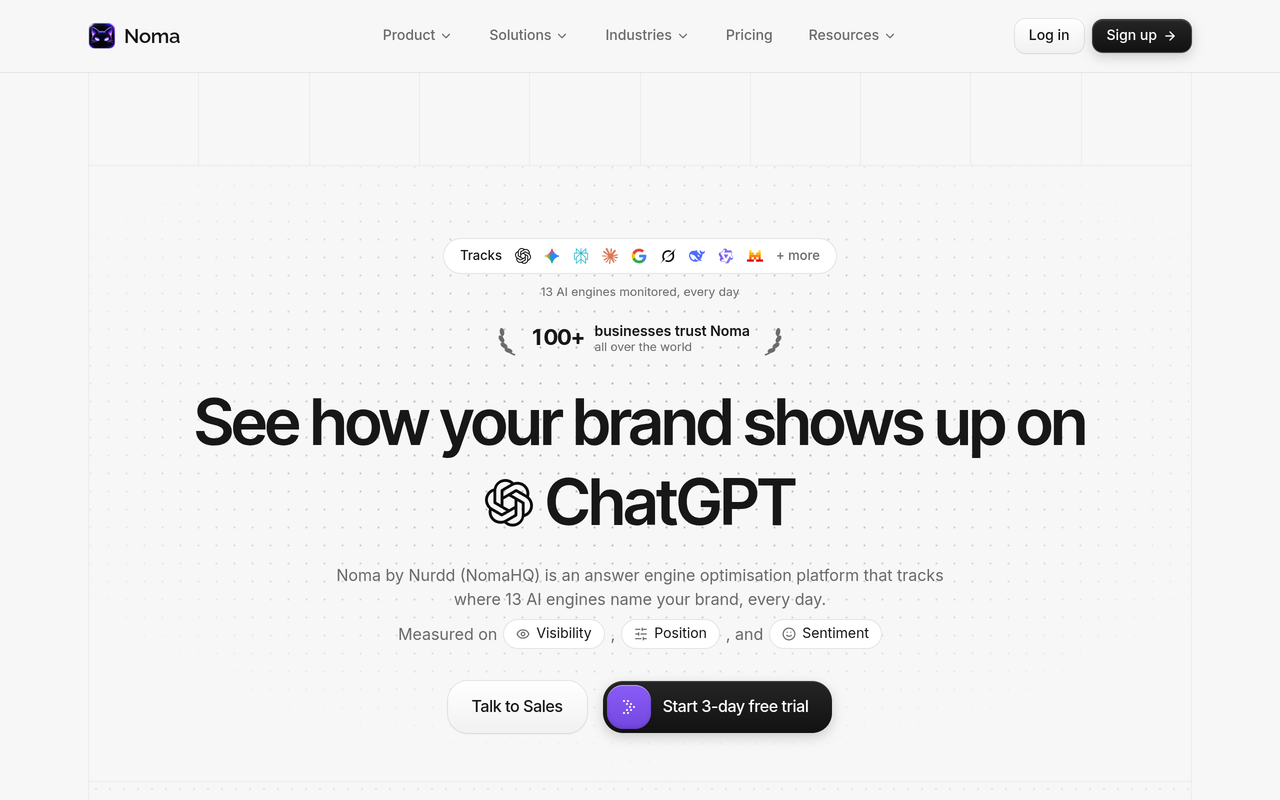
Here is how an agency's typical claims line up with what you can check yourself.
| Agency claim | What to track yourself | How to read it |
|---|---|---|
| "Your AI visibility is up" | Appearance across your prompt set, by engine, over time | Look for a trend across weeks, not one day's answer |
| "You beat competitors in our category" | Competitor comparison on the same prompts | Check the competitors named are the ones your guests actually consider |
| "We are being cited" | Which sources are cited in answers about your category | If cited sources are third-party sites, ask what was done to earn them |
| "Menu and listings are fixed" | Spot check of how engines state your hours, address and dishes | Any wrong fact is a defect to raise with the agency in writing |
| "Recommendations are working" | Which actions Noma suggests versus what the agency has delivered | Gaps between the two are your agenda for the next meeting |
Worked example: a six-site group sets its baseline
This is an illustration of the method, not a result. Imagine a group with six restaurants across two cities. You choose five prompts per site (for example a best-for-occasion prompt, a dietary prompt, a neighbourhood prompt, a cuisine prompt and a group-booking prompt), which gives 30 prompts.
Before signing, you run those 30 prompts and record, for each, whether each restaurant is named. If your tracker polls daily, you also get a trend rather than a snapshot. After 60 days of agency work you compare the same 30 prompts. The question to the agency is simple: which of the 30 changed, and which action caused each change? If the agency's report claims gains on prompts you never set, ask why those prompts were chosen.
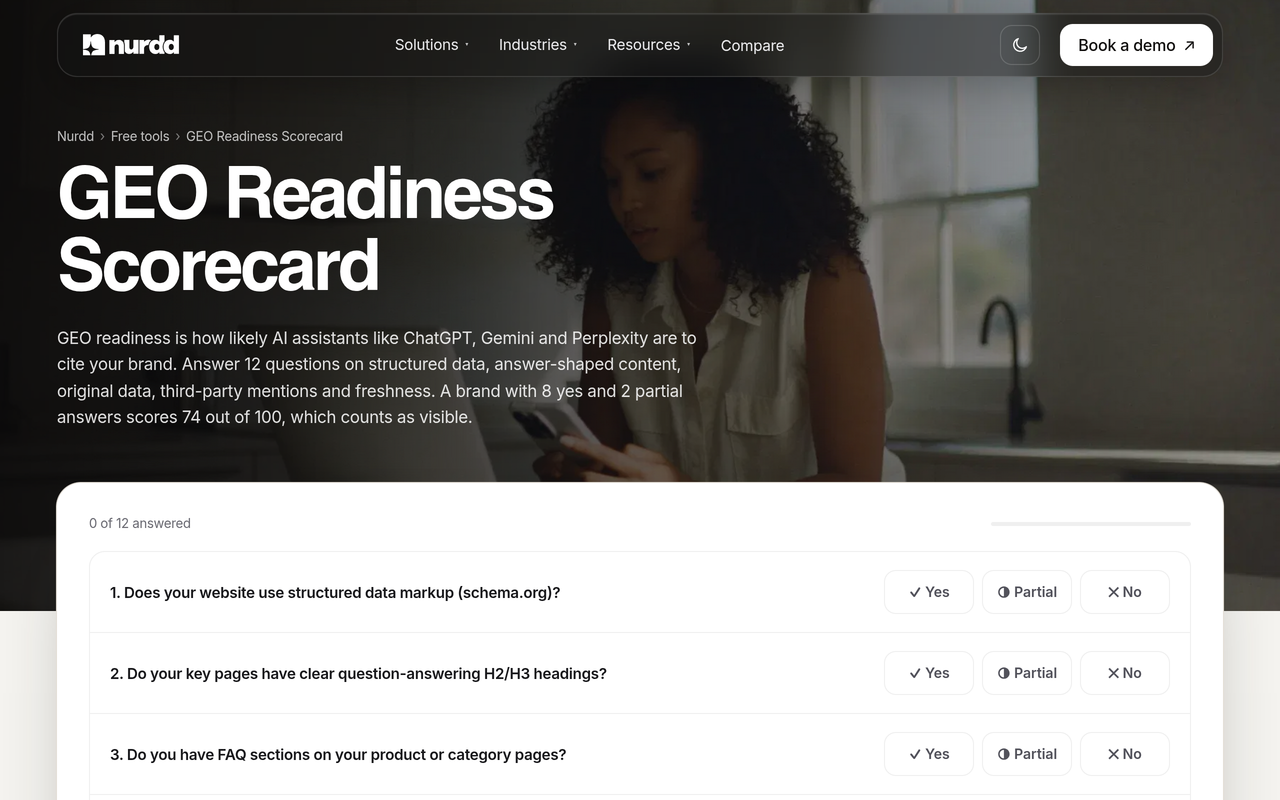
The arithmetic of the example matters most: the baseline must be fixed before the work starts, or it can be redrawn to flatter the result. For where to start, the free GEO readiness scorecard runs a 12-factor check of how ready a site is for AI answers.
How do you check an agency's work in 30 days? A checklist
- Fix the baseline. Write down your 30 or so prompts, the engines and the date, and save the answers before the agency touches anything.
- Audit your facts. Compare name, address, phone, hours and cuisine across your site, Google Business Profile, reservation and delivery listings. Log every mismatch.
- Check the menu. Confirm it exists as crawlable text on each location page and matches the Google Business Profile menu.
- Get the scope in writing. Ask the agency to confirm which of the ten questions it will answer in the statement of work, and who owns each task.
- Set the report format. Agree that the monthly report lists prompts, engines, appearance rates, cited sources and actions, with raw data access.
- Review at day 30. Re-run the prompts, compare against the baseline and ask the agency to explain each difference.
- Decide with evidence. Continue, change scope or exit based on which prompts moved and which actions explain it.
What do restaurant groups get wrong when they hire for AI search?
The first mistake is buying a promise of rank. No agency can guarantee a position in an AI answer, and organic recommendations cannot be bought. The second is treating AI search as a website project, when the sources reviewed describe listings, reviews and outside mentions as inputs alongside the website.
The third mistake is accepting an agency-owned tracker as the only record. The fourth is ignoring the engine mix: engines differ in what they read, as covered in Perplexity vs ChatGPT vs Gemini. The fifth is judging results by a single brand-name prompt ("tell me about our restaurant") rather than by discovery prompts where a new diner has never heard of you.
If your answers are wrong or your brand is missing, why your brand isn't showing up in ChatGPT answers is a good diagnostic, and the AEO audit checklist offers a longer audit to adapt for locations.
What should you ask about fees and trial terms?
Fee structures vary, so use this table as a list of questions to put to any quote, alongside the published terms for Noma. Prices are in USD where stated. Check every quote against the scope, not the headline fee.
| Model | What you pay for | Question to ask |
|---|---|---|
| Monthly retainer | Hours of work across listings, content and outreach | Which of the ten questions is covered, and what is excluded? |
| Project fee | A fixed audit and rebuild of menus and location pages | Who maintains the work after hand-over? |
| Performance fee | A share tied to a metric | Which metric, measured where, and who controls the data? |
| Noma, self-serve tracking | 3-day free trial; a card is taken at signup and billing starts on day 3; no charge if you cancel before then | Can your baseline run here before you sign anyone else? |
A performance fee is the model most sensitive to who owns the data. If the agency controls the tracker, it controls the proof, which is another reason to keep your own.
Why use Noma to check a restaurant agency's claims?
Noma by Nurdd is an AI search visibility dashboard that tracks whether a brand appears in answers from 13 AI engines, including ChatGPT, Gemini, Perplexity and Claude, polled daily. It shows citation frequency by category, competitor comparison and recommendations for improving visibility. For a restaurant group, it gives you a record of your own alongside whatever an agency reports.
Want to see Noma for your own brand? Book a demo at nurdd.club/demo, or start the 3-day free trial at nomahq.app.
Noma polls daily across 13 engines, so you can compare an agency's monthly report with a daily record on the same prompts. A separate comparison of the field is in best AI search visibility tools in 2026, and you can see how Noma sits against SEO suites in Noma vs Semrush. Multi-site groups can also look at the restaurants industry page and the franchise industry page.
Noma does not replace an agency's work on menus, listings or outreach. It gives you a way to check that work. If you want one partner for both, Nurdd's generative engine optimization services are measured in Noma.

How does this compare with ad-based and influencer routes?
Some agencies bundle AI search with paid and creator work. That can be sensible, as long as each channel has its own measure. AI search visibility is measured by appearance; paid media is measured by cost and return, and creator work by reach and sales. For paid, the free ROAS calculator and marketing budget planner help you set a split before you accept a bundle.
If the agency also wants to run ads, ask how it separates paid results from organic AI visibility; the distinction is laid out in AI search ads vs organic AI visibility.
How we researched this
We reviewed the sources linked in this article: three BrightLocal research reports, the Josh Kopel guide to restaurant AI search visibility, Owner.com's guide to ChatGPT for restaurants, Search Engine Roundtable's report on Google's menu summaries, and the Noma page. We did not run hands-on tests of any agency, interview agencies or customers, or collect our own data, and the worked example is an illustration of the method rather than a measured result.
Numbers in this article come from the linked sources and are given as those sources state them. Where a number could not be verified, the point is made without one.
Frequently asked questions
How do I choose a restaurant marketing agency that understands AI search?
Ask the ten questions above and score the answers. The agency should name the prompts and engines it tracks, explain how it handles menus and listings, describe how it earns outside mentions and agree to share raw data. Keep your own baseline so you can test its claims.
How do restaurants get recommended by ChatGPT?
ChatGPT reads the open web and repeats what credible sources say. Restaurants are more likely to be named when their name, address, hours and menu agree across their website and listings, when their pages answer guest questions, and when independent local sources mention them. Organic recommendations cannot be bought.
Can an agency guarantee my restaurant will appear in AI answers?
No. AI answers vary between runs and are not a fixed ranking, and there is no paid placement in organic recommendations. An agency can improve the inputs and measure how often you appear, but a guarantee of position is a red flag.
Do restaurants still need Google Business Profile if they target AI search?
Yes. Owner.com lists Google Business Profiles among the sources ChatGPT reads, and BrightLocal found most consumers who used AI still verified on Google or another channel. Keep the profile accurate, with current hours, photos and menu.
How often should an agency report on AI search?
Monthly is a reasonable cadence for reports, with the underlying data available on request. Because answers vary, a monthly report should show repeat-run appearance rates and the trend, not a single day's screenshot.
What should a restaurant do about its menu for AI search?
Publish the menu as crawlable text on each location's page, keep it in step with the Google Business Profile menu and update it whenever dishes or prices change. Google has been seen testing AI summaries of restaurant menus, so a clear, current menu may be read by machines as well as guests.
Is Noma free to try?
Noma has a 3-day free trial. A card is taken at signup and billing starts on day 3, with no charge if you cancel before then. That is long enough to set up a baseline prompt set before you sign an agency contract.
Can I do AI search for my restaurants without an agency?
Yes, for a single site or a small group, using a tracker and the checklist above. Agencies can add value on outreach, content production and multi-site coordination. Either way, track the results yourself.
Check your agency's claims with your own data
An agency's report is a claim; your own tracking is evidence. Book a demo at nurdd.club/demo to see Noma, or start the free trial at nomahq.app.