AI Search Visibility
AI Search Ads vs Organic AI Visibility: Where to Spend
A practical way to split budget between paid placements in AI answers and organic citations, with a four-gate test and a measurement setup.
 Sheetal Shakshi1 Nov 202616 min read

Earn organic citations first and add a capped paid test second. Ads in AI answers are labeled placements that sit beside the answer and do not buy a recommendation inside it. Use the four-gate test to decide the split, and measure paid and organic separately.
AI search ads vs organic visibility is a budget question with a clear first answer: pay for ads where you want a labeled placement next to a commercial answer, and earn organic citations where you want to be named inside the answer itself. Ads are sold as separate units, so one budget cannot buy the other.
This guide gives you a four-gate test for splitting spend, a six-step process, a worked example and a measurement setup for both sides. It is written for marketers who need a defensible plan this quarter. If you are new to the organic side, start with our explainer on generative engine optimization.
Key takeaways
- Paid and organic are separate systems. Ad spend buys a labeled placement, not a recommendation in the answer text.
- Organic visibility means the model names, cites or recommends your brand in its own answer.
- Fund organic measurement first. You cannot judge a paid test against a baseline you have never recorded.
- Run a small, time-boxed paid test only where inventory exists, your category is eligible and your tracking is ready.
- Report the two channels side by side, never blended into one attribution number.
- Check your own prompts weekly across several engines, because Seer Interactive found that advertisers were rarely named in the response above their own ad.
Should I pay for ads in AI search or focus on organic citations?
Focus on organic citations first, then add a capped paid test. Organic work builds the pages, third-party mentions and facts that every AI engine reads, and it pays off across engines that sell no ads at all. Paid placements are worth testing when your category is eligible, you have a landing page that converts and you can measure clicks.
There is one more reason to sequence it this way. In a dataset of 3,697 ChatGPT ads, Seer Interactive found the advertiser appeared in ChatGPT's actual response 5.4% of the time (Seer Interactive, updated July 28, 2026). Paying for a slot and being named in the answer are different outcomes.
Quick rule: if a buyer asks an AI engine a question about your category today and your brand is not named, ads can put a sponsored unit near that answer, but they will not put your brand into it. Only citable, consistent evidence about your brand does that.
What counts as an ad in AI search today?
Paid inventory in AI answers is uneven, and it changes quickly. The placements below are the ones documented in the sources reviewed for this guide. Check each platform before you commit budget, because eligibility, countries and formats shift.
ChatGPT ads
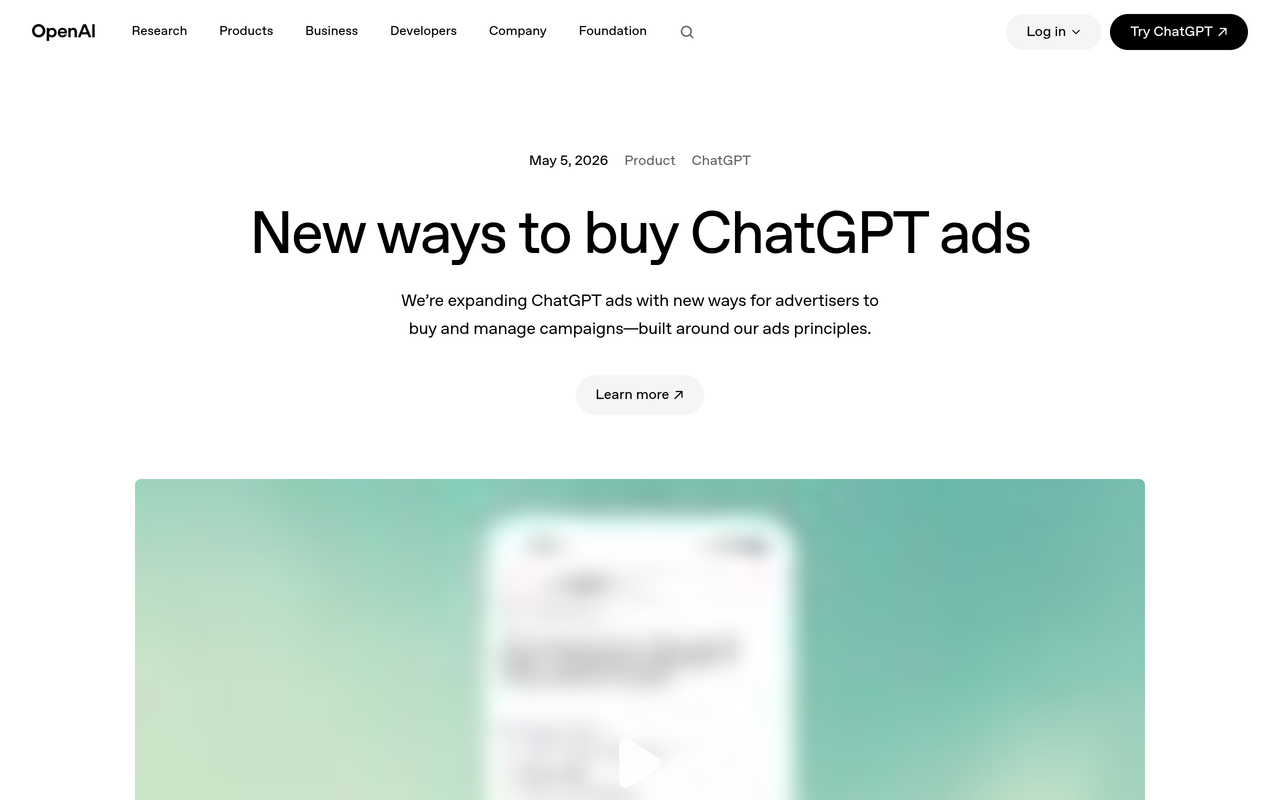
OpenAI said on February 9, 2026 that it had begun testing ads in ChatGPT in the United States for logged-in adult users on the Free and Go plans (PYMNTS, February 23, 2026). On October 5, 2026, TechCrunch reported that ChatGPT ads will be clearly labeled and will not influence the answers ChatGPT gives (TechCrunch, October 5, 2026).
OpenAI has since published details of a beta self-serve Ads Manager, cost-per-click bidding and expanded measurement tools (OpenAI, 2026). PPC Land reported that the May 2026 announcement included a Conversions API and pixel-based measurement (PPC Land, May 2026). The same TechCrunch article covers a visual ad format that sits alongside image generation results, starting in the US with a small first group of advertisers. Confirm current markets and formats with OpenAI before you plan spend.
Google ads in AI Overviews and AI Mode
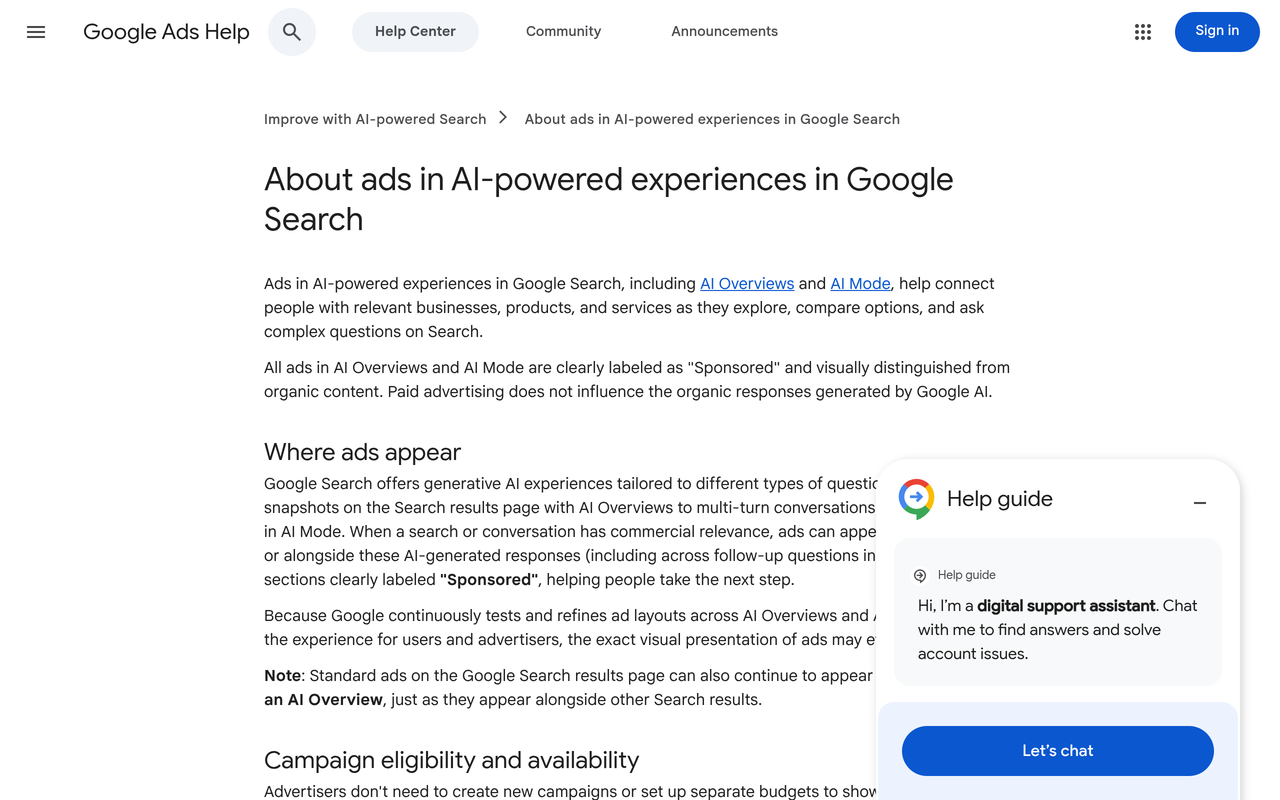
Google Ads Help says ads are eligible to show above, below or within AI Overviews. Ads above or below the overview are eligible in all 200+ markets where AI Overviews are available and follow the existing auction ranking. Ads inside AI Overviews are limited to English in a set of markets, and Google says it does not currently show them for sensitive verticals such as adult, alcohol, gambling, finance, healthcare and politics. Source: Google Ads Help. Check the page for the current market list, which Google says will keep expanding.
The mechanics matter for budget. Google says its systems match ads on the query and the content of the AI Overview, and its guidance points to AI-powered targeting such as AI Max for Search, broad match, Shopping and Performance Max (Google Ads Help). Your existing Search, Shopping and Performance Max campaigns are the buying route, so the incremental setup is small.
Perplexity and other engines
Perplexity is the cautionary case. AI Ad Placements reports that Perplexity launched sponsored follow-up questions in November 2024 and exited advertising by February 2026, so organic visibility is the only route to its users today (AI Ad Placements). The lesson is that a paid-only plan can lose its inventory, while organic work carries over to every engine.
For Gemini, Claude, Copilot and the rest, this guide does not assert ad availability, because the sources reviewed did not give a documented, current placement we could verify. If an engine sells no inventory you can buy, organic visibility is the only lever there.
How is organic AI visibility different from a paid placement?
Organic AI visibility is the degree to which AI engines mention, cite and recommend your brand in their own answers. It is earned through content the engines can read, facts that agree across the web and mentions on sources the engines trust. Brandi AI describes it as becoming one of the companies a system discovers, understands, cites, compares and recommends (Brandi AI, 2026).
A paid placement is a labeled unit bought by auction or by agreement. That is the key difference for trust: a citation reads as part of the answer, while an ad reads as an offer next to it.
| Factor | Paid placement in AI answers | Organic AI visibility |
|---|---|---|
| Where it appears | Labeled unit below, above or beside the answer | Inside the answer text or its source list |
| Can you buy it? | Yes, where inventory exists | No, it is earned |
| Influence on the answer | None, per TechCrunch's report of OpenAI's policy | Direct, through what engines read |
| Engine coverage | A few engines, some markets, some verticals | Every engine that retrieves or cites web sources |
| Speed | Days, once campaigns are approved | Weeks to months |
| Stops when budget stops? | Yes | No, but it decays if content goes stale |
| Main metric | Impressions, clicks, conversions | Mention rate, citation share, share of voice |
| Measurement source | Ad platform reports and conversion tracking | Repeated prompt sampling plus analytics referrals |
Two standalone points are worth keeping. First, TechCrunch reported on October 5, 2026 that OpenAI says ChatGPT ads are clearly labeled and do not influence the answers ChatGPT provides. Second, Seer Interactive's data shows that being the advertiser does not make a brand part of the response.
What does the evidence say about overlap between ads and organic mentions?
Seer Interactive tracked ChatGPT ads across its client portfolio and published its findings in an article updated July 28, 2026. Across 3,697 ads, the advertiser appeared in ChatGPT's actual response 5.4% of the time and was cited as a source 3.3% of the time (Seer Interactive, updated July 28, 2026). Seer's own comparison to its July 9 pull was 5.0% and 2.0%, so the numbers were still moving.
Taking the 5.4% at face value, 3,697 × 0.054 is about 200 ads with the advertiser named in the response and roughly 3,500 without. This is one company's client portfolio, not a market-wide study, so it cannot prove what ads do to organic visibility. For a marketer it is a reason to measure your own prompts rather than assume a paid slot implies an organic mention.
What is the four-gate test for splitting AI search spend?
Use this four-gate test before you assign any money to paid placements. It is an original decision framework built from the platform facts above, not a benchmark. Each gate is a yes or no question, and the number of passes sets your starting split.
| Gate | Question | If yes | If no |
|---|---|---|---|
| 1. Inventory | Can you buy a placement in an engine your buyers use, in your market? | Paid test is possible | Organic only on that engine |
| 2. Eligibility | Is your vertical allowed? (Google, for example, excludes sensitive verticals from AI Overview ads) | Continue | Organic only, plus classic channels |
| 3. Measurement | Can you track a click to a conversion, and do you have an organic baseline? | Continue | Fix tracking before spending |
| 4. Conversion path | Does a landing page answer the exact question the ad appears next to? | Paid test is worth running | Fix the page first, which also helps organic |
| Gates passed | Starting split (organic : paid test) | What to do |
|---|---|---|
| 0 to 1 | 100 : 0 | Build baseline, fix sources and pages |
| 2 | 90 : 10 | Run a very small test, review at 30 days |
| 3 | 80 : 20 | Test one engine and one query group |
| 4 | 70 : 30 | Test with weekly reviews, keep the organic floor |
The splits are starting points we propose, not published benchmarks. They reflect one principle: organic work is the base that keeps working when a paid test ends, so it keeps the larger share until your own data says otherwise. Revisit the split every quarter.
Which situations push the split toward paid or organic?
The gates give a starting point, and your situation shifts it. Use the table below as a second lens. It is a judgement aid we wrote, not a measured result.
| Your situation | Lean toward | Reason |
|---|---|---|
| Regulated vertical such as finance or healthcare | Organic | Google says it does not currently show ads in AI Overviews for these sensitive verticals |
| Sells outside the markets where ads are tested | Organic | No inventory to buy, so the gate fails |
| Launching a new product with a page that answers buyer questions | Small paid test plus organic | Ads give early clicks while citations build |
| Already named in few answers and competitors dominate | Organic | An ad does not change who the answer names |
| Strong branded search, weak category visibility | Organic | The gap is in category prompts, which ads do not close |
How do I split the budget between AI ads and organic visibility? A six-step process
- Record an organic baseline. Pick 20 to 30 prompts that match how buyers ask about your category and run them across the engines that matter to you. Result: you know your mention rate before any ad runs. Why: without a baseline you cannot tell whether a paid test changed anything. See which prompts to track.
- Run the four-gate test. Answer each gate in the table above for each engine. Result: a per-engine list of paid, organic-only or fix-first. Why: it stops you buying inventory you cannot measure or are not eligible for.
- Set the organic floor. Assign the larger share to organic work, such as page rewrites, schema, third-party mentions and a consistent brand description. Result: a funded plan that survives a failed ad test. Why: Perplexity's exit shows paid inventory can disappear, while organic work still carries across engines.
- Design a capped paid test. Choose one engine, one query group and one landing page, with a fixed end date and a spend cap. Result: a clean experiment. Why: Google lets you start through existing campaigns and OpenAI offers a self-serve Ads Manager, so you do not need a big commitment to learn.
- Instrument both sides. Use the ad platform's conversion tracking for paid, and prompt sampling plus analytics referrals for organic. Result: two separate dashboards. Why: ad platforms measure ad conversions, but they do not measure organic mentions.
- Review at 30 and 90 days. Compare cost per conversion from paid with mention rate and referral conversions from organic. Result: a reallocation decision backed by your own numbers. Why: published overlap studies are samples, so your data outranks them.

What does a worked example look like?
This example uses round numbers we chose for illustration. They are not data from any company or study. A skincare brand has a $10,000 monthly budget for AI search and sells in the United States, so ChatGPT and Google AI Overview inventory both exist.
| Step | Decision | Result |
|---|---|---|
| Gate 1: inventory | Yes, ChatGPT ads in the US and Google ads above or below AI Overviews | Pass |
| Gate 2: eligibility | Skincare is not named among Google's excluded sensitive verticals | Pass |
| Gate 3: measurement | Conversion tracking installed, 25 prompts logged for a baseline | Pass |
| Gate 4: conversion path | Product pages answer ingredient questions only vaguely | Fail |
Three gates passed gives an 80 : 20 starting split, which is $8,000 for organic work and $2,000 for a capped paid test. Because gate 4 failed, the first $2,000 of organic spend goes to rewriting the ingredient and routine pages, which also gives the ads a better landing page. After 30 days the team compares the paid cost per conversion against organic mention rate, then moves the split by 10 points at most.
For a second sanity check, run the numbers through our marketing budget planner and our Google and Meta ROAS calculator so the paid side has a break-even target before it starts.
How do I measure organic visibility in ChatGPT and Gemini?
Measure organic visibility by running a fixed prompt set on a schedule and recording whether your brand is mentioned, cited and recommended, and where. Add analytics referrals as a second signal. Prompt sampling tells you about visibility, and referrals tell you about clicks, which are different things.
Prompt-level metrics
- Mention rate: share of prompts where your brand is named at all.
- Citation rate: share of answers that link to your domain as a source.
- Recommendation position: whether you are first, in a list, or only an aside.
- Share of voice: your mentions relative to named competitors. See AI search share of voice.
- Sentiment and accuracy: whether the description is right.
Answers vary from run to run, so a single check is not a measurement. Sample each prompt repeatedly over weeks and read the trend. Our guide on tracking an AI visibility score week over week shows how to set up that routine.
Engine differences you should expect
ChatGPT, Gemini and Perplexity retrieve and cite differently, so track them separately. Our comparison of Perplexity, ChatGPT and Gemini covers the differences, and the guide on getting cited by Gemini covers its specifics. For Google surfaces, see how to track Google AI Overviews.
Analytics referrals
In your analytics tool, filter referral sources for the AI engine domains that actually appear in your reports, and tag any links you control. Brandastic makes a useful point: a person who sees your brand in an AI answer may later search your name, so the visit shows up as branded or direct traffic and not as an AI referral (Brandastic, 2026). Plan for that undercount by watching branded search alongside referrals.
Conversion claims for AI referrals vary by source. AirOps publishes a headline that AI referral traffic converts four to five times higher than organic search (AirOps, 2026), while Pixis argues the data is less clear-cut (Pixis, 2026). Treat both as reasons to measure your own conversion rate. Our own post on AI search versus Google conversion rates goes deeper.
How do I measure paid placements in AI answers?
Use the platform's own reporting and conversion tracking. OpenAI describes expanded measurement tools for ChatGPT ads, and PPC Land reported that they include a Conversions API and pixel-based measurement. Google reports ads in AI Overviews as Top Ads, so they appear in your Search reporting, and Google's help page does not describe an AI-Overview-only targeting option.
Because these placements sit next to the answer, set a clean control. Run the ad against a defined query group and watch branded search lift, assisted conversions and cost per conversion. Do not credit the ad with conversions that organic mentions earned. Our post on how to advertise on ChatGPT and measure the results walks through setup.
A checklist for reporting both channels without double counting
- Write down the prompt set, engines and dates before any paid test starts.
- Log the organic baseline: mention rate, citation rate and share of voice per engine.
- Create separate campaign naming and tracking links for each paid placement.
- Keep one dashboard for paid (spend, clicks, conversions) and one for organic (visibility, citations, referrals).
- Record branded search volume weekly as a shared halo signal.
- At 30 days, compare cost per conversion for paid with the organic trend, without merging them.
- At 90 days, move no more than 10 points of budget between sides.
- Re-run the four-gate test whenever a platform changes inventory or policy.
What are the common mistakes when budgeting for AI search?
- Expecting ads to buy mentions. TechCrunch reports that OpenAI says ads do not influence ChatGPT's answers, so a paid slot is not a recommendation.
- Skipping the baseline. Without it, every later number is a guess.
- Blending attribution. Merging paid and organic into one ROAS hides which side is working. Our D2C measurement framework keeps channels separate.
- Betting on one engine. Perplexity's exit from ads shows how quickly inventory can change.
- Ignoring eligibility. Google excludes sensitive verticals from ads in AI Overviews.
- Sending ad clicks to thin pages. The same page quality that wins ads also wins citations. See how to write content AI engines quote.
- Judging organic in a week. Answers vary, so read trends over weeks.
What organic work should the larger share fund?
Fund the work that makes your brand easy for an engine to retrieve and safe to quote. That starts with a clear entity description, covered in writing a brand description AI engines understand, then pages built to answer questions in the first sentence (the sentence type that gets quoted), plus structured data (schema markup for AI engines).
Next comes the evidence outside your site. If a competitor keeps appearing, the reasons are usually visible; read why a competitor is cited and you are not and how to get mentioned without paying for ads. A quick self-check with the GEO readiness scorecard shows which of 12 factors are weakest.
How does Noma help with the organic side?
Noma by Nurdd is a web dashboard that tracks whether a brand appears in answers from 13 AI engines, including ChatGPT, Gemini, Perplexity and Claude, polled daily. It shows citation frequency by category, competitor comparison and recommendations for improving AI visibility. That gives a marketer the organic baseline and trend this guide asks for before any paid test.
Want to talk it through? Book a demo at https://www.nurdd.club/demo and see how your own brand shows up across the engines, who is named instead of you and what to fix first. You can also try Noma directly: it has a 3-day free trial, a card is taken at signup, billing starts on day 3 and you are not charged if you cancel before then.
If you are weighing Noma against other tools, see our comparison of AI search visibility tools and Noma vs Profound.
Where should you spend next?
Spend first on measuring organic visibility, then give organic work the larger share, then cap a paid test where the four gates pass. That order protects you from vanishing inventory, from unmeasurable spend and from the false assumption that a sponsored unit equals a recommendation. Review the split every quarter, because platform rules are still changing.
How we researched this
We reviewed platform documentation and announcements from OpenAI and Google Ads Help, trade and news reporting, an original Seer Interactive study, and vendor blogs on AI visibility and AI referral traffic. We checked the pages on the publication date of this post and linked only to pages that appeared in our searches. We did not run hands-on ad campaigns or tests, and the four-gate test, the starting splits and the worked example are our own illustrations, not measured results. Vendor claims are labeled as such.
Frequently asked questions
Should I pay for ads in AI search or focus on organic citations?
Start with organic citations and a measured baseline, then add a capped paid test if inventory exists in your market and category. Ads buy a labeled placement, and TechCrunch reports that OpenAI says ads do not influence ChatGPT's answers. Organic work also carries over to engines that sell no ads.
Can ads in ChatGPT make ChatGPT recommend my brand?
No. TechCrunch reported on October 5, 2026 that OpenAI says ChatGPT ads are labeled and do not influence the answers. Seer Interactive found the advertiser was named in the response 5.4% of the time across 3,697 ads, so a paid slot does not imply a mention.
How do I measure organic visibility in ChatGPT and Gemini?
Run a fixed set of buyer-style prompts on a schedule and record mention rate, citation rate, position and competitors named. Repeat across weeks because answers vary. Add analytics referrals and branded search as secondary signals. A tracker such as Noma by Nurdd automates the polling across 13 engines.
Do ads show in Google AI Overviews?
Yes. Google Ads Help says ads can show above, below or within AI Overviews, with in-Overview placements limited to English in certain markets and excluding sensitive verticals. They use your existing Search, Shopping and Performance Max campaigns.
Are Perplexity ads still available?
Based on the AI Ad Placements report, no. It says Perplexity exited advertising by February 2026. Organic visibility is the route to its users.
How much of my budget should go to AI search ads?
There is no published benchmark we can verify. Our four-gate test suggests starting between zero and 30 percent for a capped test, depending on how many gates pass, and keeping the larger share on organic work. Adjust by 10 points at most per review.
Does AI referral traffic convert better than organic search?
Sources disagree. AirOps reports a large conversion advantage for AI referrals, while Pixis questions what that data really shows. Measure your own conversion rate by source.
Can I test Noma before committing?
Yes. Noma has a 3-day free trial. A card is taken at signup and billing starts on day 3, so cancel before then if you do not want to be charged.
Ready to see your organic baseline? Start the Noma trial, or book a demo at https://www.nurdd.club/demo to see your own brand's AI visibility and competitor gaps.