AI Search Visibility
AI Search Monitoring Alerts: What to Watch and How Often
Which changes in AI answers deserve an alert, which belong in a weekly digest, and how often to check ChatGPT, Gemini, Perplexity and Claude.
 Simran Rawat13 Nov 202616 min read
AI search monitoring alerts should fire on a small set of changes: a sustained lost citation, a new competitor in your answers, negative sentiment, a large visibility swing across a prompt group, and a new third-party source. Check weekly by default and daily only for launches or crises, because single answers change constantly.
AI search monitoring alerts are notifications that fire when the answers AI engines give about your brand change in a way that matters: a lost citation, a new competitor, a negative sentiment shift or a sharp drop in visibility. Check weekly by default, and daily only for launches, crises and a short list of high-value prompts. The rest of this guide shows which rules to set and why.
Key takeaways
- Alert on five changes: a sustained lost citation, a new competitor, negative sentiment, a group-level visibility swing and a new third-party source. Send everything else to a weekly digest.
- Never alert on one answer. Ahrefs, October 2026 found that 50% or more of citations were gone by the next day, so a single check is mostly noise.
- Use a persistence rule: alert only when a change holds across several runs, and judge a drop by how long the citation lasted before it vanished.
- Weekly checks suit most prompts. Keep a small daily set for launches, crises and the prompts tied to revenue.
- Group prompts by theme and alert on the group. Individual prompts swing too much to trigger on.
- Write down who acts on each alert and by when. An alert nobody owns is a notification, not a monitor.
What are AI search monitoring alerts?
An AI search monitoring alert is a rule applied to a record of AI answers. A monitoring tool asks a fixed set of prompts to AI engines on a schedule, stores each answer, and compares the latest results with the history. When the comparison crosses a threshold you set, someone is told.
Two parts matter. The first is the sampling: how often, on how many engines, with which prompts. The second is the rule: what counts as a change worth interrupting someone. Most weak alerting setups fail on the second part, because they treat every difference between two answers as news.
This is different from classic rank alerts. A Google ranking is a position that holds for days. An AI answer is generated fresh each time, so the same prompt can name different brands and cite different pages on consecutive runs. Alerts for AI search need to be built on trends across runs, not on any one response. For background on the discipline, see our explainer on generative engine optimization, GEO vs AEO vs SEO.
Why are AI answers too noisy to alert on every change?
Because the answers are variable by design. Four public studies show how much, and they point to the same design rule: alert on patterns, not on single outputs.
- Brand lists differ almost every time. Search Engine Journal, January 2026, reporting SparkToro research, says AI tools produced different brand recommendation lists more than 99% of the time for the same prompt. The study ran 2,961 prompts across ChatGPT, Claude and Google's AI Overviews.
- The leader is steadier than the list. Detailed, September 2026, tracked more than 70,000 responses and found the most-named brand for a prompt appeared on 82% of days on ChatGPT and 89% on Google AI Overviews.
- Exact repeats are rare. The same Detailed study found two random days returned an identical brand list on 0.3% of pairs for ChatGPT and 1.1% for AI Overviews.
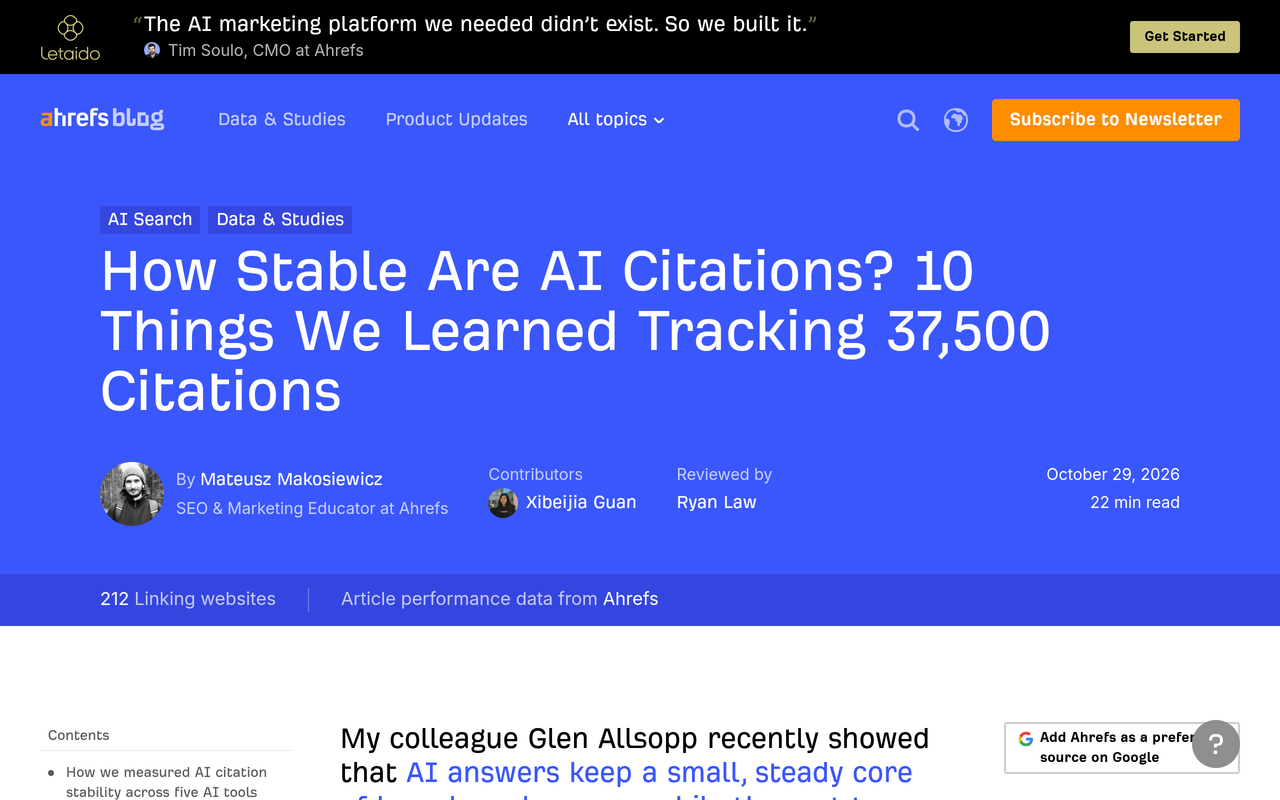
- Citations churn, then return. Ahrefs, October 2026 followed about 37,500 citations across five AI tools for 20 days. Roughly 75% of citations that disappeared came back within the study window.
Read together, these studies describe a stable core and a volatile tail. Your alerts should watch the core closely and treat the tail as background. A rule that fires when any citation goes missing would have fired on more than half of your citations by tomorrow.
Which changes in AI answers deserve an alert?
Five changes earn an alert, and a sixth category goes to a digest. The table below gives the change, a starting rule, a severity and where to send it. The rules are starting points drawn from the stability research above, not published benchmarks, so tune them against your own history after a month.
| Change | Starting rule | Severity | Route |
|---|---|---|---|
| Sustained lost citation | A page cited in most of the last seven days is absent for the last three runs | Medium | Content backlog, reviewed weekly |
| Lost brand mention on a core prompt | Your brand missing from a prompt you usually appear in, for three consecutive runs | High | Same-day message to the owner |
| New competitor | A rival appears in your answers across several prompts in one group, having been absent the previous month | Medium to high | Weekly review, same day if it is a direct rival |
| Negative sentiment | Any answer describing your brand negatively on a prompt tied to purchase | High | Same-day message, read the cited sources first |
| Group-level visibility swing | A prompt group's appearance rate moves well outside its own recent range | High | Same-day message |
| New third-party source | A domain you have never seen cited starts appearing in answers about you | Low to medium | Weekly digest, then an outreach or correction task |
Notice that the table has no rule for a single new mention or a single missing citation. Those go to a digest. If you want a second view of event types, LLM Pulse, November 2026 publishes its own list of six alert events, and AirOps, November 2026 recommends alerts on citation drops, negative sentiment and competitor share-of-voice gains.
Lost citations
A lost citation matters when it lasted. Ahrefs found that citations which held for eight or more days almost always returned (96 to 99%), while one-day citations failed to return 34 to 41% of the time. So the length of the streak before the drop tells you whether to worry.
A sensible rule is to alert on a drop only if the page had been cited on most of the previous seven days. A page that appeared once last week and is absent today is not a loss, because it was never established.
New competitors
A competitor that enters your answers matters more than a competitor who was already there. It suggests the sources the engines trust have shifted, perhaps because of a new review, a comparison article or a forum thread. Alert at the group level, so one stray mention does not trigger a review. Our guide to AI search share of voice covers how to measure that shift.
Sentiment shifts
Negative sentiment is the one change to alert on individually, because missing it costs more than a false alarm. If an engine describes your brand as unreliable or overpriced and cites a page, other engines can pick up the same source. Read the cited page before the answer text, because the page is what you can fix. See AI brand perception tracking for what to measure.
Visibility swings across a prompt group
Prompts swing too much to alert on one by one, but a group of ten to thirty prompts about the same theme is steadier. Group your prompts by product line or buying question, and alert when the group's appearance rate leaves its normal range. If you are unsure how many prompts to track, read how many prompts you need.
New third-party sources
When a domain starts being cited about your brand, you have found a source the engines now trust. It may be a review site, a roundup or a Reddit thread. This is the alert that produces outreach work rather than content work, and it links to tracking AI citations of partner and listing pages.
How often should I monitor AI search results?
Monitor most prompts weekly, a small set daily, and review trends monthly. The right cadence depends on what a week of delay would cost you, not on a universal rule.
Cadence also sets your detection window. LLM Pulse, November 2026 notes that a weekly check yields roughly 4.33 scheduled answers per model per month, while a daily check yields about 30. More samples mean steadier trends, which means fewer false alerts, so daily polling helps even if you only review weekly.
| Situation | Check cadence | Alert review | Why |
|---|---|---|---|
| Steady-state category prompts | Weekly | Weekly digest | Citations churn daily, so weekly trends are more meaningful than daily snapshots |
| Product launch or campaign window | Daily | Daily during the window | A week of delay costs launch momentum |
| Live reputation issue or wrong claim in an answer | Daily | Same day | A cited negative claim can spread to other engines |
| Revenue-critical prompts (best-of, comparison, pricing) | Daily | Same day for high severity | These decide who gets shortlisted |
| Brand-fact prompts (what you do, who you are) | Weekly | Weekly digest | Brand answers are steadier than discovery answers |
| Strategy and share-of-voice review | Monthly | Monthly report | Shows movement that daily noise hides |
AirOps suggests daily scans for critical topics, weekly brand audits and monthly competitive analysis, which is consistent with this split. The additional point worth adding is that engines differ: the Ahrefs data showed Gemini and Copilot citations vanished faster than Google's tools, partly because many of their follow-up answers cited nobody. Judge each engine against its own baseline, and do not compare raw drop rates across engines.
What is a persistence rule, and why does it matter?
A persistence rule requires a change to hold across several runs before it triggers. It is the single most effective way to cut alert noise, and it follows directly from how unstable single answers are.
There are two forms. The first is a streak rule: alert only if a brand or citation is absent for a set number of consecutive runs. The second is a window rule: alert if your appearance rate across the last seven days falls below a set share of its prior average. Ahrefs recommends counting how many of the last seven days you were cited, which is the window rule in plain form.
Persistence has a cost. It delays the alert by the length of the window. That is why high-severity alerts such as negative sentiment should use a shorter window or none, while low-severity alerts such as a new mention should use a long one.
A worked example: should this drop trigger an alert?
This example uses invented numbers for illustration, with the decision logic taken from the Ahrefs findings. A skincare brand tracks the prompt 'best vitamin C serum for sensitive skin' daily on one engine.
- Day 1 to 7: the brand's product page is cited on five of seven days. That is an established citation, not a one-off.
- Day 8: the page is absent. The rule needs a streak, so no alert fires.
- Day 9 and 10: the page is still absent. The streak rule (three consecutive absences) has not yet triggered either.
- Day 11: the third absence. The alert fires at medium severity and goes to the weekly content backlog, not to a person's phone.
- Review: the owner checks whether the page still ranks in Google, still answers the question, and whether a competitor page has appeared in its place.
The brand's mention, as opposed to the page citation, may still be present. That matters, because Ahrefs notes that brand mentions looked more stable than citations. If the mention is intact and only the link has moved, the issue is a content task. If the mention itself has disappeared on a revenue prompt, the severity rises and it goes to the owner the same day.
Also note what the rule did not do: it did not react on day 8. Per the Ahrefs data, about half of lost citations returned within three days, so reacting immediately would have meant chasing a blip.
How do you set up AI search monitoring alerts? A checklist
Follow these steps in order. Each produces something you can check before moving to the next.
- List 20 to 50 prompts from sales calls, support tickets and search queries, split into brand-fact, comparison and discovery groups. The output is a tagged prompt list. See which prompts to track.
- Record a baseline for two to four weeks across your engines before switching alerts on. The output is an average appearance rate per group, so you know what normal looks like.
- Pick the five alert types from the table above and write one rule per type, including the persistence window.
- Assign an owner and a response time to each alert. High severity gets a named person and same-day review. Medium goes to a weekly meeting.
- Set the cadence: weekly for the bulk, daily for a short list of launch, crisis and revenue prompts.
- Route low-severity events to a digest, so new mentions and minor competitor appearances do not train people to ignore alerts.
- Review the rules monthly. If an alert fired and nobody acted, loosen it. If something important slipped by, tighten it.
- Log each alert and the action taken, so you can later test whether a change you made moved visibility. For test design, see GEO experiment design.
How do alerts differ from reports, Google Alerts and rank tracking?
Each tool answers a different question, and alerts do not replace the others. The table separates them.
| Method | Question it answers | Cadence | Weakness for AI answers |
|---|---|---|---|
| AI search monitoring alert | Did something change that needs action? | Event-driven, from daily or weekly sampling | Needs good thresholds or it floods the inbox |
| AI visibility report | How are we trending against competitors? | Monthly | Too slow for a crisis; see how to build a monthly report |
| Google Alerts and web listening | Where was our name published? | Continuous | Does not see what AI engines say in private answers |
| Rank tracking | What position do we hold on Google? | Daily | Positions are stable; AI answers are not, and there is no position to track |
| Manual spot checks | What does the engine say right now? | Ad hoc | One sample, which the research above shows is unreliable |
Manual checks are still useful for the first hour of a crisis, when you need to read the exact wording of an answer. They are a poor monitor, because one sample tells you very little about a system that returns a different list more than 99% of the time. For a wider view of tool types, see search intelligence tools: classic SEO vs AI answer data.
How does Noma monitor these changes across 13 AI engines?
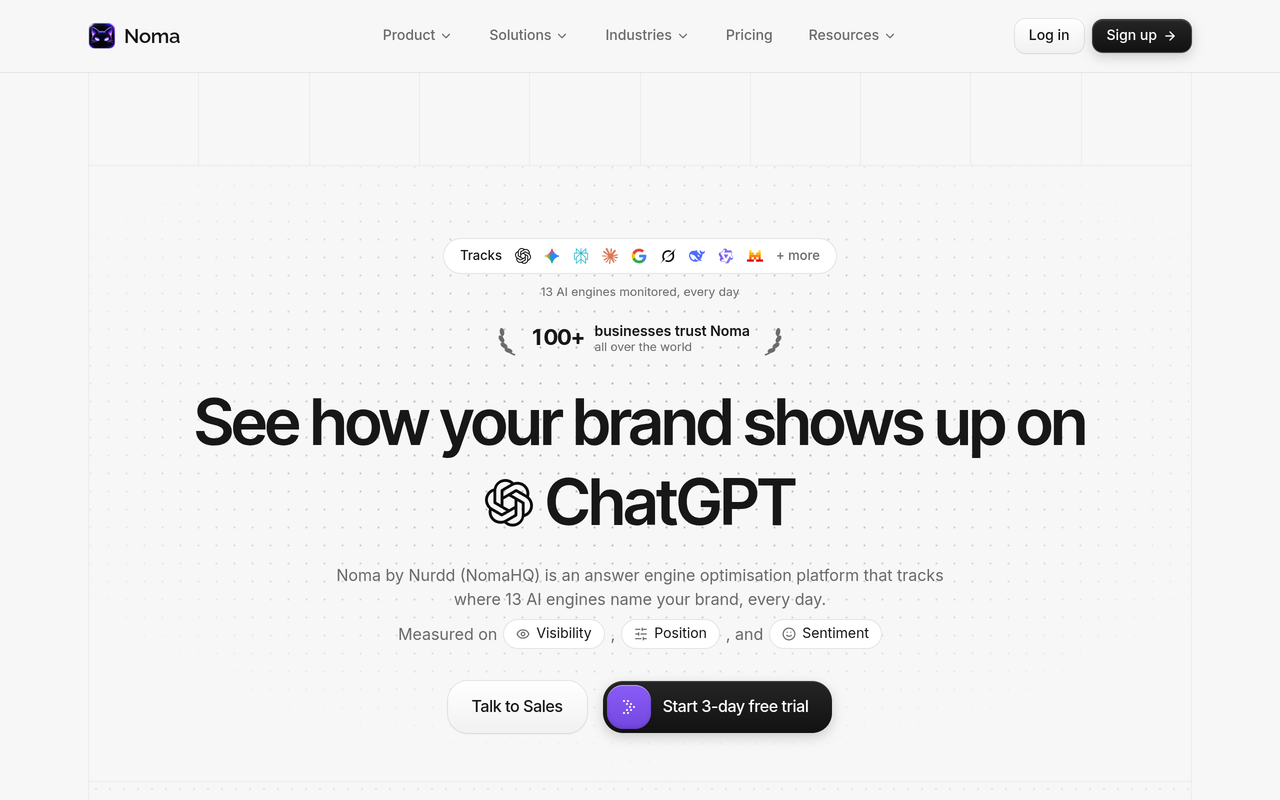
Noma tracks whether a brand appears in answers from 13 AI engines, including ChatGPT, Gemini, Perplexity and Claude, polled daily. Each run records whether the brand is named and which page each citation comes from. It also shows citation frequency by category, competitor comparison and recommendations for improving visibility.
That daily record is what makes the alert rules above workable. A persistence rule needs history, a competitor alert needs a competitor baseline, and a lost-citation alert needs the source page for every citation. Because Noma samples daily, you can run weekly reviews on trends that rest on about 30 answers a month rather than four.
Noma by Nurdd is an AI search visibility dashboard that tracks 13 AI engines, including ChatGPT, Gemini, Perplexity and Claude, polled daily. It records whether your brand is named, which page each citation comes from, and how you compare with competitors by category. Teams use it to spot lost citations, new rivals and weak answers, then act on the recommendations it gives.
Noma has a 3-day free trial. A card is taken at signup and billing starts on day 3, with no charge if you cancel before then. For a walkthrough on your own brand, book a demo and see your own prompts, your competitors and your cited pages in Noma. You can also see the product at nomahq.app.
What should you do in the first hour after a serious alert?
Treat a high-severity alert as an investigation with a fixed order. The order matters because it separates a one-off answer from a real problem.
- Re-run the prompt on the same engine a few times. If the problem appears in only one run, log it and move on.
- Check other engines. A problem on one engine is usually a model issue. A problem on several points to a shared source.
- Open the cited pages. For a negative or wrong claim, the source page is what you can change or answer.
- Check what changed on your side. Look for a redirect, a rewritten page, a blocked crawler or a removed page. Our list of AI crawler user agents helps with the crawler check.
- Check what changed on the engine side. OpenAI publishes ChatGPT release notes, checked in November 2026, which can explain a sudden shift on ChatGPT.
- Assign the fix and a review date, and avoid judging success from one comeback.
That last step comes from Ahrefs' advice not to credit a page edit for a single return, because citations vanish and come back on their own. Look for a sustained rise in how often you are cited.
What are the common mistakes with AI search alerts?
- Alerting on single answers. With lists differing more than 99% of the time in the SparkToro research, single-answer alerts fire constantly and teach people to mute them.
- Tracking only citations. Ahrefs suggests brand mentions are steadier than citations, so a mention-based alert is a more reliable signal for core prompts.
- Mixing brand and discovery prompts. Being cited for your own pricing is easier than appearing for a best-of query. Group them separately so a strong group does not hide a weak one.
- Monthly checks with daily expectations. A monthly check cannot catch a competitor who took over an answer early in the month.
- No owner. Every alert needs a person and a time limit for response.
- Comparing engines on raw numbers. Each engine has its own baseline, so compare each against itself.
- Ignoring Google's surfaces. AI Overviews and AI Mode change over time. See our guide to tracking Google AI Overviews and the SE Ranking history of Google AI Overviews updates.
What can alerts not tell you?
Alerts tell you that something moved. They do not tell you why, and they do not prove that a change on your site caused a recovery. The research is clear that citations disappear and return without any action, so attribution needs a controlled comparison, not a single before-and-after.
Alerts also depend on the prompts you chose. If your prompt set misses how customers really ask, the monitor can look calm while you lose ground. Refresh the set from sales and support questions each quarter. For deeper analysis, our pieces on AI search visibility analysis and ranking on Google but not cited by AI cover what to do once an alert points to a gap.
If you want help acting on alerts rather than only receiving them, Nurdd's team also runs answer engine optimization as a managed service, measured in Noma.
How we researched this
We reviewed published studies and vendor guides on AI answer variability and AI visibility monitoring, along with official release notes from OpenAI. We read the full text of the Ahrefs, Detailed, SparkToro-via-Search Engine Journal, LLM Pulse and AirOps pages and checked them on the publication date of this article. We also compared how the top-ranking guides structure alert advice.
We did not run our own experiments, interview customers or collect proprietary data for this post. The worked example uses invented numbers for illustration, and the alert rules are starting points built from the cited research, not measured benchmarks. Statistics are quoted as the sources state them, and the facts about Noma come from Nurdd's own product information.
Frequently asked questions
How do I get alerts when AI search answers about my brand change?
Use a monitoring tool that polls AI engines on a schedule, stores each answer and lets you set rules on the history. Define your prompts, record a baseline, then write rules for lost citations, new competitors, sentiment and group-level swings. Noma tracks 13 AI engines daily, which supplies the record those rules need; ask for a demo to see how it fits your prompts.
How often should I monitor AI search results?
Weekly is a sensible default for most prompts, with a small daily set for launches, crises and revenue-critical prompts. Review trends monthly. Single answers vary a lot, so the frequency of sampling matters more than the frequency of reading alerts.
Why does my brand appear in an AI answer one day and vanish the next?
Because AI answers are generated fresh each time. Ahrefs, October 2026, found that 50% or more of citations disappeared by the next day, and about 75% of dropped citations returned within 20 days. A single absence is not a loss.
Which alert matters most?
Negative sentiment on a purchase-related prompt, because a cited negative claim can spread to other engines and costs the most to miss. After that, a lost brand mention on a core prompt and a group-level visibility swing deserve same-day review.
Should I use Google Alerts for AI search?
Use it for what it does well, which is spotting new web mentions of your brand. It does not show what ChatGPT, Gemini or Perplexity say in their answers, so it complements AI monitoring rather than replacing it.
How many prompts do I need before alerts are useful?
Enough to form groups of roughly ten or more per theme, so a group-level rule is steadier than any single prompt. Start with 20 to 50 prompts and expand as the baseline settles. See our guide on prompt counts for more.
Do I need to monitor every AI engine?
Monitor the engines your customers use, and judge each against its own baseline. Engines differ in how often they cite sources at all, so a quiet engine is not necessarily a problem. Noma covers 13 AI engines, including ChatGPT, Gemini, Perplexity and Claude, in one view.
Conclusion
Good AI search monitoring alerts are few, persistent and owned. Five change types deserve them, weekly checks cover most prompts, and a short daily list covers the moments a week is too slow. Everything else goes to a digest.
To see this on your own brand, book a demo of Noma. You will see which of your prompts name your brand across 13 AI engines, which competitors appear beside you, and which pages are cited for each answer.
You can also start with the free GEO readiness scorecard, browse the free tools, or read our guide to shortlisting AI search monitoring tools.