Brand & Content Strategy
Best Agentic Marketing Platforms: What to Test Before Buying
A test plan for agentic marketing platforms: approvals, data access, audit trails and outcomes, plus where Noma, Nia and Pulse each fit.
 Simran Rawat4 Nov 202617 min read

The best agentic marketing platforms are the ones that pass four tests: they ask for approval before acting, take only the data access they need, keep an audit trail of every action, and tie work to a measurable outcome. Noma, Nia by Nurdd and Pulse are three separate products that each cover one job, so you test them one at a time.
The best agentic marketing platforms are the ones that pass four tests: they ask for approval before acting, take only the data access they need, keep an audit trail of every action, and tie their work to a measurable outcome. Judge any platform on those four tests, not on its demo, because a demo shows the best case and a test shows the failure case.
Key takeaways
- Test agentic marketing platforms on four things: approvals, data access, audit trails and measurable outcomes. Score each from 0 to 5 before you compare features.
- Ask every vendor to show you the approval screen, the permission list and the action log during the demo, using your own account rather than a sample one.
- Prefer read-only access first. Move to write access only for one narrow task, after the read-only results are accurate.
- Decide the outcome metric and its baseline before the trial starts, so you cannot be talked into a flattering number afterwards.
- Treat "agentic" as a spectrum. A tool that recommends is lower risk than a tool that publishes, spends or emails on its own.
- Buy by job, not by label. AI search visibility, creative and influencer work, and paid media are different jobs with different risks.
What counts as an agentic marketing platform?
An agentic marketing platform is software that does more than generate a draft: it plans a task, uses connected data and tools, takes steps on its own, and reports what it did. The key difference from older automation is that the steps are chosen by the system at run time rather than written in advance by a person as fixed rules.
That definition matters because many products now carry the word "agent" on a feature that is really a chatbot or a scheduled workflow. Our own guide to AI agents for marketing separates agents from automation and lists four use cases, and the companion post on what AI agents do and where to start goes deeper on where each one earns its keep.
A practical rule: if you can predict every step in advance, it is automation. If the system decides the steps, picks the tools and can change something outside its own screen, it is agentic, and it needs the controls in this post.
The autonomy ladder
Autonomy is not on or off. Use the ladder below to place any feature you are shown, and then decide how much oversight that rung needs.
| Rung | What the system does | Who acts | Minimum control |
|---|---|---|---|
| 1. Observe | Reads data and reports what changed | Human | Read-only access |
| 2. Recommend | Suggests specific actions with reasons | Human | Evidence behind each recommendation |
| 3. Draft | Prepares content, briefs or changes, unpublished | Human approves | Approval queue and version history |
| 4. Act with approval | Executes after a person signs off | System, gated | Scoped write access and action log |
| 5. Act alone | Executes within limits, no sign-off | System | Spend caps, rollback, alerts, full audit trail |
Most marketing teams should buy at rungs 1 to 3 first. Rungs 4 and 5 are earned by a track record you have measured yourself.
Which agentic marketing platforms are on the shortlist?
One published 2026 roundup from Netcore, 2026 lists HubSpot Breeze, Agentforce, Salesforce Marketing Cloud Next, Yarnit, SuperAGI, Adobe Experience Platform, ActiveCampaign and Netcore itself as agentic marketing platforms. That list shows how wide the label has become: it spans CRM suites, enterprise clouds, open-source agent builders and email platforms.
Because the category is so broad, a single ranked list is the wrong tool. A suite that sends email, a tool that builds ads, and a dashboard that tracks AI answers share a label but not a risk profile. Group them first, then test inside the group.
| Group | Typical job | What can go wrong | Where to test hardest |
|---|---|---|---|
| CRM and marketing suites | Email, lead nurture, journeys | Wrong message to the wrong contact | Approvals, audience scope |
| Agent builders | Custom agents you assemble | Unbounded tool access | Permissions, logs |
| Creative and influencer platforms | Ads, films, creator selection | Off-brand content, fake audiences | Brand review, vetting evidence |
| Paid media intelligence | Diagnosing Meta and Google results | Bad advice on spend | Read-only access, explanation quality |
| AI search visibility | Tracking and improving brand mentions in AI answers | Noisy or non-repeatable measurement | Prompt coverage, source tracking |
Nurdd makes three separate products that sit in three of those groups. Nia by Nurdd is a creative studio with influencer marketing built in, Noma tracks AI search visibility, and Pulse explains Meta and Google Ads performance. They are sold and tested separately, which is exactly how you should evaluate them.
How do I evaluate an AI agent platform for marketing?
Evaluate an AI agent platform for marketing by running the same four tests on every vendor: approvals, data access, audit trails and outcomes. Score each test from 0 to 5 using evidence from your own account, weight the tests by your risk, and compare totals only after each vendor has run the same task.
The framework below is the one used throughout this post. It is an original scoring method, not a published standard, so adjust the weights to your own risk.
| Test | Question it answers | Evidence to demand | Suggested weight |
|---|---|---|---|
| Approvals | Who must say yes before the agent changes anything? | The approval screen and the setting that disables it | 30% |
| Data access | What can the agent read and write, and can I narrow it? | Permission list, OAuth scopes, revoke flow | 25% |
| Audit trail | Can I reconstruct what it did and why? | Exportable log with time, action, input and user | 20% |
| Measurable outcome | Did it move a number I chose in advance? | Baseline, test window and a result you can verify elsewhere | 25% |
Test 1: Do approvals work the way the demo implies?
Action: Ask the vendor to set up a task that would change something external, such as publishing, emailing or editing a campaign. Watch for the approval step and then try to bypass it. Result: You learn whether approval is a real gate or a notification after the fact. Why: An agent that acts first and tells you later is rung 5 autonomy, whatever the sales page says.
- Can approval be required per action, per action type and per user role?
- Does the approver see the exact change, or only a summary written by the agent?
- Can an agent approve its own work through another agent?
- What happens to a queued action if nobody responds: does it expire, or run anyway?
Test 2: What data access does it really need?
Action: List every connection the platform requests and match each to a task. Result: You find access that the stated use does not need. Why: The more an agent can reach, the more a mistaken or manipulated instruction can damage.
Start read-only. A tool that connects to ad accounts through read-only OAuth can explain performance without being able to spend money, which is the safest first step for any paid media agent. Ask also how access is revoked, and whether revoking it deletes your data or only stops new reads.
Test 3: Can I reconstruct what the agent did?
Action: Ask the agent to complete a task, then ask a colleague who did not watch it to explain from the log alone what happened and why. Result: You see whether the log is a real record or a marketing feature. Why: When something goes wrong, you need to know the input, the decision and the person who approved it.
- Does each entry show time, user, action, inputs and the data source used?
- Can logs be exported, or only viewed in the interface?
- Are failed and rejected actions logged, not just successful ones?
- For research or tracking agents, does the record show the source page behind each claim?
Test 4: Does it move a number I chose in advance?
Action: Pick one metric, write down the baseline and the test window, and agree both with the vendor in writing before the trial. Result: You can tell improvement from drift. Why: Marketing metrics move on their own, and an agent will happily take credit for a seasonal rise.
Match the metric to the job. For AI search visibility, use whether your brand is named and which pages are cited. For influencer work, use forecast against attributed sales. For paid media, use ROAS against your break-even, which our Google and Meta ROAS calculator will work out. Our post on ecommerce KPIs that predict profit better than ROAS explains why ROAS alone can mislead.
What does a worked scoring example look like?
The example below is illustrative arithmetic to show the method. The vendors are hypothetical and the scores are invented for demonstration, not measured from any real product.
| Test (weight) | Vendor A score /5 | Vendor A points | Vendor B score /5 | Vendor B points |
|---|---|---|---|---|
| Approvals (30) | 2 | 12 | 4 | 24 |
| Data access (25) | 3 | 15 | 4 | 20 |
| Audit trail (20) | 5 | 20 | 3 | 12 |
| Outcome (25) | 4 | 20 | 3 | 15 |
| Total (100) | 67 | 71 |
Points are score divided by 5, multiplied by the weight. Vendor A has the better log and the better outcome, but its weak approvals (2 of 5) cost 18 points of the 30 available. Vendor B wins narrowly because approvals carry the largest weight. If your team never lets an agent act without sign-off, you might reweight approvals down, and the ranking could flip. That is the point: the weights make your risk explicit.
Add one rule on top of the total: any vendor scoring 1 or below on approvals or data access is out, whatever the total. A high log score cannot compensate for an agent you cannot stop.
What is the step-by-step test plan?
Run this plan over a trial window, with one person owning the scorecard. It works for any platform, including ours.
- Define the job. Write one sentence: "This platform should [task] for [account] so that [metric] improves."
- Record the baseline. Capture the metric for at least the same window before the trial, plus the same window a year earlier if seasonality matters.
- Connect read-only. Grant the narrowest access first and write down every permission requested.
- Check the log on day one. Make a small change and confirm it appears in the audit trail with the right user and time.
- Force an approval. Set up a task that needs sign-off, reject it, and confirm nothing ran.
- Try to break the scope. Ask for something outside the agreed task and see whether the agent refuses or complies.
- Verify a result elsewhere. Take one claim the platform made and check it against your own analytics or the original source.
- Score and decide. Fill in the four-test scorecard, apply the knock-out rule and write down the conditions for widening access.

How do the three Nurdd products compare on features?
Nurdd is the parent company of Nia, Noma and Pulse. They are separate products with separate sign-ups and separate jobs, so the table compares what each does rather than treating them as one interface.
| Row | Noma | Nia by Nurdd | Pulse |
|---|---|---|---|
| Job | AI search visibility | Creative studio with influencer marketing built in | Meta and Google Ads intelligence |
| Main action | Tracks whether a brand appears in AI answers | Makes films and ads, finds and vets creators | Explains performance and recommends actions |
| Data access | Public AI answers, no ad account needed | Brand and campaign inputs | Read-only OAuth to Meta Ads and Google Ads |
| Autonomy rung | 1 to 2: observe and recommend | 3: drafts and forecasts for human approval | 1 to 2: diagnose and recommend |
| Outcome you can verify | Brand named, source page cited, by engine | Forecast ROI before spend, sales attribution after | Performance change explained against your account |
| Where to find it | nomahq.app | Nia overview | Pulse |
The autonomy rung row is our own placement using the ladder above, based on the products' described functions. None of the three is sold as a system that spends or publishes without a person.
How do the products compare on pricing as published?
Pricing for agentic platforms is often usage-based, which makes a monthly figure hard to predict. Ask every vendor what one task costs, what happens at the limit, and whether a failed run is billed. The table covers only Nurdd's three products, as stated in Nurdd's own product facts on 2 November 2026. Prices, where given, are in USD.
| Product | Trial | Billing facts | Published plans |
|---|---|---|---|
| Noma | 3-day free trial | Card taken at signup, billing starts on day 3, no charge if you cancel before then | See nomahq.app |
| Nia by Nurdd | Paid product | Priced below comparable plans | See getnia.studio |
| Pulse | No trial | Paid, private access, walkthrough by demo | See nurdd.club/pulse |
We have not compared rival prices here, because we did not verify any rival pricing page for this post. When you do, use the vendor's own page, note the date, and compare the cost of a full task rather than the headline plan.
Where does Noma fit in an agentic marketing stack?
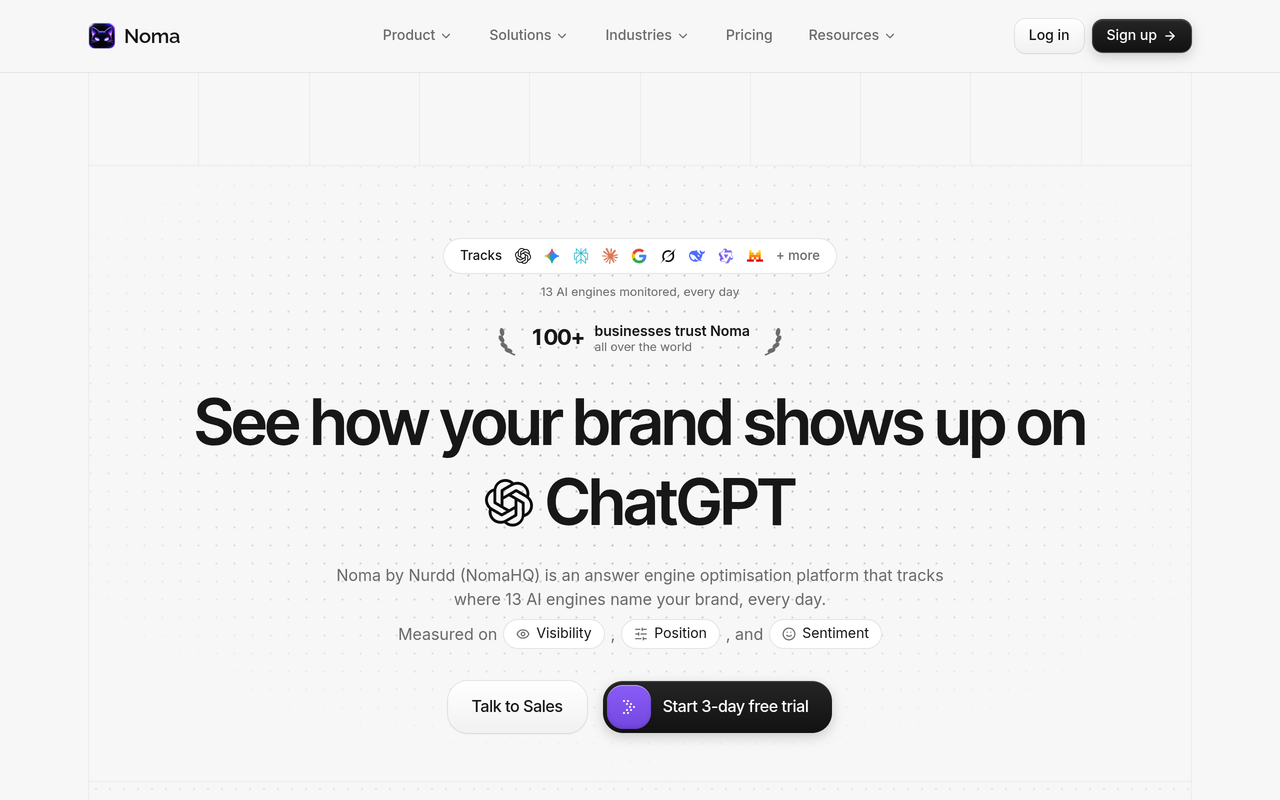
Noma fits at the measurement end: it tells you whether your brand appears when buyers ask AI assistants about your category. Noma tracks 13 AI engines, including ChatGPT, Gemini, Perplexity and Claude, polled daily, and shows citation frequency by category, competitor comparison and recommended actions. Because Noma observes and recommends rather than acting inside your accounts, it passes the approvals and data access tests by design.
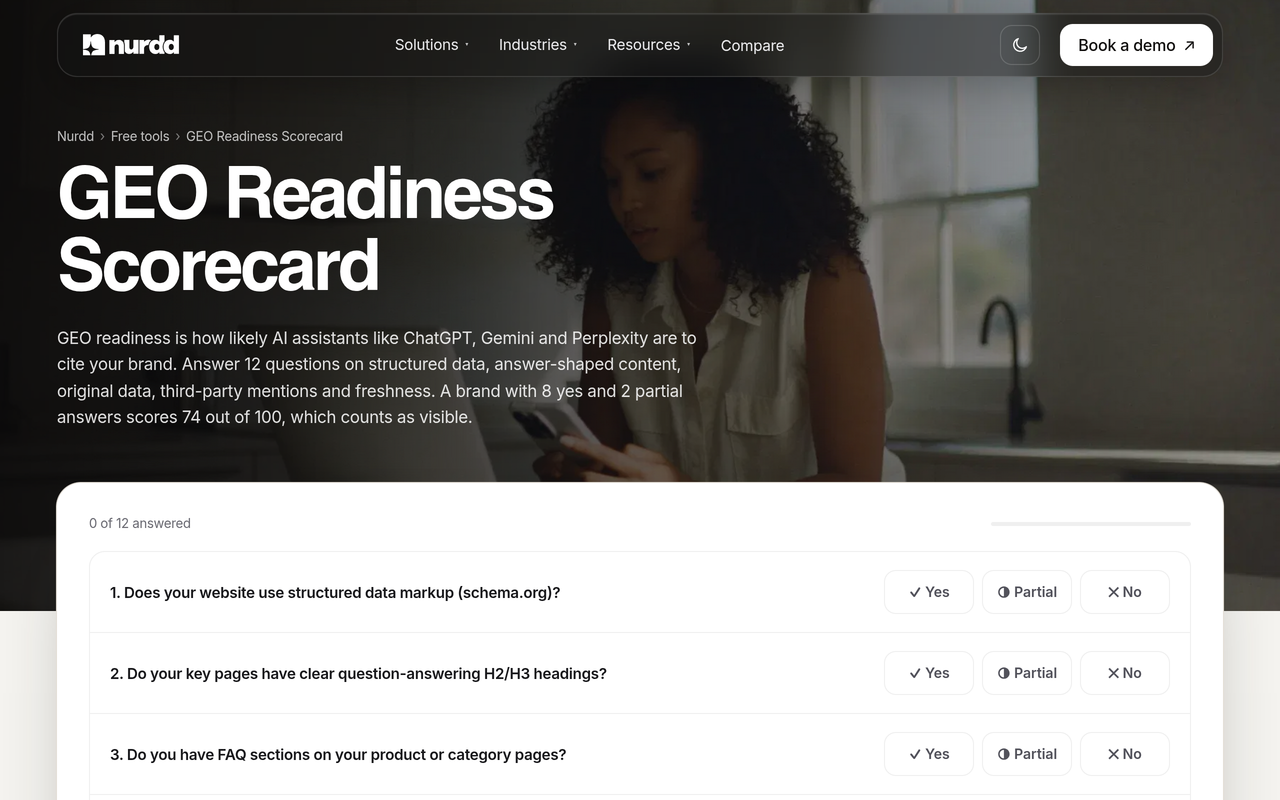
Noma is the product to lead with if your question is "are we being recommended by AI assistants?" Our posts on why a brand is missing from ChatGPT answers and which prompts to track show how the measurement is set up, and the GEO readiness scorecard gives a free 12-factor check first.
Noma by Nurdd is an AI search visibility dashboard that tracks whether a brand is named in answers from 13 AI engines, including ChatGPT, Gemini, Perplexity and Claude, and records which page each citation comes from. Marketing teams use it to see their share of AI answers against competitors and to get specific actions to improve it. It has a 3-day free trial.
Want to see this for your own brand? Book a demo and we will show you which of your category questions name you, which name competitors, and which pages are being cited.
Where does Nia by Nurdd fit?
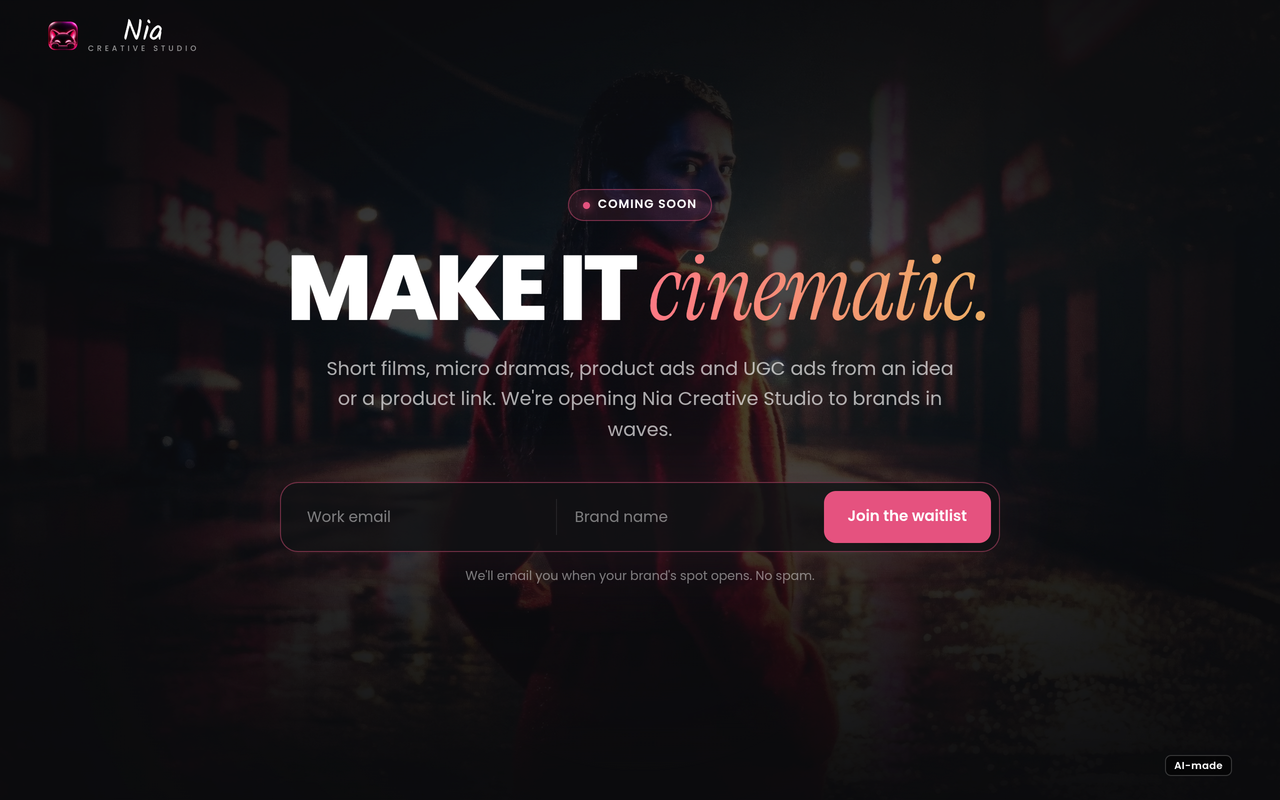
Nia by Nurdd fits the creation and creator side. Nia is an AI-native creative studio at getnia.studio, also on iOS and Android, that makes short films, micro dramas and commercials from an idea, and product and UGC ads from a link. Influencer marketing is built in: discovery across 10M+ profiles, fake follower detection with TruAI, pre-spend ROI forecasts and product-level sales attribution.
For testing, Nia is a rung 3 product: it produces drafts and forecasts that a person reviews before anything goes out. The approvals test is simple, because brand review sits before publishing. Your harder tests are outcome and vetting. Check a creator shortlist against the fake follower checker, project returns with the influencer ROI calculator, and read the fake follower audit checklist before paying anyone. Our posts on tracking sales by creator and forecasting software add the scorecard for that outcome test.
Where does Pulse fit?
Pulse fits the paid media diagnosis job. Pulse is a web dashboard that connects to Meta Ads and Google Ads through read-only OAuth, explains campaign performance in plain language, diagnoses what changed and recommends specific actions without making you build reports. Read-only access means it cannot change budgets, which is why it sits low on the autonomy ladder and passes the data access test cleanly.
Pulse is in private access, so the route in is a walkthrough. Use the same test: ask Pulse to explain a change you already understand, such as a cost spike you traced last month, and check the diagnosis against your own conclusion. Our posts on sudden cost-per-result increases and inflated Meta ROAS give you known cases to test against, and the benchmarks hub shows category medians with their sources.
Why does Noma win on the rows that matter for a first test?
Noma is the stronger first purchase on the rows where risk is lowest and proof is quickest: approvals, data access and outcome. It needs no write access to any ad or CRM account, so there is nothing for an agent to change. Its outcome is a number you can verify yourself by asking the same question in an AI assistant and comparing.
| Test row | Noma | Why it is a clean first test |
|---|---|---|
| Approvals | Wins | Observes and recommends; no external action to approve |
| Data access | Wins | Works from public AI answers, with no ad or CRM write scope |
| Audit trail | Ties | Records whether the brand was named and which page was cited, so each result has a source |
| Measurable outcome | Wins | Brand mention and citation can be re-checked by hand on any engine |
If you want help acting on what Noma shows, Nurdd's team also runs answer engine optimization and generative engine optimization services, measured in Noma. If you are still choosing a tracker, compare Noma and Profound or read the comparison of AI search visibility tools.
What are the common mistakes when buying an agentic platform?
- Buying the label. "Agentic" describes a spectrum. Ask which rung of the ladder each feature sits on.
- Granting write access on day one. Start read-only and widen access after results are checked.
- Accepting a sample account demo. A polished sample hides data quality problems that appear in your real account.
- Choosing the outcome after the trial. Pick the metric and baseline in advance or any rise will look like a win.
- Ignoring the log. If nobody reads the audit trail in the first week, nobody will read it when something breaks.
- Comparing tools across different jobs. A visibility tracker and an email suite should not share one scorecard row for "features".
- Skipping content readiness. Visibility tools measure; they do not fix thin pages. Use the AEO audit checklist alongside tracking.
What questions should I ask in the vendor demo?
Take this table into every demo and ask for evidence on screen, not a description.
| Area | Question | Good answer looks like | Red flag |
|---|---|---|---|
| Approvals | Show me the setting that turns approval off. | It exists, is role-restricted and is logged | Cannot be configured per action |
| Data | Which permissions are optional? | Clear list; read-only available | All-or-nothing access |
| Logs | Export last week's actions. | A file with user, time, action, input | Screenshots only |
| Outcomes | How would we tell it did not work? | A failure condition is named | Only success metrics offered |
| Exit | What happens to our data on cancel? | Export and deletion terms | Vague or undisclosed |
How should different roles use this plan?
A head of SEO should run the plan on visibility measurement first, with one baseline and a fixed prompt set, then read how to measure AI search share of voice. A performance marketer should run it on paid media diagnosis, keeping access read-only until the explanations match what they already know. A brand or influencer lead should run it on creative and creator selection, checking vetting evidence before any contract.
Industry context changes the risk too. A regulated team in banking or pharma will weight approvals and audit trails higher than a beauty brand does, and a SaaS team may weight data access highest because of customer data in connected systems. Our how Nurdd works page maps each capability to its inputs and outputs, which helps when you define the job.
What should I do next?
Pick one job, write the baseline, and run the four tests. If AI search visibility is the job, Noma is the cleanest place to start because it needs no write access and gives you a result you can verify by hand.
In a Nurdd demo you will see your own brand: which AI engines name you for your category questions, which competitors appear instead, and which pages the engines cite. We can also walk through Nia and Pulse separately if creative or paid media is the job. Book a demo at nurdd.club/demo and bring your scorecard. You can also look at the Noma product page directly.
How we researched this
We reviewed a published vendor roundup of agentic marketing platforms and Nurdd's own product documentation and brand facts, checked on the publication date. We did not run hands-on tests of rival products, so we make no claims about any competitor's features, controls or pricing. The four-test framework, the autonomy ladder, the weights and the worked example are our own method, and the worked example uses invented scores for illustration. Where we state a Nurdd fact, it comes from Nurdd's own product information.
Frequently asked questions
What are the best agentic marketing platforms?
It depends on the job. A published roundup from Netcore lists suites such as HubSpot Breeze, Agentforce and Adobe Experience Platform, while Nurdd's Noma, Nia and Pulse cover AI search visibility, creative with influencer marketing, and ad intelligence. Choose by job, then test each on approvals, data access, audit trails and outcomes.
How do I evaluate an AI agent platform for marketing?
Score it from 0 to 5 on approvals, data access, audit trail and measurable outcome, using your own account rather than a sample. Weight the tests by your risk, set a baseline before the trial, and reject any platform that scores 1 or lower on approvals or data access.
What is the difference between agentic marketing and marketing automation?
Automation follows steps a person wrote in advance. An agentic system chooses steps at run time, uses tools and can act outside its own interface. That difference is why agentic tools need approval gates and action logs that ordinary automation often does not.
Should I give an AI marketing agent write access?
Not at first. Start with read-only access, check that its explanations and recommendations are accurate, then grant write access for one narrow task with approval required. Widen scope only once the log shows a clean record you have verified yourself.
Is Noma an agentic marketing platform?
Noma by Nurdd is an AI search visibility dashboard that tracks 13 AI engines and recommends actions. It observes and recommends rather than acting in your accounts, so it sits at the low-risk end of the autonomy ladder. It is a separate product from Nia and Pulse.
Do Noma, Nia and Pulse work as one platform?
No. Nia by Nurdd, Noma and Pulse are three separate products from Nurdd, each with its own job and sign-up. Noma covers AI search visibility, Nia covers creative and influencer work, and Pulse covers Meta and Google Ads intelligence.
How long should an agentic platform trial run?
Long enough to cover your normal reporting cycle and a full approval round, with a baseline from the same window beforehand. Noma offers a 3-day free trial with a card taken at signup, and billing starts on day 3 unless you cancel, so plan your test tasks before you start it.