Influencer Marketing
AI Influencer Outreach: What to Automate and What Not To
AI agents can run sourcing, vetting prep and follow-ups, but first contact needs review and negotiation needs a person. Here is the step-by-step split.
 Simran Rawat12 Nov 202619 min read

AI agents can handle most of the repeatable work in influencer outreach: sourcing creators, preparing vetting data, drafting first messages and scheduling follow-ups. A person should approve first contact for creators you care about and should own negotiation and any dispute. Automating the first stages and supervising the last ones protects relationships while saving time.
AI influencer outreach works for sourcing, vetting prep, message drafting and follow-up scheduling, but negotiation and relationship-building need a person. Let software do the repeatable work and keep a named person on every conversation involving money, rights or trust. This guide shows where to draw that line, step by step.
Key takeaways
- Split outreach into five stages (sourcing, vetting, first contact, negotiation, follow-up) and set an automation level for each one, instead of automating all of it or none of it.
- Automate sourcing and the data-gathering half of vetting; keep a human on the final yes or no for every creator you pay.
- Let AI draft first messages, but have a person approve them for any creator above your spend threshold, and make the agent cite the post it referenced.
- Keep negotiation, usage rights, exclusivity and dispute handling with a person; use AI only to prepare briefs and rate context.
- Automate follow-ups with hard limits: a capped number of nudges, a stop rule on any reply, and platform and email rules respected.
- Test before you scale: run a two-week split between AI-drafted and human-written outreach and compare delivery and tone, not only reply rate.
Can AI agents handle influencer outreach?
Partly. AI agents are reliable at high-volume, rule-based work such as finding creators that match a brief, pulling audience and engagement data, drafting a first message from a creator's recent posts and tracking who has replied. They are unreliable where judgement, tone and accountability matter: pricing, rights, exclusivity, and repairing a relationship that has gone wrong.
Published guidance from vendors points the same way. InfluencerMarketing.ai says discovery, outreach at scale and reporting suit software, while creative and relationships stay human.
Rule of thumb: the more a step depends on money, rights or trust, the more a named person should own it. The more it depends on volume and data, the more an AI agent should own it.
If you are still choosing tooling, start with how to pick an influencer marketing platform and the broader explainer on AI agents for marketing, then return here to decide what each agent is allowed to do.
Why is AI influencer outreach harder than it looks?
Outreach looks like a writing problem, but it is a trust problem. Creators with real audiences get a steady stream of brand messages, so a message that reads as templated is ignored, and one that gets a detail about their content wrong marks your brand as careless. Scaling a bad message just spreads the damage faster. Wellows makes the same point: generic, deceptive or overly invasive automated outreach can damage long-term relationships.
Adoption is already widespread, which raises the bar for standing out. Aspire's State of Influencer Marketing 2026 reports that 59% of marketers are using AI to scale creator discovery, workflows and analytics. The Influencer Marketing Hub's Benchmark Report 2025 highlights that 73% of marketers believe influencer marketing can be largely automated by AI. These are usage figures and opinions, not proof that automated outreach converts better, so treat them as a signal of how crowded creators' inboxes are likely to become.
Vendor content also tends to be optimistic about time saved. Measure your own baseline, such as hours per shortlisted creator before and after, before you promise anyone a saving.
Three further constraints make full automation risky:
- Platform rules. Instagram's messaging tools are built around replying to people who message first, which shapes what a bot can do in direct messages. Check Meta's current developer documentation before building anything.
- Email reputation. Mailbox providers watch complaint rates, and a bulk campaign reported as spam hurts every future message from your domain.
- Disclosure law. Whatever you agree with a creator, the sponsored post must carry a clear disclosure, and your outreach should never push a creator to skip it.
Which outreach steps can AI do, and which need a person?
The table below is the decision framework used in the rest of this guide. It splits outreach into five stages and gives each an automation level: full (AI runs it, a person audits samples), assisted (AI drafts or prepares, a person decides) or human-led (a person runs it, AI supports with context).
| Stage | What AI agents do well | What needs a person | Automation level |
|---|---|---|---|
| 1. Sourcing | Search by niche, location, content themes; build and refresh long lists; remove duplicates and past partners | Defining who is on-brand; spotting creators who fit on paper but clash on values | Full |
| 2. Vetting | Pull engagement, audience quality and fake-follower signals; flag anomalies; score brand match | Reading recent content in context; checking controversy and brand safety; the final yes or no | Assisted |
| 3. First contact | Draft messages from recent posts; choose channel; schedule sends; log replies | Approving messages to priority creators; replying to anything unexpected | Assisted (full for low tier) |
| 4. Negotiation | Prepare rate context, draft a brief, summarise terms | Price, usage rights, exclusivity, deliverables, dispute handling | Human-led |
| 5. Follow-up | Schedule capped nudges, remind on deliverable dates, chase approvals, stop on reply | Relationship repair; thank-yous; deciding whether to rebook | Full with limits |
The pattern is simple: automation level falls as the stakes rise. A sourcing mistake costs you a wasted row in a list. A negotiation mistake can cost a budget, or a creator's goodwill.
How do I automate influencer outreach without hurting relationships? A step-by-step process
Follow these seven steps in order. Each one states the action, the result you should see and the reason it protects the relationship.
Step 1: Write down your automation rules before you buy or build anything
Action: create a one-page policy with the five stages, the automation level for each (from the table above), a spend threshold above which a person must approve first contact, and the names of the people who own each stage. Result: everyone, including any AI agent configuration, works from the same limits. Why: most outreach damage comes from agents doing something nobody agreed they could do, such as sending a counteroffer.
Step 2: Automate sourcing with a tight brief
Action: give the agent a brief with niche, content themes, audience location, minimum engagement, exclusions (competitors' ambassadors, past bad experiences) and a list size cap. Result: a ranked long list that refreshes weekly without anyone copying profiles into a spreadsheet. Why: sourcing is the cleanest case for automation because errors are cheap and visible. Be wary of agents told to hit a fixed number of new creators every day regardless of fit, because a quota rewards volume over relevance. For what to ask of discovery software, see the influencer discovery software evaluation guide.
Step 3: Let AI gather vetting data, then have a person decide
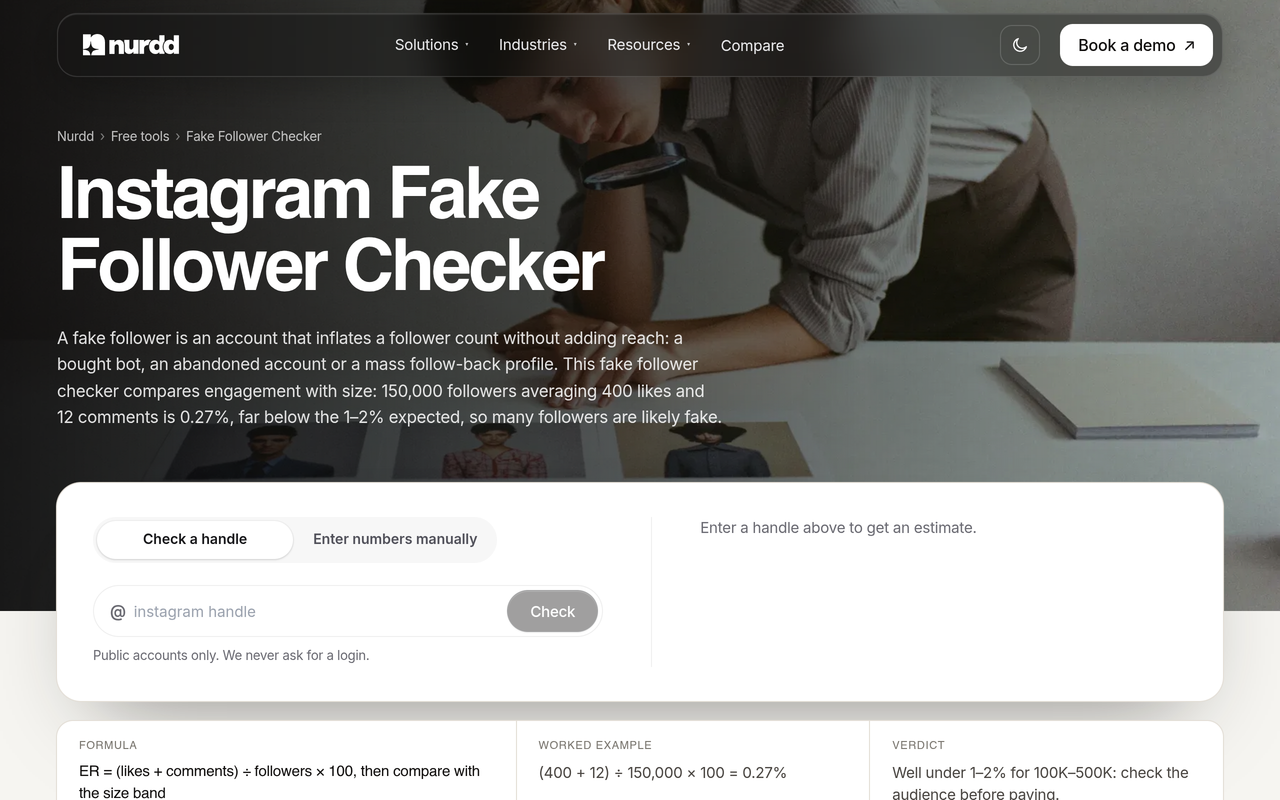
Action: have the agent compile engagement rate, audience location, fake-follower signals and a brand-match score for each shortlisted creator, then have a person read the last 10 to 20 posts of every creator you intend to pay. Result: a short, evidence-backed approve or reject list. Why: scores catch inflated audiences, but only a person notices tone, recent controversies or a competitor sponsorship from last week. You can sanity-check any account yourself with the free fake follower checker and the engagement rate calculator, and the fake follower audit checklist lists what each method misses.
Step 4: Use AI to draft first contact, and route by tier
Action: have the agent draft each first message from the creator's recent posts, then route it: low-spend creators get a sampled review (a person reads one in five, for example), and creators above your spend threshold get a person's approval on every message. Result: messages that mention something real and recent, sent at a pace your team can supervise. Why: a drafted message that misreads a creator's content is worse than a plain honest one. Require the agent to cite the specific post it referenced so a reviewer can check it in seconds.
Good first messages share a few traits: they say who you are and what the brand sells in one line, name the specific post that made you reach out, state the type of collaboration and whether it is paid, and make the next step easy. Compare that with the content you would brief later in how to brief a creator.
Step 5: Keep negotiation with a person, supported by data
Action: when a creator replies with interest, hand the thread to a named owner and give them an AI-prepared pack: the creator's published rates if any, benchmark ranges for their tier, your budget ceiling, and a draft brief. Result: negotiations that start informed and stay conversational. Why: price, usage rights and exclusivity are commitments. An automated counteroffer that a creator finds insulting rarely gets a second chance. Use the influencer rate card estimator for published USD ranges by tier and format, and read what to include in a rate card before you agree terms.

Step 6: Automate follow-ups, but cap them and stop on any reply
Action: set at most two or three nudges spaced several days apart, a global stop rule when a creator replies on any channel, and reminders for deliverable dates and content approvals. Result: fewer dropped threads without pestering anyone. Why: persistence helps only until it feels like pressure; a nudge sent after the creator already replied somewhere else is the most visible sign of careless automation.
Step 7: Audit weekly and measure outcomes past the reply
Action: each week, read a sample of sent messages and every reply that was negative or confused, log complaints, and track accepted offers, delivered posts and sales per creator. Result: a feedback loop that tells you whether automation is helping or only increasing volume. Why: reply rate alone rewards pushy messages. Compare cost per delivered post and attributed sales instead; the influencer performance attribution guide and the UTM structure guide show how to set that up.
What should you tell an AI agent it may and may not do?
Most outreach failures trace back to vague instructions. Write the agent's permissions as a short list a reviewer can check against every sent message.
- May: search and rank creators, compile vetting data, draft first messages that cite a real post, schedule capped follow-ups, log replies and flag them to an owner.
- May not: state a price, promise exclusivity or usage rights, answer a question about contract terms, send to anyone on the exclusion list, or contact an existing partner with a cold-style template.
- Must: stop on any reply, hand over the full thread to a named person when a creator mentions money, rights or a complaint, and record which post each message referenced.
Treat this list as the agent's job description. When something goes wrong, the question is whether the agent broke the list or the list was missing a rule, and the answer tells you what to fix.
When should the agent hand a thread to a person?
A handover rule is the most useful single safeguard in automated outreach. Define the triggers in advance so the agent does not have to judge them.
- Money: the creator mentions a rate, a fee, free product as payment or a budget.
- Rights: the creator asks about usage, whitelisting, exclusivity or how long content stays live.
- Emotion: the reply is annoyed, confused, sarcastic or asks why they were contacted.
- Third parties: a manager or agency replies on the creator's behalf.
- Anything off-script: a question the agent cannot answer from the brief.
On handover, the agent should pass the full thread, the post it referenced, the vetting notes and the stage it was at. The person then replies from a real name, so the creator never feels they were passed between systems without anyone owning the conversation.
What does a good AI-assisted first message look like?
A useful draft is short, specific and checkable. Below is a structure you can give an agent as a template, with a field the reviewer can verify.
- Opening line: who you are and what the brand sells, in one sentence.
- Proof of attention: the specific post you saw, with a link the reviewer can open.
- The offer: the type of collaboration and whether it is paid or product-only.
- The next step: one easy question, such as whether they would like a short brief.
- Opt-out: a plain way to say no thanks, which also protects email reputation.
What the agent must not do is just as important: it should not state a price, promise exclusivity or rights, invent a shared history, or flatter the creator about content it could not have watched. If the agent cannot cite the post, the message does not send.
What do the platform, email and disclosure rules say about automated outreach?
Automated outreach has to fit the channel's rules. Two public sources set practical boundaries for email and disclosure, and platform documentation covers direct messages.
For Instagram direct messages, Meta's developer documentation describes its messaging tools as a way for businesses to respond to people who message them, with limits on when and how an app can reply. The practical point: those tools are built for inbound conversations, not for cold-messaging creators at scale, so first contact by direct message is usually a person-led or tool-assisted task. Read Meta's current Instagram messaging documentation for the exact limits before you build anything.
For email, Google's own Email sender guidelines FAQ says senders should keep their spam rate below 0.1% and should prevent it from ever reaching 0.3% or higher. A batch of poorly targeted messages can push complaints toward those limits and affect your normal brand email too, so cold outreach should come from a properly authenticated domain with a clear way to unsubscribe.
For disclosure in the United States, the FTC's Endorsement Guides (16 CFR 255.5) say that a connection between a creator and a brand that might materially affect the weight or credibility of an endorsement, and that the audience would not reasonably expect, must be disclosed clearly and conspicuously. Such material connections can include a business, family or personal relationship, monetary payment, or free or discounted products. The practical rule is to put a clear disclosure requirement into your brief and into your agent's instructions, and never to have an agent write praise for a creator to post as if it were their own experience. Check the rules in your market. This is general information, not legal advice.
Which channel suits which stage?
| Channel | Best used for | Automation fit | Main risk |
|---|---|---|---|
| Cold first contact, briefs, contracts | Drafting and scheduled sends with an unsubscribe and stop rule | Spam complaints hurting domain reputation | |
| Instagram direct message | Warm replies, quick questions | Inbound replies only; first contact is person-led | Platform limits and the look of spam |
| Creator marketplace or platform inbox | Structured briefs and applications | High, within the platform's own rules | Generic templates among many similar offers |
| Phone or video call | High-value negotiation, ambassador deals | AI prepares notes; person runs the call | None from automation, because a person owns it |
How much autonomy should each type of creator get?
Not every creator deserves the same process. A second framework, tiered autonomy, sets how much an AI agent may do depending on the creator's value to you. Use spend and strategic importance as the two inputs.
| Creator type | Sourcing and vetting | First contact | Negotiation | Follow-up |
|---|---|---|---|---|
| Low spend, product seeding or small paid post | AI runs it; sampled human review | AI drafts and sends; one in five read by a person | Person on any reply asking for money or rights | AI, capped nudges |
| Mid spend, repeat partner candidates | AI gathers data; person approves | AI drafts; person approves every message | Person | AI reminders; person for any problem |
| High spend, ambassador or long-term deal | AI gathers data; person owns shortlist | Person writes or heavily edits | Person, senior sign-off | Person |
| Existing partner | Not applicable | Person only; no cold-style templates | Person | Person; AI for reminders and reports |
The last row matters most. Existing partners should never receive the same sequence as a stranger. If you want to know why repeat partners can underperform and what to change, read the influencer trap.
Worked example: sorting 120 shortlisted creators by tier
The numbers below are an illustrative calculation with assumptions we chose, not data from a study. They show how a tiered policy changes the human workload.
- Assumption: your agent shortlists 120 creators. You decide that 90 are low spend, 24 are mid spend and 6 are high spend.
- Low tier: a person reads one message in five, so 18 of 90 messages.
- Mid tier: a person approves all 24 messages.
- High tier: a person writes all 6 messages.
Total human-reviewed or human-written first messages: 18 + 24 + 6 = 48 of 120, or 40%. The other 72 go out drafted by the agent, with a person checking a sample. If your team spends five minutes on each reviewed message, that is 240 minutes, or four hours, of review work. Change the assumptions to your own counts and times and you have a staffing estimate before any tool is bought. Use the influencer ROI calculator to check whether the expected return justifies the creator budget itself.
How does this look for different teams?
A beauty brand seeding products
A beauty brand sending product to many small creators can let the agent source and draft at volume, since the stakes per creator are low. The person's job is to check that claims about ingredients or results are never put in a creator's mouth. Follow-ups are capped and stop when the creator replies.
A SaaS company seeking a few trusted voices
A SaaS team usually wants a handful of credible creators, so the agent builds the shortlist and vetting pack while a marketer writes every first message. Negotiation covers usage rights and exclusivity, which stay human. The macro-micro rule for B2B SaaS helps decide how to split the budget.
An agency running many clients
An agency needs consistent rules across accounts, so the one-page policy from step 1 is kept per client, with different spend thresholds. The weekly audit in step 7 becomes the quality gate before anything reaches a client's creators.
A checklist you can run before any agent sends a message
- Does the creator appear on your exclusion list (competitor ambassador, previous dispute, brand-safety flag)?
- Has a person read at least the last 10 posts of any creator you plan to pay?
- Does the message name a specific recent post, and is that post real and correctly described?
- Does it state who you are, what you sell and whether the collaboration is paid?
- Is the channel allowed for automated sending (email with unsubscribe, or a person for direct messages)?
- Does the message avoid promising price, rights or exclusivity?
- Is a stop rule active so that any reply on any channel halts further nudges?
- Is there a named owner for replies, with a response target (for example, the same working day)?
- Does your brief tell the creator to disclose the partnership clearly?
- Will the result be tracked with a UTM or code so you can compare creators by sales, not just replies?
How can I test whether AI outreach helps or hurts?
Run a two-week split test using only information you can see in your own inbox. Split a similar group of creators in two. Send one group human-written messages and the other AI-drafted ones with human sampling. Keep tier, channel, offer and timing the same.
Then compare five things, not only the reply rate:
- Positive reply rate versus any negative or confused reply.
- Share of replies that ask a real question about the brief, a sign the message landed.
- Time from first message to agreed terms.
- Share of agreed creators who deliver on time.
- Sales or tracked actions per creator after the posts go live, which the campaign benchmarker can put against benchmarks.
If AI-drafted messages win on volume and time but lose on delivery or tone, tighten the review rule rather than abandoning automation. With small groups the result is directional, not statistical proof, so repeat it before you change policy.
What are the common mistakes in AI influencer outreach?
- Letting the agent negotiate. A single bad counteroffer costs more than the hours saved.
- Fake personalisation. Mentioning a post the creator never made, or praising a video you did not watch, is obvious and often shared.
- No stop rule. Nudging a creator who already replied by direct message shows nobody is reading.
- Treating existing partners like leads. Long-term creators expect personal contact.
- Skipping vetting in the rush to volume. Without a check on audience quality you pay for reach that is not there. See how to vet an influencer's audience before paying.
- Measuring only replies. Reply rate says nothing about delivery or sales.
- Ignoring a missed deliverable. When a creator does not deliver, a calm human response works better than a sequence; follow the brand's playbook for when an influencer does not deliver.
Where does Nia by Nurdd fit?
Nia by Nurdd is an AI-native creative studio with influencer marketing built in, so discovery and campaign work sit in one place. It discovers creators from a database of 10M+ profiles across Instagram and other platforms, filters by niche, audience quality, engagement authenticity and brand match score, and detects fake followers with TruAI, Nurdd's proprietary technology. It also forecasts ROI before spend and attributes product-level sales to creators afterwards. It does not replace the conversation with a creator; that stays with your team.
Book a demo at https://www.nurdd.club/demo to see Nia by Nurdd run discovery, fake follower detection and a pre-spend ROI forecast for your own brand and category.
In the framework above, Nia's discovery and vetting data support the sourcing and vetting stages, and its forecasts and sales attribution give your team evidence for pricing conversations and the weekly audit. Read more on the Nia overview page or at getnia.studio, compare it with other tools on the comparison hub or see Nia vs Insense. Nia is priced below comparable plans. If you would rather hand the work over, the influencer marketing agency service runs creator campaigns on Nia, and the best influencer marketing platforms guide shows the wider field. To connect replies and deals to your customer records, see the CRM integration guide, and to prioritise by expected sales rather than follower count, read how to pick influencers based on predicted sales.
The bottom line on automating influencer outreach
Use AI agents where the work is repetitive and the cost of an error is small: sourcing, vetting data, drafting and follow-up scheduling. Keep people on first contact for important creators, on negotiation and on every relationship that you want to last. Set the rules in writing, tier your creators, cap the nudges and measure delivery and sales, not replies.
Want to see this for your own brand? Book a demo and you will see Nia by Nurdd finding and vetting creators in your category, with fake follower checks and a pre-spend ROI forecast.
How we researched this
We reviewed publicly available material: vendor and industry articles on AI influencer outreach, Aspire's and Influencer Marketing Hub's published research, Google's email sender guidelines FAQ and the FTC's Disclosures 101 page. The Aspire and Influencer Marketing Hub figures were compared with the text on those publishers' own pages. We did not run hands-on tests of rival tools, and the worked example uses assumptions we chose, not customer data. Vendor claims are labelled as such.
Frequently asked questions
Can AI agents handle influencer outreach?
They can handle much of it: finding creators, gathering vetting data, drafting messages and scheduling follow-ups. They should not own negotiation, rights or dispute handling. Keep a named person responsible for any conversation involving money or trust.
How do I automate influencer outreach without hurting relationships?
Automate by stage, not wholesale. Require a person to approve messages to priority creators, cap follow-ups, stop all nudges when a creator replies anywhere and treat existing partners personally. Audit sent messages weekly so errors are caught early.
Will creators know a message was written by AI?
Often, if the message is generic or gets a detail wrong. Messages that cite a specific, correct recent post and make a clear offer read as relevant whatever tool drafted them. Always have the agent name the source post so a reviewer can verify it.
Can an AI agent send Instagram direct messages to creators?
Meta's messaging tools are built mainly around responding to people who message a business, so cold first contact by direct message is typically done by a person or with a tool's assisted workflow. Limits change, so check Meta's current documentation before building anything.
Should AI negotiate influencer rates?
No. Use AI to prepare rate context and a draft brief, then have a person negotiate. Price, usage rights and exclusivity are commitments, and a poorly judged counteroffer can end a relationship before it starts.
What should I measure to know if AI outreach works?
Measure beyond reply rate: positive versus negative replies, time to agreed terms, on-time delivery and sales per creator. Use UTMs or codes to attribute results, and run a split test between AI-drafted and human-written messages before scaling.
Does Nia by Nurdd send outreach for me?
Nia by Nurdd covers discovery, vetting with TruAI fake follower detection, pre-spend ROI forecasting, campaign management and sales attribution. The relationship with each creator stays with your team. To see how it would work for your category, book a demo.