Paid Media
Should a Paid Media Agency Report on AI Search?
Yes, add AI search to paid reports, but as a separate section with its own metrics, so it never muddies ROAS. Here is what to include and how.
 Sheetal Shakshi6 Nov 202618 min read

Yes. A paid media agency should report on AI search, because AI answers now sit beside paid results and change clicks, but it should do so in a separate section from ad metrics. Use Pulse for Meta and Google Ads performance and Noma for brand mentions and citations across 13 AI engines.
Should a paid media agency report on AI search? Yes, but as its own clearly labelled section, not blended into ROAS, CPA or CTR. AI answers now appear next to paid results and change how many people click, so clients will ask about them. Paid media agency reporting on AI search works when it adds visibility metrics (mentions, citations, share of voice) beside, not inside, ad performance.
This guide is for agency leads, media buyers and in-house paid teams who have been asked, or expect to be asked, what AI search means for the monthly report. It covers what to include, what to leave out, how to keep the numbers apart, and how Pulse by Nurdd and Noma by Nurdd split the work between the ad layer and the AI search layer.
Key takeaways
- Report AI search in a separate section with its own metrics. Never fold AI mentions into ROAS, CPA or conversion counts.
- Google Ads does not give a separate report for ads inside AI Overviews, so do not promise one. Report Top Ads signals and say what is unknown.
- The core AI search metrics are brand mention rate, citation rate, share of voice against named competitors and the pages cited, tracked on a fixed prompt set.
- Search Console counts AI Overviews and AI Mode impressions together, and the clicks sit inside the normal web report, so label any AI click number as an estimate.
- Agree the scope, owner and cadence with the client before the first report, and state what the agency is and is not accountable for.
- Use one tool for the ad layer (Pulse) and another for the AI search layer (Noma), so each number has one source.
Why are clients asking paid media agencies about AI search?
Clients ask because the search results page they pay to appear on has changed. In a March 2025 analysis, Pew Research Center, July 2025 found that users who saw an AI summary clicked a traditional result link in 8% of visits, against 15% for those who did not. Only 1% of visits to pages with an AI summary included a click on a link inside the summary.
That is a shift in where attention goes, and paid teams feel it first because CPCs, impression share and click-through rates all sit on that same page. A client who sees CTR slip will ask whether it is the creative, the auction or the AI answer. If the report has no AI search section, the agency has no evidence for the third explanation.
There is also a budget conversation. AI surfaces are becoming paid channels as well as organic ones, which means a client may ask the agency to explain both in the same meeting. An agency that arrives with a measured answer first controls the framing.
What does a paid media report miss without AI search?
A paid report covers what you bought. It does not cover whether the brand is named when someone asks an AI assistant for a recommendation, which is where research increasingly happens before any ad is clicked. The gap shows up in three places.
- Branded search lift and demand. If an AI answer recommends a competitor, branded search volume and conversion rate can weaken with no change in the ad account.
- Click-through on non-brand terms. An AI summary can absorb the click that a text ad or organic result used to get.
- New paid surfaces. Ads now run inside AI Overviews, and OpenAI has opened ads in ChatGPT, so the paid plan itself touches AI search.
None of these gaps is fixed by adding a metric to Google Ads. They are fixed by adding a second data source that measures the AI layer and presenting it next to the first.
What does Google actually report about ads in AI Overviews?
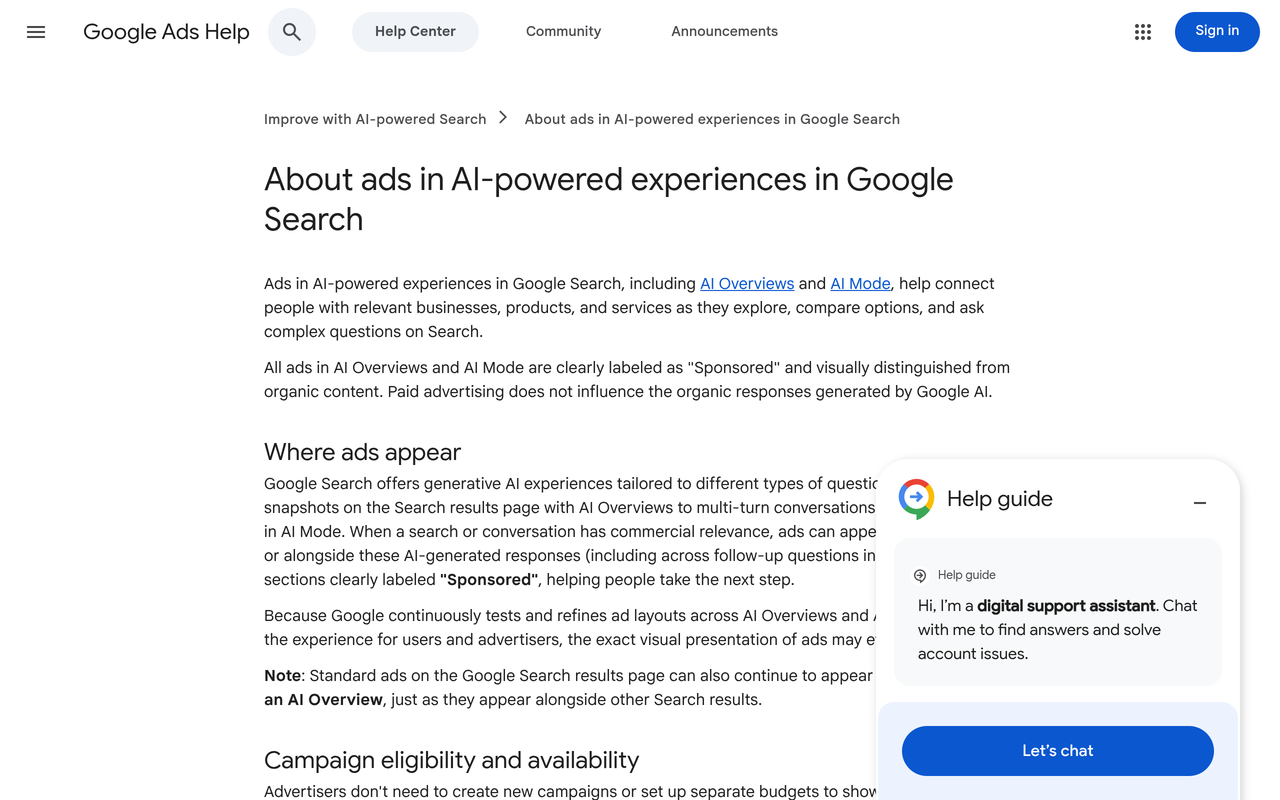
Less than many agency decks imply. According to Google Ads Help, ads in AI Overviews are reported as Top Ads, you cannot target placements only inside AI Overviews, you cannot opt out of serving there, and Google Ads does not currently offer segmented reporting for ads shown within AI Overviews.
A practical read-through from PPC News Feed reaches the same conclusion for agencies: do not promise a client an AI Overviews performance report, and watch Top impression rate and Top of page rate as the closest proxy signals. That advice is sound. A report should state the limit rather than invent a number.
Google Ads does not provide a separate report for ads that appear inside AI Overviews. They roll into Top Ads, so any agency figure for AI Overview ad performance is an estimate, not a platform number.
The organic side has a similar limit. Search Engine Journal reports that the Search Console Generative AI Performance Report counts impressions for AI Mode and AI Overviews collectively, while clicks from those features remain inside the standard Performance report as part of all web results. Search Engine Journal also reports the AI reports have rolled out to all websites worldwide, and Google introduced them on the Google Search Central Blog, June 2026.
How do you add AI search to a paid media report?
Follow these six steps. Each one states the action, the result you get and why it matters, so you can adapt it to your own reporting stack.
Step 1. Agree the scope and ownership in writing
Action: Add one page to the statement of work that says the agency will report on AI search visibility, who acts on it (paid, SEO or content), and what the agency is not accountable for. Result: The client knows AI search is measured, not managed, unless a separate service covers it. Why: Reporting a number the agency cannot influence creates blame without remedy. If the client also wants the numbers improved, scope that as a separate service such as answer engine optimization.
Step 2. Build one fixed prompt set
Action: Write 20 to 40 prompts a real buyer would ask, grouped by category, comparison and brand questions, and freeze them for the quarter. Result: Month-to-month changes mean something. Why: AI answers vary, so a moving prompt list makes every trend line unreadable. The guide on which prompts to track shows how to choose them.
Step 3. Pick the four core AI search metrics
Action: Track brand mention rate, citation rate, share of voice against three to five named competitors, and the list of pages cited. Result: Four numbers that a client can read in a minute. Why: They map to the questions clients ask: are we named, are we sourced, are we ahead, and from where. Definitions follow in the next section, and the share of voice guide covers the maths.
Step 4. Put the AI section on its own page
Action: Place AI search after the paid sections, on its own page, with its own date range, source line and a note on what it does not measure. Result: ROAS and CPA stay clean. Why: AI visibility is a leading indicator with no direct click or conversion tie, so mixing it with attributed revenue invites false arithmetic.
Step 5. Add a single bridge line, not a bridge metric
Action: Close the AI page with two or three observations that connect it to paid results, for example a competitor gaining share of voice in a category where your CTR fell. Result: The client gets the story without a fake formula. Why: Correlation notes are honest; a blended index is not defensible when challenged.
Step 6. Set a cadence and an action list
Action: Report AI search monthly, review prompt sets quarterly, and end each report with up to three actions with owners. Result: The section drives decisions rather than filling space. Why: A visibility number with no owner is the first thing a client stops reading. The monthly AI search report guide has a longer layout.

What AI search metrics belong in a paid media report?
Four AI search metrics belong in the report: brand mention rate, citation rate, share of voice and cited pages. Two supporting items help: sentiment or positioning notes, and any AI referral sessions visible in analytics. Everything else is detail for a specialist appendix.
| Metric | What it answers | How to read it | Where it sits |
|---|---|---|---|
| Brand mention rate | In what share of tracked prompts is the brand named? | Prompts with a mention divided by prompts tracked, per engine and per category | AI search page |
| Citation rate | How often is a brand page linked as a source? | Answers that cite the brand domain divided by answers tracked | AI search page |
| Share of voice | How does the brand compare with named rivals? | Brand mentions as a share of all tracked brand mentions | AI search page |
| Cited pages | Which pages and third-party sources do engines trust? | Ranked list of URLs cited, brand-owned and external | AI search page, action list |
| AI referral sessions | Do any visits arrive from AI assistants? | Analytics sessions from known assistant referrers; treat as a floor, not a total | Footnote, not a headline |
| Top impression rate, Top of page rate | Is paid search showing in the most visible positions? | Google Ads proxy for the AI Overview era, not a direct measure | Paid search page |
Notice the last row. It belongs on the paid page, because it comes from Google Ads, even though it is relevant to the AI question. The rule is simple: if the platform that owns the number is an ad platform, it goes in the paid section; if the number comes from sampling AI answers, it goes in the AI section. More detail on definitions is in the AI search metrics reporting guide and the comparison of AI search metrics and SEO metrics.
How do you keep AI search separate from ad metrics?
Use a four-rule separation test. If a proposed number fails any rule, it does not go beside ROAS.
- One source per number. Every figure names the system that produced it: Meta Ads, Google Ads, Search Console, analytics or an AI visibility tracker.
- No shared denominators. Do not divide ad spend by AI mentions or add AI citations to conversions. The units are different.
- No attribution claims without a method. An AI mention is not a click. If the client wants to estimate downstream impact, use a stated experiment, such as the approach in the GEO experiment design guide.
- Unknowns are written down. The report lists what the data cannot show, such as ads inside AI Overviews, so the client never has to find the gap alone.
The same discipline applies to ad numbers themselves. Dashboard ROAS often disagrees with the bank balance, as the post on why Meta ROAS looks inflated explains, so mixing a softer AI metric into it makes a shaky number worse.
A worked example: reading a CTR dip with and without an AI section
This example uses real published figures from Pew for the arithmetic, applied to an invented round number of visits for illustration. It is not client data.
Suppose a client sees 1,000 visits to Google results pages for a non-brand category. Pew's March 2025 figures suggest roughly 150 of those visits would include a click on a traditional result when no AI summary appears (15%), and roughly 80 when one does (8%). If the share of searches that show an AI summary in the category rises, the click total falls even if the ad account has not changed.
| Scenario | Visits | Click rate on traditional results | Clicks |
|---|---|---|---|
| No AI summary shown | 1,000 | 15% | 150 |
| AI summary shown | 1,000 | 8% | 80 |
Pew measured organic result links, not paid ads, so this does not predict ad CTR. What it does show is why a report needs to separate two explanations. Without an AI section, the agency can only offer creative fatigue or auction pressure. With one, it can add: the category prompts now return AI answers that name two competitors and not the client, and that is a different problem with a different owner.
For the paid side, benchmarks give context. Nurdd's benchmarks hub records Triple Whale medians (August 2025 to July 2026) of a $15.06 CPM and 1.88 ROAS on Meta and $15.35 and 3.27 on Google Ads, which let a report judge ad results against category norms before any AI conversation starts. Check your own numbers with the Google and Meta ROAS calculator.
Which paid surfaces in AI search should the report cover?
Two paid surfaces now touch AI search, and each needs a line item with its own caveats.
Google ads in AI Overviews and AI Mode
These ads come from your existing Search, Shopping and Performance Max campaigns, and Google decides placement. Report them under Top Ads and state plainly that there is no segmented view. The guide to reporting on ChatGPT ads and AI Overviews goes further on wording.
ChatGPT ads
OpenAI, May 2026 describes a beta self-serve Ads Manager, cost-per-click bidding and expanded measurement tools, and says advertisers can also buy through partners. It states that advertisers do not receive conversations or personal details. Digiday reported that the ad pilot reached $100 million in spending while questions about ROI lingered. Treat ChatGPT ads as a separate paid channel with its own page and its own measurement, never as part of AI visibility. See how to advertise on ChatGPT for setup and measurement.
A key distinction for clients: paying for a ChatGPT ad does not buy a mention in the answer itself, and being named in an answer cannot be bought. That is why the paid channel and the visibility metrics must stay on different pages.
Paid report versus AI search report: what goes where?
| Question the client asks | Section | Data source | Cadence |
|---|---|---|---|
| Did ads hit the ROAS target? | Paid performance | Meta Ads, Google Ads | Monthly, weekly check-ins |
| Why did CPA move? | Paid diagnosis | Meta Ads, Google Ads | Monthly |
| Are we in the most visible ad positions? | Paid search | Google Ads Top impression rate, Top of page rate | Monthly |
| Does an AI assistant recommend us? | AI search | AI visibility tracker | Monthly |
| Which rival is cited more than us? | AI search | AI visibility tracker | Monthly |
| Are Google AI features showing our pages? | AI search, organic | Search Console Generative AI report | Monthly |
| Are ChatGPT ads working? | Separate paid channel | OpenAI Ads Manager reporting | Monthly |
This table doubles as a quick scoping tool in a kickoff call. Run down the client's top questions and see which section each one lands in. Anything that lands on two sections at once is a sign the question needs to be split.
How do Pulse and Noma divide the reporting work?
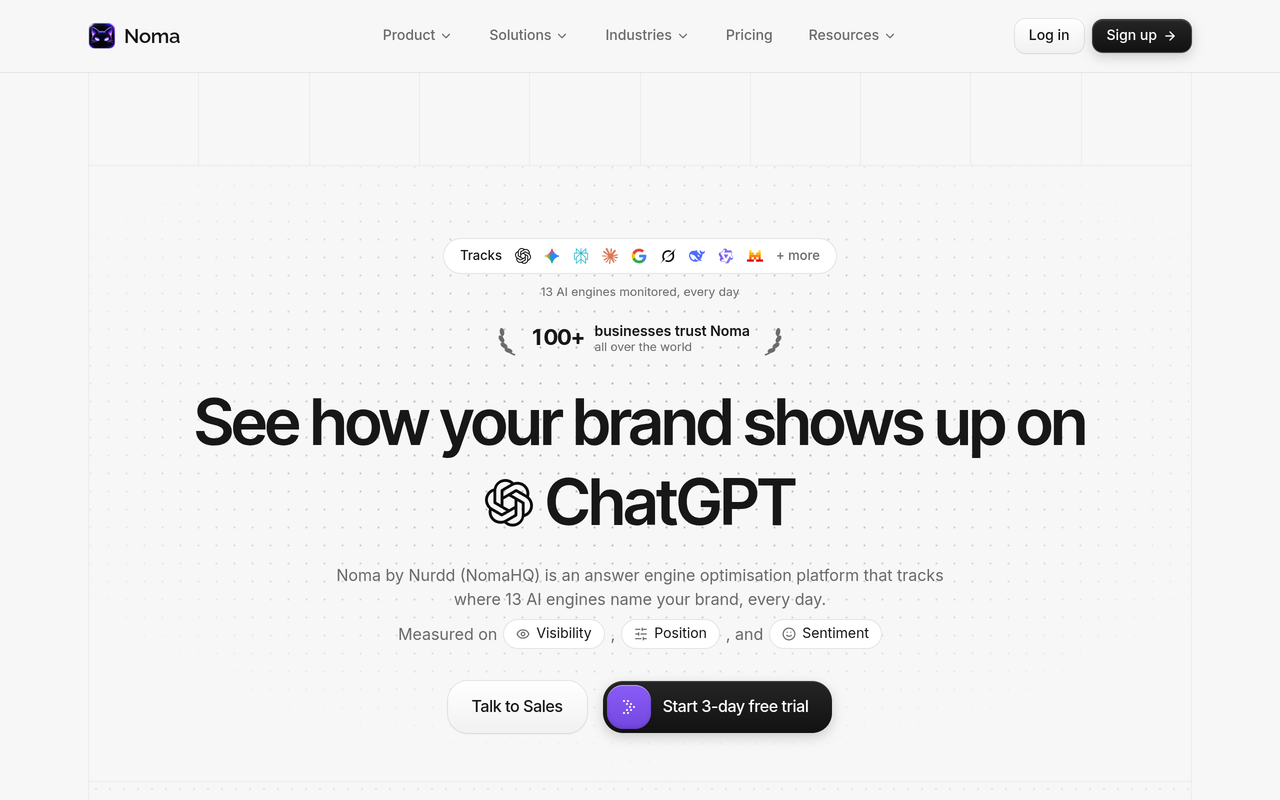
Pulse and Noma are two separate products from Nurdd, and they cover two separate layers. Pulse by Nurdd is the ad layer; Noma by Nurdd is the AI search layer. Keeping them apart mirrors the separation the report needs.
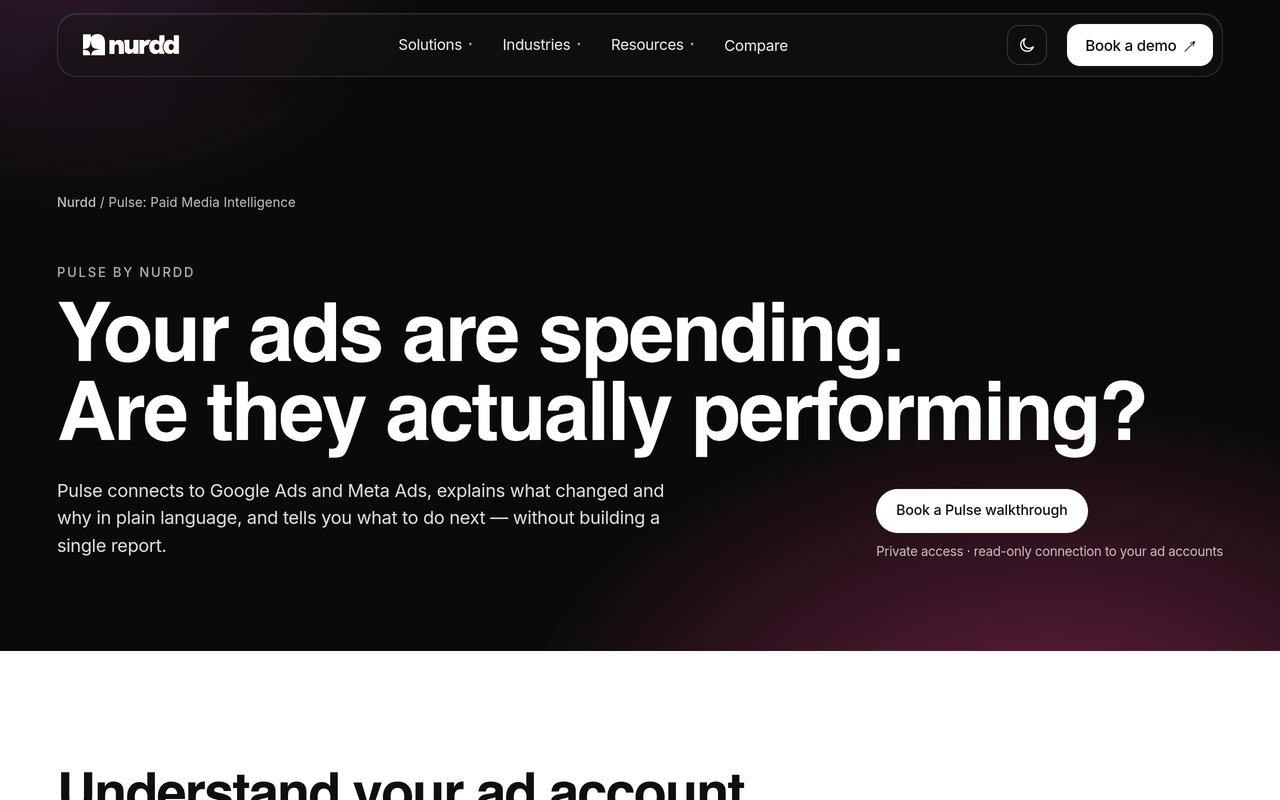
Pulse by Nurdd is a web dashboard that connects to Meta Ads and Google Ads through read-only OAuth. It explains campaign performance in plain language, diagnoses what changed and recommends specific actions, without anyone building reports by hand. Pulse is paid, has no trial and is in private access, so the route in is a walkthrough.
Noma by Nurdd tracks whether a brand appears in answers from 13 AI engines, including ChatGPT, Gemini, Perplexity and Claude, polled daily. It shows citation frequency by category, a competitor comparison and recommendations for improving AI visibility. Noma has a 3-day free trial; a card is taken at signup and billing starts on day 3, with no charge if you cancel before then.
Nurdd is an AI marketing intelligence company, and Pulse belongs in this answer because it handles the paid half of the report that agencies already own: reading Meta and Google Ads performance and explaining changes. Noma belongs because it supplies the AI search half, which ad platforms cannot, and each product keeps its numbers in its own dashboard.
Want to see how the two layers fit your own reporting? Book a demo to see Pulse and Noma: how Pulse presents Meta and Google Ads performance, and how Noma shows which of 13 AI engines name a brand and which pages they cite.
What does the combined report look like?
A one-page-per-layer template keeps the monthly pack short. Copy this outline and fill it from the two sources.
- Page 1: Paid summary. Spend, ROAS or CPA against target, change from last month, benchmark comparison. Source: Meta Ads and Google Ads.
- Page 2: What changed and why. Top three movements with a cause and an action. Source: ad account diagnosis.
- Page 3: Paid search visibility. Top impression rate and Top of page rate, with a note that ads inside AI Overviews are reported as Top Ads.
- Page 4: AI search visibility. Mention rate, citation rate, share of voice, cited pages, by engine. Source: AI visibility tracker.
- Page 5: Google AI features in organic. Search Console generative AI impressions, with the note that clicks sit in the standard report.
- Page 6: Unknowns and actions. What cannot be measured this month, and up to three actions with owners.
Teams comparing tooling for this layout can read paid social agency versus software and paid social reporting: agency or software. Teams with a managed brief can look at Nurdd's paid social advertising service, which reports monthly against published benchmarks.
What should you check before sending the first AI search report?
Run this checklist once before the first pack goes out, then keep it as a standing review step.
- Confirm the statement of work names who owns AI search actions.
- Check the prompt set is frozen, dated and covers category, comparison and brand questions.
- Confirm every number names its source system.
- Check no AI metric sits on a page with ROAS, CPA or conversions.
- Write the unknowns box, including ads inside AI Overviews and any AI click figures.
- Add the competitor view next to each brand number.
- List no more than three actions, each with an owner and a date.
If an item fails, fix it before sending. A client who spots a blended number or an unsourced figure on the first report will read every later report with suspicion.
What are the common mistakes when agencies report on AI search?
- Blending AI mentions into ROAS. There is no valid formula, and a client who spots one will distrust the whole report.
- Promising AI Overview ad reporting. Google Ads Help says segmented reporting does not currently exist, so the promise cannot be kept.
- Quoting one screenshot as a trend. A single AI answer is an anecdote. Use a fixed prompt set sampled repeatedly.
- Reporting traffic only. AI referral sessions understate influence, because many users read an answer and never click. Pew found only 1% of visits to pages with an AI summary included a click on a link in the summary.
- Skipping the competitor view. A mention rate of 30% means little until the client sees a rival at 55%.
- Changing prompts every month. Trend lines break and the report loses credibility.
- Ignoring that AI answers can differ by user. See the note on personalization in AI answers before quoting one result.
Should every agency add AI search, or only some?
Use this decision table to decide how much to include. It is a judgement framework, not a statistic.
| Client situation | Recommended depth | Why |
|---|---|---|
| Non-brand search drives most paid revenue | Full AI search page, monthly | AI summaries sit on the same results pages as these ads |
| Shopping or ecommerce with product comparison queries | Full AI page plus product-prompt set | Assistants are used for product recommendations |
| Mostly Meta, brand-led demand | One-page summary, quarterly deep dive | Less exposure on Google results pages; still worth knowing if the brand is named |
| Client already pays for AEO or GEO services | Shared dashboard, agency reads and comments | Avoid double reporting; keep the paid report clean |
| Client has not asked and has tiny budgets | Offer a one-off audit | A monthly page may cost more than it informs |
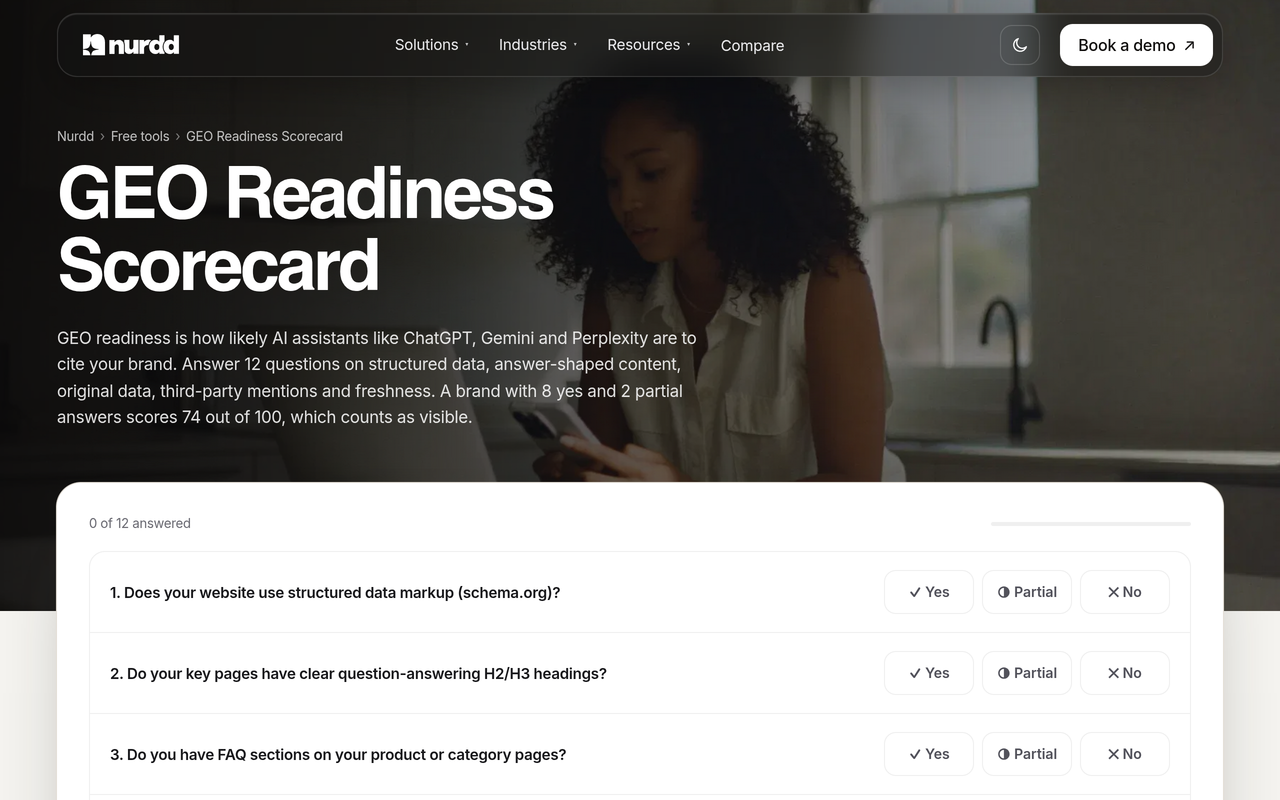
To judge readiness before adding the section, run the client's site through the free GEO readiness scorecard, a 12-factor check of readiness for AI answers. It gives the conversation a concrete starting point.
Is it worth charging for AI search reporting?
Reporting that merely repeats a dashboard is hard to charge for. Reporting that interprets the dashboard, flags what changed and assigns actions is easier to justify, particularly when it prevents the client buying a separate monitoring tool they cannot read. Agencies adding the layer should decide in advance whether it is included in the retainer, scoped as an add-on, or sold alongside optimisation work.
If the client wants the visibility numbers improved, not just reported, that work sits with content, technical and third-party source building. Nurdd's generative engine optimization services do that, measured in Noma, and the primer on what generative engine optimization is explains how it differs from SEO.
How we researched this
We reviewed platform documentation (Google Ads Help, Google Search Central), OpenAI's published advertising announcement, a Pew Research Center study, and trade press from Search Engine Journal, Digiday and PPC News Feed. Numbers are quoted as the source states them. We did not run hands-on tests, interview agencies or use customer data, and the worked example uses an invented round figure for illustration only.
Frequently asked questions
Should my paid media agency report on AI search?
Yes, as a separate section. AI answers appear on the same results pages as paid ads and change click behaviour, and clients will ask about them. The agency should state clearly what it measures, what it cannot measure and who owns the actions, so the report adds clarity without muddying ad results.
What AI search metrics belong in a paid media report?
Brand mention rate, citation rate, share of voice against named competitors and the list of cited pages, tracked on a fixed prompt set. Add Search Console generative AI impressions and any AI referral sessions as supporting footnotes. Keep Google Ads proxies such as Top impression rate on the paid page.
Can Google Ads report on ads inside AI Overviews?
Not separately. Google Ads Help says ads in AI Overviews are reported as Top Ads and that segmented reporting is not currently offered. Agencies should report Top Ads signals and say plainly that the placement cannot be isolated.
Do AI mentions count as conversions or attributed revenue?
No. A mention is a visibility signal, not a click or a sale. If a client wants to estimate impact, run a documented test and label the result as an estimate. Do not add mentions to ROAS or CPA.
How often should AI search be reported?
Monthly works for most accounts, with the prompt set reviewed quarterly. Daily or weekly polling is useful for the tool, but a client report that changes weekly invites noise. Pair the monthly view with a short action list.
Does Search Console show AI Overview clicks?
Not as a separate figure. According to Search Engine Journal, the Generative AI Performance Report counts AI Mode and AI Overviews impressions together, and clicks are included in the standard Performance report with all web results. Label any AI click number as an estimate.
Which tool should track AI search for a paid media agency?
Use a tracker built for AI answers rather than an ad platform. Noma by Nurdd tracks 13 AI engines, including ChatGPT, Gemini, Perplexity and Claude, and records whether the brand is named and which page is cited. Pulse by Nurdd covers the Meta and Google Ads side.
Are ChatGPT ads part of AI search reporting?
They are a paid channel and belong in the paid section with their own measurement. Paying for an ad does not buy a mention in an answer, so ad spend and brand visibility should be reported on different pages.
Next step: see both layers for your own brand
The fastest way to settle the scope question is to look at how the reporting would work for you. Book a demo with Nurdd to see Pulse and Noma: how Pulse reads Meta and Google Ads performance in plain language, and how Noma shows which AI engines name your brand, which competitors they name instead and which pages they cite. You can also read how the pieces fit on the How Nurdd works page.