Paid Media
Meta Ads Beauty Content Types: What to Test First
A testing order for beauty and perfume Meta ads: creator video, demo, UGC and static, and how to read engagement against purchase signals.
 Sheetal Shakshi2 Nov 202618 min read

For most beauty brands, test creator-led video first, then a product demo, then a proof format such as a testimonial or before-and-after, and keep static and carousel for retargeting. Perfume is the exception: start with brand-controlled mood video and a gifting angle. Judge every format on purchase signals, not on likes.
The Meta ads beauty content types to test first are creator-led video, then a product demo, then a proof format such as a testimonial or before-and-after, with static and carousel held back for retargeting. Perfume changes the order, because scent cannot be shown. Rank every format by purchase signals, not by likes or views.
Key takeaways
- Test in this order: creator video, product demo or tutorial, proof stack (testimonial, before-and-after), then static and carousel for retargeting.
- For perfume, open with brand-controlled mood video and a gifting angle, because the published evidence says fragrance is the one beauty sub-vertical where polished brand creative still holds up.
- Test distinct concepts, not small edits of one ad. Meta's delivery system now rewards creative diversity.
- Write down the purchase signal (cost per purchase, add-to-cart rate, new-customer share) before launch, and use engagement only as a diagnostic.
- Compare formats against the same quarter. Beauty ROAS swings seasonally, so a Q4 result is not comparable with a Q1 result.
- Repeat each winning format test for each campaign objective you plan to use it in.
Which Meta ad content types work best for beauty brands?
Published industry analyses agree on a direction, not on exact numbers. Short, creator-style video leads for cold prospecting, proof-heavy formats do the work in the middle, and static and catalogue ads are used for remarketing. The figures below come from vendor and agency analyses, so treat them as starting hypotheses to confirm in your own account.
Webtonic summarises AdLibrary's cosmetics analysis in a format table. It lists UGC creator-led video at +35–55% CTR versus static, before-and-after carousel at +20–35%, tutorial video at +15–30%, and founder or expert testimonial at +25–40% (Webtonic, October 2026). The same page says UGC beats studio creative on CTR in cold traffic in every cosmetics sub-vertical except luxury fragrance, where brand-controlled aesthetics still win.
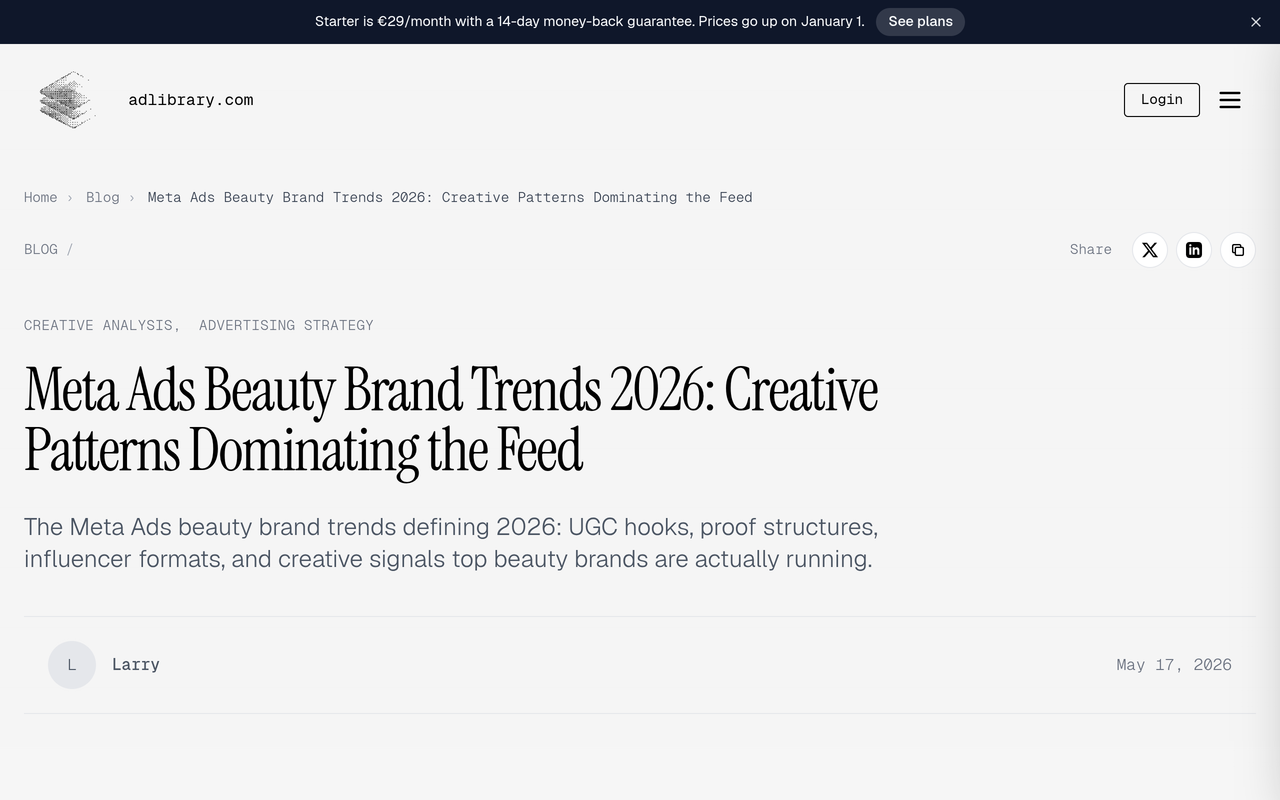
AdLibrary describes phone-filmed, creator-narrated UGC-style creative as the default prospecting layer for most DTC beauty brands, with mid-market brands often using creator content for prospecting and brand video for retargeting (AdLibrary, October 2026). That is a sensible prior. It is still a prior, and the rest of this guide shows how to turn it into a result you can trust.
What is the right testing order? A quick decision table
The order below is a framework built from the sources in this article, not a published standard. It follows funnel depth: first find what earns attention from cold audiences, then what explains the product, then what removes doubt, then what closes. Each stage has one question and one signal that answers it.
| Order | Content type | Question it answers | Primary signal | Typical placement in the funnel |
|---|---|---|---|---|
| 1 | Creator-led video (UGC style) | Will a cold audience stop and watch? | 3-second views, then cost per landing page view | Prospecting |
| 2 | Product demo or tutorial | Does seeing the product in use drive intent? | Add-to-cart rate, cost per add-to-cart | Prospecting and mid-funnel |
| 3 | Proof stack: testimonial, before-and-after, expert | Does evidence remove the doubt? | Cost per purchase, new-customer share | Mid-funnel |
| 4 | Carousel (shades, variants, bundles) | Can people self-select a product? | Swipe-through, then purchase rate | Mid-funnel and retargeting |
| 5 | Static (shade range, ingredient call-out, offer) | Is the value clear at a glance? | Cost per purchase on warm audiences | Retargeting and catalogue |
Perfume swaps rows 1 and 3 in practice: start with a brand-controlled mood film and a gift angle, then add creator reactions as proof. The perfume section below explains why.
Why is testing beauty creative on Meta so hard?
Three things make beauty testing noisier than most categories. The first is that Meta's delivery system has changed what a test means. The second is that "beauty" is several businesses with different economics. The third is seasonality, which can make a good ad look bad for reasons unrelated to the creative.
Meta now rewards distinct concepts, not small edits
Dentsu's analysis of Meta's Andromeda system, introduced in July 2025, says it performs best when advertisers supply distinct creative concepts rather than minor variations of one idea. It names testimonials, product demos, emotional storytelling and humour as examples of distinct concepts (Dentsu, October 2026). Soku, citing Meta's April 2025 post, reports that Meta says the focus has shifted from niche targeting to creative diversification, and that Meta tells advertisers to "forget the idea of a 'perfect ad'" (Soku, October 2026).
For testing, this means a resize, a recoloured background or a new button label is not a new test cell. Count distinct concepts, not ad objects. A creator demo, a dermatologist testimonial and a before-and-after are three concepts. Three crops of the same creator demo are one.
Beauty is five businesses, not one
AdLibrary splits beauty on Meta into skincare, haircare, personal care, beauty tools and devices, and wellness, and warns that category-wide benchmarks mislead. Its published ranges include skincare CPM of $14–22 and CPA of $38–95, and personal care CPM of $8–13 and CPA of $18–40 (AdLibrary, October 2026). If your brand sells a $12 lip balm and a $180 serum, test them as separate businesses with separate benchmarks. The Nurdd beauty industry page covers how that category's marketing differs.
Seasonality can fake a winner or a loser
Webtonic, citing eMarketer and Cart.com data on 35+ accounts, reports that beauty social ROAS dipped to $1.90 in Q4 2024 and recovered to $3.50 in Q1 2025, an 84% rebound (Webtonic, October 2026). A format that runs through holiday auctions and another that runs in January are not on a level field. Run formats you are comparing in the same window.

How do I test creative formats on Meta, step by step?
Follow these seven steps in order. Each one states the action, the result you should get, and why it matters.
Step 1: Fix the purchase signal before you launch
Action: Write down one primary metric (cost per purchase or blended new-customer CAC), two supporting signals (add-to-cart rate and landing page view rate) and the engagement metrics you will read only as diagnostics (3-second view rate, hold rate, shares, saves). Result: a one-line decision rule such as "the cell with the lowest cost per purchase after the agreed spend wins." Why: if you pick the metric after seeing results, the most flattering number always wins.
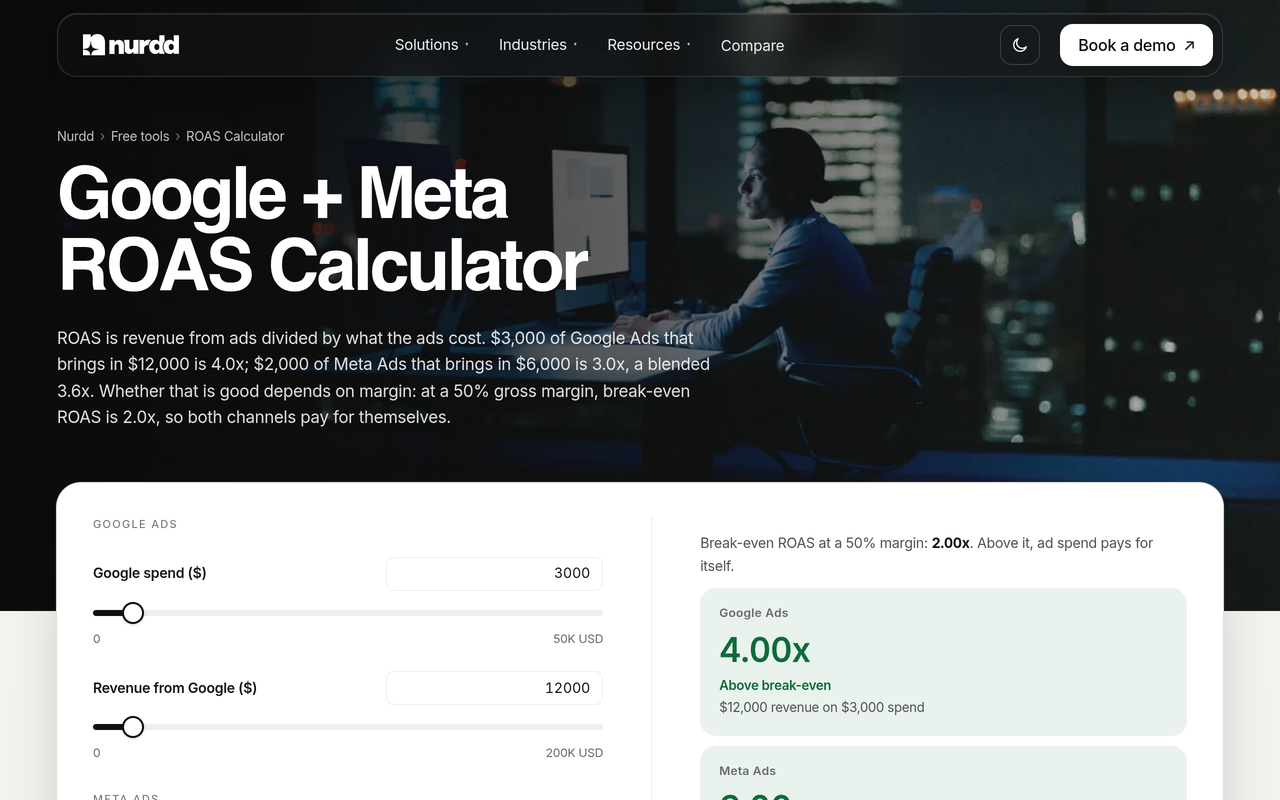
Webtonic's roundup cites a DTC beauty CAC average of $60.45 and cosmetics CPA of $28–$95 depending on average order value and funnel stage (Webtonic, October 2026). Use numbers like these only as a sanity range. Your own break-even, from your margin, is the real threshold, and the Google + Meta ROAS calculator will show it.
Step 2: Build clean test cells
Action: Use Meta's A/B test tool, or separate ad sets with identical audience, placement and budget, so each concept competes on equal terms. Give each cell one creative concept. Result: cells that differ in only the thing you are testing. Why: Meta's own help guidance warns that you may need to broaden audiences more than usual to avoid under-delivery in a test, and suggests raising budget if a test under-delivers (Meta Business Help Centre, October 2026).
Keep the audience broad and let the creative do the targeting. Before you start, check that learning-phase rules will not interfere; the guide to what resets the Meta learning phase lists the edits to avoid mid-test.
Step 3: Test creator-led video first
Action: Brief two or three creators with different hooks (a before-state, a texture close-up, a direct claim) and run each as a separate concept against your current best static. Result: a first read on whether cold audiences stop for creator content in your sub-vertical. Why: it is the format most analyses rank first for prospecting, so it sets the baseline everything else must beat.
Stackmatix describes an ideal 9–12 second Reels ad as a 2-second hook such as a close-up of application or a before-and-after cut, 5–7 seconds of demonstration, and a 2–3 second product reveal with a call to action. It also reports short-form video under 15 seconds beating longer feed video by 2x on completion rates for beauty brands (Stackmatix, October 2026). Use that as a structure to brief against, then see whether your account agrees. The creator briefing guide covers how to write the brief.
If you run these through partnership ads, note that Social Native reports one partnership ad reaching 685,000 people, more than sixteen times the organic reach of the same post, and that content with licensed third-party music cannot be promoted as a partnership ad (Social Native, October 2026). Ask creators to use original or commercially cleared audio from the start.
Step 4: Test a product demo or tutorial
Action: Run a demo concept where the product does one job on screen: shade payoff on skin, a serum texture, a how-to routine. Result: a comparison of attention (creator video) against intent (demo). Why: cosmetics depend on demonstration, and a demo often shows a lower view rate but a higher add-to-cart rate than a personality-led video.
Test creatives in the same format against each other next. Meta's guidance says that if a video beat a single image, the next test should pit two videos against each other, which moves you from knowing which format works to knowing what works best within it (Meta Business Help Centre, October 2026).
Step 5: Test a proof stack
Action: Run one testimonial, one before-and-after, and one expert or founder piece as separate concepts. Result: a view of which kind of evidence lowers cost per purchase. Why: AdLibrary names a clinical-plus-testimonial "double-anchor" structure as one of the dominant beauty patterns of 2026 (AdLibrary, October 2026), so proof is where many brands compete.
Check claims and consent here. Before-and-after content and health-adjacent claims carry advertising-policy and local regulatory risk, so get legal review before you scale a winner.
Step 6: Test carousel and static for warm audiences
Action: Put shade or variant carousels and a clean static (ingredient call-out, bundle, price) against the proof winner, but only on retargeting audiences. Result: the cheapest closing format. Why: Stackmatix says static works when the value proposition is instantly clear, and that carousels suit multi-product lines, with shade-swatch sequences reaching 45% higher swipe-through than carousels mixing product categories (Stackmatix, October 2026).
Step 7: Read, decide, and repeat by objective
Action: After the agreed spend, rank cells on the pre-chosen purchase signal, then use engagement to explain the ranking. Promote the winner, and write the next test as a variation within the winning concept. Result: a testing log with one decision per round. Why: Meta advises repeating a creative test for each campaign objective you plan to use the creative in, rather than assuming it carries over (Meta Business Help Centre, October 2026).
How do I read engagement against purchase signals?
Engagement tells you why a result happened; purchase signals tell you whether it mattered. The table below pairs the common patterns with the likely cause and the next move. It is a diagnostic framework for decisions, not a published benchmark.
| What you see | Likely cause | What to do next |
|---|---|---|
| High 3-second views, weak click-through | The hook stops the scroll but does not promise anything | Keep the hook, rewrite the middle with a clear product benefit |
| High click-through, weak add-to-cart | The ad over-promises or attracts the wrong audience; landing page mismatch | Match the landing page to the ad's first frame; tighten the claim |
| High add-to-cart, weak purchase | Price, shipping or trust friction after the click | Test a proof format or offer in retargeting; check checkout |
| Low engagement, strong cost per purchase | A narrow, high-intent audience is converting quietly | Do not kill it; test whether it scales at higher budget |
| High shares and saves, no sales | Entertaining or aspirational content with no purchase path | Move it to the top of the funnel and pair with a demo in retargeting |
| Good ROAS on the dashboard, flat revenue | Attribution overlap or credit for sales that would have happened anyway | Cross-check with blended revenue and new-customer share |
The last row matters more than it looks. The write-up on why Meta ROAS looks great while the bank account disagrees explains how to cross-check. If your cost per result moved suddenly mid-test, read why Meta cost per result can double overnight before blaming the creative. A breakdown report by placement, age and device often reveals that one concept won only on Reels.
How do I test perfume ads on Meta?
Perfume breaks the usual playbook because the product's main attribute, scent, cannot be seen, heard or demonstrated on a feed. The creative job is to translate scent into mood, memory and occasion, then use proof to lower the risk of a blind purchase. Start from the one piece of published evidence that separates fragrance from the rest of beauty.
Webtonic, summarising AdLibrary's cosmetics data, says UGC beats studio creative on cold-traffic CTR in every sub-vertical except luxury fragrance, where brand-controlled aesthetics still win (Webtonic, October 2026). So for a luxury or niche perfume brand, a polished mood film may deserve the first test cell, not the third.
| Order | Perfume test | What you are learning | Primary signal |
|---|---|---|---|
| 1 | Brand mood film (bottle, raw materials, a moment of use) against a creator "first spray" reaction | Does aspiration or personality earn the click? | Cost per landing page view, then cost per purchase |
| 2 | Gifting angle against self-purchase angle | Who is the buyer and what is the occasion? | Cost per purchase by season |
| 3 | Scent-notes explainer (what it smells like in plain words) against social proof | What lowers the fear of buying blind? | Add-to-cart rate, then purchase |
| 4 | Discovery set or sample offer against full-size bottle | Does a low-risk first purchase raise new-customer volume? | New-customer share, repeat rate |
| 5 | Carousel of the range against static offer, on warm audiences | What closes returning visitors? | Cost per purchase on retargeting |
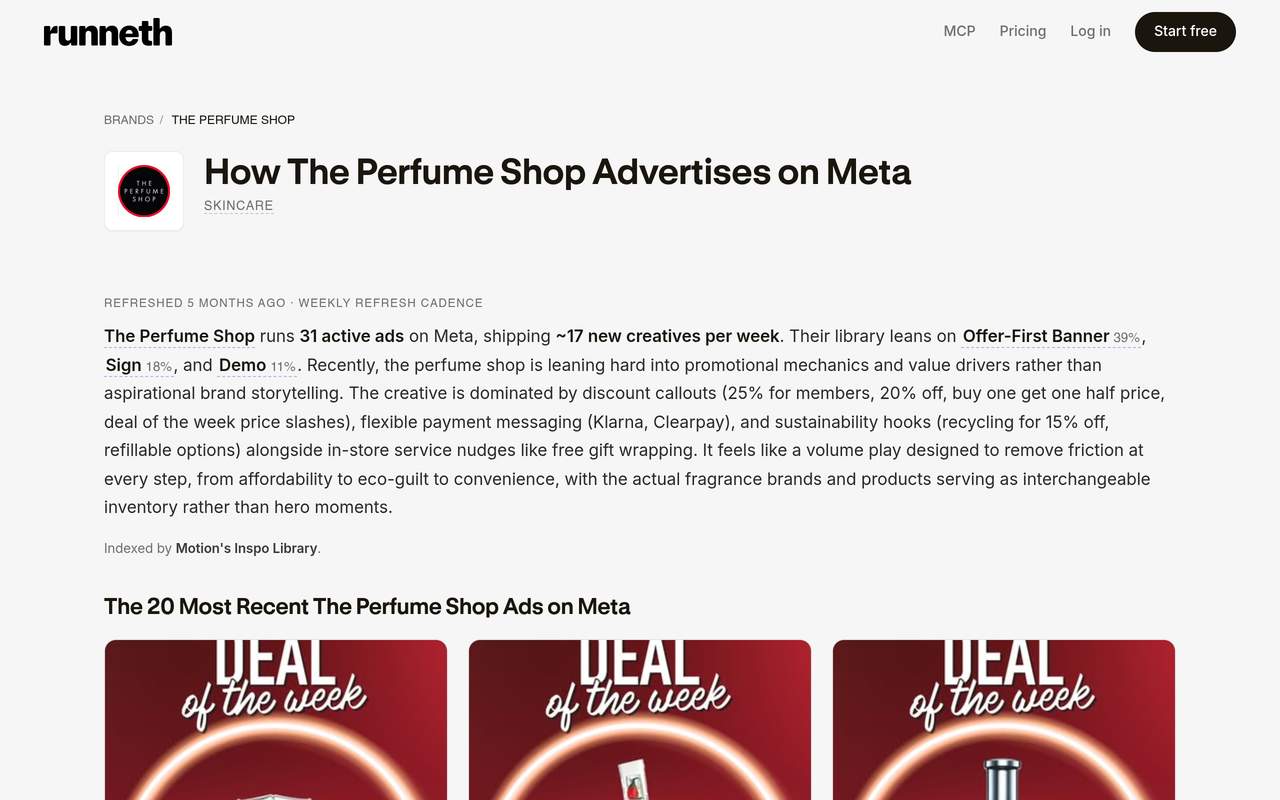
Competitive context helps here. Motion's library page on The Perfume Shop shows 31 active Meta ads and roughly 17 new creatives per week, and describes the retailer as leaning on promotional mechanics and value drivers, plus a gift angle, rather than aspirational storytelling (Motion, October 2026). A niche brand cannot match that volume, so it should differentiate on the concept, not the count.
Scento's guide to fragrance social ads suggests a funnel that starts with scent-story video, moves to carousels of authentic designer fragrances, and ends with a clear shop call to action, and recommends refreshing creative roughly every quarter to limit fatigue (Scento, October 2026). Treat the quarterly refresh as a minimum, and watch frequency and cost per result for earlier fatigue signals.
Worked example: reading one test round with source numbers
This example uses published ranges and one assumed budget to show the arithmetic. The budget and cell names are assumptions for illustration; the benchmark figures come from the sources cited.
- Set the reference point. Webtonic's roundup cites a DTC beauty CAC average of $60.45 (Webtonic, October 2026). A skincare brand with a first-order margin that supports about $60 per new customer treats $60 as the line.
- Size each cell. Assume $600 per cell across three cells: creator demo, testimonial, static. At a $60.45 CPA, each cell is expected to produce about 10 purchases ($600 ÷ $60.45 ≈ 9.9). Ten purchases is a thin sample, so treat the first round as directional and plan a second round on the top two.
- Read the result. Suppose the creator demo has the most 3-second views but the testimonial has the lowest cost per purchase. By the pre-agreed rule, the testimonial wins the round. The demo's attention becomes a lead for the next brief: keep its hook, add testimonial proof in the second half.
- Check the season. Webtonic's eMarketer and Cart.com figures show ROAS of $1.90 in Q4 2024 and $3.50 in Q1 2025. If round one ran in Q4 and round two in Q1, a better result in round two may be the calendar, not the creative. Rerun the control in each round to separate the two.
The point of the example is the sequence: reference line, cell size, rule-based decision, seasonal control. The same sequence works at any budget.
Checklist: run your first beauty creative test
- Pick one sub-vertical and one product (skincare serum, lip product, fragrance) and look up its break-even CPA from your margin.
- Write the primary purchase signal, two supporting signals and the diagnostic engagement metrics in a single sentence.
- Define three to four distinct concepts, not variations: for example creator demo, testimonial, before-and-after, static offer.
- Keep audience, placement, optimisation event and budget identical across cells; broaden the audience if the test under-delivers.
- Clear audio rights and claims with legal before launch, especially for partnership ads and before-and-after content.
- Set the spend and the minimum run time, and do not edit ads inside the learning phase.
- Add UTM parameters so creator and format are visible in analytics; the UTM structure guide shows a clean pattern.
- After the run, rank by the purchase signal, explain with engagement, and log one decision.
- Run a second round inside the winning concept (new hook, new opener, new creator), keeping the same format.
- Repeat the winning test for each campaign objective and for each season.
For a faster pre-launch check on the account itself, the 30-minute Meta ad account audit catches structural issues that would otherwise contaminate a test.
What mistakes ruin beauty creative tests?
- Calling a crop a concept. Resizes and button changes do not give the system or you a new idea to learn from.
- Judging on likes. Views and reactions are cheap to win and loosely tied to revenue. A creator post can do well on social and still not sell, as the piece on viral creator posts with zero sales explains.
- Testing too many cells on too little budget. Four cells at a few purchases each produce noise. Cut cells before you cut budget per cell.
- Pausing too early. The framework for when to pause a Meta campaign versus let it optimise gives rules that stop panic edits.
- Ignoring creator quality. A format test is only fair if the creators have real audiences. Run a fake follower audit before you pay for creator content that you also plan to boost.
- Comparing different quarters. Seasonal ROAS swings can swamp the format effect.
- Skipping the hand-off to retargeting. A prospecting winner needs a proof and closing sequence behind it. If retargeting reaches people who already bought, read how to exclude existing customers.
How can creator content be made at the volume testing needs?
Distinct concepts need distinct footage, and that is the real bottleneck for most beauty teams. There are two routes: brief more creators, or generate more first drafts. Nia by Nurdd is an AI-native creative studio at getnia.studio that makes product and UGC ads from a product link and can cast real creators and AI creators in the same production, with influencer marketing built in. Nia is priced below comparable plans, and the Nia overview explains how it fits beside paid media.
Use any first-draft route to widen the concept pool, then let the purchase signal decide. Before you pay for creators, estimate their audience quality with the fake follower checker, check expected returns with the influencer ROI calculator and set the split with the marketing budget planner.
How does Pulse by Nurdd help you compare creative test results?
Pulse by Nurdd is a web dashboard that connects to Meta Ads and Google Ads through read-only OAuth, explains campaign performance in plain language, diagnoses what changed, and recommends specific actions without requiring you to build reports. For a beauty team running format tests, that means the question "did the testimonial win, or did the account change underneath it?" is answered inside the same view as the results. Pulse is paid, has no trial, and is in private access.
Book a demo at https://www.nurdd.club/demo and bring your own Meta account: you will see how Pulse reads your own creative tests, what changed in your campaigns, and what it would recommend next. Product details are on the Pulse page.
Pulse is also useful when your purchase signal sits across channels. Beauty shoppers often see a Meta ad and then search the brand on Google, so the guide to reading Meta and Google performance side by side is a good companion. If influencer sales are part of your test, influencer performance attribution shows how to track sales by creator. You can also benchmark engagement and cost per engagement with the campaign benchmarker.
How we researched this
We reviewed publicly available material: Meta's own business help guidance on A/B testing, agency and analyst write-ups on Meta's Andromeda system, vendor benchmark pages for beauty and skincare advertising, creator-platform guidance on partnership ads, and creative-library pages on perfume advertisers. We also read the top-ranking articles on beauty Meta creative to see what they cover and leave out. All pages were checked on the publication date of this post.
We did not run these tests ourselves or interview advertisers. Benchmark figures come from vendors and agencies that do not always publish their methods, so they are quoted with attribution and used as ranges, not guarantees. The testing order, decision tables and worked example are our own frameworks built from those sources.
Conclusion
Start with creator-led video, add a demo, then prove the claim with testimonial or before-and-after, and keep static and carousel for the last click. For perfume, begin with brand-led mood and a gifting angle. Whatever the order, decide the purchase signal first, test distinct concepts, and compare like with like across the same quarter.
To see how your own Meta results read against purchase signals, book a Pulse demo. You will walk through your own account, with the formats you ran, the changes that affected them and the next test to run.
Frequently asked questions
Which Meta ad content types work best for beauty brands?
Published analyses rank creator-led video first for cold prospecting, with tutorials, testimonials and before-and-after content in the middle of the funnel and static or carousel for retargeting. The exact lifts vary by source and are vendor-reported, so confirm them with a controlled test in your own account. Sub-vertical matters: skincare, haircare and personal care have different benchmarks.
How do I test creative formats for perfume ads on Meta?
Test a brand mood film against a creator first-spray reaction, then a gifting angle against self-purchase, then scent-notes explainers and proof. Webtonic's summary of AdLibrary's data says luxury fragrance is the exception where brand-controlled aesthetics still beat UGC on cold CTR. Judge each cell on cost per purchase and new-customer share.
Is UGC better than static for beauty ads?
For cold audiences, vendor analyses report UGC-style video beating static on CTR by a wide margin. Static still has a job in retargeting, where an offer, shade range or ingredient call-out can close a warm visitor. Test both against your purchase signal rather than assuming one always wins.
How much should I spend on each test cell?
Size each cell so it can produce enough purchases to compare. Divide the cell budget by your expected CPA: a $600 cell at a $60.45 CPA produces about 10 purchases, which is directional only. If budget is tight, run fewer cells for longer rather than more cells for a few days.
Which metric matters most when comparing beauty creative?
Cost per purchase, or new-customer CAC, should decide the winner. Add-to-cart rate and landing page view rate are supporting signals, and 3-second views, hold rate, shares and saves explain why a result happened. Engagement alone can rank an entertaining ad above one that sells.
How often should I refresh beauty and perfume creative?
Scento suggests refreshing fragrance creative about every quarter to limit viewer fatigue. In practice, watch frequency and cost per result and refresh when they worsen, since a large retailer like The Perfume Shop ships about 17 new creatives a week, according to Motion. Meta's system also favours new concepts over minor edits.
Do partnership ads help beauty creator content perform?
They let a brand run ads through a creator's handle, which can extend the reach of strong organic content. Social Native reports one example reaching more than sixteen times the organic reach. Content using licensed third-party music cannot be promoted as a partnership ad, so brief creators on audio.
Does Pulse by Nurdd have a free trial?
No. Pulse is paid and has no trial. It is in private access, and you can book a walkthrough at nurdd.club/demo to see it read your own Meta and Google Ads data.