Paid Media
Paid Social Advertising Agency vs Software: How to Choose
Compare a paid social advertising agency with ads intelligence software on fees, control and measurement, with a decision table and checklist.
 Simran Rawat30 Oct 202615 min read

Choose a paid social advertising agency when you need creative and hands-on campaign management; choose ads intelligence software when you already have a buyer and need to understand Meta and Google results. WideFoc.us and Social Rails publish agency fees of 10% to 20% of ad spend, and Lyfe Marketing cites 15% to 20%. Pulse by Nurdd is the paid software option, with no trial and private access through a booked walkthrough.
Choose a paid social advertising agency when you need someone to build creative, run campaigns and carry the account day to day. Choose ads intelligence software when you already have a buyer and need to understand Meta and Google performance without waiting for a monthly report. Many budget holders end up using both, with the software checking the agency's work.
Key takeaways
- An agency sells labour: strategy, creative, setup and optimisation. Software sells visibility: it reads your accounts and explains them. They answer different problems.
- Published guides put percentage-of-spend fees at 10% to 20% (WideFoc.us, Social Rails) and 15% to 20% (Lyfe Marketing), so the cost scales with your spend.
- Meta ad sets need roughly 50 optimisation events in a 7-day window to exit learning, as reported by Jetfuel Agency from Meta's Business Help Center, so frequent edits by anyone can hold results back.
- Whichever route you pick, insist on admin ownership of your own ad accounts and a plain explanation of why results moved.
- Use the decision table below to score your team, budget and need for creative before you sign a retainer.
- Pulse by Nurdd is the software option here. It is paid, has no trial, and is accessed through a booked walkthrough.
Why is this decision harder than it looks?
A paid social advertising agency and an ads intelligence tool are often compared as if they were substitutes. They are not. One is a team that does the work, the other is a layer that shows you what the work produced.
The confusion comes from the word management. Agencies sell management of your Meta and Google accounts. Software sells understanding of them. If you buy management when your real gap is understanding, you pay a percentage of spend for something a dashboard could have shown you. If you buy a dashboard when your real gap is creative and execution, you will see the problem clearly and still have nobody to fix it.
This guide is written for the person who holds the budget, not the person who clicks in Ads Manager. It sets out what each option costs as published, what each cannot do, how to evaluate an agency, and how to run a short test before you commit. For the wider picture on reading results, see the guide to reading Meta and Google performance without a data analyst.
What does a paid social advertising agency actually do?
A paid social advertising agency plans, builds, launches and optimises ads on platforms such as Meta, TikTok and LinkedIn on your behalf. Agency service pages typically describe the same core work: audience strategy, creative development, campaign setup, testing and reporting.
What you are really buying is a team: a strategist, a media buyer and usually a creative resource. That team can produce ads, which software cannot. It can also be a single point of accountability, which matters if nobody in your company wants to own the account.
The limits are structural. An agency is paid from your budget, often as a share of it, and the person reporting results is the person being judged by them. That does not make agencies dishonest, but it does mean you should be able to check the numbers yourself.
What does ads intelligence software do instead?
Ads intelligence software connects to your ad accounts, reads the data and explains it. Pulse by Nurdd is a web dashboard that connects to Meta Ads and Google Ads through read-only OAuth. It explains campaign performance in plain language, diagnoses what changed and recommends specific actions, without asking the user to build reports.
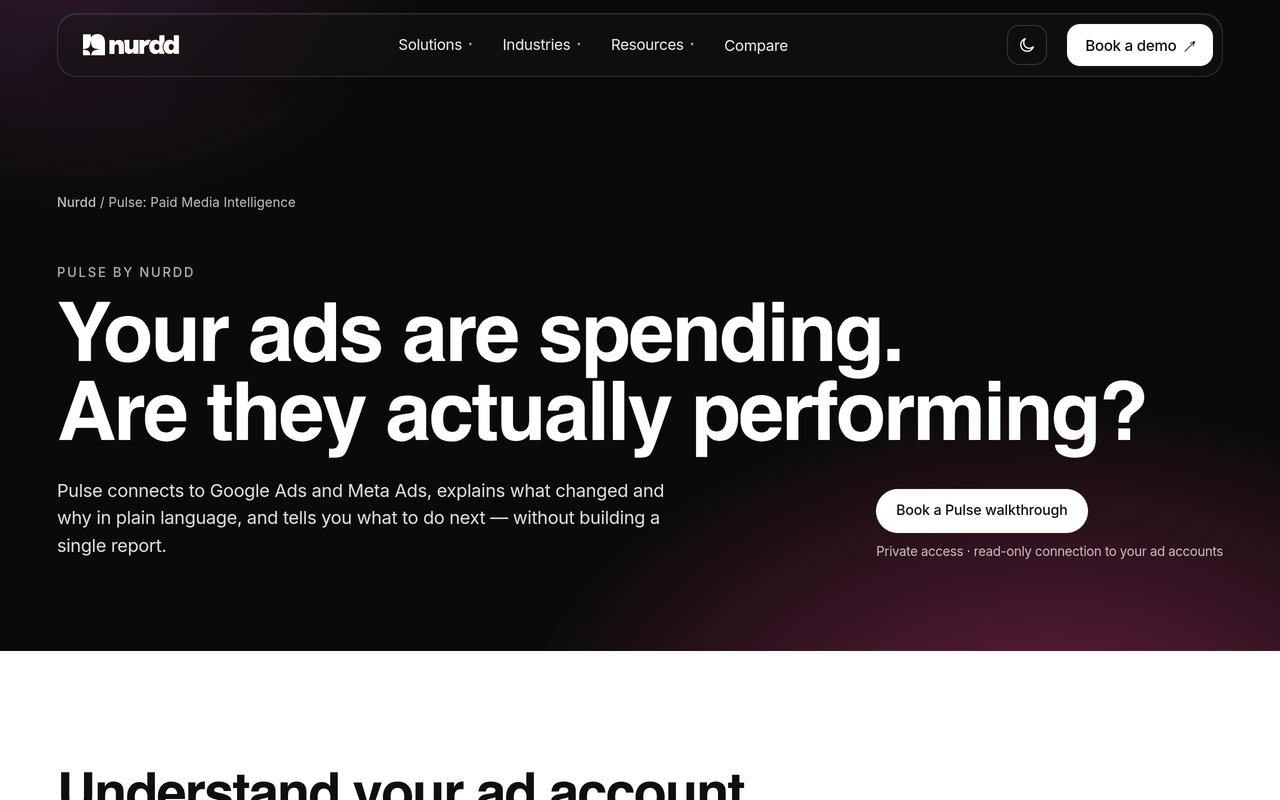
Read-only access matters for a budget holder. The software can look but cannot change bids, pause ads or spend money, so connecting it carries a different risk than handing an agency full account permissions.
Pulse does not produce ad creative and does not run your campaigns for you. It tells you what moved and what to do about it, and someone on your side, or your agency, still makes the change. That is the honest boundary of the category.
How much does a paid social advertising agency cost?
Published pricing guides agree on the shape of the fee, if not on a single figure. Lyfe Marketing says a social media marketing agency charges anywhere from $650 to $20,000 a month or more, and cites 15% to 20% of ad spend for ad agencies. WideFoc.us describes paid social management as commonly priced at 10% to 20% of ad spend, sometimes with minimums for small budgets.
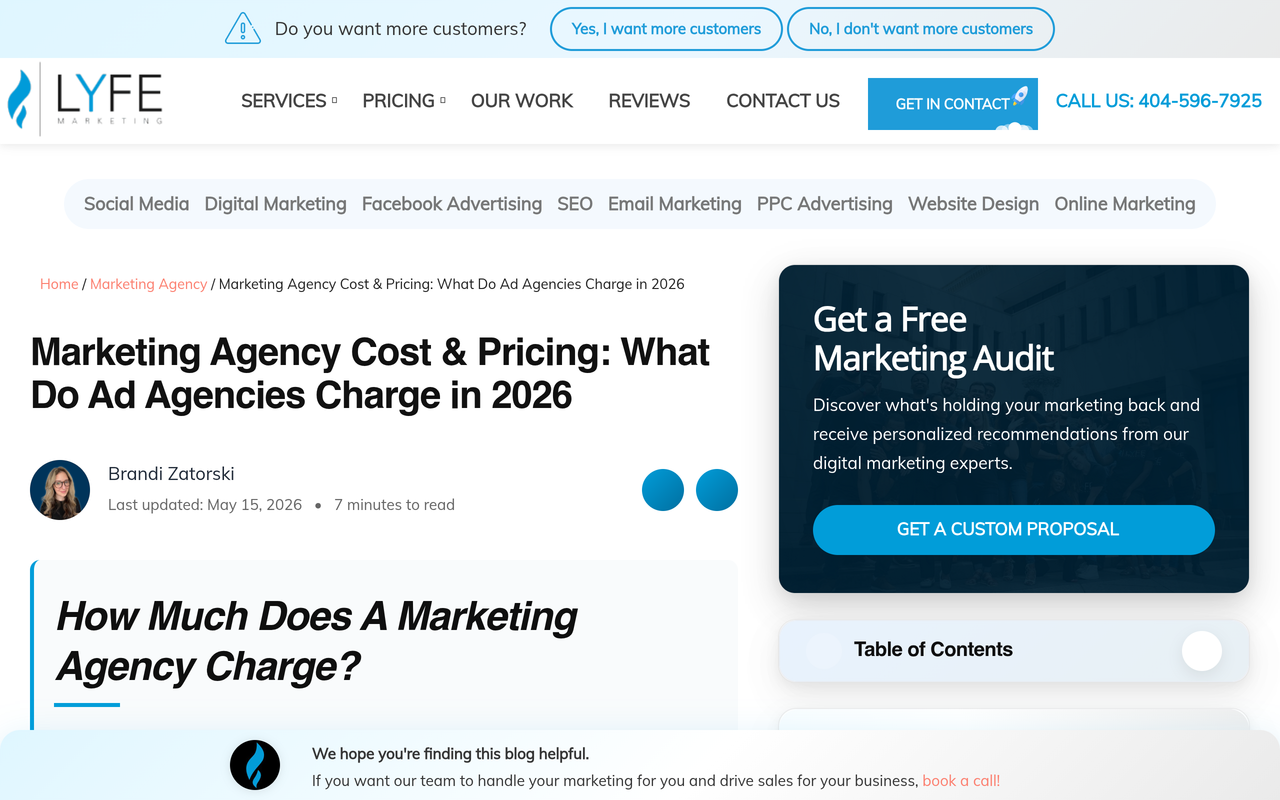
Social Rails lists flat paid management fees of $500 to $2,000 a month or 10% to 20% of spend, and minimum ad budgets of $500 to $2,000 a month. Stackmatix shows social retainers in a $1,500 to $3,000 tier that exclude paid management, which is a reminder to check whether paid work is in the scope or priced on top.
| Fee model | How it is charged (as published) | What to watch |
|---|---|---|
| Percentage of ad spend | 10% to 20% of spend (WideFoc.us, Social Rails); 15% to 20% (Lyfe Marketing) | Fee rises when you spend more, whether or not results improve |
| Flat management fee | $500 to $2,000 a month (Social Rails) | Check what is included and the minimum ad budget |
| Social retainer | A $1,500 to $3,000 tier without paid management (Stackmatix) | Confirm whether paid is included or added on top |
| Overall agency range | $650 to $20,000 a month or more (Lyfe Marketing) | A wide range: scope and spend drive the quote |
Worked example: what a percentage fee means on your budget
Take a brand spending $20,000 a month across Meta and Google. The 10% to 20% range published by WideFoc.us and Social Rails implies a management fee of $2,000 to $4,000 a month, or $24,000 to $48,000 a year, before any creative production. This is arithmetic on the published range, not a quote from any agency.
Now double the spend to $40,000. At the same percentage the fee doubles to $4,000 to $8,000 a month, even if the account needs no more attention than before. A flat fee or a capped fee removes that effect, which is why the fee model is worth negotiating before the contract is signed.
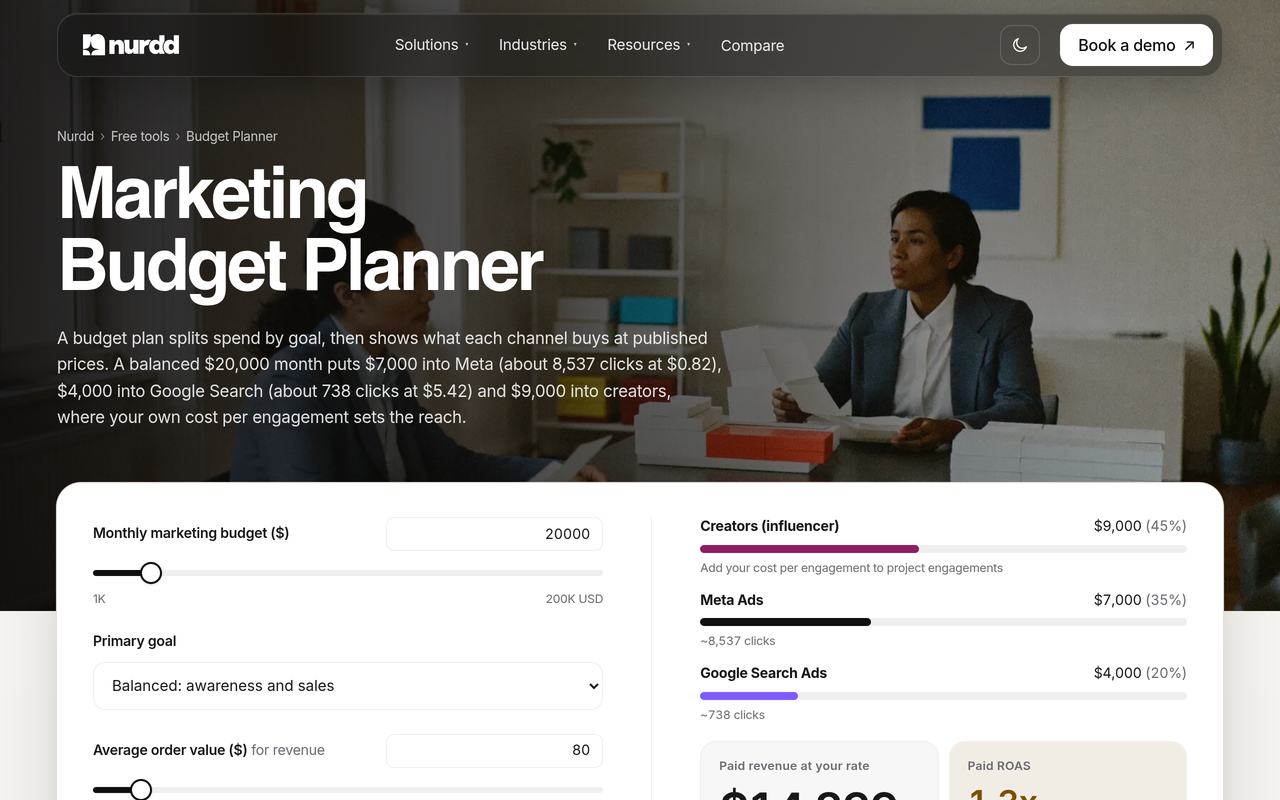
You can model your own spend split with the marketing budget planner and check break-even with the Google and Meta ROAS calculator before you enter a conversation about fees.
How long do Meta and Google need before results mean anything?
This is the part most agency-versus-software discussions skip, and it affects both. Jetfuel Agency, citing Meta's Business Help Center, reports that an ad set exits learning after about 50 optimisation events within a 7-day period, and that a significant edit restarts the count. Google runs its own learning periods for Smart Bidding and Performance Max, so check Google's help centre for the current guidance before you judge a campaign.
The practical point for a budget holder: a buyer who edits constantly can keep an account in a permanent learning state, and a client who judges results after four days is judging noise. Neither an agency nor software changes that rule. Both should be able to tell you whether an ad set is in learning, and why. Our explainer on what resets the Meta learning phase lists the edits to avoid.
Paid social results are only comparable after learning completes. Any agency or tool that reports on an ad set still in learning should say so alongside the number.
Agency or software: how do they compare?
The table below compares the two routes on the criteria a budget holder usually cares about. Rows that say depends are where the answer turns on the agency or your own team rather than the category.
| Criterion | Paid social advertising agency | Pulse by Nurdd (software) |
|---|---|---|
| Builds ad creative | Yes, usually included or priced separately | No |
| Runs and edits campaigns | Yes, with account permissions | No; recommends actions, read-only access |
| Explains why performance changed | Depends on reporting cadence, often monthly | Yes, plain-language diagnosis of what changed |
| Covers Meta and Google together | Depends on the agency's specialism | Yes, both connected in one dashboard |
| Independent check of results | No, the agency reports its own work | Yes, reads the accounts directly |
| Cost model | Percentage of spend, flat fee or retainer | Paid product; private access via a booked walkthrough |
| Free trial | Not applicable; contracts and minimums vary | No trial |
| Needs a buyer on your side | No | Yes, someone makes the changes |
Pulse is paid and has no trial, which is worth saying before you build it into a plan. Access is by private walkthrough, which you can request at nurdd.club/demo.
Which option fits your situation? A decision table
Score each line for your own business. The right-hand column shows the route that line points to, and the pattern across lines matters more than any single answer.
| If this is true for you | It points to |
|---|---|
| Nobody on the team has ever run Meta or Google ads | Agency or freelancer |
| You need new creative every week and have no studio | Agency, or a creative tool such as Nia by Nurdd alongside software |
| You have an in-house buyer but cannot tell why results moved | Software |
| You already pay an agency and doubt the monthly report | Software as a second opinion |
| Spend is under the agency's minimum budget | Software plus in-house or freelance help |
| You want one accountable owner and will not touch Ads Manager | Agency |
| You run several brands or accounts and need one view | Software, with agencies per brand if needed |
If most of your answers sit in the top half, hire. If most sit in the lower half, software is likely to cover your gap at lower cost. A mixed pattern usually means an agency for execution and software for oversight.
How do you evaluate a paid social advertising agency?
Treat the evaluation as an audit of process, not a review of a pitch deck. Agency guides converge on a few questions. Newbird advises asking which data sources the agency uses for attribution and how it handles platform discrepancies, such as when Meta reports more conversions than your CRM shows. Silverback Strategies argues that a good agency understands incrementality testing and media mix modelling as better measures of impact than platform ROAS.
Embertribe adds two checks: ask for a line-item breakdown of where the media budget goes, and ask about the creative testing process. Those are practical because they test transparency and capability in one conversation.
Checklist: ten steps before you sign
- Write the problem down. State whether you lack execution, creative, measurement or all three, so you buy the right thing.
- Set a spend and fee ceiling. Decide the maximum percentage or flat fee you accept, using the table above.
- Ask for account ownership in writing. Your business, not the agency, should own the ad accounts, pixels and data.
- Ask how results are measured. Request the attribution method and how platform numbers are reconciled with your sales data.
- Ask for the creative testing process. Look for how tests are structured and how winners are chosen, not a portfolio.
- Ask for a line-item media breakdown. Know what share of budget reaches the platform.
- Check the change policy. Ask how often they edit live ad sets and how they avoid resetting learning.
- Negotiate the exit. Agree notice periods and what you keep when you leave.
- Arrange independent read access. Connect a read-only tool or give a trusted colleague view access so you can verify reports.
- Define a review date. Judge on a pre-agreed window long enough for learning, not on the first week.
Step nine is the one most buyers skip. Our 30-minute Meta ad account audit is a way to run that check yourself.
What should you ask an agency about measurement?
Measurement is where agency relationships break down, because the agency and the client are often reading different numbers. The agency reports platform ROAS, the finance team sees the bank account, and the two disagree. Our piece on why Meta ROAS can look better than your bank account explains the gap.
- Which number is the agency's headline metric, and where does it come from?
- How do platform conversions compare with orders in your store or CRM?
- Does the agency run holdout or incrementality tests? See how to calculate incrementality for the method.
- How is attribution handled across channels? Compare last-touch and multi-touch models.
An agency that welcomes these questions is a better bet than one that answers with a case study.
Where does Pulse fit in a paid social setup?
Pulse by Nurdd is an ad intelligence dashboard for Meta Ads and Google Ads. It connects through read-only OAuth, explains performance in plain language, diagnoses what changed and recommends specific actions, which makes it a fit for budget holders who want to understand their accounts without building reports. It is a paid product with no free trial, and it is currently offered through a private walkthrough.
Book a demo at nurdd.club/demo and you will see Pulse connected to Meta and Google data, with a plain-language read of what changed and what to do next.
Pulse beside an agency
If you already employ an agency, Pulse gives you an independent read of the same accounts. You can compare the agency's monthly story with what the dashboard shows, and ask better questions when the two differ. Questions such as why cost per result jumped overnight are easier to ask when you can see the data.
Pulse instead of an agency
If you have an in-house buyer or a capable generalist, Pulse can replace the reporting layer that agencies often provide. It does not replace creative production or execution, so pair it with a creative source. Brands in ecommerce often face this split.
What are three realistic scenarios?
A founder spending under the agency minimums
A founder with a small monthly budget finds that agencies quote minimum ad budgets, with Social Rails citing $500 to $2,000 a month, and that a fee at 10% to 20% of a small budget is a small absolute sum. At that scale the founder is often better off learning the basics, using software to understand results and seeking freelance help for creative. The risk is time, not money.
A marketing lead with an agency and a monthly PDF
A marketing lead gets a monthly report and cannot tell whether a dip is seasonal, creative fatigue or a bidding change. Connecting read-only software lets the lead see the same accounts between reports and ask the agency specific questions. The agency relationship continues, with more accountability.
A finance-minded CMO with several brands
A CMO overseeing several brands pays a percentage fee on each account and wants one view of Meta and Google performance across them. Software provides a consistent explanation of changes across accounts, while agencies stay in place where creative and execution are needed. This is the split that paid ads reporting tool comparisons tend to arrive at.
What mistakes do budget holders make?
- Buying management to solve a visibility problem. If the gap is understanding, a fee that scales with spend is expensive for what you receive.
- Judging inside the learning window. Compare results only after ad sets exit learning.
- Accepting platform ROAS as profit. Reconcile with sales data. The D2C KPIs that beat ROAS are a starting set.
- Letting the agency own the accounts. If you cannot log in as admin, you cannot leave cleanly.
- Ignoring creative. Embertribe stresses a creative testing process, so a tool without a creative source leaves half the problem.
- Not reading search and placement detail. Guides on the Google Ads search term report and the Meta breakdown report show where wasted spend hides.
How can you test the choice in 30 days?
You can run a simple comparison from your own data without committing to a long contract. The test below is a framework we describe, not a result we have measured.
- Days 1 to 3: snapshot. Export current spend, cost per result and sales by channel from Meta and Google.
- Days 4 to 7: set rules. Agree which edits are allowed, so ad sets can complete learning.
- Days 8 to 21: run. Let the buyer or agency work to the plan, and log every change with a date.
- Days 22 to 28: read. Use software or a manual audit to explain each movement, and match it to the change log.
- Days 29 to 30: decide. If most movement was explained by your changes, the process works. If much is unexplained, you need better oversight or a different partner.
Performance Max may need longer, so read our guide on what Performance Max hides from D2C brands before judging those campaigns. For delivery decisions, see when to pause a Meta campaign or let it optimise.
What does a good account look like before you hire anyone?
Before paying a fee, check that the basics exist. A healthy account has clear conversion tracking, sensible campaign structure and no obvious waste, as described in what a healthy Google Ads account looks like. If the basics are broken, any agency or tool will inherit the mess, and you will pay to discover it.
Benchmarks help you judge a pitch. The campaign benchmarker compares engagement and cost per engagement against reference ranges, and the free tools library holds other calculators for planning.
How we researched this
Written by Simran Rawat. We reviewed published agency pricing guides, agency-selection guides and a summary of Meta's learning-phase guidance found through web search, and checked them on the publication date of this post. We did not interview agencies, run a hands-on test of any agency, or collect customer data, and the 30-day test above is a described framework, not a measured result.
Fee figures are as published by the named sources and vary by market and scope. Treat them as ranges to challenge, not as quotes. The learning-phase figure comes from a secondary summary of Meta's guidance, so confirm it in Meta's own help centre before relying on it.
Frequently asked questions
Should I hire a paid social agency or use software?
Hire an agency if you need creative, execution and a single accountable owner. Use software if you have a buyer and need to understand Meta and Google performance. Many teams combine them, with software giving an independent read of the agency's work.
How do I evaluate a paid social advertising agency?
Audit process rather than pitch. Ask about attribution and platform discrepancies, the creative testing framework, a line-item media breakdown, account ownership and exit terms, as the checklist above sets out.
How much does a paid social advertising agency charge?
WideFoc.us and Social Rails publish 10% to 20% of ad spend, and Lyfe Marketing cites 15% to 20%. Social Rails also lists flat paid management fees of $500 to $2,000 a month, and Lyfe Marketing gives an overall social agency range of $650 to $20,000 a month or more. Your quote depends on scope, spend and creative needs.
Can software replace a paid social agency?
Software can replace the reporting and diagnosis layer, not creative production or hands-on campaign edits. Pulse by Nurdd reads Meta and Google accounts and recommends actions, but a person or agency still makes the changes.
Is Pulse free or is there a trial?
No. Pulse by Nurdd is a paid product with no free trial, and access is private, through a walkthrough booked at nurdd.club/demo.
Is it safe to connect software to my ad accounts?
Pulse connects through read-only OAuth, meaning it can view data but not change campaigns or spend. Always check the permission level any tool or agency requests before approving.
How long should I wait before judging paid social results?
Allow ad sets to leave learning first. Jetfuel Agency, citing Meta, reports about 50 optimisation events within 7 days. Check Google's help centre for Smart Bidding and Performance Max guidance.
Do I need an agency if I use influencers and creator content?
Creator content is a creative source rather than a replacement for media buying. Nia by Nurdd makes ads and manages influencer campaigns, while paid social still needs someone to run and read the media.
Which should you choose?
Match the option to the gap. If the gap is labour and creative, a paid social advertising agency is the right purchase, provided you own the accounts and can verify the reports. If the gap is understanding, software costs less and keeps decisions in your hands. If both are true, buy execution from the agency and oversight from software.
See Pulse on your own accounts. Book a demo and you will see how Pulse reads your Meta and Google performance, what changed and which actions it recommends, so you can judge whether you need an agency, software or both.