Paid Media
Agentic Marketing vs AI Agents in Demand Gen: Where to Start
Which demand gen tasks AI agents can safely handle on Meta and Google Ads today, which still need a human, and how to measure the results.
 Sheetal Shakshi6 Nov 202615 min read

AI agents in demand gen can safely handle monitoring, reporting, anomaly detection, search-term triage and creative drafting today, while humans keep spend approval, strategy, attribution and regulated copy. Start read-only, move one task at a time up an autonomy ladder, and test every automation against a control and a break-even ROAS.
AI agents in demand gen can safely handle monitoring, reporting, anomaly detection, search-term triage and creative variant drafting today, provided a human approves spend, targeting and strategy. This ai agents demand gen split follows one rule: let agents read and recommend first, then act only inside guardrails you set and can audit.
The term "demand gen" is used two ways: the marketing discipline of creating demand, and Google's separate Demand Gen campaign type. This post uses the first meaning, with a focus on paid media on Meta and Google Ads, where agents already touch real budget.
Key takeaways
- Start agents in read-only roles (reporting, diagnosis, alerts) before letting them change bids, budgets or audiences.
- Use an autonomy ladder per task: report, recommend, act with approval, act within limits. Move a task up only after it has a clean track record.
- Platform automation (Advantage+ on Meta, AI Max on Google) is already an agent-like layer; test it with a control group instead of trusting the headline claim.
- Set a break-even ROAS before any agent optimises toward ROAS, or it will optimise toward the wrong number.
- Keep strategy, brand claims, attribution choices and regulated-category copy with a human.
- Measure the agent as you would a media buyer: what changed, what it cost, and what the result was against a benchmark.
What is the difference between agentic marketing and AI agents in demand gen?
Agentic marketing is the operating model: software that pursues a goal across several steps and tools, with people setting the goal and the limits. An AI agent is one component of that model, a piece of software that takes a defined job such as "find wasted spend in this account" and carries it out. Agentic marketing is the whole system, and an agent is a worker inside it.
The distinction matters because most teams already use AI as a tool: you open it, ask, copy the answer. An agent differs in that it can call other tools, check its own output and continue until a stopping rule is met. For a longer definition, see AI agents for marketing and the paid-media angle in AI agents for paid media: what to automate on Meta and Google.
| Concept | What it is | Who decides | Demand gen example |
|---|---|---|---|
| AI tool | Responds to a single prompt | Human at every step | Asking a chatbot for ten headline options |
| AI agent | Pursues a bounded goal using tools | Human sets goal and limits | An agent that reads yesterday's spend and flags anomalies |
| Platform automation | Built-in optimisation inside an ad platform | Platform, within your settings | Advantage+ sales campaigns, AI Max for Search |
| Agentic marketing | Operating model combining agents, automation and human review | Team, with documented guardrails | Weekly cycle of agent diagnosis, human approval, tracked result |
Why does this matter for demand gen teams now?
Ad platforms have moved much of the tactical work into their own automation. Google's announcement of AI Max for Search campaigns (May 2025) says advertisers who activate it typically see 14% more conversions or conversion value at a similar CPA or ROAS. That is Google's claim about its own product, and it is the reason to test it in your account rather than assume it.
Meta describes Advantage+ sales campaigns as an end-to-end, automated route to online sales. When the platform runs targeting and placement by itself, the human job shifts from pulling levers to setting constraints, checking tracking and judging results. That is where an agent that reads and explains performance earns its place.
There is also a caution from analysts. MarTech, reporting Gartner's June 2025 prediction, says more than 40% of agentic AI projects will be canceled by the end of 2027, based on a poll of more than 3,400 organizations. Gartner's analyst described most current projects as early experiments that are often misapplied. Starting small and measuring is the response to that risk, not a reason to wait.
Ownership is a second risk. In a September 2026 press release, Gartner predicts that by 2028, 70% of enterprises will abandon agentic AI built by vendor forward-deployed engineering, citing soaring costs and an inability to evolve it in-house. For a demand gen lead, the practical lesson is to keep the rules, prompts and approval logic documented in a form your own team can edit.
How do AI agents work in a paid media workflow?
An agent in paid media runs a loop: read data, form a diagnosis, propose or take an action, then check the result. Each part needs a different level of trust. Reading data is low risk, diagnosis is medium risk because it can be wrong with confidence, and acting changes real money.
Connection method is the first control. Search Engine Land (October 2025) reported that Google's open-source MCP server for the Google Ads API was initially read-only, built for diagnostics and analytics. That shape, read first and write later, is a good template for any agent you deploy yourself.
The second control is the platform's own test tooling. According to Google Ads Help, checked November 2026, AI Max experiments split an existing Search campaign into a control with AI Max off and a trial with it on. That structure lets you compare an automated change against a baseline, and it should be the default for any change an agent proposes.
The autonomy ladder
- Level 0, report: the agent summarises performance in plain language. No account access beyond read-only.
- Level 1, recommend: the agent proposes a specific action with a reason and an expected effect.
- Level 2, act with approval: the agent prepares the change and a human clicks approve.
- Level 3, act within limits: the agent applies changes inside caps you set, such as a maximum daily budget shift, and logs each one.
- Level 4, autonomous: no human gate. For most demand gen tasks this is not advisable today.
Which demand gen tasks can AI agents handle safely today?
The safe tasks share three traits: the data is structured, the cost of a mistake is small or reversible, and success can be checked against a number. The risky tasks involve money moving, public words under your brand name, or choices about what counts as success. The table assigns a maximum recommended autonomy level to each common paid media task.
| Task | Max autonomy today | Why | Human gate |
|---|---|---|---|
| Daily performance summary across Meta and Google | Level 3 | Read-only, easy to verify against the platform UI | Spot-check weekly |
| Anomaly alerts (spend spikes, CPA jumps, tracking drops) | Level 3 | Alerts are reversible and cheap to dismiss | Owner reviews each alert |
| Diagnosing "what changed" between two periods | Level 1 | Useful, but causal claims can be wrong | Buyer confirms cause before acting |
| Search term triage and negative keyword suggestions | Level 2 | Wrong negatives silently cut good traffic | Approve list before it goes live |
| Drafting ad copy and creative variants | Level 2 | Fast to produce, but brand voice and claims need review | Approve every asset before launch |
| Budget pacing within a monthly cap | Level 3 | Bounded by a cap you set | Cap and exceptions set by human |
| Reallocating budget between Meta and Google | Level 1 to 2 | Depends on attribution, which differs by platform | Human decides on blended view |
| Bid strategy and target ROAS or CPA changes | Level 2 | Can reset learning and move spend quickly | Approve, log, review after one cycle |
| Audience exclusions and retargeting rules | Level 2 | Errors compound across campaigns | Approve changes |
| Ad copy in regulated categories (health, finance) | Level 1 | Compliance risk sits with the brand | Compliance sign-off |
| Choosing KPIs, attribution model, break-even ROAS | Level 0 | This is strategy, not execution | Marketing lead owns it |
The ladder is an original framework built from the platforms' documented controls and the Gartner cautions above, not a published standard. Treat the levels as a starting position and adjust for your category and risk tolerance.
Which paid media tasks should I automate with AI agents first?
Automate measurement and diagnosis first, then low-risk hygiene, then creative production, and leave allocation and strategy for last. The order follows risk: each stage produces evidence that the next stage can be trusted. Teams that begin with autonomous bid changes skip the evidence stage.
1. Reporting and diagnosis
An agent can compile spend, results and changes across Meta and Google Ads every morning and write a plain-language summary. The value is time saved and fewer missed problems. Check its numbers against the platform dashboards for the first month. If you need a manual baseline for the check, follow how to audit your Meta ad account in 30 minutes.
2. Search term and query hygiene
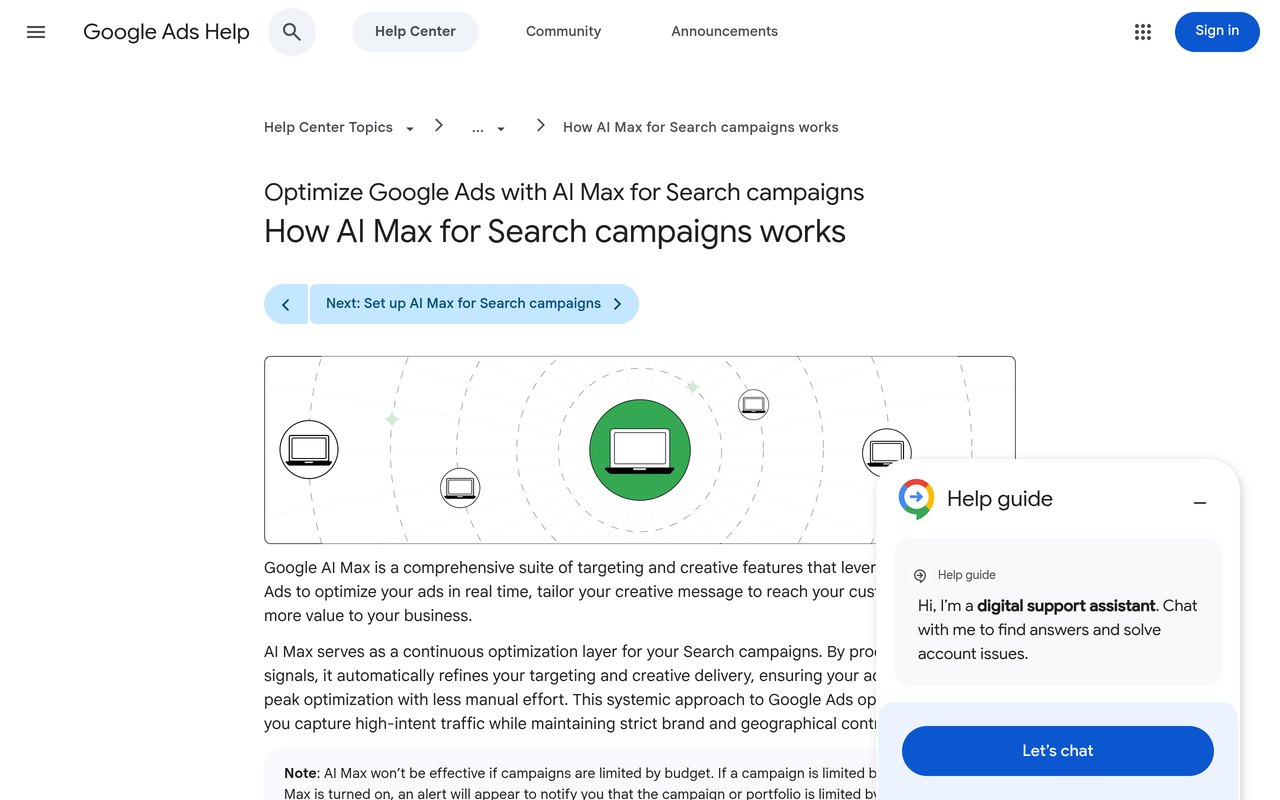
Google's help page on how AI Max for Search campaigns works says AI Max adds an "AI Max" match type in the search terms report, with a source column showing whether a match came from broad match expansion or keywordless matching. That makes the report more important, because queries now come from more places. An agent can sort those queries and propose negatives, and a person can approve them; the walkthrough in how to read a Google Ads search term report shows what to look for.
3. Creative variants
Agents are well suited to producing many first drafts of headlines, hooks and formats. The constraint is review, not volume. For creator-led formats, Meta's Advantage+ catalog ads page notes that partnership ads can combine creator storytelling with catalog ads, so human-made content still has a place inside automated delivery. Nia by Nurdd, an AI-native creative studio, makes product and UGC ads from a link and can cast real and AI creators in the same production, which suits this variant-heavy step.
4. Pacing and guardrails
Budget pacing against a monthly cap is a good Level 3 task because the cap limits the downside. The agent can warn when a campaign will overspend or underspend and shift within limits. Learning-phase effects matter here, so read what resets the Meta learning phase before letting any agent edit budgets or targeting on Meta.
5. Allocation and strategy
Moving money between Meta and Google, or between prospecting and retargeting, depends on how each platform counts conversions. An agent can show the options; a person should decide. Attribution inflation is a common trap, covered in why Meta ROAS can look great while the bank account disagrees.
What should still need a human?
Five categories belong with people today: strategy, brand claims, attribution, regulated copy and exceptions. Agents execute a defined plan well and struggle when the situation falls outside their pattern, because they can act confidently on a wrong premise. The human role is to define success, set limits and read the exceptions.
Rule of thumb: an agent may act on anything you could undo in a day and verify in a number. Anything else needs a person to approve it first.
Platform automation deserves the same discipline. Performance Max, for example, hides some detail by design, which is why what Performance Max is hiding from D2C brands is worth reading before you decide what an agent should be allowed to judge. Likewise, when to pause a Meta campaign versus let it optimise gives a decision frame that you can encode as agent limits.
What does a worked example look like with real benchmark numbers?
This example uses published medians as the yardstick, with one stated assumption. Triple Whale's medians (August 2025 to July 2026), as summarised on Nurdd's benchmarks page, are a $15.06 CPM and 1.88 ROAS on Meta, and a $15.35 CPM and 3.27 ROAS on Google Ads. The same Triple Whale data are on the Nurdd marketing benchmarks hub.
Assume a brand with a 60% gross margin. That assumption is illustrative, not data. Break-even ROAS is 1 divided by the margin, so 1 / 0.60 = 1.67. A brand at the Meta median of 1.88 clears break-even by only 0.21, while a brand at the Google median of 3.27 clears it by 1.60.
- The agent reports blended ROAS and ROAS by channel against the 1.67 break-even.
- It flags that Meta has thin headroom, so a small rise in CPM could push the channel below break-even.
- It recommends, at Level 1, testing a creative refresh on Meta rather than cutting Meta budget outright.
- A human decides whether to move budget to Google, because Google's higher ROAS may reflect captured demand rather than created demand.
The point is the division of work: the agent does arithmetic and surfaces the trade-off, and the human decides whether the trade-off is worth taking. You can rerun this with your own margin in the Google + Meta ROAS calculator, then split spend with the marketing budget planner.
How do AI agents compare with platform automation and a human buyer?
| Dimension | Human media buyer | Platform automation (Advantage+, AI Max) | AI agent on top of the account |
|---|---|---|---|
| Scope | Strategy through execution | One platform, one campaign layer | Cross-channel reading and recommending |
| Speed of detection | Daily or weekly review | Continuous inside its own platform | Continuous across connected accounts |
| Transparency | Can explain reasoning | Limited visibility into decisions | Depends on how it logs reasoning |
| Main risk | Capacity and inconsistency | Optimises for the platform's own conversion count | Confident wrong diagnosis |
| Best use | Strategy, judgment, exceptions | Delivery and matching | Monitoring, diagnosis, hygiene, drafts |
The three are layers, not rivals. For a buyer's view of software versus managed help, see paid social advertising agency vs software and the test list for agentic marketing platforms.
How do you start? A six-step checklist
- Write down break-even ROAS and target CPA. Result: a number every agent is judged against. Why: agents optimise whatever target they are given, so a wrong target scales a wrong result.
- Verify tracking before connecting anything. Result: a trusted baseline across Meta and Google. Why: an agent reading broken conversion data will produce confident, wrong advice.
- Connect read-only first. Result: daily summaries and alerts with no ability to change the account. Why: you learn how often the agent is right before it can cost money.
- Run a 30-day shadow period. Result: a log comparing the agent's recommendations with what your buyer actually did. Why: this gives you an accuracy rate from your own account rather than a vendor claim.
- Promote one task to approval mode. Result: the agent prepares changes, such as negative keywords, and a person approves. Why: it keeps a human gate while removing the manual work.
- Test every automation against a control. Result: a measured lift or no lift. Why: Google's experiment setup and Meta's split tests exist for exactly this purpose, and a claimed 14% lift is an average, not a promise for your account.

What are the most common mistakes?
- Handing over budget before measurement. Without a baseline you cannot tell whether the agent helped.
- Optimising to platform-reported ROAS only. Each platform counts its own conversions, so the sum can exceed reality. Compare against a blended number and against the campaign benchmarker.
- Treating a vendor claim as a forecast. Google's 14% figure is a typical result across advertisers, and your account may differ.
- Giving the agent write access on day one. Read-only access is enough to learn most of what you need.
- Letting the logic live only with the vendor. Gartner's September 2026 warning about vendor-built agents is a reminder to keep rules and approvals documented and editable by your team.
- Ignoring the AI search side of demand. Paid clicks are one input; paid media reporting for ChatGPT ads and AI Overviews covers how reporting is changing.
Where does Pulse by Nurdd fit?
Pulse by Nurdd is a web dashboard that connects to Meta Ads and Google Ads through read-only OAuth, explains campaign performance in plain language, diagnoses what changed and recommends specific actions without requiring you to build reports. In the autonomy ladder above, it covers Levels 0 and 1: the measurement and diagnosis work that should come before any agent touches budget. Pulse is paid, has no trial and is in private access.
Book a demo at https://www.nurdd.club/demo to see Pulse read your own Meta and Google Ads accounts, with a plain-language explanation of what changed and which action it would recommend first. For hands-on channel management, Nurdd also runs a paid social advertising service, scoped per brand, and you can see the overall approach to paid social across Nurdd's products.
How we researched this
We reviewed top-ranking English-language articles on this keyword, two of them in full, which are written mainly for B2B account-based and outbound programs, and noted that those two do not cover Meta and Google Ads measurement, an autonomy ladder per task or break-even ROAS. We also reviewed platform documentation from Google and Meta, analyst coverage of Gartner predictions, trade press and published benchmarks. Sources were checked on the publication date of this post. We did not run hands-on tests of agents, and the margin in the worked example is an assumption we state openly.
Frequently asked questions
How can AI agents help with demand generation?
AI agents help most with monitoring, reporting, diagnosis, query hygiene and first-draft creative. They save time on repeatable work and surface problems faster than a weekly review. They are weaker at strategy, brand judgment and choices about attribution.
Which paid media tasks should I automate with AI agents?
Start with daily reporting, anomaly alerts and pacing within a cap, then move to approval-based negatives and creative drafts. Keep budget allocation between channels, bid target changes and regulated copy behind human approval. The table in this post gives a maximum autonomy level for each task.
Is Advantage+ or AI Max an AI agent?
They are platform automation layers rather than agents you control. They optimise delivery and matching inside one platform, and Google's AI Max documentation describes it as a continuous optimisation layer for Search campaigns. An agent on top of your account reads across platforms and recommends, which is a different job.
Can an AI agent change my Google or Meta budgets on its own?
Technically yes, if you grant write access, but it is not advisable as a first step. Google's open-source MCP server for the Google Ads API began as read-only, which is a sensible pattern to copy. Use caps and an audit log if you move to Level 3.
How do I know whether an agent is working?
Compare its recommendations with the outcome of what your team did over a 30-day shadow period, then test automations against a control. Judge results against break-even ROAS and published category benchmarks. If it cannot beat your baseline, keep it at report or recommend level.
What is a safe first project for a small team?
A read-only daily summary with anomaly alerts for Meta and Google Ads. It needs no write access, it is easy to verify, and it builds the baseline that later automation depends on. Tools like Pulse by Nurdd are built for this stage.
Are AI agents replacing demand gen managers?
Current evidence points to a shift in the role rather than removal. Gartner's prediction, as reported by MarTech, that over 40% of agentic AI projects will be canceled by the end of 2027 suggests that human oversight remains central. Managers move from pulling levers to setting goals, limits and reviews.
Conclusion
The safest way to use AI agents in demand gen is to climb the autonomy ladder one task at a time: read, recommend, approve, then act within limits. Measurement comes first because every later step depends on trusted numbers and a break-even target. Strategy, claims and attribution stay with people.
Ready to see this on your own accounts? Book a Pulse demo and watch it read your Meta and Google Ads data, explain what changed in plain language and show the first action it would recommend.