Paid Media
Paid Social Reporting: Agency or Software?
Decide when an agency is enough and when paid social advertising reporting software gives you an independent Meta and Google Ads view.
 Sheetal Shakshi31 Oct 202615 min read

Use an agency when you need strategy, creative and campaign management, and add paid social advertising reporting software when you need your own side-by-side view of Meta and Google Ads. Most brands benefit from both, with the agency executing and read-only software such as Pulse by Nurdd explaining what changed.
Use an agency when you need strategy, creative and account management; add paid social advertising reporting software when you need to see Meta and Google Ads performance side by side without waiting for a deck. Most brands end up with both: the agency runs the accounts and the software gives the brand its own read-only view. This guide gives you a decision table, a worked example and a checklist to decide.
The question matters because the person running your ads is usually the person reporting on them. That is a conflict of interest even when the agency is excellent, and it is a gap when you have no one to ask 'what changed?'. Below, we compare the three options, explain where Pulse by Nurdd fits, and point to free tools you can use today, such as the Google + Meta ROAS calculator.
Key takeaways
- An agency buys you labour and judgement; reporting software buys you an independent, always-on view. They solve different problems.
- If you cannot answer 'which channel drove last week's change?' without emailing someone, you need your own reporting layer.
- Meta and Google Ads each claim credit for the same sale, so compare platform numbers against your store or CRM revenue before trusting either.
- Keep the agency if creative, bidding and testing are the bottleneck. Add software if visibility and speed of diagnosis are the bottleneck.
- Choose read-only connections so a reporting tool can never change budgets or campaigns.
- Pulse by Nurdd is a paid product with no trial, so use a demo to see it on your own account data first.
What does a paid social agency do that software cannot?
An agency supplies people: a strategist, a media buyer, often a creative team and an account manager. They decide audiences, write briefs, build campaigns, launch tests and adjust bids. Software does not do that work, whatever its marketing says.
What an agency usually delivers on reporting is a periodic document: a weekly or monthly deck, often assembled from platform exports. That is useful for a narrative, but it is slow, it reflects the agency's chosen metrics, and the brand rarely sees the underlying account views between meetings.
What does paid social advertising reporting software do that an agency does not?
Reporting software connects to your ad accounts and shows performance continuously, in one place, in a consistent format. The category is broad. For example, ASK BOSCO's own paid social reporting page, retrieved October 2026, describes pre-built reports across social platforms, side-by-side comparison and '72+' out-of-the-box reports. That shows how tools in this space present themselves: dashboards and templates first.
Dashboards answer 'what happened'. The harder question is 'why did it happen and what should I do', which is where tools differ. A reporting tool does not replace a media buyer, but it lets the brand check the media buyer's story against the numbers at any hour.
How do agency, software and a hybrid compare?
| Criteria | Agency only | Software only | Agency plus software |
|---|---|---|---|
| Who builds and optimises campaigns | Agency team | Your in-house person | Agency team |
| Independent view of performance | No, reports come from the agency | Yes | Yes |
| Meta and Google side by side | In periodic decks | On demand | On demand, plus agency commentary |
| Speed of diagnosing a sudden change | Depends on response time | Minutes, if the tool explains changes | Minutes for you, fix by agency |
| Creative production | Often included or extra | Not included | Agency or a separate creative tool |
| Requires in-house media skill | Low | High | Low to medium |
| Main risk | Grading its own homework | Nobody executes the advice | Two bills to justify |
When should you rely on an agency?
Rely on an agency when the constraint is capacity or craft. That means you have no one who can build campaigns, you are launching a new channel, or your creative testing volume is beyond what your team can produce.
- You have no in-house media buyer and no time to hire one.
- You are entering Meta or Google for the first time and need account structure set up properly.
- Creative is the bottleneck and you need a steady supply of variants.
- You want strategic input across channels, not only reporting.
When should you add reporting software?
Add software when the constraint is visibility. The signs are consistent across brands: you wait days for answers, numbers differ between the agency deck and the platform, or no one in the company can explain a spike in cost per result.
- Your agency reports are the only source of truth for ad performance.
- You spend on both Meta and Google Ads and cannot compare them in one view.
- You want to question a recommendation with evidence before approving budget.
- You are about to renew, change or tender an agency contract and need a neutral baseline.
If your questions are about a sudden jump in cost, our guide on why Meta cost per result doubled overnight shows what to check first, and the 30-minute Meta ad account audit gives you a baseline without any tool.
Why is comparing Meta and Google Ads side by side so hard?
The two platforms measure differently. Each uses its own attribution logic, its own conversion definitions and its own reporting windows, and each is built to show the platform's contribution. When both count the same purchase, the sum of platform-reported revenue can exceed what actually reached your store.
Meta mostly captures demand through discovery in a feed; Google Ads often captures demand that already exists through search. Judging both by the same last-click ROAS rewards one and penalises the other. Read our explainers on why Meta ROAS looks inflated and how to read Meta and Google Ads performance without an analyst for the mechanics.
Worked example: two platforms, one set of sales
The figures below are hypothetical and chosen only to show the arithmetic, not taken from any study or customer.
| Item | Meta Ads | Google Ads | Combined |
|---|---|---|---|
| Spend | $2,000 | $2,000 | $4,000 |
| Revenue claimed by platform | $6,000 | $5,000 | $11,000 |
| Platform ROAS (revenue divided by spend) | 3.0 | 2.5 | 2.75 |
| Revenue your store recorded from paid | n/a | $7,000 | |
| Blended ROAS (store revenue divided by total spend) | n/a | 1.75 | |
In this example the platforms claim $11,000 while the store recorded $7,000, so $4,000 of claimed revenue was counted twice or was not paid-driven. An agency deck that shows only the 2.75 looks healthy; the 1.75 blended figure may sit below your break-even. Enter your own numbers in the ROAS calculator to see per-channel and blended ROAS against break-even.
What should you look for in paid social advertising reporting software?
Use these criteria to compare any tool, including ours. Each is a question you can ask a vendor on a call.
| Criterion | What to ask | Why it matters |
|---|---|---|
| Platform coverage | Does it connect to both Meta Ads and Google Ads? | Side-by-side comparison needs both in one model. |
| Access level | Is the connection read-only? | A reporting tool should not be able to change spend. |
| Explanations | Does it say what changed and why, in plain language? | Charts alone leave the diagnosis to you. |
| Actions | Does it recommend specific next steps? | Insight without action stays in a dashboard. |
| Report building | Do you need to build reports yourself? | Setup time is a hidden cost. |
| Reconciliation | Can you compare against store revenue? | Platform claims overlap, as the worked example shows. |
| Commercial terms | Is there a trial, and what is billed? | Know the cost before you connect accounts. |
Which tool compares Meta and Google Ads performance?
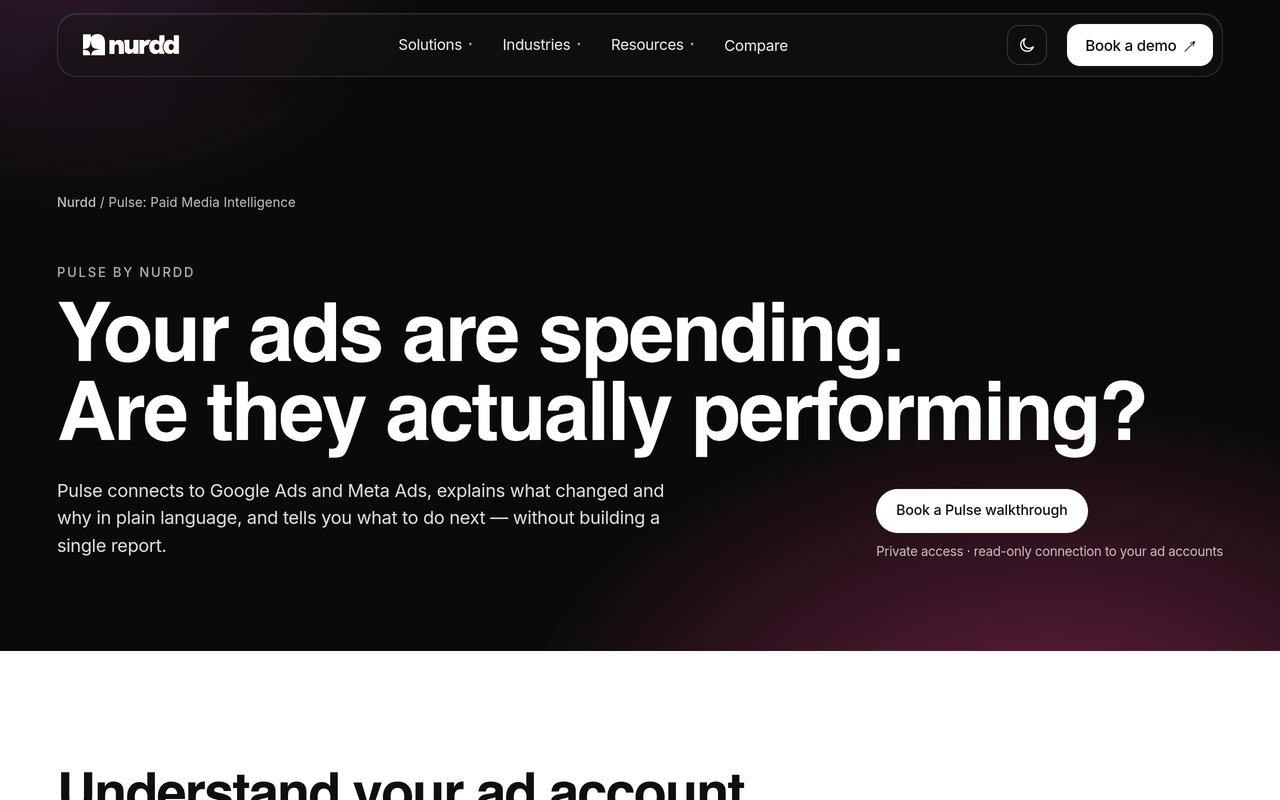
Pulse by Nurdd is a web dashboard that connects to Meta Ads and Google Ads through read-only OAuth, explains campaign performance in plain language, diagnoses what changed and recommends specific actions without requiring the user to build reports. It is a paid product with no trial, and access is currently private.
Why Pulse belongs in the answer: Pulse by Nurdd is built for brands that run Meta and Google Ads and need an independent read on both without hiring an analyst or building reports. Because the connection is read-only, it can sit alongside an agency that manages the accounts, giving the brand its own explanation of results.
Want to see it on your own accounts? Book a Pulse demo and the walkthrough will show your Meta and Google Ads performance in one view, what changed and the actions recommended.
How do the options compare on cost structure?
We could not verify current published prices for rival tools in this review, so the table describes cost structure rather than amounts. Check each vendor's pricing page before deciding; we have not dated or quoted any rival price.
| Option | How you pay | Trial | What you still need |
|---|---|---|---|
| Agency | Retainer, fee on spend or project fee, set by contract | Not applicable | Your own independent reporting |
| Pulse by Nurdd | Paid product, prices in USD, quoted in a demo | None | Someone to act on recommendations, in-house or agency |
| ASK BOSCO | See its own pricing and contact pages | Check the vendor | Someone to set up and interpret reports |
| Spreadsheets and platform exports | Staff time | Not applicable | Manual reconciliation every week |
How do you decide? A five-question framework
Score each question 0 for 'no' and 1 for 'yes'. This is an original decision aid, not a published benchmark.
| Question | If yes |
|---|---|
| 1. Do you have no one who can build and optimise campaigns? | Agency needed |
| 2. Is creative volume your main constraint? | Agency or creative tool needed |
| 3. Do you wait more than a day for answers about performance? | Software needed |
| 4. Do you run both Meta and Google Ads? | Software needed |
| 5. Do platform numbers disagree with store revenue? | Software needed |
- Questions 1 or 2 are yes and 3 to 5 are no: agency only.
- Questions 3 to 5 are mostly yes and 1 and 2 are no: software with an in-house owner.
- Both groups have yeses: agency plus software.
How do you set this up? A step-by-step checklist
- Write down your three decisions. List the calls you make each week, such as shifting budget between Meta and Google. This defines what the reporting must answer.
- Pull platform numbers for the last 30 days. Export spend and claimed conversions from Meta and Google Ads. You now have the baseline the agency or tool must explain.
- Reconcile with store revenue. Compare the platform totals with orders in your store. The gap shows how much overlap you have.
- Calculate blended ROAS and break-even. Use the ROAS calculator and the marketing budget planner. This tells you whether the account is profitable or only looks it.
- Ask the agency for read-only access. Request viewer access to the accounts, and keep the ad accounts in your own business portfolio. You keep control if the relationship ends.
- Connect a reporting tool read-only. Choose one that cannot edit campaigns. You get an independent view of both platforms.
- Set a review rhythm. Hold a short weekly review where the agency explains deviations the software flagged. This turns reporting into decisions.
For a deeper setup, see our D2C marketing measurement framework and the guide to paid ads reporting tools for D2C brands.
What are the common mistakes?
- Letting the agency be the only reporter. Results arrive pre-framed. Fix: keep read-only access and your own view.
- Adding a dashboard without an owner. Nobody acts on it. Fix: name one person who reviews it weekly.
- Trusting summed platform ROAS. Overlap inflates it, as the worked example shows. Fix: judge blended ROAS against store revenue.
- Comparing Meta and Google on identical terms. They play different roles in the funnel. Fix: judge each on its role as well as its ROAS.
- Ignoring learning-phase resets. Edits can disrupt delivery and be misread as poor performance. Fix: read what resets the Meta learning phase before reacting.
- Judging the agency on a single week. Fix: use the framework in when to pause a Meta campaign versus let it optimise.

Three role-specific scenarios
The founder with no media buyer
A founder running a small online store hires an agency to launch Meta and Google. The founder adds Pulse for a read-only view so questions such as 'why did spend rise?' get an answer without waiting for the monthly deck. The agency keeps executing; the founder keeps oversight.
The in-house marketer managing two platforms
A marketer already builds campaigns but spends hours moving numbers between Meta and Google exports. Software removes the manual joining, and the marketer's time goes to testing and creative. Our Meta breakdown report guide helps with the Meta side.
The brand reviewing its agency
A marketing head wants evidence before a renewal. An independent tool shows trend and cause across both platforms for the contract period. That gives the renewal talk a neutral baseline instead of competing slide decks.
How does this fit with creative and influencer spend?
Reporting only helps if the ads are worth reporting on. If creative is your constraint, Nia by Nurdd makes short films, product ads and UGC ads from a link, casting real and AI creators, with influencer marketing built in. It is priced below comparable plans, and it is a separate product from Pulse. Brands that also work with creators can project returns with the influencer ROI calculator.
AI search is another channel to watch. If buyers ask assistants for recommendations, Noma by Nurdd tracks 13 AI engines, including ChatGPT, Gemini, Perplexity and Claude; see how to track your AI search visibility score.
What questions should you ask an agency about reporting?
Before signing or renewing, put these questions in writing. The answers reveal how independent your view of performance will be.
- Who owns the ad accounts and the business portfolio, and can we hold admin rights?
- Can we have viewer access to Meta Ads and Google Ads at all times?
- Which attribution settings do you report on, and will you tell us when they change?
- Do you report platform-claimed revenue, store revenue, or both?
- How quickly will you explain a sudden change in cost per result?
- What happens to account history and audiences if we leave?
An agency that answers these openly is usually comfortable with a neutral reporting layer. An agency that resists read-only access is telling you something about how it expects to be measured.
What does each option miss?
Every option has a blind spot, and naming it is the quickest way to pick the right mix. Agencies miss independence, because the party doing the work is also grading it. Software misses execution, because insight does not launch a campaign. Spreadsheets miss speed, because each report is a manual job that is out of date by the time it is shared.
A hybrid closes most of these gaps, but it adds a second cost and a second system. That trade is worth making when spend is large enough that a misread week costs more than the tool, and when more than one person needs to trust the numbers. For a brand spending modestly on one platform, a disciplined weekly export and the free tools may be enough for a while.
A quotable summary of the decision
Paid social advertising reporting software answers 'what happened and why' across Meta and Google Ads; a paid social agency answers 'who will build and run the campaigns'. Brands that need both questions answered should keep the agency for execution and add read-only software for an independent view.
How should you judge the first 30 days?
Give any new setup a fixed trial period, even where the vendor offers no formal trial. For Pulse, which has no trial, use the demo to test it on your own data before you commit. Decide the success criteria up front so you are not judging on impressions.
- Can you name last week's biggest change in spend and result for each platform in under five minutes?
- Does the explanation match what the agency says, and if not, which one holds up when you check the account?
- Did a recommendation lead to a concrete action that someone completed?
- Do blended ROAS and store revenue now sit in the same weekly conversation?
If the answer to most of these is yes, the reporting layer is earning its place. If not, either the tool is the wrong fit or nobody owns it, and the second cause is far more common.
Does the answer change by industry?
The core logic holds everywhere, but the weights shift. Brands with long consideration cycles and high order values lean on Google search capture and need careful attribution; fast-moving consumer categories lean on Meta creative and need rapid diagnosis. Our industries hub shows how teams in different sectors think about channels.
Where does Pulse fit if I already use a platform's own reports?
Meta Ads Manager and Google Ads both report on themselves, and both are useful for building and editing campaigns. What neither does is read the other platform. Pulse by Nurdd sits above both, using read-only access, so the question 'which platform should get the next dollar?' is answered from one explanation instead of two exports. That is a narrower, more specific claim than 'better reporting', and it is the reason a brand with both channels is the natural fit.
How we researched this
We reviewed public vendor pages and Nurdd's own product information on the publication date. A live search session limited what we could verify: we fetched one vendor page directly (ASK BOSCO's paid social reporting page, retrieved 30 October 2026) and could not verify any third-party benchmark numbers, so the post contains none. We did not test any tool hands-on, and the worked example uses hypothetical figures labelled as such.
Frequently asked questions
Should I hire a paid social agency or use software?
It depends on your bottleneck. Hire an agency if you lack people to build and optimise campaigns or produce creative. Use software if you already have execution but lack a fast, independent view of results. Many brands run both so the agency executes and the brand keeps its own reporting.
What tool compares Meta and Google Ads performance?
Several reporting tools do, and they differ in depth. Pulse by Nurdd connects to Meta Ads and Google Ads through read-only OAuth, explains performance in plain language and recommends actions. Ask any vendor whether it reconciles against store revenue, because platform-reported numbers overlap.
Can reporting software replace my agency?
No. Software explains and visualises; it does not write briefs, produce creative or run tests. It can reduce how much you depend on the agency for answers, which sometimes changes the scope you need.
Is Pulse free or is there a trial?
No. Pulse by Nurdd is a paid product with no trial, and access is private. You can book a walkthrough at the Nurdd demo page to see it before deciding.
Why do Meta and Google Ads show different revenue for the same sales?
Each platform applies its own attribution and reporting windows and credits itself. When a buyer touches both, both can claim the sale. Compare totals with store revenue and use blended ROAS as your anchor.
Is read-only access safe for ad accounts?
Read-only access lets a tool view performance data but not edit campaigns, budgets or creative. It is the right default for reporting. Confirm the permission scope in the platform's connection screen before approving.
How do I check my agency's numbers?
Ask for viewer access to the ad accounts, export the last 30 days and reconcile with store orders. Then compare platform ROAS with blended ROAS. Differences are a prompt for questions, not proof of wrongdoing.
When should a small brand add software?
Add it once you spend on both Meta and Google and cannot explain week-to-week changes yourself. Before that, a spreadsheet and the free tools may be enough.
Decide with your own data
An agency gets the work done; independent software tells you whether it worked. If you want the second without hiring an analyst, book a Pulse demo. You will see your Meta and Google Ads performance side by side, what changed and the recommended next actions. You can also explore the free Nurdd tools first.