AI Search Visibility
Peec AI Alternatives for Brand Perception Tracking
How to track what ChatGPT, Gemini and other AI engines say about your brand, what to ask any vendor, and where Noma's 13-engine tracking fits.
 Sheetal Shakshi7 Nov 202614 min read

The strongest Peec AI alternatives for brand perception record the full wording of AI answers, cover the engines your buyers use and show which sources shaped each description. Noma by Nurdd tracks 13 AI engines, including ChatGPT, Gemini, Perplexity and Claude, polled daily, and records which page each citation comes from. Use the 12 vendor questions below to test any tool, Noma included.
The best Peec AI alternatives for brand perception tracking are tools that store the full text of AI answers, cover the engines your buyers actually use, and show which sources shaped each description of your brand. Noma by Nurdd is built for that job: it tracks 13 AI engines, including ChatGPT, Gemini, Perplexity and Claude, polled daily. This guide explains how to track brand sentiment and positioning in AI answers, and gives you 12 questions to put to every vendor, including us.
Key takeaways
- Brand perception in AI search means the tone, themes and positioning an AI engine uses when it describes your brand, not just whether it names you.
- Engine coverage decides what you can see. A tool that tracks a few engines is blind to the rest, and your buyers do not all use the same assistant.
- Ask every vendor how sentiment is scored, whether you can read the raw answer, and whether the cited source behind a negative description is shown.
- Run a fixed prompt library on a fixed schedule. Without one, a sentiment shift can be nothing more than a changed prompt.
- Shortlist two or three tools, give each the same 20 prompts, and compare what each one records. Book a demo to see Noma run your own brand's prompts.
What does brand perception tracking mean in AI search?
Brand perception tracking in AI search measures how AI engines describe your brand when a buyer asks about your category. It goes beyond a yes or no on whether you were mentioned. It records the tone, the attributes the engine attaches to you, and where you sit against competitors in the same answer.
Exploding Topics defines AI brand sentiment as the tone, positive, negative or neutral, that large language models use when describing a brand (Exploding Topics). Tone is only one of three layers worth tracking:
- Presence: is your brand named at all for the prompt?
- Tone: is the language positive, neutral or negative?
- Positioning: which attributes, price tier, audience and use case does the engine attach to you, and are they the ones you intend?
Most readers searching for Peec AI alternatives want the second and third layers. Our guide to AI brand perception tracking covers measurement design in more depth; this page focuses on choosing a tool.
Why are people looking for Peec AI alternatives?
Buyers typically look past a first tool for three reasons: they need more engines, they need deeper reading of how the brand is described, or they need a clearer path from a finding to a fix. These are gaps that appear once a team moves from counting mentions to managing reputation in AI answers.
The pages ranking for this keyword today are mostly listicles. Nightwatch lists Knowatoa AI as sentiment-focused and Scrunch AI as brand perception tracking (Nightwatch). Quattr says Scrunch AI focuses on narrative control and brand sentiment (Quattr), and SE Visible compares nine tools in a table by speciality (SE Visible). Withgauge also names Scrunch for AI brand perception and journey mapping (Withgauge).
What those lists leave out is a way to test the claim. A vendor saying it does "sentiment" tells you nothing until you know how it scores the answer, which engines it reads and whether you can see the source behind a negative line. The sections below fill that gap.
How do I track brand sentiment in ChatGPT and Gemini?
You track brand sentiment in ChatGPT and Gemini by running the same set of buyer prompts on a schedule, saving each full answer, and scoring how the brand is described. Trysight describes the method as running a fixed library of brand, comparison and recommendation prompts across the platforms your buyers use on a set schedule (Trysight). A separate Trysight guide suggests 30 to 50 realistic buyer prompts (Trysight).
You can do this by hand for a first pass. For ongoing tracking, software saves the answers, repeats the run and shows the trend.
Checklist: set up AI sentiment tracking in seven steps
- Write 20 to 30 prompts in three groups. Use direct brand questions ("Is [brand] good for sensitive skin?"), comparison questions ("[brand] vs [competitor]") and category recommendation questions ("best moisturiser for dry skin"). The groups reveal different risks.
- Fix the engines. Choose at least ChatGPT, Gemini, Perplexity and Claude, plus Google's AI surfaces if search matters to you.
- Run each prompt on a schedule. Weekly is a sensible minimum; daily polling catches faster shifts. Keep the wording identical between runs.
- Save the full answer and the cited sources. A score without the underlying text cannot be audited.
- Label each answer. Record presence, tone and the attributes named, such as price, quality, support or trust.
- Trace negatives to a source. If the engine says something unflattering, find the page it cited.
- Review monthly against a baseline. Change one thing at a time. Our GEO experiment design guide shows how.
For the prompt list itself, see which prompts to track and how many prompts you need.
What should a brand perception tool actually show?
A brand perception tool should show an overall tone, the themes engines associate with your brand, the attributes inside each theme, and the sources behind them. Without all four, a team can see a score but cannot explain or change it.
Noma by Nurdd records whether your brand is named across 13 AI engines, which page each citation comes from and how you compare with competitors, so a team can read how engines position the brand and trace it to a source.
A sentiment score you cannot trace to an answer and a cited page is a label, not evidence.
How do Peec AI alternatives compare on brand perception?
The table compares capabilities that matter for brand perception. Noma's cells come from Nurdd's own product facts. For rival tools, the only fact stated is one drawn from the vendor's own public page; everything else is a question to put to the vendor.
| Capability | Noma by Nurdd | Profound (own documentation) | Peec AI, Scrunch AI, AthenaHQ |
|---|---|---|---|
| Engine coverage | 13 AI engines, including ChatGPT, Gemini, Perplexity and Claude, polled daily | Ask which engines are on your plan | Ask which engines are on your plan |
| Brand named in answers | Yes, with citation frequency by category | Ask for a live example | Ask for a live example |
| Source behind each citation | Yes, records which page each citation comes from | Its documentation says Sentiment scans the citations behind responses | Ask for a live example |
| Competitor comparison | Yes | Its documentation says sentiment is compared by AI platform and topic | Ask for a live example |
| Themes and attributes scored for tone | Ask to see on your own prompts in a demo | Its documentation describes themes and attributes | Ask how scoring works |
| Recommendations to act on | Yes, actionable recommendations to improve AI visibility | Ask what is recommended | Ask what is recommended |
Profound's sentiment documentation is at Profound documentation. For every cell that says "ask", the 12 questions below are the test.

What should I ask any vendor about brand perception?
Ask 12 questions, grouped by what they reveal. Put the same list to Peec AI, Profound, Scrunch, AthenaHQ, Noma and anyone else on your shortlist, and keep the written answers. Our vendor questionnaire extends this for procurement teams.
Coverage
- Which AI engines are tracked on the plan I would buy, and which are paid add-ons?
- How often is each prompt run: daily, weekly or on demand?
- Are answers collected from the consumer interface or only an API, and can you say which?
Scoring
- How is tone scored: a model, rules or human review? Can I see the prompt that does the scoring?
- Can I read the full, original answer behind every score?
- Does the tool separate tone about my brand from tone about the category in the same answer?
Evidence
- For a negative description, does the tool show the cited page that caused it?
- Does it show competitors in the same answer and how they are framed?
- Can I see how the answer changes over time for the same prompt?
Action and commercial terms
- What does the tool recommend when perception is wrong, and who carries it out?
- Can I export raw answers, or am I locked to dashboards?
- What exactly is billed, and what happens if I cancel in the first days?
Questions 4, 5 and 7 do the most work. They test whether a sentiment score is a number you can defend in front of a CMO, or a label you take on trust.
Why does engine coverage matter?
Engine coverage matters because each assistant draws on different sources and can describe the same brand differently. A brand might get a clear recommendation in one assistant and a generic mention in another. A tool tracking only a handful of engines hides that gap.
Noma tracks 13 AI engines, including ChatGPT, Gemini, Perplexity and Claude. That breadth lets a team compare how each engine positions the brand, then decide where to focus. Our Perplexity vs ChatGPT vs Gemini guide explains why engines differ, and the personalization article covers why one answer is never the whole picture.
Whatever you buy, write the engine list into the contract and compare it with where your customers ask questions.
What does a worked example look like?
The walkthrough below uses placeholders, so you can repeat it with your own counts. No figures here are data from any source or customer.
Let P be the number of prompts, E the number of engines, and A = P × E the number of answers collected in a week. Label every answer, then count M, the answers that name your brand. Of those, count Pos positive, Neu neutral and Neg negative mentions.
| Measure | Formula | What it tells you |
|---|---|---|
| Presence rate | M ÷ A | How often engines name you at all |
| Positive share | Pos ÷ M | How favourably you are described when named |
| Negative share | Neg ÷ M | The size of the reputation risk |
| Engine concentration | Negatives on one engine ÷ Neg | If close to 1, investigate that engine's cited sources first |
The headline numbers matter less than the clustering. If most negatives sit on one engine, that points to a specific cited page rather than a general reputation problem. A tool that lets you click from the negative answer to the cited URL turns that into a quick fix instead of weeks of guessing.
Which Peec AI alternatives are worth shortlisting for perception?
Shortlist by the job you need done, then test. Use only what each vendor's own public pages say, and put the 12 questions to each one.
Noma by Nurdd
Noma is a web dashboard that tracks whether a brand appears in answers from 13 AI engines, polled daily. It shows citation frequency by category, competitor comparison and recommendations. For perception work, you can read how each engine names you and see the page each citation comes from. Noma vs Peec AI gives the direct comparison.
Profound
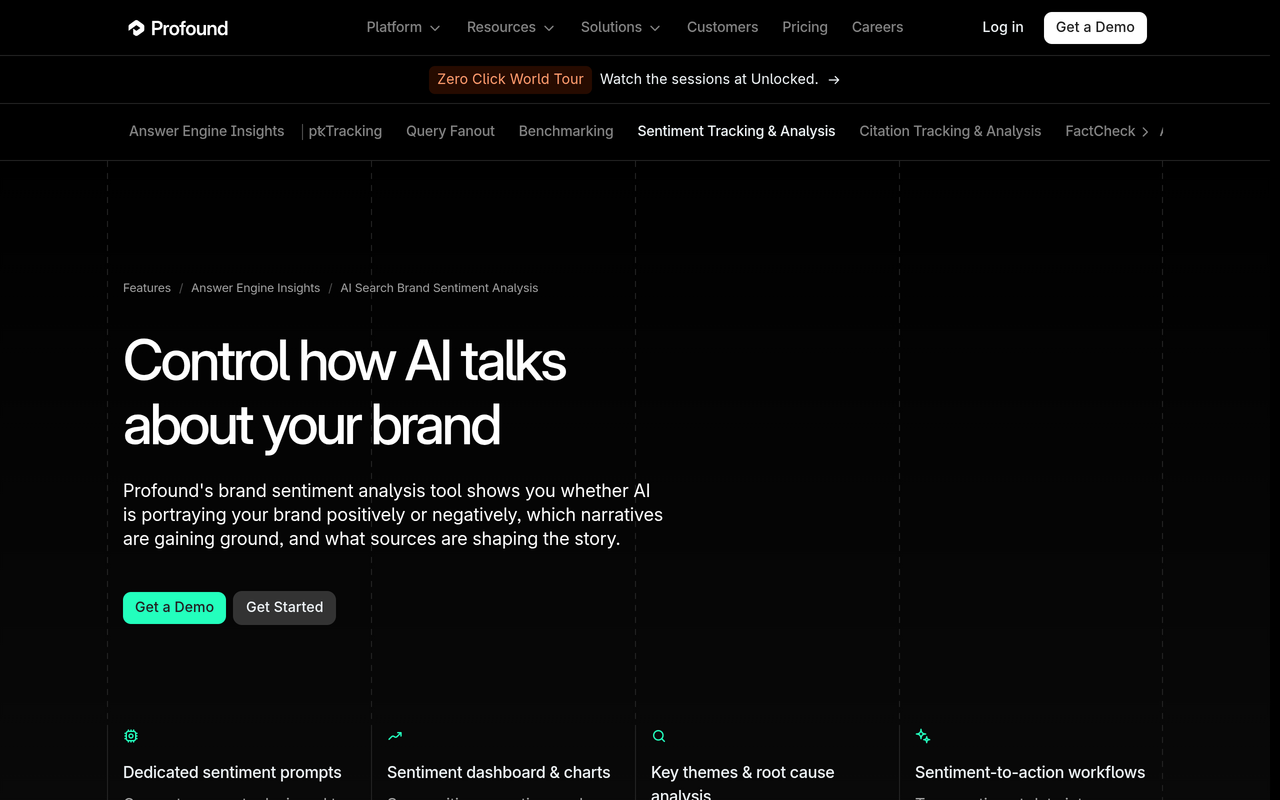
Profound's documentation says its Sentiment feature surfaces an overall score, themes and attributes, scans citations and is available on all plans (Profound documentation). See Noma vs Profound and Profound alternatives.
Scrunch AI
Third-party lists describe Scrunch as oriented to brand narrative and perception (Quattr). Our Scrunch AI review checklist lists what to confirm, and Noma vs Scrunch sets the two side by side.
AthenaHQ
Use Noma vs AthenaHQ and AthenaHQ alternatives for comparison points, and confirm engines and limits on the vendor's own pricing page.
Sentiment-first newcomers
Nightwatch describes Knowatoa AI as focused on how AI systems describe a brand across ChatGPT, Claude, Gemini, Perplexity and Google AI Overviews (Nightwatch). Treat any such claim like the others: test it on your prompts.
How do pricing and trials compare?
Pricing changes often, and review sites quote different numbers for the same plan, so we have not copied any rival's price. The table states what is published for Noma and what to confirm with others.
| Vendor | Free trial or entry point | What to confirm on the vendor's own pricing page |
|---|---|---|
| Noma by Nurdd (checked 7 Nov 2026) | 3-day free trial; a card is taken at signup, billing starts on day 3, no charge if cancelled before then | Current plan prices in USD at nomahq.app |
| Profound | Ask the vendor | Plan prices, prompt limits, engines per plan |
| Peec AI | Ask the vendor | Plan prices, engines included, add-on models |
| Scrunch AI | Ask the vendor | Plan prices, engines per plan, prompt limits |
| AthenaHQ | Ask the vendor | Plan prices, credit model, model coverage |
Compare cost per engine and per prompt, not just the monthly figure. Two plans at similar prices can cover very different amounts of the AI landscape.
Why is Noma the stronger choice for brand perception?
Noma is the stronger choice where breadth and traceability matter most: 13 engines, daily polling, citation sources and competitor comparison in one dashboard. Those rows decide whether you can find where your brand is misdescribed and prove it to your team.
Noma by Nurdd is an AI search visibility dashboard that tracks whether a brand appears in answers from 13 AI engines, including ChatGPT, Gemini, Perplexity and Claude. It records whether the brand is named and which page each citation comes from, with competitor comparison and recommendations. Teams use it to see how engines position them and to fix the sources behind it.
Want to see this on your own brand? Book a demo and we will run your category prompts across the engines, so you can read how each one describes you and which pages it cites.
Where Noma wins or ties: engine breadth, daily polling, citation sources, competitor comparison and recommendations. Where you should test rather than assume: tone scoring on your own prompts. Ask for it in the demo, using questions 4, 5 and 7. Our comparison of AI search visibility tools and buyer checklist put Noma next to the wider field.
What happens after you find a perception problem?
After you find a perception problem, trace it to the cited source, fix or replace that source, then re-run the same prompts. Perception in AI answers is built from pages, so the fix is usually a content or reputation task rather than a setting.
- Open the negative or inaccurate answer and list the sources it cites.
- Decide if the source is your own page, a review site, a forum thread or a stale article.
- For your own pages, rewrite the brand description plainly; see how to write a brand description AI engines can use.
- For entity confusion, add consistent identifiers; the Wikidata and sameAs guide shows how.
- For third-party sources, earn better coverage of your brand.
- Re-run the same prompts for four weeks and compare, as in our four-week test plan.
If you would rather hand this to a team, Nurdd's answer engine optimization agency service works on the content and sources AI engines read, measured in Noma.
What are the common mistakes in brand perception tracking?
- Changing prompts between runs. Wording changes move answers, so a trend becomes noise.
- Trusting a score with no answer text. If you cannot read the original, you cannot defend the number.
- Tracking too few engines. You see one assistant's view and assume it is everyone's.
- Ignoring the cited source. Negative tone is usually inherited from a page, and the page is the fix.
- Reporting sentiment alone. Pair it with share of voice; see AI search share of voice and the monthly AI search report template.
- Treating one answer as truth. Answers vary by run and user, so look at patterns across many prompts.
How we researched this
We reviewed vendor documentation and public feature pages, third-party comparison articles that rank for this keyword, and published guides on measuring brand sentiment in AI answers. Sources were checked on 7 November 2026, the publication date. We did not run hands-on tests of rival tools, interview customers or collect our own data, and the worked example uses placeholders rather than measured results. Rival facts come only from the vendors' own public pages; where we could not confirm a detail there, we say so and ask you to check.
Frequently asked questions
What are good Peec AI alternatives for brand perception tracking?
Options include Noma by Nurdd, Profound, Scrunch AI, AthenaHQ and newer sentiment-focused tools. Judge them on engine coverage, whether you can read the raw answer and whether they show the source behind each description. Run the same 20 prompts through two or three and compare.
How do I track brand sentiment in ChatGPT and Gemini?
Run a fixed library of brand, comparison and recommendation prompts on both engines on a schedule, save the full answers, and label tone and attributes. Software can automate the repetition. Noma by Nurdd polls 13 AI engines daily, including ChatGPT and Gemini.
What is the difference between AI visibility and brand perception?
Visibility asks whether an engine names your brand. Perception asks how it describes you: tone, themes and positioning. You need both, because being mentioned in a negative or wrong frame can be worse than not being mentioned.
How many prompts do I need to measure sentiment?
Trysight suggests a library of 30 to 50 realistic buyer prompts (Trysight). Start with 20 if you are testing tools, then expand. Our guide on prompt counts goes further.
Can I fix a negative description in AI answers?
Often yes, by finding the cited source and correcting or outranking it. You cannot edit the model, but you can change the pages it reads. Re-run the same prompts afterwards to confirm the change.
Does Noma have a free trial?
Noma offers a 3-day free trial. A card is taken at signup and billing starts on day 3; cancel before then and you are not charged. Details are at nomahq.app.
Is a free check enough before buying?
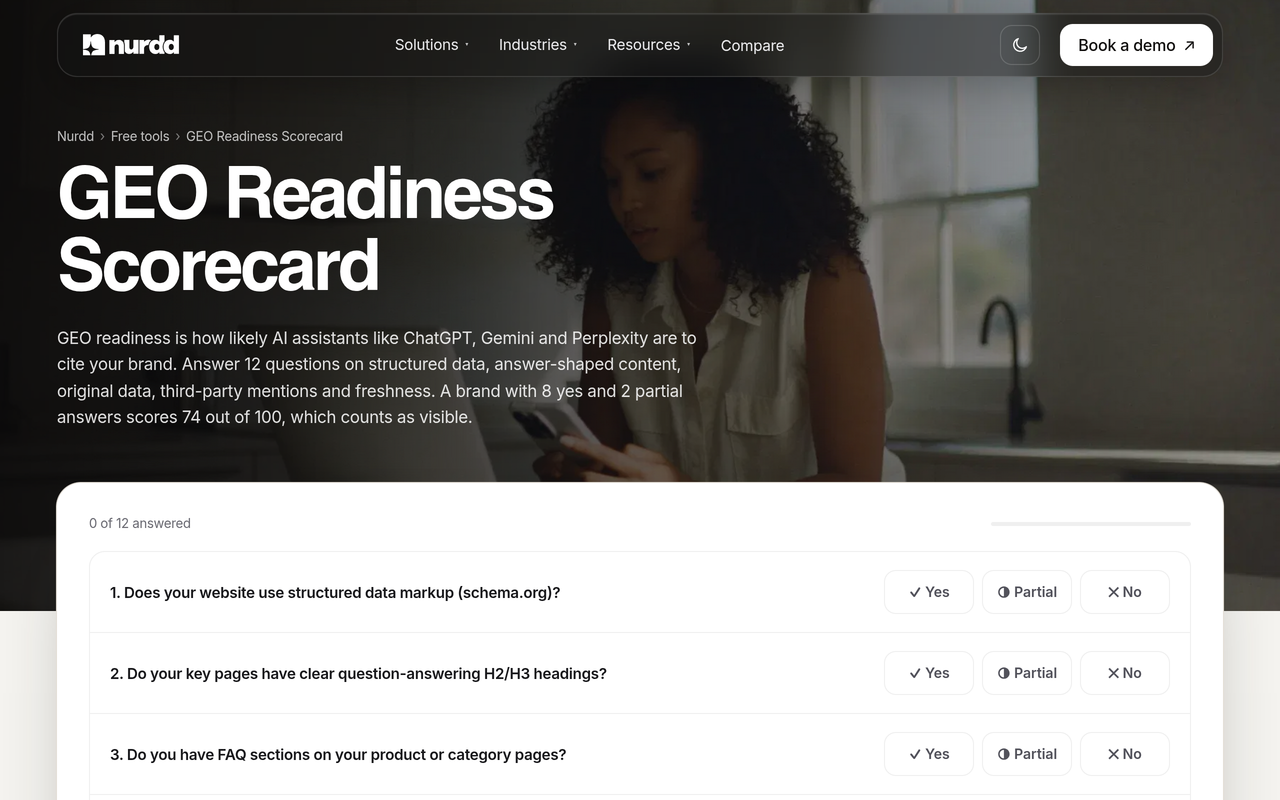
A free check helps you decide whether you are ready. Nurdd's GEO readiness scorecard runs a 12-factor check. It does not replace ongoing tracking across engines.
Next step: see how engines describe your brand
Perception tracking only pays off when you can read the answers and follow them to a source. Book a demo of Noma and you will see your own brand's prompts run across 13 AI engines, the pages each engine cites and how you compare with competitors. You can also read how Nurdd works first.