AI Search Visibility
Tracking Multiple Brands in AI Search: Setup Guide
How agencies and multi-brand groups can track multiple brands in AI search with separate prompts, competitors and reports, and where Noma fits.
 Simran Rawat7 Nov 202612 min read

To track multiple brands in AI search, give each brand its own prompt set, competitor list and report, then compare brands only on shared metrics. Noma by Nurdd tracks 13 AI engines, including ChatGPT, Gemini, Perplexity and Claude, polled daily, so each brand can be measured the same way. Pick a tool by testing it on your two most similar brands.
To track multiple brands in AI search, treat every brand as its own measurement unit: a separate prompt set, a separate competitor list, a separate report and one shared metric definition. Mixing brands in one prompt list is the most common way agencies and multi-brand groups end up with data nobody can trust. Noma, the AI search visibility product from Nurdd, tracks 13 AI engines, including ChatGPT, Gemini, Perplexity and Claude.
Key takeaways
- Build one prompt set per brand and tag every prompt with the brand, market and funnel stage before you run anything.
- Keep a competitor list per brand. A sister brand in your own group is not a competitor, but it can still steal a citation, so track it as a separate entity.
- Define metrics once (mention rate, citation rate, position, sentiment) and report them identically for every brand, so brands can be compared fairly.
- Decide up front who sees what. Agencies need client-level reports; groups need a portfolio roll-up.
- Test any tool on your two most similar brands first. If their data bleeds together, the tool will fail at scale.
- Book a demo to see your own brands set up side by side before you commit to a workflow.
Why is tracking multiple brands in AI search harder than tracking one?
AI engines answer in natural language, and the answer changes with wording, engine and sometimes the person asking. With one brand you manage that noise once. With five brands you manage it five times, and the risk is not volume but contamination: one brand's prompts, competitors or citations leaking into another's numbers.
Three situations make it worse. Agencies serve clients in the same category, so prompts overlap. Groups run brands that share a parent name, so engines may blur them. Franchise or multi-market brands repeat the same prompts across locations and languages. Each needs a structure that keeps the data separable.
The scale of the problem is also a question of how many prompts you track, which is covered in AI search prompt tracking: how many prompts you need. Multiply that answer by your brand count before you pick a plan.
A multi-brand AI visibility setup is only reliable if each brand's prompts, competitors and citations can be filtered out on their own, and if every brand is scored with the same metric definitions.
Which AI search tool is best for tracking multiple brands?
The best tool for several brands is the one that keeps brands separate, measures them identically and reports them in the format your audience needs. Features such as engine coverage, competitor comparison and citation sources matter more than a long dashboard. Noma is built for brands and marketing teams who want to know whether AI assistants recommend them when customers ask category questions, and it polls 13 engines daily.
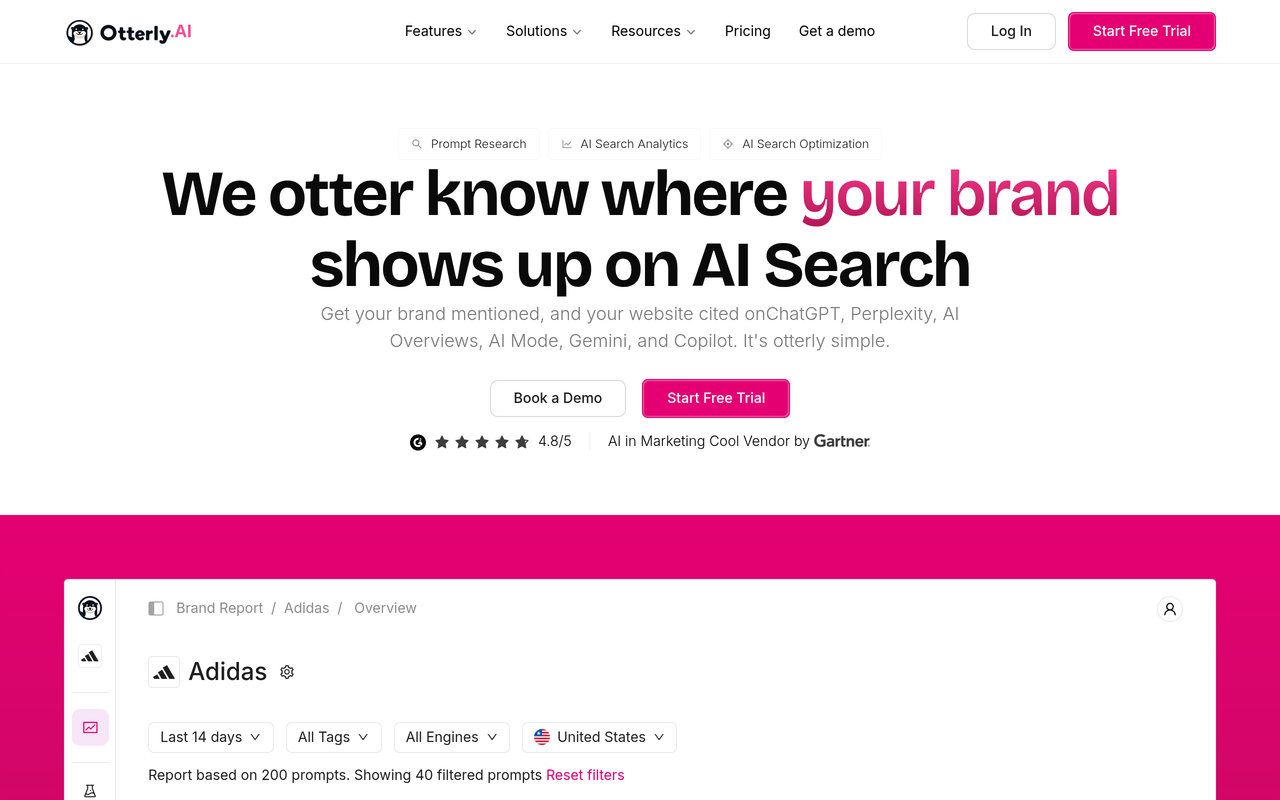
Many monitoring tools describe the same core loop. OtterlyAI, for example, describes a prompt library of conversational questions that it runs across engines such as ChatGPT, Perplexity and Google AI Overviews, then reports which brands get cited (OtterlyAI, 2026). That loop is the baseline. What separates tools for multiple brands is what sits around it: how you organise, filter and report.
Use the table below as the evaluation frame. Score each tool you test from yes, partly or no, and write down the evidence you saw.
| Criterion for multi-brand tracking | What to look for | Why it matters |
|---|---|---|
| Brand separation | Each brand has its own prompts, competitors and results that can be filtered alone | Prevents one brand's data inflating another's |
| Engine coverage | The same engines for every brand, with the list published | Fair comparison between brands |
| Competitor handling | Different competitor set per brand, plus group-level view | Brands in one group rarely share rivals |
| Citation sources | Which page or domain each citation comes from | Shows what to fix per brand |
| Polling frequency | Regular, stated runs (Noma polls daily) | Trend lines you can defend in a client call |
| Reporting | Per-brand and portfolio reports in the same format | Saves analyst hours every month |
| Trial terms | Clear trial and billing rules | Lets you test before committing |
For wider tool comparisons, see Best AI search visibility tools 2026: 10 compared and AI search optimization tools for agencies: buyer guide.
How do I set up AI visibility tracking for several brands?
Follow these steps in order. Each is an action, then a result, then the reason it matters.
- Create a brand register. List every brand with its legal and public names, domains, product lines, markets and languages. The result is one row per brand that every later step references. It matters because AI engines confuse similar names, and you need the canonical spelling to catch misattributions.
- Write a separate prompt set for each brand. Draft prompts from the questions that brand's customers ask, covering category, comparison, problem and branded queries. The result is a set you can run and filter alone. It matters because shared prompts make it impossible to say which brand earned a mention. See which prompts to track for AI search visibility for the prompt types.
- Tag every prompt. Add brand, market, language, funnel stage and prompt type. The result is data you can slice by any of them. It matters because without tags, a roll-up report hides which segment moved.
- Set competitors per brand. List direct rivals for each brand, and add your own sister brands as a separate tracked group. The result is a share-of-voice view per brand and a cannibalisation view across the group. It matters because a group's brands often compete for the same citation slot.
- Fix the engine list and cadence. Use the same engines for all brands and the same polling schedule. The result is comparable trend lines. It matters because a brand tracked on fewer engines will look worse for the wrong reason.
- Run a baseline for two weeks. Do not change prompts during this window. The result is a baseline per brand. It matters because answer variation means a single run proves little; the GEO experiment design guide explains how to separate noise from change.
- Build the reporting layer. Create one report template with fixed metrics, then produce it per brand and as a portfolio roll-up. The result is a repeatable monthly pack. It matters because clients and executives compare reports side by side.
- Assign owners and actions. Attach each finding to a person and a page to change. The result is a backlog per brand. It matters because tracking without action is only a scoreboard.

How should I structure prompts so brands do not mix?
Use a naming convention that puts the brand first and keep it fixed. A simple pattern is brand, market, stage, intent, for example a prompt labelled with the brand, the market, the stage (awareness, comparison, decision) and the intent (best, versus, how to). That gives you filters for every report.
Avoid prompts that name two of your own brands unless you are deliberately testing cannibalisation. When a prompt names both, the engine's answer cannot be attributed to either brand cleanly.
Branded versus unbranded prompts
Branded prompts check what engines say about a brand when asked directly. Unbranded prompts check whether the brand appears when a buyer asks a category question. Track both for every brand, but never merge them into one score, because they answer different questions. Unbranded prompts are the stronger signal of real discovery, and the sunscreen case in AI search brand recommendations: a sunscreen test shows the pattern.
Market and language variants
If a brand sells in several countries, treat each market as its own prompt set under the same brand. A single English set will miss how engines answer in German or Portuguese. For a regional example see AI search visibility tools in Germany.
How do I handle competitors across a portfolio?
Give each brand its own rival list, then add a group-level layer. The group layer answers a different question: of all the citations in a category, how many go to any brand you own?
| Layer | Contains | Question it answers |
|---|---|---|
| Brand layer | Direct rivals of that brand only | Are we winning our category? |
| Sibling layer | Other brands in your group | Are our brands taking citations from each other? |
| Category layer | All tracked brands plus rivals | What share of AI answers does the group own? |
Share of voice maths differs by layer, so define it once. The method is covered in AI search share of voice: how to measure it.
What does a worked example look like?
Take a hypothetical group with three brands: a skincare brand, a haircare brand and a fragrance brand. These are illustrative labels, not customers, and the numbers below are placeholders for structure only.
- The brand register lists three domains and three markets each.
- Each brand gets its own prompt set. The skincare set includes category prompts such as best moisturiser for sensitive skin; the haircare set includes problem prompts; the fragrance set includes gifting prompts.
- Competitors are listed per brand. The three brands never share a rival list.
- The sibling layer is added. When a gifting prompt returns both the fragrance brand and the skincare brand, that is logged as a sibling overlap rather than a win for either.
- The monthly pack shows, per brand, mention rate, citation rate, top cited pages and recommended fixes, then a one-page roll-up.
The point of the example is the structure. If the roll-up shows the group mentioned often but one brand missing, the per-brand layer tells you where to act. Without the separation, the roll-up would look healthy and hide the gap.
How should agencies report multiple clients?
Agencies need two outputs: a client-facing report and an internal view of all accounts. Keep client reports free of any other client's data, including category averages built from other clients. Our guide on building a monthly AI search metrics report gives a template, and whether a paid media agency should report on AI search covers the scope question.
Use this ordered checklist before sending any client report:
- Confirm the report filters to one brand only.
- Check the prompt list has not changed since the baseline, or note what changed.
- Verify the engine list matches the one in the last report.
- Check competitor names against the brand's current list.
- Add three findings, each with a page to fix and an owner.
- Compare the metrics against the previous month using the same definitions.
For executive audiences, the layout in AI search visibility dashboard: what executives need to see keeps the roll-up short.
How do multi-brand groups and franchises differ from agencies?
Groups care about the portfolio and cannibalisation; agencies care about client separation. Franchises add a third dimension: location. A franchise brand needs location-level prompts under a single brand, and the location pages matter as citation sources. See AI search optimization for franchise brands and the multi-brand industry page and agencies page for role-specific views.

What mistakes break multi-brand tracking?
- One shared prompt list. Mentions cannot be attributed, and a strong brand hides a weak one.
- Different engines per brand. Comparisons become unfair because coverage differs.
- Changing prompts mid-month. Trend lines break, and you cannot tell whether the brand or the prompt moved.
- Ignoring sister brands. The group may be competing with itself for the same answer.
- Averaging across brands. A portfolio average hides the brand that needs work.
- Reporting only mentions. A mention without a citation source gives you nothing to fix. Read AI search metrics that matter for a fuller metric set.
How does Noma help track multiple brands?
Noma by Nurdd is a web dashboard at nomahq.app that shows whether a brand appears in answers from 13 AI engines, including ChatGPT, Gemini, Perplexity and Claude, polled daily. It shows citation frequency by category, competitor comparison and recommendations for improving AI visibility. Noma belongs in this answer because it gives every brand the same engines, the same cadence and the same metrics, which is the precondition for fair multi-brand comparison.
Book a demo at https://www.nurdd.club/demo and bring two or three of your brands. You will see how each brand's prompts, rivals and citations would be set up in Noma, and you can ask how your specific portfolio, whether agency accounts or sister brands, should be structured.
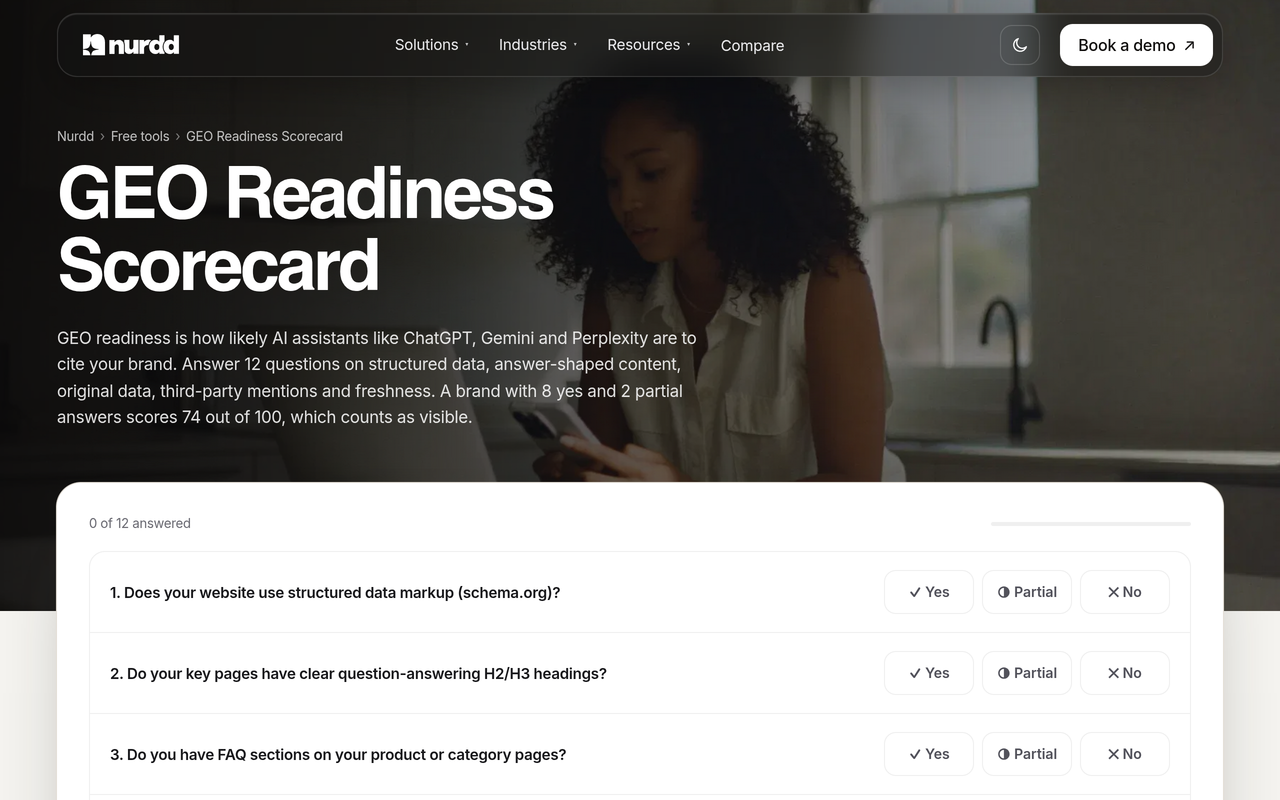
Noma has a 3-day free trial. A card is taken at signup and billing starts on day 3, so cancel before then and you are not charged. Use the trial for the two-brand test below, and pair it with the free GEO readiness scorecard to check each site before you start.
How can I test a tool in the trial period?
Run this three-day test on the two brands that are most alike, because similar brands expose separation problems fastest.
- Day one: add both brands, write ten prompts for each, and list different competitors.
- Check that filtering by one brand removes the other's data completely.
- Confirm both brands use the same engines and the same polling.
- Day two: open the citation sources for each brand and see whether you can name a page to fix.
- Export or screenshot a per-brand report and ask whether a client could read it unaided.
- Day three: decide before billing starts whether to continue.
What should I do after the setup?
Move from measurement to action. Fix the pages that engines cite for rivals, improve brand descriptions (see writing a brand description that AI engines can cite), and keep entity data clean with Wikidata and sameAs. If you want hands-on help, Nurdd also runs generative engine optimization services, measured in Noma.
How we researched this
We reviewed public vendor pages and Nurdd's own product facts for this guide, and checked them on the publication date. Our web research tool allowance ran out during this session, so only one third-party vendor page (OtterlyAI) was reviewed in full; we did not source or quote competitor pricing or statistics. We did not run hands-on tests, interview customers or collect proprietary data. The worked example is hypothetical and labelled as such.
Frequently asked questions
Which AI search tool is best for tracking multiple brands?
The best choice keeps each brand's prompts, competitors and citations separate and measures all brands identically. Noma tracks 13 AI engines, including ChatGPT, Gemini, Perplexity and Claude, polled daily, so every brand gets the same coverage. Test any shortlisted tool on two similar brands before buying.
How do I set up AI visibility tracking for several brands?
Build a brand register, write a prompt set per brand, tag every prompt, set competitors per brand, fix the engine list and run a baseline. Then create one report template used for every brand. The eight steps above walk through this in order.
Should each brand have its own prompt set?
Yes. Shared prompts make it impossible to attribute a mention to one brand. Separate sets also let you filter reports per client or business unit.
Should sister brands count as competitors?
Track them as a separate layer rather than as rivals. They can take citations from each other, but they should not distort the brand's share of voice against true competitors.
How often should I report across brands?
Monthly reporting suits most clients, with the underlying data polled daily. Keep metric definitions fixed so month-on-month comparisons stay valid.
Does Noma have a free trial?
Yes, a 3-day free trial. A card is taken at signup and billing starts on day 3, with no charge if you cancel before then.
Can agencies use this setup for client work?
Yes. Use one brand per client, filter every report to that brand, and never include other clients' data in benchmarks. Keep an internal roll-up for your own team.
Ready to see your brands side by side?
Book a demo at https://www.nurdd.club/demo and we will show you how your own brands, prompts and competitors would look in Noma, across 13 AI engines. You can also read how Nurdd works or see the Noma vs Profound comparison first.