AI Search Visibility
Search Visibility Checking Software: What to Measure
Rank checkers and AI answer trackers measure different things; here are the metrics to demand from each and a repeat-run test before you buy.
 Simran Rawat6 Nov 202616 min read

Search visibility checking software comes in two kinds: rank checkers that report Google positions, and AI visibility checkers that report whether ChatGPT, Gemini, Perplexity, Claude and Google's AI features name or cite your brand. Buy both, and demand mention rate across repeated runs, cited URLs and share of voice from the AI tool, because identical prompts rarely return the same brand list.
Search visibility checking software comes in two kinds, and most buyers need both. Rank checkers measure where your pages sit in Google's results. AI visibility checkers measure whether ChatGPT, Gemini, Perplexity, Claude and Google's AI features name or cite your brand in the answer.
Key takeaways
- Buy by question: rank checkers answer "where do I appear in a list?", AI visibility checkers answer "am I named inside the answer?". Neither replaces the other.
- For AI answers, demand mention rate across repeated runs, cited URLs, competitor share and sentiment. Do not accept a single rank position.
- Run the same prompt several times in any trial. Search Engine Journal, January 2026 reports that identical prompts returned the same brand list in less than 1% of runs in SparkToro's study.
- Keep Google Search Console and a rank tracker for Google. Google Search Central says AI Overviews and AI Mode traffic sits inside the Web search type in the Performance report.
- Score every vendor on the decision table below before you look at a price page.
What is search visibility checking software?
Search visibility checking software is any tool that measures how often and how prominently your brand or pages appear when people search. The category now covers two different measurements. Rank checkers report position for a keyword list. AI visibility checkers report presence inside generated answers.
The classic definition is narrow. Semrush, August 2025 describes SEO visibility as how likely users are to see your site in organic results for target keywords, usually on Google, and notes that tools calculate it from factors such as keyword rankings, impression share, click share, click-through rates and search volumes. That definition assumes a ranked list. AI answers are not a ranked list.
SearchScore, accessed November 2026 splits the field into rank position, citation presence and site readiness, and says buying the wrong category is the expensive mistake. That framing is useful, and the rest of this guide builds on it with the metrics and a test the top-ranking pages leave out.
How do rank checkers differ from AI answer checkers?
A rank checker sends a keyword to a search engine from a set location and records the position of your URL. The result is stable enough to chart weekly. An AI answer checker sends natural-language prompts to AI engines, records the full response and extracts brand names and cited links. The result varies run to run, so the method matters as much as the dashboard.
| Dimension | Classic rank checker | AI answer visibility checker |
|---|---|---|
| Question answered | Where does my URL rank for this keyword? | Is my brand named or cited when buyers ask this question? |
| Input | Keyword list, location, device | Prompt list written as buyers phrase them, per engine |
| Output unit | Position 1 to 100 | Mention or no mention, cited URL, sentiment, competitors named |
| Stability | Fairly stable between checks | Varies between identical runs |
| Headline metric | Visibility score modelled from rankings, click-through and search volume | Mention rate and share of voice across many runs |
| Click data | Search Console gives real impressions and clicks | Engines rarely report impressions; referral traffic in analytics is the proxy |
| Typical fix | Page content, links, technical SEO | Answer-ready content, third-party sources engines cite, crawler access |
The stability row is the one that changes how you buy. Search Engine Journal, January 2026 reports that SparkToro and Gumshoe.ai ran 2,961 prompts across ChatGPT, Claude and Google's AI features, and that the same list of brands in the same order appeared in less than 1% of repeated runs. The authors found that visibility percentage across many runs was more consistent than ranking position.
Why does Google rank data alone no longer show the whole picture?
Google now places AI-generated summaries above the links on a share of searches, and clicks behave differently when they appear. Pew Research Center, July 2025 analysed 68,879 Google searches from 900 U.S. adults in March 2025. Users who saw an AI summary clicked a traditional result link in 8% of visits, against 15% for those who did not, and clicked a link inside the summary in 1% of visits.
The same Pew analysis found that 18% of searches in the sample produced an AI summary, and that longer searches triggered one more often than short ones. Those long, conversational queries are exactly the prompts people type into ChatGPT and Perplexity. A rank tracker built on short keywords samples the part of search least touched by AI.
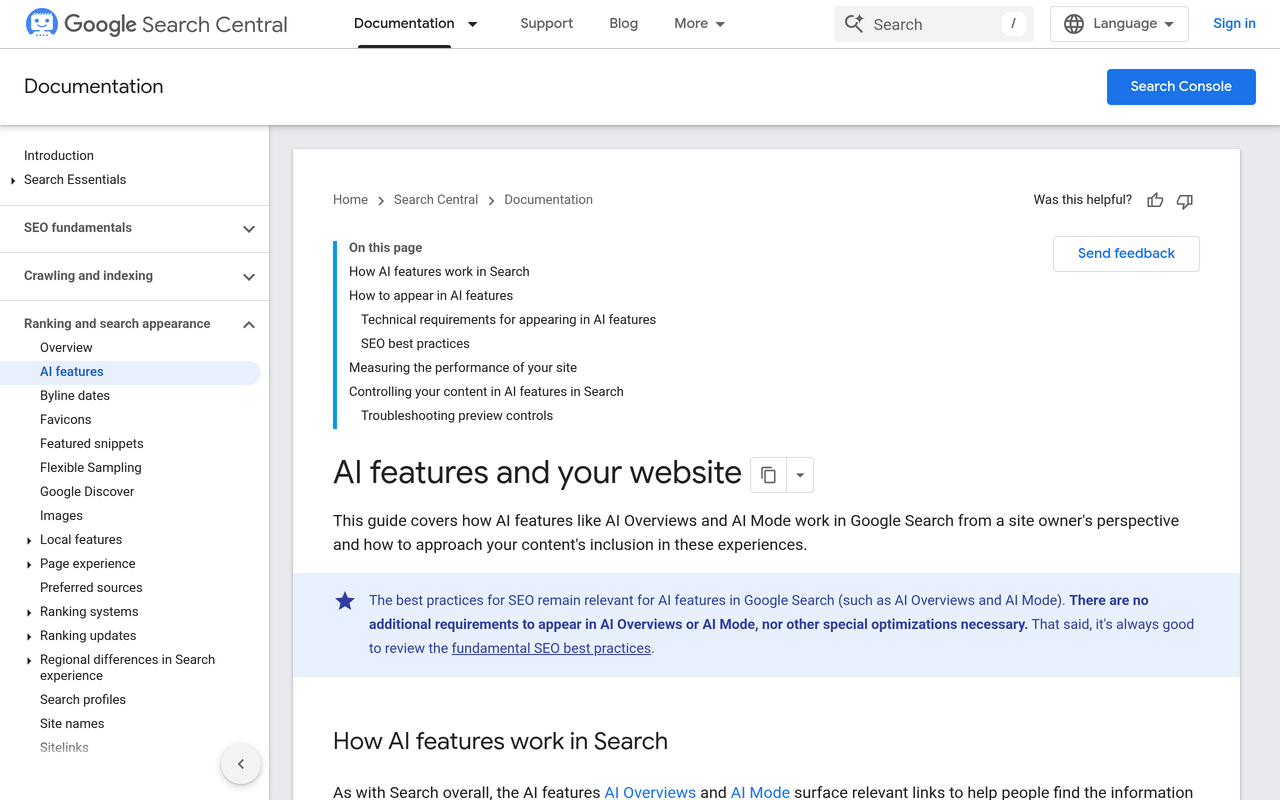
Rank data still matters. Google Search Central, last updated December 2025 states there are no additional requirements to appear in AI Overviews or AI Mode, that a page must be indexed and eligible to show with a snippet, and that SEO fundamentals remain relevant. Strong organic foundations feed AI visibility; they do not guarantee it.
Which metrics should you demand from a classic rank checker?
Demand five things from a rank checker: a click-weighted visibility score with a documented formula, tracking by location and device, SERP feature tracking, competitor comparison and page-level reporting. Anything less leaves you guessing why a number moved.
- Documented visibility formula. Semrush, August 2025 explains that visibility scores are modelled from rankings, click-through rates and search volumes. Ask any vendor which click-through curve sits behind its number.
- Location and device. A position without a location is not reproducible.
- SERP features. Google shows AI features above the links on some results pages, so a tool that ignores that block misses the top of the page. See Google Search Central for how those features work.
- Competitor tracking on the same keyword set.
- Page-level view so you can tie a visibility change to a URL.
How to read a visibility score
A visibility score is a model of expected clicks, not a count of appearances. Two sites can each rank for ten keywords and still score very differently, because a top position carries far more expected clicks than a position on page two or three. Moving every keyword down one place lowers the score even though no keyword was lost.
Use the score for direction and compare it with Search Console clicks to check the model against reality. Do not compare scores between vendors, because each uses its own curve and keyword set.
Which metrics should you demand from an AI visibility checker?
Demand eight metrics from an AI visibility checker, and ask how each is sampled. The headline should be a rate across many runs, never a single answer.
| Metric | What it tells you | What to ask the vendor |
|---|---|---|
| Mention rate | Share of tracked prompt runs in which your brand is named | How many runs per prompt, per engine, per day? |
| Citation rate and cited URLs | Which of your pages are linked as sources | Do you store the exact URL for each citation? |
| Share of voice | Your mentions as a share of all brands named for the category | Which competitors, and who chooses them? |
| Engine coverage | Which AI engines are polled | Which engines, and are Google's AI features included? |
| Prompt set quality | Whether prompts reflect how buyers ask | Can I import my own prompts and group them by funnel stage? |
| Sentiment and accuracy | How the answer describes you and whether facts are right | Is the full answer text stored for review? |
| Source gaps | Third-party pages cited for competitors but not for you | Is the gap list exportable? |
| Trend with confidence | Movement over time with run counts shown | Do you show variance or only a point score? |
Vendors' own pages show what they count. Semrush, accessed November 2026 says its free checker reports an AI visibility score, total brand mentions, a breakdown across ChatGPT, Gemini and Google results, pages driving citations, topics and prompts, and estimated audience reached. Ahrefs, accessed November 2026 lists benchmarking against competitors, the share of conversations you appear in, custom prompt tracking and fan-out query tracking as parts of its approach.
Fan-out matters because engines break one question into several searches. Google says AI Overviews and AI Mode may use a "query fan-out" technique, issuing related searches across subtopics before answering. A checker that logs only the prompt you typed cannot show the sub-questions that decide who gets cited.
How do you choose between tool types? A decision table
Use this table to match your situation to the tool type. It is built from the measurement differences above, not from vendor rankings.
| If your main question is… | Buy first | Metrics that matter | Keep alongside |
|---|---|---|---|
| Which Google keywords are slipping? | Rank checker plus Search Console | Position, click-weighted visibility, SERP features | An AI checker for the same topics |
| Do buyers see us when they ask ChatGPT or Gemini for options? | AI visibility checker | Mention rate, share of voice, cited URLs | Search Console for AI Overviews and AI Mode clicks |
| Our traffic fell but rankings held | Both, compared on the same topics | Impressions, clicks, AI mention rate | Analytics referral reports |
| Which pages should we fix first? | AI checker with cited-URL data | Citation by page, source gaps | Rank checker page report |
| Is our brand described correctly? | AI checker that stores full answers | Sentiment, factual accuracy | Manual spot checks |
| Reporting to executives monthly | Either, if exports are clean | Trend with run counts, share of voice | A one-page monthly AI search metrics report |
How do you check your brand's visibility in ChatGPT and Google, step by step?
Follow these steps whether you use software or a spreadsheet. Each step ends in a result you can keep, and the reason it matters.
- Write 20 to 30 buyer prompts. Action: list how a customer asks for a product in your category, from broad ("best X for Y") to specific. Result: a prompt set grouped by funnel stage. Why: people phrase the same need in very different ways, so one phrasing never represents buyers. The guide to which prompts to track goes deeper.
- Pick the engines your buyers use. Action: choose ChatGPT, Gemini, Perplexity, Claude and Google AI features as a minimum. Result: an engine list. Why: Ahrefs data reported by Search Engine Journal says AI Mode and AI Overviews cite different sources 87% of the time for the same query, so one engine is not a proxy for another.
- Run each prompt several times. Action: repeat every prompt at least five times per engine in separate sessions. Result: a mention rate instead of a yes or no. Why: identical prompts return different lists, as shown above. See also how personalization changes AI answers.
- Record the evidence. Action: save the full answer, brands named and every cited URL. Result: an audit trail. Why: you need the URL to know which page to fix, and the text to catch wrong facts.
- Calculate share of voice. Action: divide your mentions by all brand mentions for the prompt group. Result: one comparable number per group. Why: it shows whether you are gaining ground even when absolute mentions swing. The AI search share of voice guide covers the formula.
- Pull the Google side from Search Console. Action: open the Performance report, Web search type, and compare the same topics. Result: real impressions and clicks. Why: Google says AI features are counted there, but the report does not isolate them, so read it as the overall Google picture.
- Check the cause of absence. Action: confirm AI crawlers are allowed and the pages are indexable. Result: a list of access problems. Why: a blocked page cannot be cited. See the AI crawler user agents list.
- Repeat weekly and change one thing at a time. Action: log content edits against mention rate. Result: evidence of cause. Why: GEO experiment design explains how to avoid reading noise as progress.
How do you test a vendor before you buy? The repeat-run test
Most vendor pages describe features. They rarely tell you how to check that the numbers are trustworthy. This test uses only public evidence and takes about a week during a trial.
- Choose five prompts you know the answer to, including two where your brand should appear and one where a competitor should.
- Run each prompt yourself five times in a fresh session on one engine and note the brands named.
- Ask the tool for the same prompts and engine. Compare its mention rate with your manual rate; large gaps mean different sampling or location settings.
- Open three cited URLs the tool reports and confirm they appear in the stored answer.
- Check whether the tool shows run counts. A trend line built on one run per day is thin, and a vendor should say so.
- Export the data. If you cannot take the raw answers with you, you cannot audit the score later.
SparkToro's own caveat supports this test: the authors left open how many runs are needed for reliable visibility data and whether API calls match manual prompts. A vendor who states its run count and engine access method is giving you what you need to judge the number.
How does Noma by Nurdd help with the AI answer side?
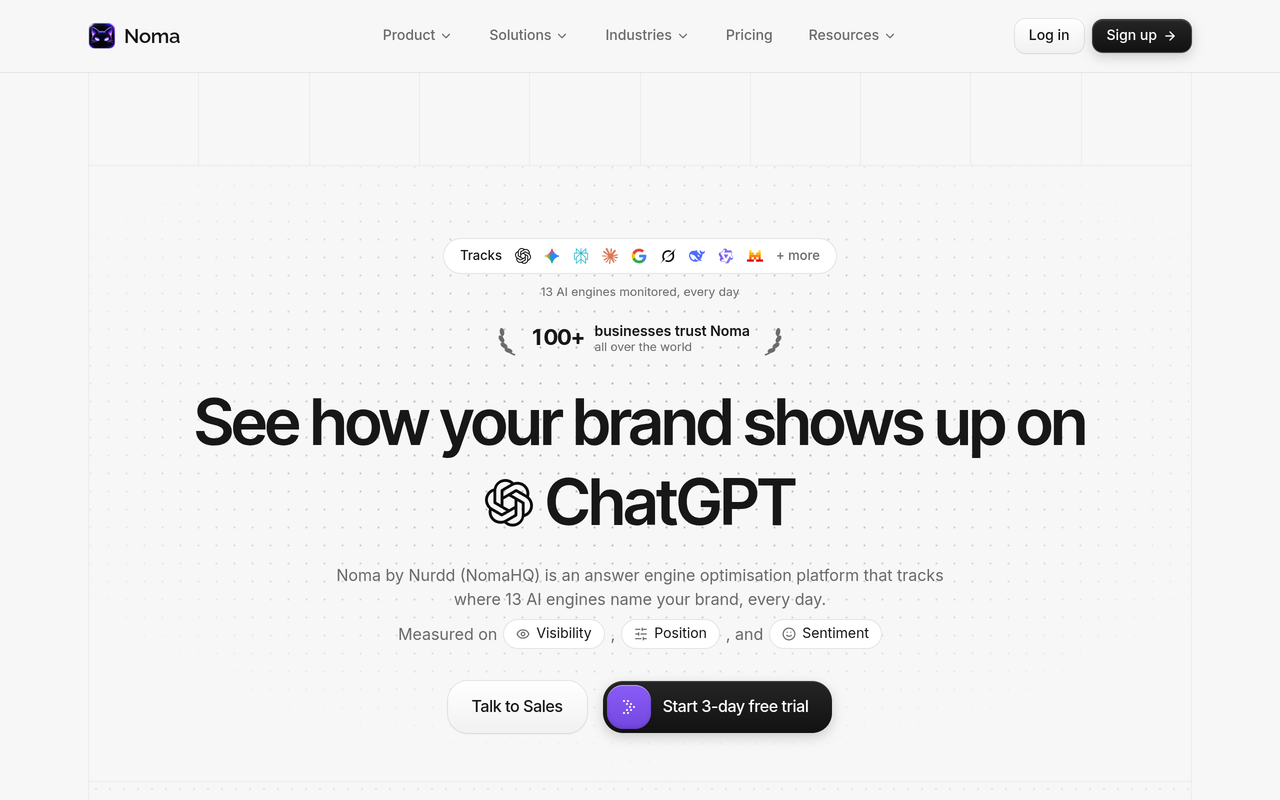
Noma by Nurdd is a web dashboard that tracks whether a brand appears in answers from 13 AI engines, including ChatGPT, Gemini, Perplexity and Claude, polled daily. It shows citation frequency by category, competitor comparison and recommendations for improving AI visibility, and it records whether a brand is named and which page each citation comes from. Noma covers the AI answer side; keep your rank tracker and Search Console for Google positions.
Book a demo at nurdd.club/demo and we will walk through your own brand in Noma: which of the 13 engines name you today, which competitors appear beside you and which pages get cited.
Noma has a 3-day free trial. A card is taken at signup and billing starts on day 3; cancel before then and you are not charged. For the product itself, see Noma; for how it sits against SEO suites, read Noma vs Semrush and Noma vs Ahrefs.
What are the common mistakes when buying visibility software?
- Treating one answer as a rank. A single run is a sample. Ask for rates across runs.
- Buying one tool for both jobs. SearchScore makes the same point: a Google rank tracker cannot tell you whether ChatGPT recommends you.
- Ignoring the prompt set. A tool that tracks only your brand name measures awareness, not discovery. Include category questions where you are not named.
- Skipping the source view. Knowing you are absent is not enough; you need the pages engines cite instead. Read why a brand does not show up in ChatGPT answers.
- Reporting a score without context. Executives need trend, competitors and run counts. The AI search visibility dashboard guide shows the layout.
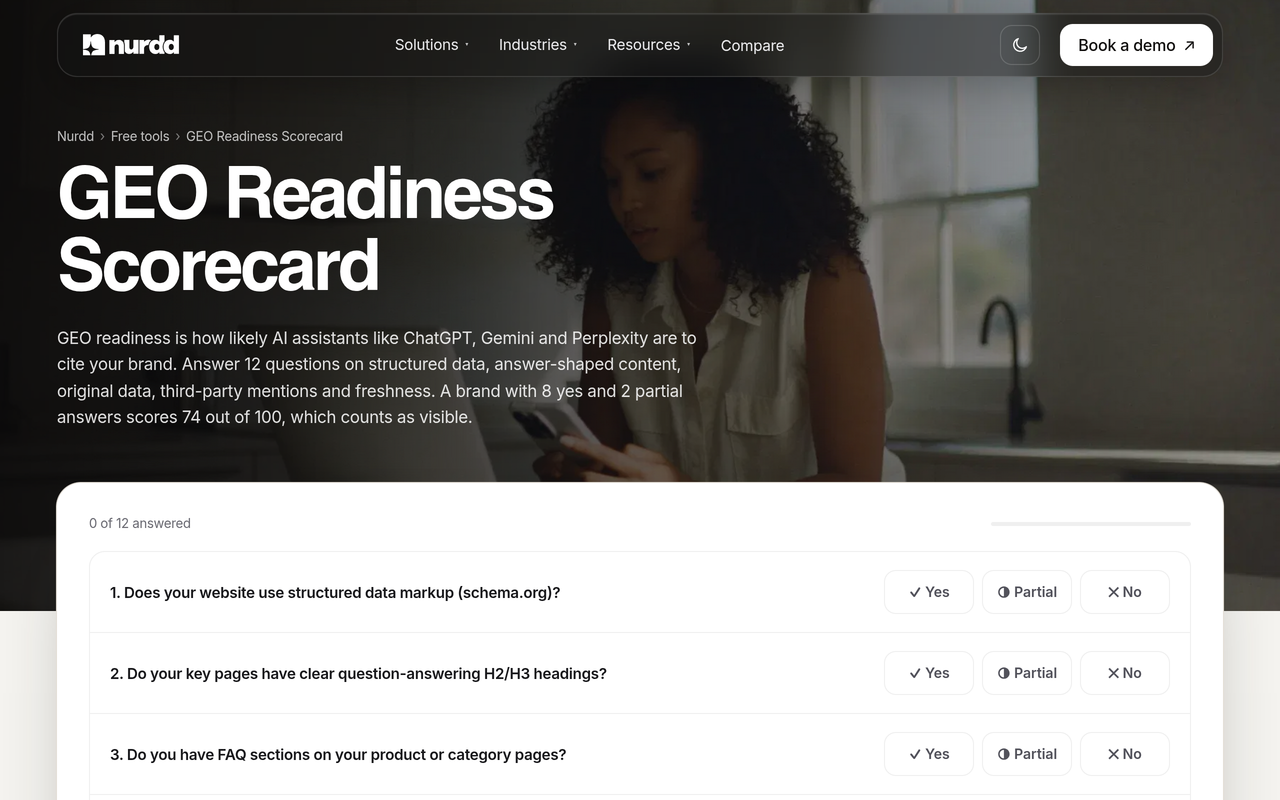
- Forgetting readiness. Measurement shows the gap; the fix sits in content and access. The free GEO readiness scorecard checks 12 factors.
Checklist: what to confirm before you sign
- The tool states which engines it polls and how often.
- It shows mention rate with run counts, not only a score.
- It stores full answer text and cited URLs.
- It lets you import and group your own prompts.
- It names competitors you chose, not only ones it picked.
- It exports raw data.
- Your rank tracker or Search Console covers Google positions and clicks.
- You have an owner for the fixes, in house or through an answer engine optimization agency.
For wider shortlists, see best AI search visibility tools and how to choose answer engine optimization tools. If you need the background terms, what is generative engine optimization defines GEO, AEO and SEO.
How do you read AI mention rate? A worked arithmetic example
The numbers below are placeholders to show the arithmetic, not a measurement of any brand. Suppose you track 25 prompts on one engine and run each five times, which gives 125 runs. If your brand is named in 40 of them, your mention rate is 40 divided by 125, or 32%.
Now suppose all brands combined are named 500 times across those runs and yours accounts for 40 of them. Your share of voice is 40 divided by 500, or 8%. The two numbers answer different questions: mention rate says how often you are present, and share of voice says how crowded the answer is.
- High mention rate, low share of voice: you appear, but alongside many rivals. Work on being the first or most specific recommendation.
- Low mention rate, high share of voice: a narrow prompt set or a niche category. Widen the prompts before drawing conclusions.
- Both low: check access and indexation first, then the content and third-party sources engines rely on.
SparkToro's headphone prompts show why category shape matters. Search Engine Journal, January 2026 reports that major headphone brands appeared in 55 to 77% of responses to varied headphone prompts, while broader categories were more scattered. A tight category produces a stable consideration set; a broad one needs more runs.
Why do two tools report different numbers for the same brand?
Two AI visibility tools can disagree for legitimate reasons, so compare method before you compare scores. The usual causes are listed below.
- Different prompt sets. A tool that tracks twenty branded prompts and one that tracks twenty category prompts will never match.
- Different engines and modes. Google says AI Overviews and AI Mode may use different models and techniques, so the links they show vary.
- Different run counts. One run a day and five runs a day produce different noise levels.
- Different locations and accounts. Personalised or localised answers shift results.
- Different definitions. A mention may mean a brand name in text, a link, or both. Ask which the tool counts.
The practical rule is to pick one tool as the system of record, keep its prompt set stable, and judge it on trend rather than on agreement with another vendor. A changed prompt set resets your baseline, so log every edit.
Who inside the team should own each measurement?
Ownership prevents the two data sets from drifting apart. The SEO lead owns rank tracking and Search Console, because the data and fixes sit in technical and on-page work. A content or brand lead usually owns AI mention rate and cited URLs, because the fixes are answer-ready pages and third-party coverage.
Review both on one monthly page. Put Google clicks and impressions beside AI mention rate and share of voice for the same five or six topics, and note what changed on the site that month. Teams that report the two in separate decks tend to argue about which channel matters; one page makes the trade-offs visible.
How we researched this
We reviewed vendor pages, platform documentation and published research on the publication date of this post. The sources include Google Search Central documentation, Pew Research Center, Search Engine Journal's report on the SparkToro study, and the public pages of Semrush, Ahrefs, SearchScore and SUSO Digital. We did not run hands-on tests of rival tools, and no customer data is used. Numbers are quoted as the sources state them. For related sourced figures, see AI search statistics you can safely cite.
Frequently asked questions
What software checks search visibility in AI engines?
AI visibility checkers such as Noma poll AI engines with prompts and record mentions and citations. Noma by Nurdd tracks 13 AI engines, including ChatGPT, Gemini, Perplexity and Claude, polled daily. Check the engine list and run counts for any tool you consider.
How do I check my brand's search visibility in ChatGPT and Google?
For ChatGPT, run a set of buyer prompts several times and record whether your brand is named and which URLs are cited, or use a tracker that automates it. For Google, use Search Console's Performance report plus a rank tracker. Compare both on the same topics.
Is Google Search Console enough to measure visibility?
It is the source of truth for Google impressions and clicks, and Google says AI Overviews and AI Mode traffic is included in the Web search type. It does not show ChatGPT, Claude or Perplexity answers, so it cannot tell you whether those engines name you.
What is a good AI visibility score?
There is no universal benchmark, because scores depend on the prompt set, engines and method each vendor uses. Compare your score with competitors on the same prompts and watch the trend. Ask how many runs sit behind it.
Why do AI answers change every time I ask?
Generative engines produce each response fresh. SparkToro's study, reported by Search Engine Journal in January 2026, found that repeated runs of the same prompt almost never returned the same brand list. That is why rates across many runs are more reliable than a single answer.
Can a free AI visibility checker replace paid software?
A free checker is typically a one-off snapshot, which is useful for a first look. Semrush and SUSO Digital both offer free versions. If you need ongoing tracking, check whether a tool offers scheduled runs, competitor sets and exports.
How often should I check search visibility?
Check Google rankings weekly and AI mention rate weekly or daily, depending on tool polling. Report monthly to avoid reacting to noise. Always log content changes beside the metrics.
Do I still need SEO rank data if I track AI answers?
Yes. Google says SEO fundamentals still apply to AI features, and organic pages remain the base that AI engines read. Rank data tells you about Google; AI tracking tells you about answers. See AI search optimization vs SEO.
Next step
Rank data and AI answer data answer different questions, and a buyer who funds only one will miss half the picture. Keep your Google tools, and add measurement for the answers where buyers now ask. Book a demo to see Noma run on your brand: the prompts, the engines that name you, the competitors beside you and the pages being cited.