AI Search Visibility
Top AI Visibility Tool Providers: A Vendor Questionnaire
A 24-question vendor questionnaire for shortlisting the top AI visibility tool providers, with a worked prompt-volume example and Noma's answers.
 Sheetal Shakshi6 Nov 202618 min read

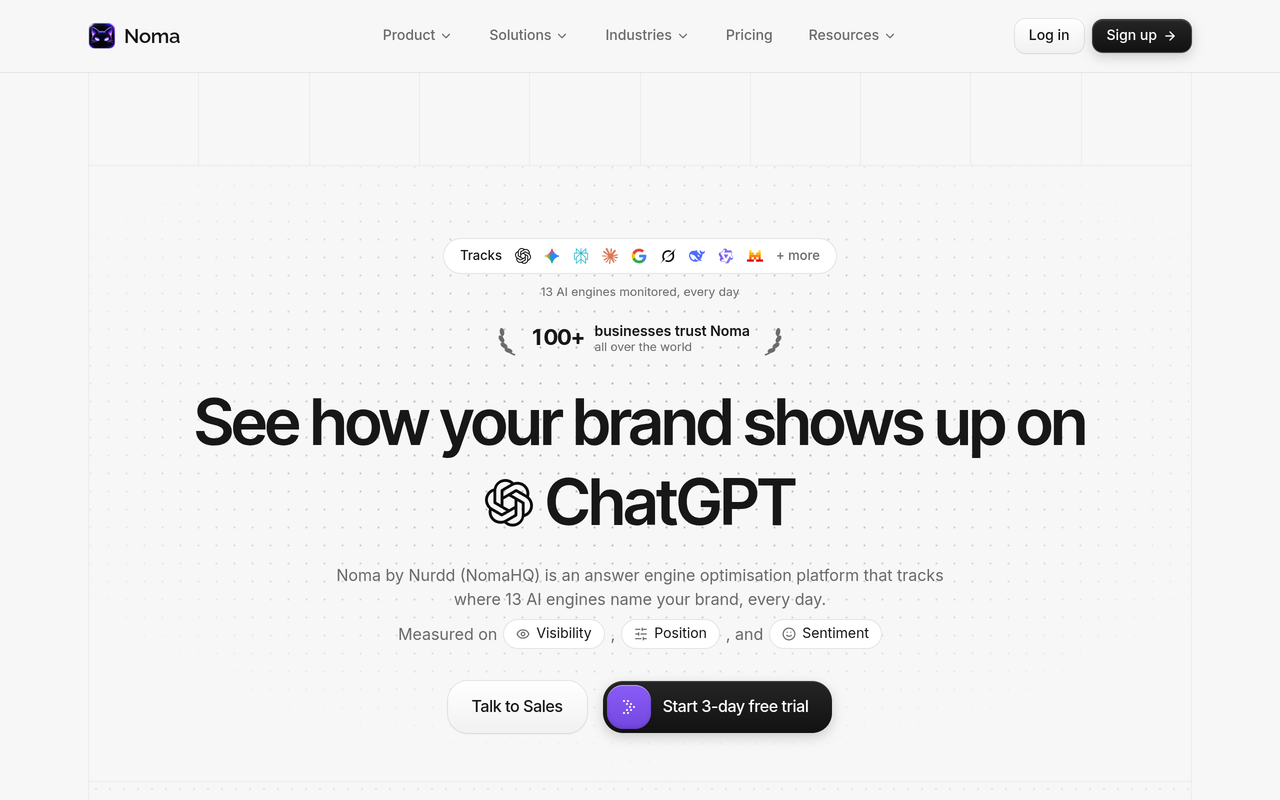
The top AI visibility tool providers include Otterly.AI, Rankscale, OmniSEO, Peec AI, Profound, Semrush, Ahrefs and Noma by Nurdd, but the right one depends on your answers to a short vendor questionnaire. Ask every vendor about engine coverage, prompt limits, data export, trial terms and reporting, then convert the quotes into the same unit. Noma tracks 13 AI engines and offers a 3-day free trial.
The top AI visibility tool providers are a crowded list, and the fastest way to shortlist them is to stop comparing feature pages and start sending every vendor the same questions. This guide gives you a 24-question vendor questionnaire covering engine coverage, prompt limits, data export, trial terms and reporting, plus a worked example that converts any vendor's quote into a comparable unit. Noma by Nurdd answers each question in the open, including 13 AI engines and a 3-day free trial.
Disclosure: this page is written by Nurdd, which makes Noma, an AI visibility tool. Noma facts below come from Noma's pricing page, read on 5 November 2026. We did not verify rival prices for this article, so the rival column of the scorecard is left for you to fill in from each vendor's own page.
Key takeaways
- Send every vendor the same written questionnaire before any demo. Vendors that answer in a table are easier to compare than vendors that answer on a call.
- Convert every quote into one unit: prompts multiplied by engines multiplied by days. Prompts, responses and credits are not the same meter.
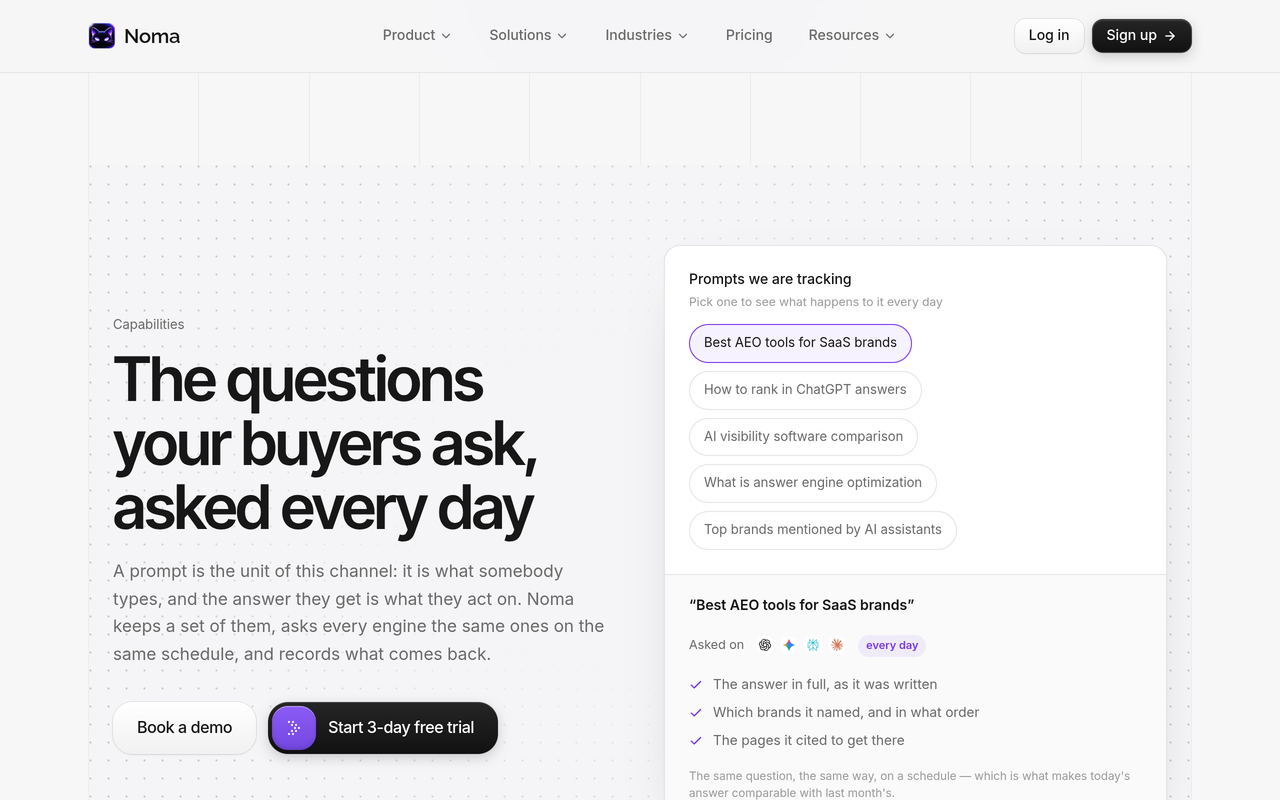
- Ask which engines are on the base plan and which are paid add-ons. Noma, for example, includes ChatGPT, Gemini, Perplexity and Claude on every plan and sells the other engines as add-ons.
- Check data export and API access before you buy, because reporting that lives only inside a dashboard rarely survives a client or board request.
- Read the trial terms line by line: length, card at signup, when billing starts and whether a cancel before day one of billing is free.
- Score vendors on the answers you receive, not on a ranked list. Any list, including this one, reflects its author's criteria.
Who are the top AI visibility tool providers?
An AI visibility tool asks AI engines the questions your buyers ask, stores every answer and turns the results into numbers you can track. The same software is sold as an AEO tool, a GEO tool or an AI search monitoring tool, which is why shortlists often look inconsistent. Our explainer on generative engine optimization, GEO vs AEO vs SEO covers the naming.
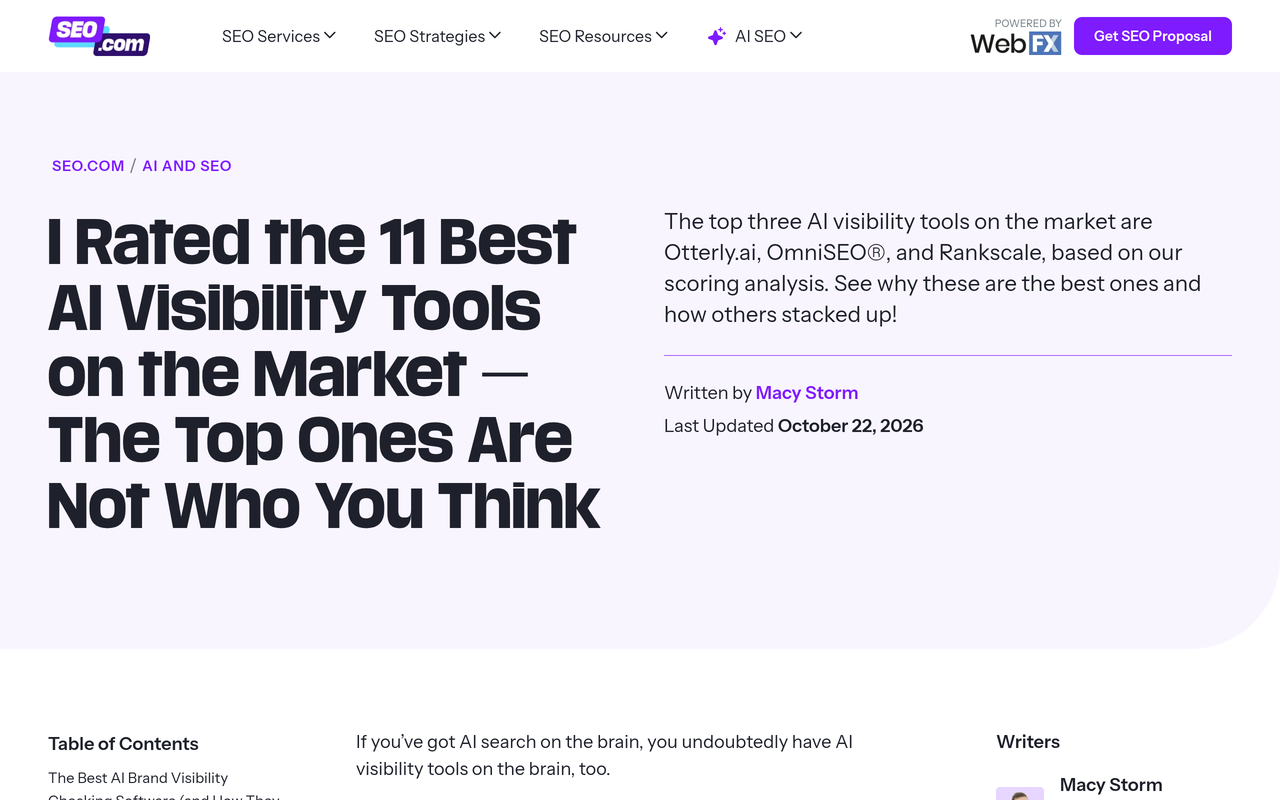
One public list is the SEO.com review of 11 AI visibility tools, updated October 2026. It names Otterly.AI, Rankscale, OmniSEO, Peec AI, Profound, Semrush AI Toolkit, Ahrefs Brand Radar, Surfer SEO AI Tracker, BrightEdge, SE Visible and Moz Pro. SEO.com scores them against its own rubric: engine coverage, citation analysis, prompt intelligence, actionability, competitor analysis, workflow and integrations, and value for cost.
Noma by Nurdd is not on that list, so it is added here as a provider you can put through the same questionnaire. The providers fall into three groups, and the group tells you which questions matter most.
| Provider type | Examples named in public lists | What to press hardest on |
|---|---|---|
| Dedicated AI visibility trackers | Otterly.AI, Rankscale, OmniSEO, Peec AI, Profound, Noma | Engine coverage per plan, prompt limits, sampling method, export |
| Add-ons to an SEO suite | Semrush AI Toolkit, Ahrefs Brand Radar, Surfer SEO AI Tracker, Moz Pro | Whether AI tracking is a separate price, how prompts are chosen, how it joins existing reports |
| Enterprise search platforms | BrightEdge | Contract length, security review, onboarding, custom reporting |
For head-to-head pages on individual rivals, see our comparisons of Noma vs Profound, Noma vs Peec AI, Noma vs Semrush and Noma vs Ahrefs.
Why does a questionnaire beat a ranked list?
A ranked list scores tools against one author's rubric. The SEO.com rubric, for example, gives actionability 20 points and value for cost 5 points. If your team already has strong content operations and a fixed budget, those weights are the wrong way round for you.
A questionnaire turns your own priorities into the test. Every vendor answers the same questions in writing, and you weight the answers yourself. It also exposes the gap between a marketing page and a contract: a vendor that cannot state prompt limits or export formats in one line will not state them clearly after you sign.
An AI visibility tool is software that measures how often AI engines such as ChatGPT, Gemini and Perplexity name your brand when people ask about your category, how they describe it, and which sources they cite. Source: Noma, 31 October 2026.
That definition also tells you what to ask. If the product measures naming, description and citation, then ask how each is recorded, how often, from which sessions and in which markets.
What questions should I ask an AI visibility tool vendor?
Ask 24 questions in five groups: engines, prompts, data and export, trial and pricing, and reporting. The table below lists each question, why it matters and what a good answer looks like. The right-hand column shows where Noma answers it, using only what Noma publishes.
Group 1: Engine coverage
| # | Question to ask | What a good answer looks like | Where Noma answers |
|---|---|---|---|
| 1 | How many AI engines do you track, and which ones? | A named list, not a number alone | 13 AI engines, including ChatGPT, Gemini, Perplexity, Claude, Grok and Google AI Overviews |
| 2 | Which engines are on each plan and which are add-ons? | A plan-by-engine grid | ChatGPT, Gemini, Perplexity and Claude on every plan; the rest as add-ons |
| 3 | Are engines scored separately or blended? | Per-engine scores, with a blended view as an option | Each engine scored separately rather than blended into one number |
| 4 | Do you track the consumer app, the API or a search surface? | A plain statement per engine | Ask on a demo; the pricing page lists the engines, not the access method |
| 5 | Which languages and markets can I track? | Prompts in the buyer's own language | Prompts asked in the language buyers use, for example French, German, Japanese and Portuguese |
Question 4 is the one vendors skip. Answers from an engine's consumer app and answers from its developer API can differ, so a vendor should say which one it measures. If the vendor does not know, treat the numbers as directional.
Group 2: Prompts and sampling
| # | Question to ask | What a good answer looks like | Where Noma answers |
|---|---|---|---|
| 6 | How many prompts can I track per plan? | A number per workspace or project | 50 on Starter, 60 per workspace on Growth, 100 per workspace on Scale |
| 7 | How often is each prompt asked? | Daily, with the schedule stated | Asked once a day on each engine |
| 8 | Are sessions clean or personalised? | Fresh sessions with no history | Each poll runs from a clean session |
| 9 | Can I separate branded and category prompts? | Yes, with separate scores | Branded and category prompts kept apart |
| 10 | What happens to history when I edit the prompt set? | Changes logged and dated | Every change to the prompt set is recorded and dated |
| 11 | Can I re-run one prompt on demand? | Yes, from the prompt's page | Any single prompt can be re-run on demand |
Question 10 matters more than it looks. If a vendor lets you quietly drop the prompts where you lose, your visibility score rises for the wrong reason. For choosing the prompts themselves, read which prompts to track for AI search visibility, and for the personalisation point see whether personalisation changes AI answers.
Group 3: Data, citations and export
| # | Question to ask | What a good answer looks like | Where Noma answers |
|---|---|---|---|
| 12 | Do I see the full answer text, or only a score? | Stored answers, word for word | The exact answers that mention you or leave you out |
| 13 | Do I see which pages were cited? | Cited URLs and domains per answer | The pages each answer cites |
| 14 | Can I get the underlying records out? | An API or export, with plan limits stated | API access on Scale and Studio: prompts, answers, brands named and sources cited |
| 15 | Are client or brand workspaces kept separate in export? | Yes, per workspace | Workspaces stay separate through the API as in the product |
| 16 | Do you show which AI crawlers read my site? | Crawler identification from server logs | Agent analytics names the bot behind each visit |
Noma states on its API access page that the records behind the charts, not a rendering of the charts, are available on the plans that carry it. If export matters to you, check that your plan is one of them: on Noma's published pricing, the Starter and Growth plans do not list API access.
Question 16 is a quiet differentiator. Seeing a citation tells you the answer used a page; seeing crawler visits tells you whether engines can read the page at all. Our list of AI crawler user agents explains what to allow.
Group 4: Trial and pricing
| # | Question to ask | What a good answer looks like | Where Noma answers |
|---|---|---|---|
| 17 | How long is the trial? | A number of days, stated | 3 days |
| 18 | Is a card required at signup? | A direct yes or no | Yes, a card is taken at signup |
| 19 | When does billing start, and is cancelling free before then? | A date rule | Billing starts on day 3; cancel before then and you are not charged |
| 20 | What does a plan include in units I can compare? | Prompts, responses, seats, competitors, URLs | Published per plan on the pricing page |
| 21 | Are prices monthly or annual, and in which currency? | Both shown, in a named currency | US dollars, before tax; annual plans are billed monthly at ten months for twelve |
Group 5: Reporting and action
| # | Question to ask | What a good answer looks like | Where Noma answers |
|---|---|---|---|
| 22 | What metrics are reported? | Visibility, position, share of voice, sentiment, citations | Those five metrics, read per engine |
| 23 | Can reports be scheduled and white-labelled? | Yes, with the plan stated | Weekly digest email on Growth and Scale; white-label reports and dashboards on the agency plans |
| 24 | Does the tool help me act, or only observe? | Gap analysis, drafts or audits | Gap analysis on Growth and Scale, content drafts on every plan, and a managed option |
Pair question 22 with our guides on AI search share of voice and the monthly AI search metrics report, so you know what a finished report should contain before a vendor shows you theirs.
How do I compare vendor quotes on the same unit? A worked example
Vendors meter their plans in different units: prompts, responses, credits or queries. To compare them, convert each plan into responses per month using one formula: prompts multiplied by engines multiplied by days. Here is the formula checked against Noma's published plan numbers, as read on 5 November 2026.
| Noma plan | Prompts | Engines | Workspaces | Days | Calculated responses | Published responses a month |
|---|---|---|---|---|---|---|
| Starter | 50 | 4 | 1 | 30 | 6,000 | 6,000 |
| Growth | 60 | 4 | 3 | 30 | 21,600 | 21,600 |
| Scale | 100 | 4 | 10 | 30 | 120,000 | 120,000 |
The calculated and published numbers match on all three plans, which tells you the meter is simple: one response per prompt, per engine, per day. Ask every other vendor to confirm whether theirs works the same way, or whether it samples each prompt several times or charges credits for extra actions.
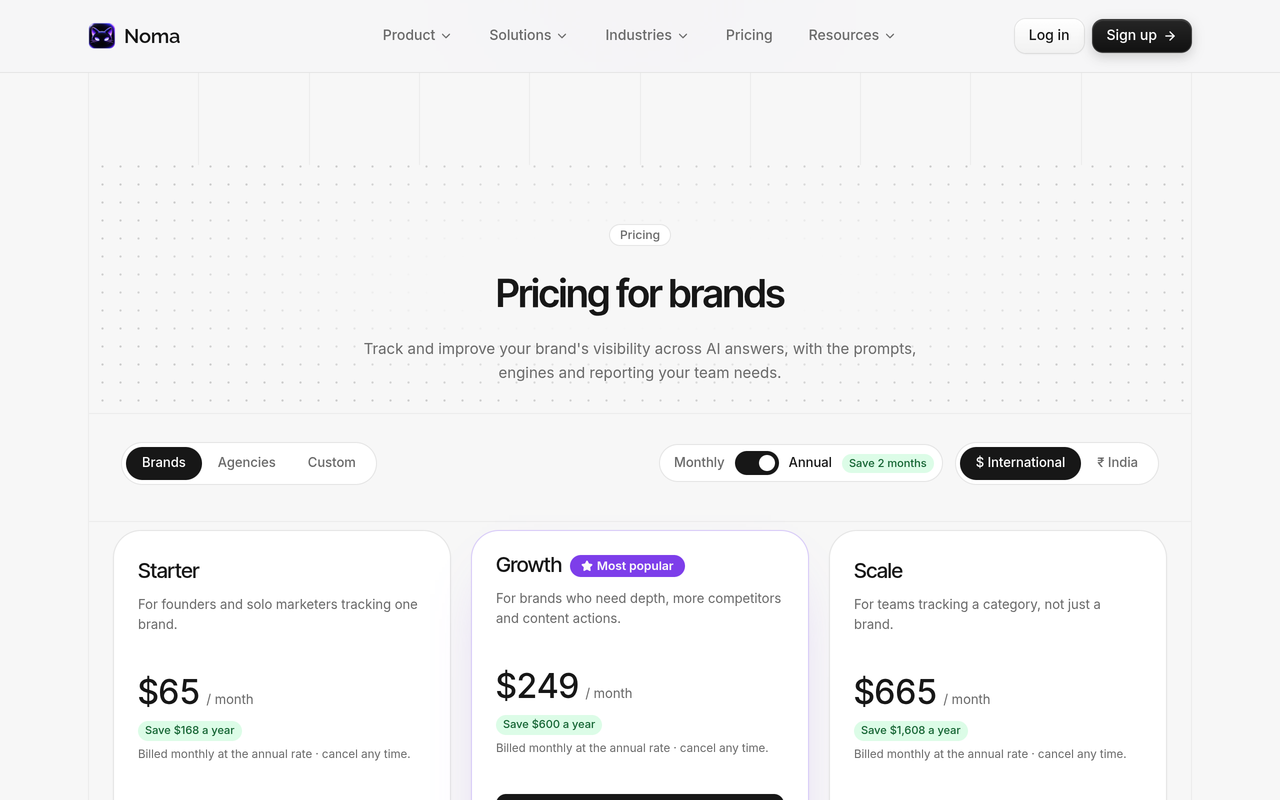
Next, work out cost per response. On Starter, the published monthly price is $79 for 6,000 responses, which is about $0.013 per response (our calculation: $79 divided by 6,000). On the annual rate, Starter is $65 a month, or about $0.011 per response. Run the same sum on each rival's quote, and note that a lower sticker price can hide a lower meter.
One more adjustment: count the engines you actually need. If a plan covers 4 engines and you need 6, price the add-ons before you compare. The vendor that looks cheapest on the base plan may not be cheapest on your engine list.
How should I run the shortlisting process step by step?
Use this checklist to go from a long list of providers to a decision in about two weeks. Each step has an output, so you can stop and check before moving on.
- Write your engine list. Name the AI engines your buyers use, in the markets you sell to. Output: a one-line list that every vendor must cover. Why: it removes vendors that cover engines you do not need.
- Draft 30 to 50 buyer prompts. Split them into branded and category prompts. Output: a prompt file you can give every vendor. Why: identical prompts make results comparable.
- Send the questionnaire in writing. Use the 24 questions above. Output: written answers you can score. Why: written answers can be quoted back to the vendor later.
- Convert quotes into responses per month. Use the prompts times engines times days formula. Output: a cost per response for each vendor. Why: it exposes meters that look generous but are not.
- Start two or three trials in the same week. Load the same prompts into each. Output: three sets of answers for the same questions. Why: you can see where the tools disagree and ask them why.
- Check the trial terms before you enter a card. Diarise the day billing starts. Output: a calendar reminder. Why: a short trial is easy to forget.
- Test export and one report. Pull a sample of records out and build one report from them. Output: a real report, not a screenshot. Why: you find the limits of the tool before it is embedded in your reporting.
- Score and decide. Use the scorecard below. Output: one vendor, with reasons you can show your team.
If you plan to test a change after you choose, the GEO experiment design guide and the four-week ChatGPT test plan show how to run it.
Which scorecard should I use to weigh the answers?
Give each question group a weight that reflects your situation, score each vendor from 0 to 5 on each group, and multiply. The weights below are a starting point for a brand team that reports monthly to leadership; change them if you are an agency or a startup.
| Group | Suggested weight | Raise the weight if | Noma by Nurdd | Rival 1 | Rival 2 |
|---|---|---|---|---|---|
| Engine coverage | 25% | Your buyers use several assistants | 13 engines; four on every plan | Fill in | Fill in |
| Prompts and sampling | 25% | You will make decisions on trends | Daily, clean sessions, dated prompt changes | Fill in | Fill in |
| Data and export | 20% | You report to clients or a warehouse | API on Scale and Studio | Fill in | Fill in |
| Trial and pricing | 15% | Budget is fixed | 3-day trial, card at signup, USD plans | Fill in | Fill in |
| Reporting and action | 15% | You need to prove the work moved answers | Digest email, gap analysis, drafts | Fill in | Fill in |
The rival columns are blank on purpose. Rival prices and limits change often, and the only reliable source is each vendor's own pricing page on the day you buy. SEO.com's October 2026 review is a useful cross-check on feature claims, for example it notes that Rankscale can track up to 17 AI engines and OmniSEO 10 major AI engines, but confirm any figure with the vendor in writing.
What should I watch for in each answer?
A few answer patterns signal risk. They are not proof of a weak product, but each deserves a follow-up question before you trust the number.
- Engine count without a list. A vendor that says it covers many engines but will not name them may be counting model versions or regions as separate engines.
- Prompt limits with no sampling rule. Fifty prompts asked once a week is not the same as fifty asked daily.
- A single blended score. Engines name different brands for the same question, so a blended number can hide a weak engine.
- Branded prompts in the headline. You appear in nearly every prompt that contains your name, so branded prompts flatter the total.
- Export on the enterprise tier only. If you need data in your warehouse, price the tier that has it.
- Vague trial terms. If the vendor will not say when billing starts, assume the worst case.

Common mistakes when shortlisting AI visibility providers
The same errors show up in most vendor selections. They are cheap to avoid if you know them in advance.
- Choosing from a ranked list alone. A list reflects one rubric. Use it to build a long list, then run your own questionnaire.
- Comparing plan names instead of units. A mid-tier plan at one vendor can be smaller than a starter plan at another.
- Tracking too few prompts to see a trend. A small set moves with noise. Plan for enough prompts that one answer change does not swing the score.
- Forgetting seats and workspaces. Agencies in particular should price per client workspace, not per brand.
- Ignoring what happens after the data. A dashboard without a route to action produces reports and no change. See AI search visibility analysis for what to do with the findings.
- Skipping the human cross-check. Before you commit, ask the engines yourself. The GEO readiness scorecard is a free 12-factor check you can run in minutes.
Why does Noma belong on your shortlist?
Noma by Nurdd belongs on the shortlist because it publishes the answers to most of the questions above on one pricing page. Noma tracks 13 AI engines, including ChatGPT, Gemini, Perplexity and Claude, asks each prompt daily from clean sessions, stores the full answers and cited sources, and offers a 3-day free trial. It is one of three separate Nurdd products, alongside Nia and Pulse.
If you want to see this against your own category, book a demo. You will see which of your buyer questions name your brand, which competitors appear instead, and which pages the engines cite for your category.
Where Noma wins or ties on the questionnaire
Noma answers the engine, prompt and trial questions with published numbers, so you can score them without a sales call. The table lists each question group, the Noma answer and what to verify yourself. All Noma facts are from Noma's pricing page, read on 5 November 2026.
| Question group | Noma's published answer | What to verify in your trial |
|---|---|---|
| Engine coverage | 13 AI engines; ChatGPT, Gemini, Perplexity and Claude on every plan; others as add-ons | Which add-on engines you need and their price |
| Prompt limits | 50 prompts on Starter; 60 per workspace on Growth; 100 per workspace on Scale | Whether your prompt set fits the plan |
| Sampling | Asked daily from clean sessions; prompt changes dated | That your baseline stays stable over the trial |
| Data export | API access on Scale and Studio | Whether your plan carries it |
| Trial terms | 3-day free trial, card taken at signup, billing starts on day 3, no charge if cancelled before | Set a reminder for day 2 |
| Reporting | Visibility, position, share of voice, sentiment, citations; weekly digest on Growth and Scale | Build one report from your own data |
Noma's plans, as published and read on 5 November 2026, are in US dollars before tax:
| Plan | For | Tracked prompts | Monthly | Annual rate (per month) |
|---|---|---|---|---|
| Starter | Brands | 50 | $79 | $65 |
| Growth | Brands | 60 per workspace, 3 workspaces | $299 | $249 |
| Scale | Brands | 100 per workspace, 10 workspaces | $799 | $665 |
| Studio | Agencies | 50 per workspace, 10 workspaces | $499 | $415 |
| Agency | Agencies | 50 per workspace, 25 workspaces | $1,199 | $999 |
| Managed | Done for you | Run by the Noma team | $999 | On request |
Where Noma is the better fit on this questionnaire is the combination of a stated meter, named engines, dated prompt changes and a trial whose terms are on the page. If you would rather have the work done than the dashboard, Nurdd also runs answer engine optimization and generative engine optimization services, measured in Noma.
Three role-based ways to use the questionnaire
If you are an in-house SEO lead
Weight engine coverage and prompt sampling highest, because you will defend the trend line to leadership. Send the questionnaire, then load the same prompts into each trial and compare. Read AI search optimization vs SEO to decide what to fund first.
If you are an agency
Weight workspaces, white-labelling and API access highest. Price per client, not per brand, and ask how workspaces are separated in export. See answer engine optimization agency vs in-house tooling for the build-or-buy question.
If you are a startup
Weight trial terms and base-plan engine coverage highest, because every dollar counts and you need to know exactly when billing starts. The AI search visibility tools for startups budget checklist goes deeper on this.
How we researched this
We reviewed one public third-party comparison of AI visibility tools, SEO.com's review, updated 22 October 2026, and Noma's own pages: its pricing page, its AI visibility tool guide and its prompt tracking and API access pages. All were read on 5 November 2026, the publication date of this post.
We did not run hands-on tests of any tool for this article, and we did not interview vendors or customers. Rival prices and limits were not verified, so we did not publish them. For the wider landscape, see our comparison of 10 AI search visibility tools and the tracking tools buyer checklist.
Frequently asked questions
Who are the top AI search visibility tool providers?
Public lists commonly name Otterly.AI, Rankscale, OmniSEO, Peec AI, Profound, Semrush, Ahrefs, Surfer SEO, BrightEdge, SE Visible and Moz Pro. Noma by Nurdd is a further option, tracking 13 AI engines. The best provider for you depends on your engine list, prompt volume, export needs and budget, so use the questionnaire above rather than a single ranking.
What questions should I ask an AI visibility tool vendor?
Ask which engines are covered on each plan, how many prompts you can track, how often each is asked, whether sessions are clean, and whether you can export the underlying records. Then ask about trial length, card requirements, when billing starts and what reports you can schedule. The 24 questions in this guide cover all of these.
How many AI engines should a tool track?
Track the engines your buyers actually use, not the highest number on a feature page. Most teams start with ChatGPT, Gemini, Perplexity and Claude, then add others such as Grok or Google AI Overviews where their category needs them. Ask whether extra engines cost more.
How many prompts do I need to track?
It depends on your category, but you need enough that a single changed answer does not swing your score. Noma's Starter plan tracks 50 prompts, and its larger plans track more per workspace. Start with 30 to 50 buyer prompts split between branded and category questions, then expand.
Does a free trial need a credit card?
It varies by vendor, so ask directly. Noma's 3-day free trial takes a card at signup, billing starts on day 3, and you are not charged if you cancel before then. Put a reminder in your calendar for day 2.
Can I export data from an AI visibility tool?
Some tools offer export or an API and some do not, and it is often limited to higher plans. Noma lists API access on its Scale and Studio plans, giving access to prompts, answers, brands named and sources cited. Check your plan before you buy.
Should I pick an SEO suite add-on or a dedicated tool?
An SEO suite add-on is convenient if your team already lives in that suite. A dedicated tool usually gives more control over prompts, engines and sampling. Ask both types the same questionnaire and compare cost per response, as in the worked example above. Our page on Noma vs traditional SEO tools covers this trade-off.
Next step: see the questionnaire answered for your brand
Send the questions above to every vendor, convert each quote into responses per month, and score the answers. To see how Noma answers them for your own brand, book a demo and bring your category prompts. You can also look at Noma directly, read how Nurdd works, or browse the free tools.