AI Search Visibility
AI Search Visibility Software Demo: 10 Questions to Ask
Ten questions to put to any AI visibility vendor, covering engines, prompts, freshness, exports and pricing, with a scorecard and a worked cost example.
 Simran Rawat13 Nov 202617 min read
In an AI search visibility software demo, ask which engines are tracked on your plan, where prompts come from, how often each is run, how mentions and citations are defined, which source pages you can see, what you can export and what one tracked prompt costs. Send your own prompts beforehand so the vendor runs them live, and score every vendor on the same sheet.
The ai search visibility software demo questions that matter most are about method, not features: which engines are tracked on your plan, where prompts come from, how often each is run, how a mention is counted, which source pages are shown, what you can export and what one tracked prompt costs. Ask all ten below and compare the answers side by side.
A vendor demo is the one moment you can make a dashboard prove itself on your brand. Most buyers lose it by watching a polished tour of a sample account. This guide gives you ten questions, a scoring sheet, a worked pricing example and a checklist for the call, so you leave with comparable evidence instead of impressions. If you are still building a shortlist, start with our comparison of AI search visibility tools.
Key takeaways
- Send your own 10 to 20 prompts and three competitors before the demo, and ask the vendor to run them live.
- Get the engine list in writing for the exact plan you would buy, because engine coverage can be gated by plan.
- Ask how a mention, a citation and share of voice are counted. Two vendors can show different numbers for the same answer.
- Convert every quote to cost per tracked prompt per engine per month before comparing prices.
- Ask to see the source pages behind each citation. A score with no sources gives you nothing to fix.
- Use a trial to check the demo against your own brand before signing anything.
What should I ask in an AI search visibility software demo?
Ask questions that force the vendor to show method on your data. The strongest demos answer ten things: engine coverage, prompt sourcing, run frequency and sampling, freshness, metric definitions, citation sources, competitor set, recommended actions, exports and security, and pricing units. If a vendor cannot show one of them on screen, treat it as unconfirmed.
The need for this is documented. In a comparison of enterprise platforms, seoClarity, October 2026, says vendors bill by prompts, credits, checks or bundled subscriptions, and that engine coverage and enterprise controls can vary by plan. seoClarity sells a competing product and says it did not test the platforms, so read it as a map of the category's general problem, not a ranking of any vendor.
Why are AI visibility demos hard to compare?
The category is young, and vendors define the same words differently. One tool counts a brand once per answer, another counts every appearance. One tracks the engines you care about only on a top tier. One prices by prompt, another by credit. A demo hides these differences unless you ask.
There is a second problem: AI answers are not stable the way a ranking position is. The same prompt can return a different brand list on different runs, so a single screenshot proves little. That is why the questions on run frequency, sampling and trend lines matter more than any single chart. Our GEO experiment design guide explains how to test changes without fooling yourself with noise.
The 10 questions at a glance
| # | Question | Good answer sounds like | Red flag |
|---|---|---|---|
| 1 | Which engines are tracked on my plan? | A named list, per plan, in writing | “All the major ones” |
| 2 | Where do prompts come from, and can I add mine? | Your own prompts plus a stated suggestion method | Fixed prompt sets you cannot edit |
| 3 | How often is each prompt run, and how is variation handled? | Repeated runs, trends rather than single answers | One run presented as truth |
| 4 | How fresh is the data on screen? | A stated cadence (daily, weekly) with a timestamp | No date on the charts |
| 5 | How do you define mention, citation and share of voice? | Written definitions you can reproduce | A single opaque “visibility score” |
| 6 | Can I see the pages AI engines cite? | Source URLs per answer, grouped by domain | Scores with no sources |
| 7 | Who counts as a competitor, and who decides? | You choose the set and can change it | Competitors auto-assigned |
| 8 | What do I do next with the data? | Specific recommendations tied to prompts | Reports only |
| 9 | What can I export, and what is the security position? | Named formats and a current audit report | “Compliant” with no document |
| 10 | What is the pricing unit and total cost at my volume? | Cost per prompt per engine, plus exit terms | Quote only for a bundle |
The rest of this guide takes each question in turn: why it matters, what to ask, and what to do with the answer. Where we describe how Noma by Nurdd answers, we limit ourselves to what Noma publishes, and we say so when a point is best confirmed live in a demo.
How do I run the demo? Ten questions, step by step
Each question below follows the same pattern: the action you take on the call, the result you should see, and the reason it matters.
1. Which AI engines are tracked, on the plan I would actually buy?
Action: ask for the engine list for your exact plan, in writing, and check it against where your buyers ask questions. Result: a named list, not a category. Why: coverage can vary by plan, and a vendor's own pages can be out of step with each other, so get the answer on paper from the person selling.
Also ask whether Google AI Overviews and AI Mode are counted as separate engines, and whether a tracked engine means the consumer app or an API model. The two can answer differently. Each engine deserves its own read, so ask for results broken out by engine rather than one blended number.
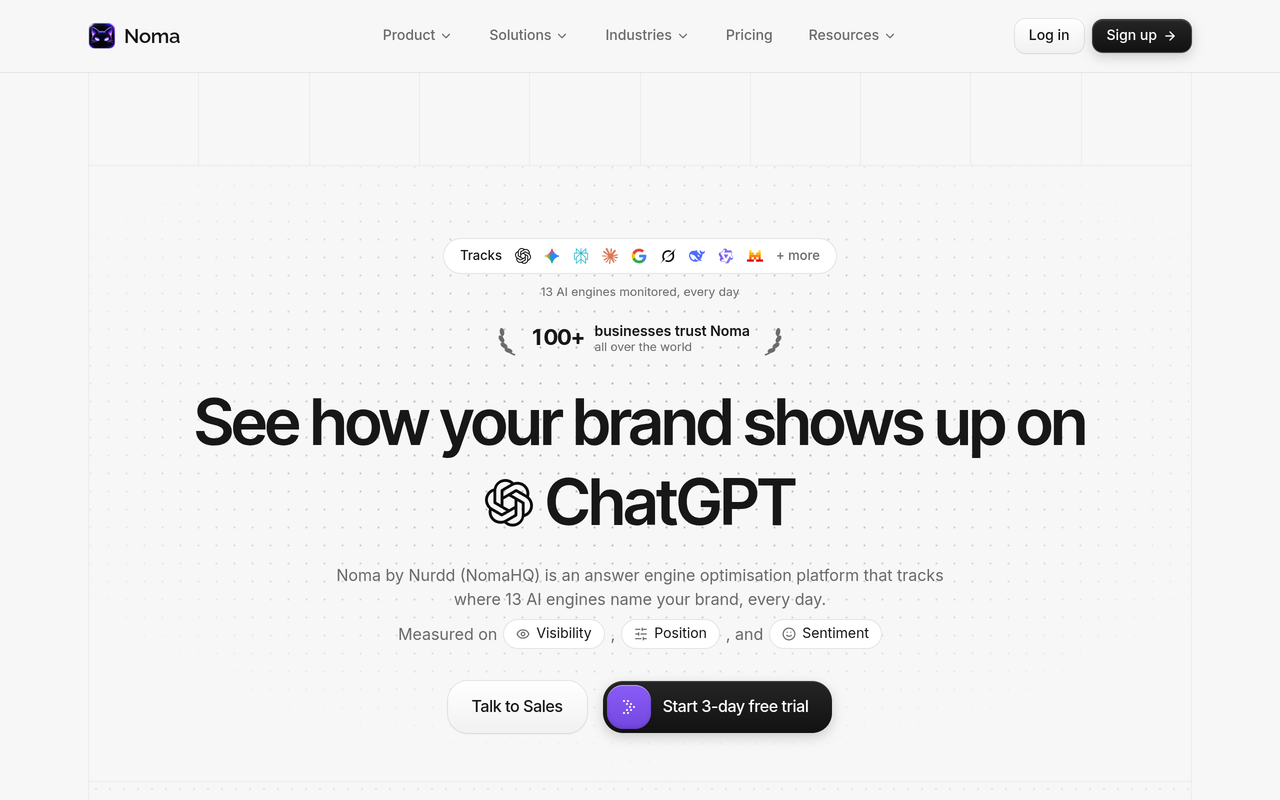
How Noma answers: Noma tracks 13 AI engines, including ChatGPT, Gemini, Perplexity and Claude, polled daily, and shows citation frequency by category. Ask to see the full engine list on screen during your demo and compare it to the list you wrote down beforehand.
2. Where do the prompts come from, and can I bring my own?
Action: hand over 10 to 20 prompts your customers would really type, including comparison and “best for” questions, and ask which of them the tool can track. Result: your prompts running in the product, not a sample brand's. Why: if you can only monitor a vendor-chosen list, you measure the vendor's idea of your market.
Prompt sourcing methods differ across the category: some tools suggest prompts from search questions or keywords, others from your site or category. None of those guarantees the prompt reflects how a buyer talks to a chatbot, which is usually longer and more specific. Our guides to which prompts to track and how many prompts you need cover the selection side.
Ask a follow-up about volume: does the vendor show how often a prompt is asked? Treat any volume figure as an estimate, and ask for its source. A relative score is fine if it is labelled as one.
3. How often is each prompt run, and how do you handle answer variation?
Action: ask how many times a prompt is run per period, and whether the dashboard shows an average, a range or one answer. Result: a trend you can trust over weeks. Why: because a model can phrase and rank brands differently each time, a single snapshot overstates both wins and losses.
A useful test during the demo: ask the presenter to run one of your prompts twice and compare the brand lists. If the two lists differ, ask how the product reports that difference. A vendor who shows you the variation and explains how it is smoothed is giving you better evidence than one whose charts never move.
How Noma answers: Noma polls its tracked engines daily, which gives repeated readings to build a week-over-week view. Our walkthrough on tracking an AI visibility score week over week shows how to read that trend rather than a single day.
4. How fresh is the data I am looking at?
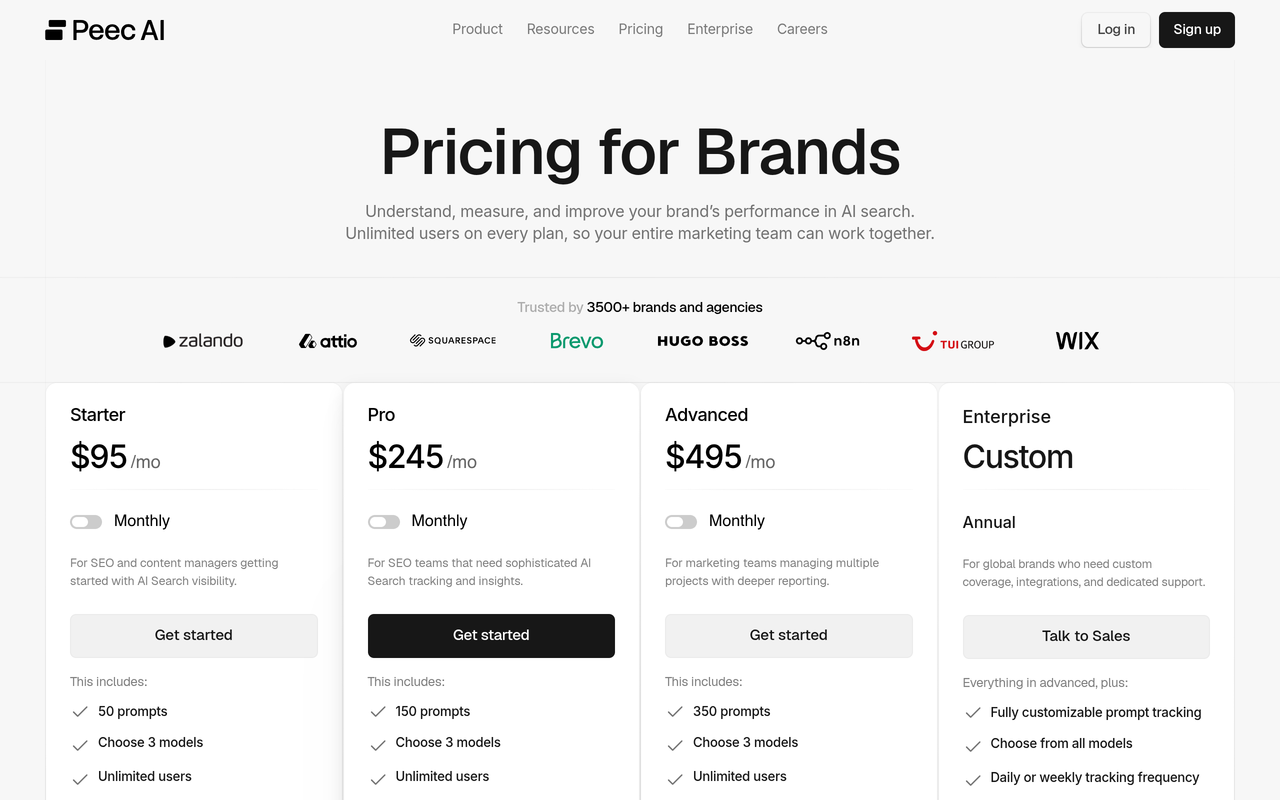
Action: find a timestamp on the chart you are shown and ask what cadence the plan includes. Result: a stated refresh rate per plan. Why: cadence differs between vendors and can change by plan. The Peec AI pricing page, checked in November 2026, lists daily tracking on its self-serve plans. Daily and weekly data answer different questions: daily catches a sudden drop, weekly suits a monthly report.
Ask whether a custom prompt you add today shows data tomorrow or after the next batch, and whether history is kept when you edit a prompt. Editing a prompt can break a trend line without anyone noticing.
5. How do you define mention, citation and share of voice?
Action: ask for the written definition of each metric and recompute one by hand from a single answer. Result: a number you can reproduce. Why: definitions are not standard. The Ahrefs Help Center, September 2026, says a mention is counted when a brand appears at least once in an AI response, so three appearances in one answer still count as one mention. It also separates a citation (a page shown as a cited source) from “found in” (a page retrieved in the background but not necessarily cited).
That distinction changes what you can claim. A brand named in the text with no link is visible but not cited. A page retrieved but not cited influenced the answer but earned no traffic. Ask every vendor which of these they report, and keep them as separate columns. Our guide to AI search share of voice sets out a definition you can use as a neutral yardstick.
Standalone definition: in Ahrefs Brand Radar, a mention is counted once per AI response in which a brand appears, regardless of how many times the brand is named in that response (Ahrefs Help Center, September 2026).
6. Can I see the source pages AI engines cite for each answer?
Action: pick one prompt where a competitor is named and ask to see every URL cited, grouped by domain. Result: a list of pages you could earn a mention on or improve. Why: a visibility score tells you where you stand, while the cited sources tell you what to do. Engines often cite review sites, forums and third-party lists rather than the brand's own pages.
Ask whether the tool separates your own pages from third-party pages, and whether it shows which of your pages are cited most. This is the data behind why a competitor is cited and you are not, and it is also what you need to fix a page that ranks on Google but is not cited by AI.
How Noma answers: Noma records whether a brand is named and which page each citation comes from. In your demo, ask for the citation sources on one of your own category prompts and look at which domains repeat.
7. Who counts as a competitor, and who decides?
Action: give the vendor three direct competitors and one indirect one, and ask them to add all four. Result: a side-by-side comparison on your prompts. Why: in AI answers the competitors that appear are often not the ones your sales team names. Tools that auto-assign competitors can miss a rival the models keep recommending.
Ask whether you can see the competitors AI engines mention that you did not list. That reveals market positions you did not know existed. For teams managing several brands, also ask how competitor sets are separated per brand.
How Noma answers: Noma includes competitor comparison alongside citation frequency by category, so you can see your brand next to rivals on the same prompts.
8. What do I do next with this data?
Action: ask the presenter to turn one finding into a task: which page to change, which source to pursue, which question to answer. Result: a concrete next step tied to a prompt. Why: monitoring alone produces reports; improvement needs a work list. Also ask whether agent or automation features are billed separately, because some vendors charge credits for each run, which changes your real cost.
Ask who does the work. If the answer is “your team,” check you have hours for it. Our AEO audit checklist is a way to estimate that workload before you buy.
How Noma answers: Noma gives actionable recommendations to improve AI visibility (GEO, generative engine optimization) next to the tracking data. For teams that prefer to hand the work over, Nurdd also runs generative engine optimization services and an answer engine optimization agency service, measured in Noma.
9. What can I export, and what is the security position?
Action: ask for the export formats, whether raw answers and citations are included, and who owns the data if you leave. Then ask for the current security report. Result: a named format and a document, not a promise. Why: security words are not standardised. seoClarity, October 2026, notes that “certified,” “compliant,” “completed an audit,” “in progress” and “pursuing” mean different things, and that SSO, API and MCP access often sit on higher tiers across the category.
If you report to a board or a client, ask whether the history exports with the same definitions it was calculated under, so next year's numbers still compare to this year's. If you run an agency, ask about white-label reporting and per-client access.
How Noma answers: export formats and access controls are exactly the kind of detail to confirm live. Book a demo, name the format you need, and ask to see it done on your own account data before you decide.
10. What is the pricing unit, and what does it cost at my volume?
Action: ask for the price per tracked prompt per engine per month at the volume you need, plus contract length and cancellation terms. Result: one comparable number per vendor. Why: headline prices hide different units. The worked example below shows how to convert them.
Worked example: what does one tracked prompt cost?
The Peec AI pricing page, checked on 12 November 2026, lists three self-serve plans on monthly billing, each with three chosen models. The arithmetic below uses only those published figures. It is an illustration of the method, not a verdict on any vendor.
| Plan (monthly billing) | Price per month | Prompts | Models | Cost per prompt | Cost per prompt per model |
|---|---|---|---|---|---|
| Starter | $95 | 50 | 3 (chosen) | $1.90 | about $0.63 |
| Pro | $245 | 150 | 3 (chosen) | about $1.63 | about $0.54 |
| Advanced | $495 | 350 | 3 (chosen) | about $1.41 | about $0.47 |
Source for the inputs: Peec AI pricing page, November 2026. The cost columns are our own division of price by prompts, and by prompts times three models. USD, as published.
Two lessons follow. First, the cost per prompt falls as the plan grows, so the right plan depends on how many prompts you really need. Second, the same sum on a vendor that bundles engines, or prices by credits, needs a different formula. Ask every vendor to fill in this table for you, with your prompt count and the engines you listed in question 1.
For the broader pricing picture across vendors, see our software for AI search visibility pricing guide.
How Noma answers: Noma has a 3-day free trial. A card is taken at signup and billing starts on day 3, with no charge if you cancel before then. That lets you test questions 1 to 9 on your own brand before paying, and it lets you check the dashboard against what you saw in the demo.
How do I choose AI visibility software after the demo?
Choose by evidence, not by feel. Score each vendor on the same sheet within 24 hours of the call, while the answers are fresh, and weight the rows by what you need. The table below is a decision aid you can copy.
| Criterion | Weight (1 to 3) | Vendor A (0 to 2) | Vendor B (0 to 2) | Vendor C (0 to 2) |
|---|---|---|---|---|
| Engine list in writing for my plan | 3 | |||
| My own prompts run live | 3 | |||
| Run frequency and variation explained | 2 | |||
| Timestamps and refresh cadence | 2 | |||
| Metric definitions reproducible | 3 | |||
| Citation sources visible | 3 | |||
| Competitor set under my control | 2 | |||
| Recommendations tied to prompts | 2 | |||
| Exports and security documents | 1 | |||
| Cost per prompt per engine at my volume | 3 |
Score 0 when the vendor could not show it, 1 when they described it without showing it, and 2 when they showed it on your data. Multiply by weight and total. A vendor scoring 1 on engines and sources should not win on a nicer interface.
If the top two are close, run each trial on the same 20 prompts for the same week and compare. Our 4-week ChatGPT tracking test plan gives a structure, and the optimization tool checklist covers further questions for procurement.
Checklist: before, during and after the demo
- Write 10 to 20 real customer prompts, including two comparison prompts and two “best for” prompts.
- List your three direct competitors and one indirect competitor.
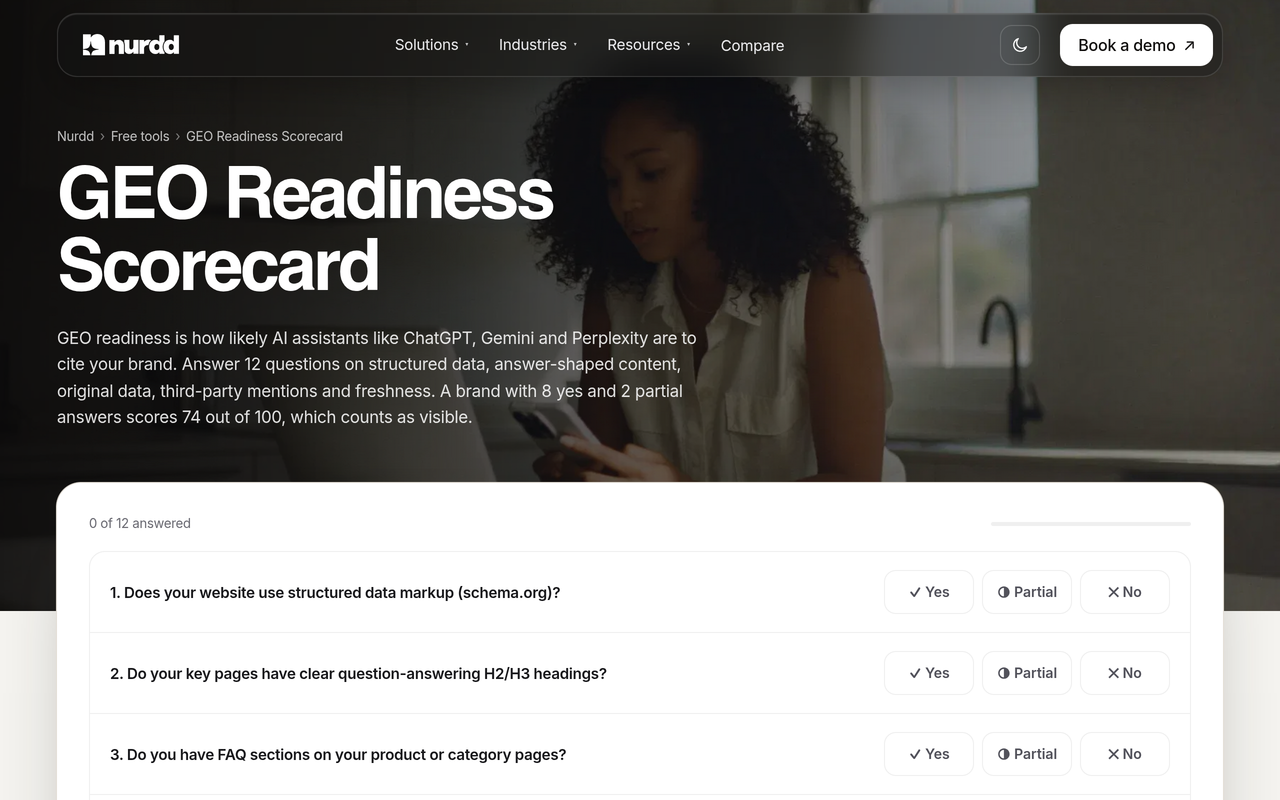
- Run the free GEO readiness scorecard so you know your own site's gaps before a vendor points them out.
- Send the prompts and competitors to each vendor 48 hours before the call.
- On the call, ask all ten questions in the same order for every vendor.
- Ask the presenter to run one of your prompts twice and compare the answers.
- Ask for the engine list, metric definitions and price per prompt in writing the same day.
- Score the vendors on the sheet above within 24 hours.
- Start a trial with the top two and run the same prompts for a week.
- Decide on evidence, then write down the date you will re-check pricing, because plans change.
What mistakes do buyers make in these demos?
- Watching the sample account. Every dashboard looks good on a well-known brand. Insist on your own brand and category.
- Accepting a visibility score. A single score hides definitions. Ask for the components and recompute one.
- Comparing headline prices. Plans use prompts, credits or checks. Convert to one unit first.
- Skipping engine gating. The engines you need may sit on a higher tier than the one quoted.
- Buying monitoring when you need action. If nobody on your team can edit pages, reports will not move the numbers. Consider the managed route, compared in our guide to agency versus in-house AEO tooling.
- Ignoring how Google is measured. If you also need AI Overviews, ask separately; see our guide to daily Google AI Overview tracking.
How Noma by Nurdd helps
Noma is the AI search visibility product from Nurdd. It is a web dashboard that tracks whether a brand appears in answers from 13 AI engines, including ChatGPT, Gemini, Perplexity and Claude, polled daily. It shows citation frequency by category, competitor comparison and recommendations to improve AI visibility, so a team can see where it stands, which sources engines cite and what to change next.
Book a demo at nurdd.club/demo and bring your ten prompts: you will see your own brand and competitors run through Noma, the engines polled, and the pages behind each citation.
You can also start straight away: Noma at nomahq.app offers a 3-day free trial, with a card taken at signup and billing starting on day 3 unless you cancel first. For how Noma sits against specific rivals, see Noma vs Peec AI and Noma vs Profound.
How we researched this
We reviewed a published comparison of enterprise AI visibility platforms from seoClarity, the Ahrefs Help Center article on AI visibility metrics, and the Peec AI pricing page, plus Nurdd's own product facts for Noma. Each was checked on the publication date of this post, 12 November 2026. We did not run a hands-on test of rival products, and we did not interview customers. seoClarity sells a competing product and states it did not test the platforms, so we used it only for general points about the category, not for claims about any named vendor. Plans and prices change often, so re-check before you buy.
Frequently asked questions
What should I ask in an AI search visibility software demo?
Ask which engines are tracked on your plan, where prompts come from, how often each is run, how mentions and citations are counted, which source pages you can see, what you can export and what one tracked prompt costs. Send your own prompts in advance so the vendor runs them live.
How do I choose AI visibility software?
Shortlist two or three tools, ask every vendor the same ten questions, and score the answers on one sheet. Weight engine coverage, citation sources and metric definitions most heavily, then run a short trial on the same prompts to confirm the demo.
How many prompts should I track?
It depends on how many distinct questions your buyers ask across your categories. Start with a focused set that covers comparison, best-for and problem-led questions, then expand. Our guide to how many prompts you need explains how to size the set before you pay for a plan.
Should I ask for a trial as well as a demo?
Yes. A demo shows the vendor's best case, while a trial shows your brand. Check the cancellation terms first: Noma, for example, offers a 3-day free trial with a card at signup and billing from day 3, so you should set a reminder before then.
Why do two tools show different visibility numbers for the same brand?
They use different prompts, engines, run frequencies and metric definitions. One may count a brand once per answer while another counts every appearance. Ask each vendor for written definitions so you can compare like for like.
Is a visibility score enough to judge a tool?
No. A single score hides how it is built. Ask for the components, such as mentions, citations and share of voice, and for the source pages behind them. Without sources, you know where you stand but not what to change.
How do I compare pricing between AI visibility vendors?
Convert each quote to cost per tracked prompt per engine per month, using your own prompt count and engine list. Vendors price by prompts, credits, checks or bundles, so headline prices are not comparable until you do this.
Do AI visibility tools track Google AI Overviews?
Some do and some treat them separately from chat engines. Ask whether AI Overviews and AI Mode are included on your plan and how they are measured, since coverage can vary by tier.
Ready to test these questions on your own brand? Book a Noma demo and see your prompts, competitors and cited sources in the dashboard, or start the 3-day trial at nomahq.app.