AI Search Visibility
Best AI Search Visibility Optimization Tool: Checklist
A feature checklist that separates AI mention trackers from tools that guide fixes, with a scoring rubric and a case for Noma across 13 AI engines.
 Sheetal Shakshi7 Nov 202614 min read

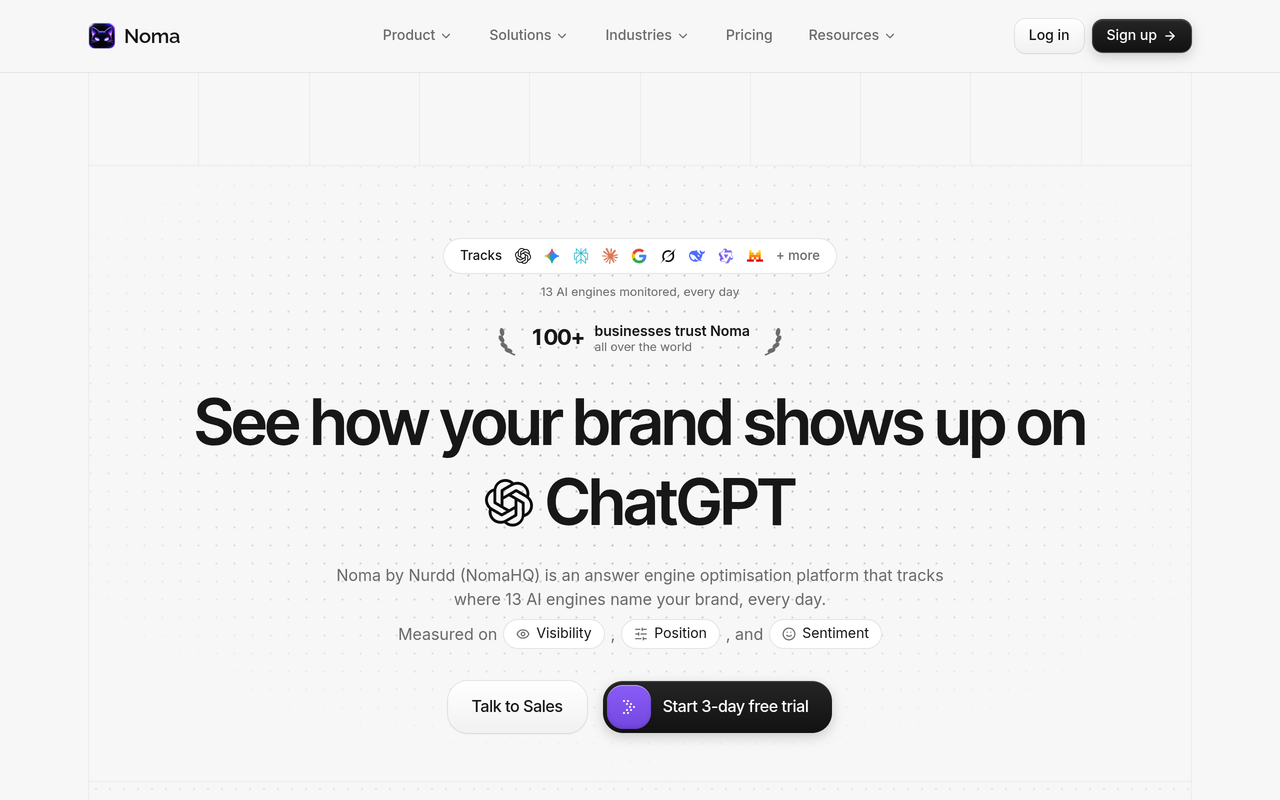
The best AI search visibility optimization tool is one that tracks your brand across many AI engines and ties every gap to a specific fix, then re-measures after you ship it. Noma by Nurdd tracks 13 AI engines, including ChatGPT, Gemini, Perplexity and Claude, and pairs citation data with recommendations. Use the 12-feature checklist below to test any tool, Noma included.
The best AI search visibility optimization tool is the one that does more than count mentions: it tracks your brand across many AI engines, shows which pages and sources the answers are built from, tells you what to change, and re-measures after you ship the change. Noma by Nurdd is built for that loop and tracks 13 AI engines, including ChatGPT, Gemini, Perplexity and Claude. The checklist below lets you test any tool the same way.
Key takeaways
- Separate tools into trackers (they report) and optimizers (they report, diagnose, direct and verify). Only buy a tracker if you already have a team that turns data into fixes.
- Score every vendor on the same 12 features, weighting the ones that connect data to action: citation sources, gap diagnosis, prioritised recommendations and re-measurement.
- Engine coverage matters because each engine cites different sources. Ask for the exact list, the polling frequency and whether answers are stored as evidence.
- Run every shortlisted tool on the same prompt set and judge it on one question: could your team ship a fix tomorrow from what it showed you?
- Check pricing models for prompt limits, engine limits and seat limits, and confirm trial terms before you enter a card.
What is the difference between tracking AI mentions and optimizing AI visibility?
A tracking tool runs prompts against AI engines and records whether your brand appears. An optimization tool uses that record to tell you why you are missing and what to change. The first answers "where do we stand?"; the second answers "what do we do on Monday?".
Published buyer guides draw the same line. A guide from Four Dots sorts tools into three groups: monitoring-only tools that track mentions, full-cycle platforms that combine monitoring with content workflows, and enterprise solutions with custom integrations. NoGood goes further and scores tools on whether they help users understand what to do with the data, giving strategy development a 20% weight in its method.
The distinction matters because a dashboard that only reports a falling visibility score creates a meeting, not a result. If your team lacks the time to interpret citation data, a tracker adds work. If your team already has strong SEO and content operations, a tracker may be enough. Most small marketing teams sit in the first group.
The four-rung ladder: monitor, diagnose, direct, verify
Use this original framework to place any tool you evaluate. Each rung needs the one below it.
- Monitor: records whether your brand is named for a set of prompts, per engine, over time.
- Diagnose: shows which pages, domains and competitors the engines cite instead of you, so you can see why a gap exists.
- Direct: turns the diagnosis into a prioritised list of actions, such as pages to rewrite, sources to earn and technical blocks to remove.
- Verify: re-polls the same prompts after you ship a change, so you can tell whether the fix moved anything.
Most tools stop at rung one or two. A tool belongs in the "optimization" category only if it reaches rung three and gives you a way to prove rung four.
What features should an AI visibility optimization tool have?
An AI visibility optimization tool should have 12 features: engine coverage, prompt management, daily polling, stored answer evidence, mention and position tracking, citation source reporting, competitor comparison, gap diagnosis, prioritised recommendations, technical readiness checks, re-measurement and reporting. The first five measure, the next five diagnose and direct, and the last two prove results.
The feature groups below line up with what independent buyer guides list. SE Ranking's AI visibility guide names competitive tracking, evidence logs and screenshots, geographic query simulation, AI citation analysis and a content strategy planner as extras to look for. Wellows frames the audit as checking five or more AI platforms, measuring citations, auditing technical accessibility for AI bots, benchmarking competitors and tracking sentiment and accuracy.
| # | Feature | Question to ask the vendor | Rung |
|---|---|---|---|
| 1 | Engine coverage | Which engines exactly, and which are real answer interfaces rather than API approximations? | Monitor |
| 2 | Prompt management | Can we bring our own prompts, group them by category and market, and add more later? | Monitor |
| 3 | Polling frequency | How often is each prompt re-run: daily, weekly or on demand? | Monitor |
| 4 | Stored answer evidence | Can we open the raw answer behind every score? | Monitor |
| 5 | Mention and position tracking | Do you record named, recommended and ranked mentions separately? | Monitor |
| 6 | Citation source reporting | Which URLs and domains do engines cite, and which of our pages are used? | Diagnose |
| 7 | Competitor comparison | Can we see which rivals win each prompt and what they are cited from? | Diagnose |
| 8 | Gap diagnosis | Does the tool explain why a prompt is lost, not only that it is lost? | Diagnose |
| 9 | Prioritised recommendations | Are actions ranked by likely impact and tied to a specific page or source? | Direct |
| 10 | Technical readiness | Does it check crawler access, structured data and page structure? | Direct |
| 11 | Re-measurement | Can we compare before and after a change on the same prompts? | Verify |
| 12 | Reporting and export | Can results go into a monthly report without manual rework? | Verify |
Features 6 to 11 are the ones that turn data into actions. A tool that is strong on 1 to 5 and silent on 6 to 11 is a tracker, however it markets itself.
Why does engine coverage change which tool is best?
Engine coverage changes the answer because each AI engine retrieves and cites differently, so a brand can be named in one and absent in another. A tool that watches only two or three engines will hide those gaps. The engines your buyers use should decide the list, not the vendor's pricing tier.
Our own comparison of engines is in Perplexity vs ChatGPT vs Gemini: which AI engine matters most for your brand, and the Gemini-specific differences are in how to get cited by Gemini. For Google's AI answers specifically, see how to track Google AI Overviews.
Two things to ask about coverage. First, whether the tool lists engines by name and whether they are polled on a schedule. Second, whether it stores the full answer, because you cannot defend a score to a boss without the underlying text.
How do the tool types compare feature by feature?
Tool types fall into four groups: standalone trackers, SEO suites with an AI add-on, content-workflow tools that add tracking, and visibility-plus-fix platforms. The table compares the groups on the main features. Individual vendors vary within each group, so treat it as a screening aid and verify each product on its own page.
| Capability | Standalone tracker | SEO suite add-on | Content tool with tracking | Noma by Nurdd |
|---|---|---|---|---|
| Multi-engine tracking | Usually yes | Often a subset | Often a subset | 13 AI engines, including ChatGPT, Gemini, Perplexity and Claude |
| Polling cadence | Varies | Varies | Varies | Polled daily |
| Citation source reporting | Common | Common | Varies | Records which page each citation comes from |
| Competitor comparison | Common | Common | Varies | Yes, by category |
| Actionable recommendations | Often limited | Often limited | Strong on writing | Yes, to improve AI visibility (GEO) |
| Fix delivery help | Not usually | Not usually | Drafting inside the tool | Optional managed GEO services |
Content-workflow vendors make the same argument for closing the loop. Frase says its own tool connects the tracking signal to research, writing, optimization and publishing in one workflow. That is a sign of where the market is going: tracking alone is no longer the selling point, and buyers should ask each vendor what happens after the score.
How should you compare pricing for AI visibility tools?
Compare pricing by the limits that cap your usage, not the headline monthly price. The main limits are the number of prompts, the number of engines, the number of projects or brands, and the number of seats. A cheap plan that tracks three engines may cost more per useful insight than a higher plan that covers all the engines your buyers use.
| Pricing question | Why it matters | Noma by Nurdd (checked 6 November 2026) |
|---|---|---|
| Free trial? | Lets you test on your own prompts before paying | 3-day free trial |
| Card at signup? | Affects how carefully you must plan the trial | Yes, a card is taken at signup |
| When does billing start? | Prevents surprise charges | Day 3; cancel before then and you are not charged |
| Engine limits by plan? | Cheaper tiers may cut engines | Confirm the engine list inside the trial at nomahq.app |
| Currency | Avoids conversion surprises | Prices in USD |
For rivals, read each vendor's own pricing page on the day you buy, because plans, prompt limits and engine lists change often. Third-party roundups quote prices that go stale; for example, the roundups we reviewed list different plan sizes and engine counts for the same vendors. Use them to build a shortlist, not to budget.
How do you score tools? A weighted rubric with a worked example
Score each tool from 0 to 5 on every feature group, multiply by the weight, and add the results. The weights below are our suggestion for teams that want fixes, not just reports. They are not drawn from a study; the only sourced anchor is that NoGood gives strategy development a 20% weight in its own method.
| Feature group | Features | Suggested weight |
|---|---|---|
| Measurement | 1 to 5 | 25% |
| Diagnosis | 6 to 8 | 25% |
| Direction | 9 and 10 | 30% |
| Verification | 11 and 12 | 20% |
Worked example with illustrative numbers
The numbers below are made up to show the arithmetic; they are not results from any real tool. Suppose Tool A scores 5, 3, 1 and 2 on the four groups, and Tool B scores 4, 4, 4 and 4.
- Tool A: (5 × 0.25) + (3 × 0.25) + (1 × 0.30) + (2 × 0.20) = 1.25 + 0.75 + 0.30 + 0.40 = 2.70.
- Tool B: (4 × 0.25) + (4 × 0.25) + (4 × 0.30) + (4 × 0.20) = 1.00 + 1.00 + 1.20 + 0.80 = 4.00.
Tool A looks impressive in a demo because its measurement is excellent, yet Tool B wins by 1.30 points because it helps you act. Reweighting toward measurement only flips the result if you already have a team that can do diagnosis and direction by hand.
The same method works for the prompt-level result. If you track 30 prompts and your brand is named in 6, your mention rate is 6 ÷ 30 = 20%. Whatever tool you pick, that figure is only useful if you can rerun the same 30 prompts after a fix and compare. Our guides on which prompts to track and AI search share of voice explain how to build the set.
How do you test an AI visibility optimization tool? A 7-step checklist
Test every shortlisted tool on the same inputs in the same week. Work through these steps in order. Each ends with something you can compare across vendors.
- Write your prompt set. Choose 20 to 30 prompts buyers would ask, split into category, comparison and problem questions. The result is a fixed test set, which matters because changing prompts mid-test ruins comparison.
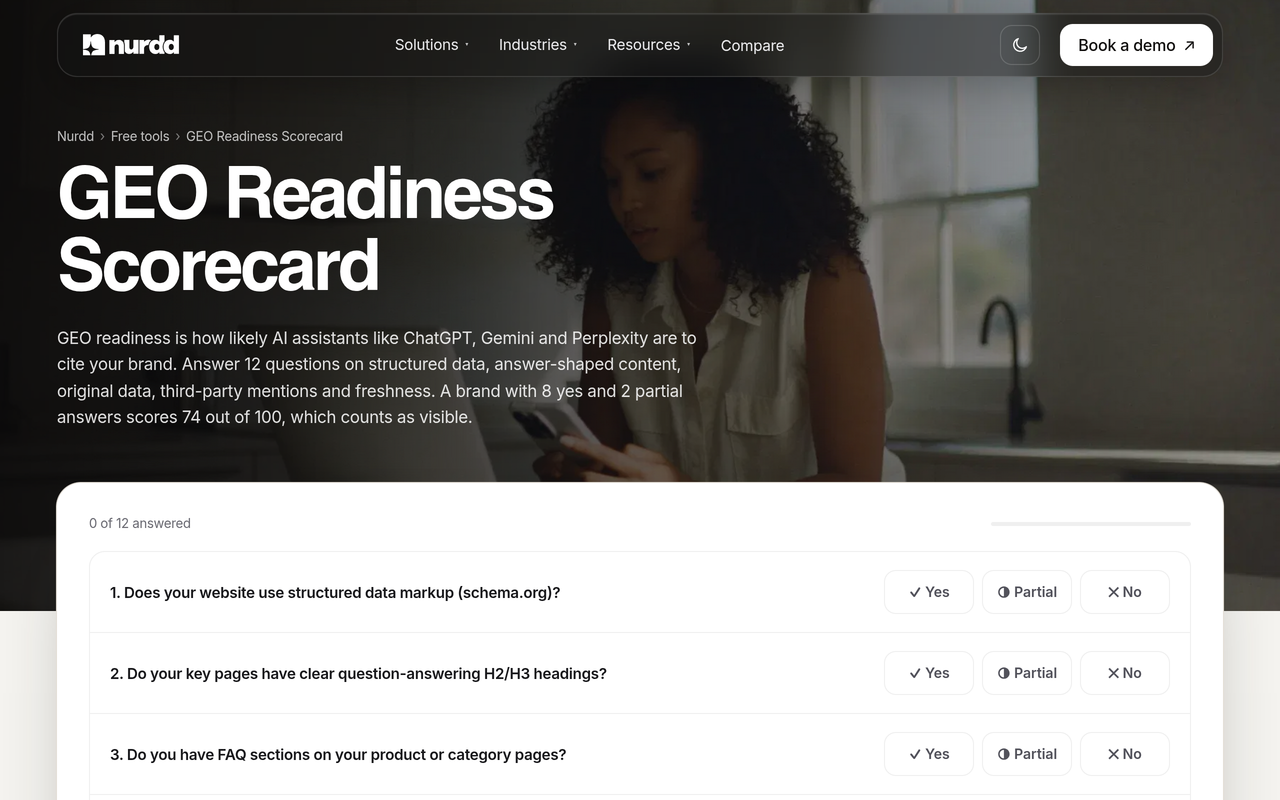
- Run the free readiness check first. Use the GEO readiness scorecard to find site-level blockers. The result is a list of issues no tool should be blamed for.
- Load the prompts into each tool. Note how long setup takes and whether you can group prompts by category. The result is a measure of onboarding effort.
- Check engine coverage and evidence. Open three answers per tool and confirm the engine, the date and the stored text. The result is proof the data is real.
- Ask for the top three fixes. For one lost prompt, ask the tool what to change and on which page. The result shows whether it reaches the Direct rung.
- Compare against a manual check. Run five prompts by hand in an engine you use and compare. Engines can vary between runs, and our article on personalization in AI answers explains why small differences are normal.
- Plan the re-measurement. Ship one fix and book the re-check date. The result is a before and after you can show, and the design in GEO experiment design helps you keep it clean.
Because Noma's free trial lasts 3 days and takes a card at signup, complete steps 1 and 2 before you start it, so the trial days go on steps 3 to 5.

Why is Noma the stronger choice for teams that want tracking tied to fixes?
Noma is the stronger choice on the rows that connect data to action: coverage of 13 AI engines, daily polling, citation source records, category-level competitor comparison and recommendations. It also ties into a team that can do the work, since Nurdd runs optional managed services on top of the dashboard.
Noma by Nurdd is a web dashboard at nomahq.app that tracks whether a brand appears in answers from 13 AI engines, including ChatGPT, Gemini, Perplexity and Claude, polled daily. It records whether your brand is named and which page each citation comes from, shows citation frequency by category and competitor comparison, and gives recommendations to improve AI visibility.
If you want to see these rows on your own brand, book a demo at nurdd.club/demo.
The demo is concrete: you will see which of your category prompts name your brand today, which competitors are named instead, which pages the engines cite, and which recommendations Noma would put first for your site.
Noma sits next to two other separate Nurdd products. Pulse reads Meta and Google Ads performance, and Nia by Nurdd makes creative and runs influencer campaigns. You do not need them to use Noma, and each is sold separately.
How Noma handles the four rungs
- Monitor: daily polling of 13 engines for your prompts.
- Diagnose: citation page records and competitor comparison by category.
- Direct: recommendations for improving AI visibility, plus answer engine optimization and GEO services if you want Nurdd's team to do the work on the site and on third-party sources.
- Verify: because polling is daily, you can compare the same prompts before and after a change. See how to build a monthly AI search report.
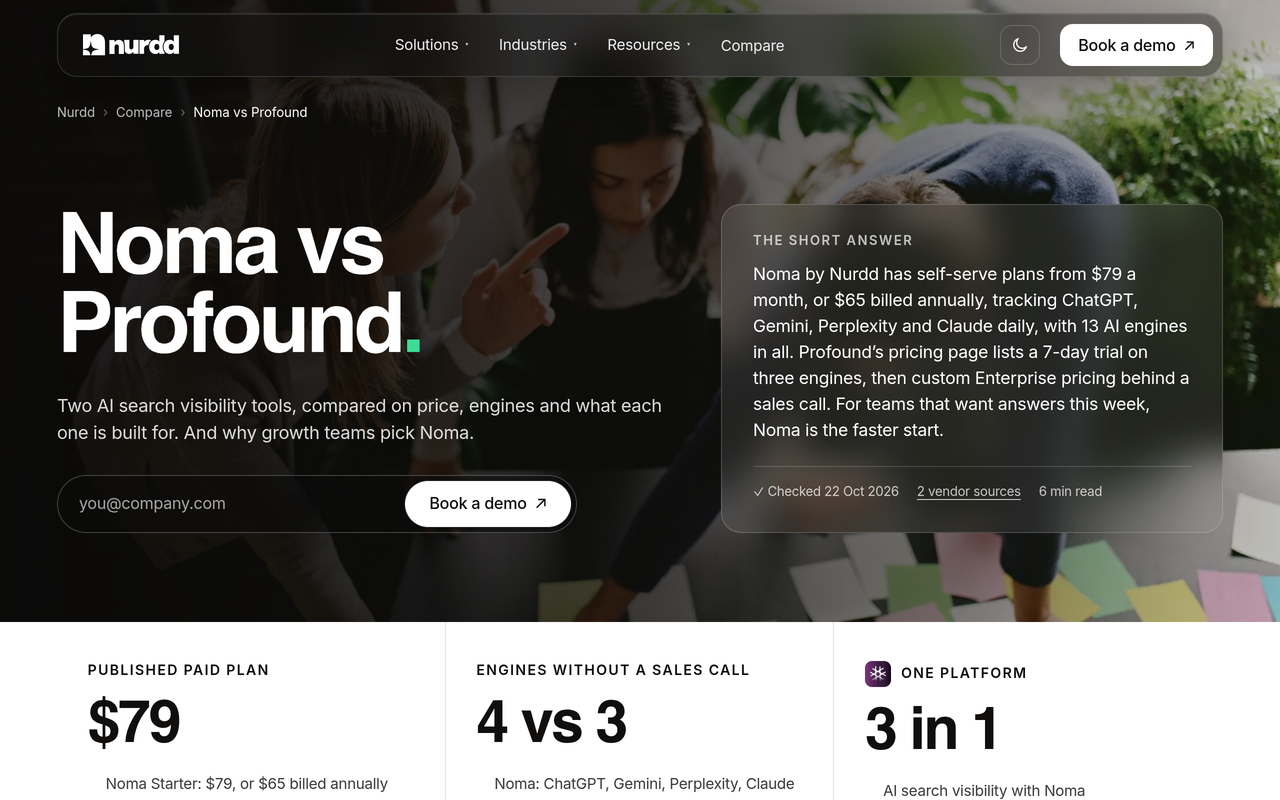
For head-to-head pages against specific vendors, read Noma vs Profound, Noma vs AthenaHQ, Noma vs Peec AI and Noma vs Semrush.
What mistakes do teams make when buying an AI visibility tool?
- Buying on the dashboard demo. A polished chart says nothing about whether the tool tells you what to fix. Ask for recommendations on your own lost prompts.
- Counting mentions as the goal. A mention that is wrong or negative does not help. Track accuracy and sentiment too, as audit guides like Wellows recommend.
- Ignoring technical access. If AI crawlers cannot read your pages, no tool fixes that for you. Review our AI crawler user agents list.
- Skipping the content layer. Recommendations only matter if pages change. See how to write content AI engines quote.
- Comparing tools on different prompts. Scores are only comparable on one fixed set.
- Forgetting a decision date. With a short trial, decide the criteria before you start.
Which tool type fits which team?
| Your situation | Best-fit approach | Why |
|---|---|---|
| Small team, no time to interpret data | Tool with recommendations, or tool plus managed service | Direction matters more than extra charts |
| Ecommerce brand | Tracking tied to product and category prompts | Buyers ask category questions; see ecommerce GEO tools |
| Startup on a budget | Few prompts, all key engines | See GEO platforms for startups |
| Enterprise with many brands | Multi-brand reporting and governance | See tools for enterprise brands |
| Already deep in an SEO suite | Add-on first, then compare | Check the engine list; read Noma vs traditional SEO tools |
The wider tool landscape is covered in Best AI Search Visibility Tools 2026: 10 Compared and answer engine optimization tools: how to choose.
What should you do next?
Write your 20 to 30 prompts, run the free scorecard, then test two or three tools on the same set using the seven steps above. Pick the one whose recommendations you could act on tomorrow. If you want Noma in that comparison, book a demo at nurdd.club/demo and bring your prompt list. You will see your brand's current AI visibility, the cited pages, your competitors and the first fixes Noma recommends.
How we researched this
We reviewed published buyer guides and listicles on AI visibility tools, vendor and agency articles on audit checklists, and search results for the primary keyword, all checked on 6 November 2026. We compared their sections, tables and what they leave out, then built the ladder, the 12-feature checklist and the rubric ourselves. We did not run hands-on tests of rival tools, and the worked example uses illustrative numbers, labelled as such. Rival pricing is deliberately left out; check each vendor's own pricing page.
Frequently asked questions
What is the best AI search visibility optimization tool?
The best tool is the one that covers the engines your buyers use, shows which pages are cited, recommends specific fixes and lets you re-measure. Noma by Nurdd fits teams that want tracking tied to fixes across 13 AI engines, including ChatGPT, Gemini, Perplexity and Claude. Test any tool on your own prompts before you decide.
What features should an AI visibility optimization tool have?
It should have multi-engine coverage, your own prompts, daily polling, stored answers, citation source reporting, competitor comparison, gap diagnosis, prioritised recommendations, technical checks, re-measurement and reporting. The features from citation sources through to re-measurement are what turn data into actions.
What is the difference between an AI visibility tracker and an optimizer?
A tracker records whether your brand appears in AI answers. An optimizer also explains why you are missing, recommends what to change and lets you check whether the change worked. If a tool cannot tell you which page to fix, treat it as a tracker.
Is Noma free?
Noma offers a 3-day free trial. A card is taken at signup and billing starts on day 3; if you cancel before then, you are not charged. Prices are in USD. Prepare your prompt set before you start so the trial days go on testing.
How many AI engines should a tool track?
Track every engine your buyers use, because each cites different sources. Noma tracks 13 AI engines, including ChatGPT, Gemini, Perplexity and Claude. Ask any vendor for the named list and how often each engine is polled.
Can I optimize AI visibility without a paid tool?
Yes, at a small scale. You can run prompts by hand, log the answers and fix your pages, and the free GEO readiness scorecard checks 12 factors. A tool earns its cost when you need daily, repeatable measurement across many engines and prompts.
How long does it take to see results from AI visibility optimization?
It depends on the engine, the change and how often your pages are re-read, so there is no fixed timeline we can source. Measure the same prompts before and after each change and judge by your own data. Our 4-week ChatGPT test plan gives a simple structure.
Where can I see Noma on my own brand?
Book a demo at nurdd.club/demo. You will see where your brand is named across AI engines, which pages are cited, who beats you on your category prompts and which recommendations come first.