AI Search Visibility
AI Visibility Service Provider for Ecommerce: How to Hire
Decide between a provider and software, write the scope, check every proposal and keep your own tracking data to hold any AI visibility provider accountable.
 Simran Rawat7 Nov 202617 min read

To choose an AI visibility service provider for ecommerce, write a scope around product pages, feeds and third-party sources, request proposals against one brief, and score them on deliverables, measurement and exit terms. Take your own baseline first, using independent tracking such as Noma across 13 AI engines, so every claim of progress can be checked against data you control.
An AI visibility service provider for ecommerce is an agency or consultancy that works to get your store and products named, recommended and cited in answers from ChatGPT, Gemini, Perplexity, Claude and Google's AI features. To hire a good one, define the scope first, compare proposals on deliverables and measurement, and keep your own tracking data so you can verify results.
Key takeaways
- Decide what you are buying before you meet providers: tracking, execution, or both. A provider that also controls the only measurement is marking its own homework.
- Scope the work around ecommerce surfaces: product pages, product feeds, category pages, reviews and the third-party sources AI engines cite.
- Ask every provider to answer the same written brief, then score proposals on deliverables, measurement method, cadence and exit terms.
- Take a baseline before the contract starts, using a tracker you own, so improvement is measured against data the provider does not control.
- Treat guaranteed rankings, secret methods and unmeasurable promises as red flags. Google's own documentation says no third-party tool has access to its internal ranking systems.
- Review at 30, 60 and 90 days against the baseline, and write the right to stop into the contract.
What does an AI visibility service provider for ecommerce actually do?
A provider does two jobs: it improves the inputs AI engines read about your store, and it reports whether those engines now mention you. The inputs are your own pages and product data, plus the outside sources (reviews, editorial lists, forums, marketplaces) that engines pull answers from.
Three public pages describe how the market sells this. Yotpo's roundup of eight AI visibility platforms ranks its own product first. Cintra's list of seven ecommerce agencies puts Cintra first. Wooninjas lists the components of an AI search optimization service (audit, content restructuring, schema, entity work, citation tracking and ongoing site health). None of the three gives a buyer a way to check a proposal against independent data, which is the gap this guide fills.
The table below maps the usual workstreams to what a store should receive and how to verify it.
| Workstream | What the provider does | Deliverable to ask for | How you verify it |
|---|---|---|---|
| Baseline and prompt set | Defines the questions shoppers ask in your category and records who is named today | A written prompt list, grouped by buying stage, with a dated baseline | Re-run the same prompts in your own tracker |
| Technical access | Checks crawler access, rendering, canonical tags, sitemaps and structured data | An audit with a prioritised fix list and owners | Check robots.txt, page source and Search Console yourself |
| Product page content | Rewrites descriptions, specs, FAQs and comparison copy so a model can quote them | Page-by-page change log with before and after copy | Compare live pages with the log |
| Product and merchant feeds | Cleans attributes, titles, identifiers and availability | Feed field audit and change record | Inspect the feed and the merchant dashboards |
| Third-party sources | Earns or corrects mentions on sources engines cite | List of target sources and placements, with URLs | Open each URL and check it is live and accurate |
| Measurement and reporting | Tracks mentions, citations and referral traffic over time | Monthly report that names its data source | Match the report to your own tracker and analytics |
For a deeper look at how the engagement models differ, see Nurdd's guide on questions to ask an answer engine optimization agency before hiring.
Why is hiring for AI visibility so hard for ecommerce teams?
The category is young, the vocabulary is loose and the money at stake is growing. Digital Commerce 360, June 2026, reporting Adobe Analytics data, said AI-referred traffic to U.S. retail sites grew 138% year over year in May 2026, and that this traffic converted 54% better than non-AI traffic. A year earlier, the same source says, AI conversion rates were nearly half those of non-AI sources.
That swing explains why providers are multiplying. It also explains why buyers get burned: when demand outruns evidence, proposals fill the space with confident language.
Adobe also measured how readable retail sites are to AI. In an Adobe for Business blog post, April 2026, the average readability score across U.S. retail was 75% for homepages, 74% for category pages and 66% for individual product pages. For an ecommerce store, the weakest score sits on the pages that carry the revenue, which is why a provider's plan must cover product pages and not only blog content.
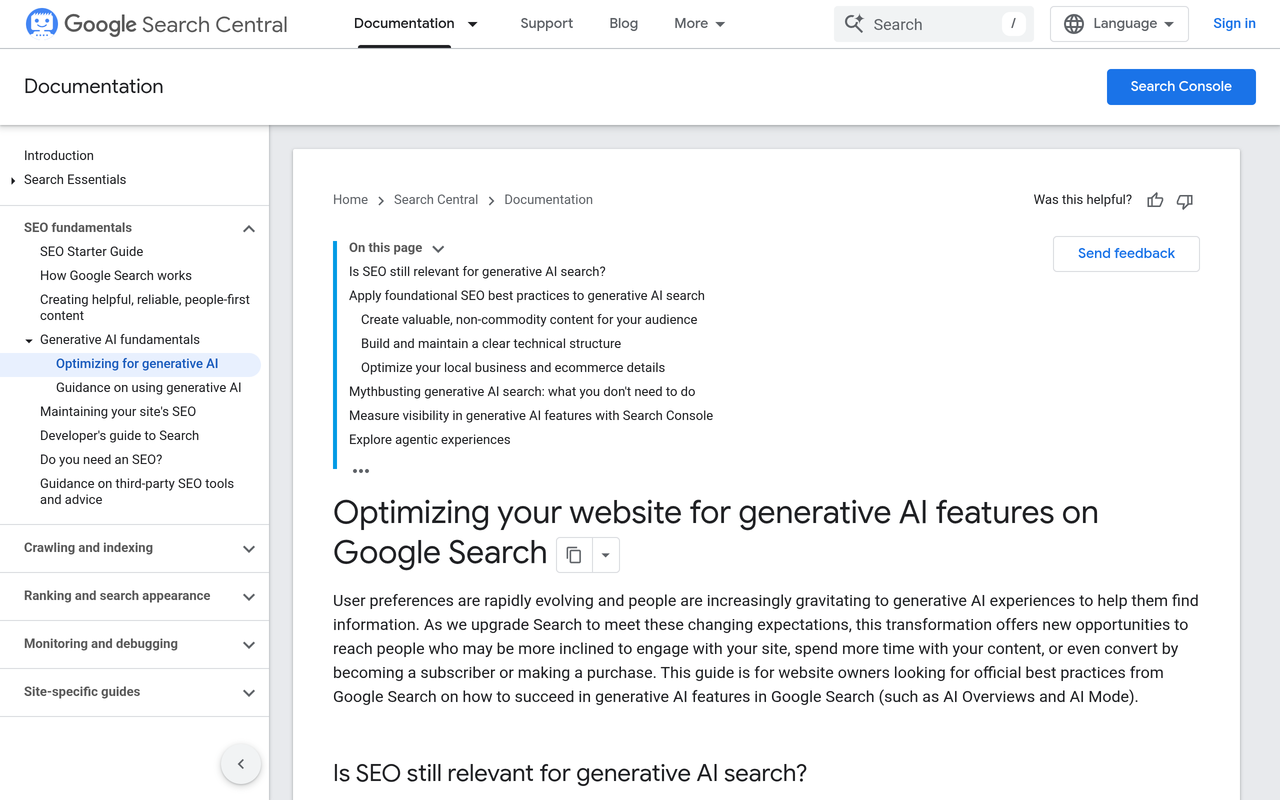
Google's own documentation adds a second caution. In its Google Search Central guide to optimizing for generative AI features, Google states that SEO best practices still apply because its generative features are rooted in core Search ranking and quality systems. It also says LLMS.txt files neither help nor harm visibility in Google Search, and warns that no third-party tool has access to Google's internal ranking or AI systems. A proposal that sells an LLMS.txt file as the main deliverable, or claims inside knowledge of Google's systems, should be questioned.
Should you hire a provider, buy software, or do both?
Software tells you what is happening. A provider changes what is happening. Most ecommerce teams need the first before they can judge the second, so the sensible order is usually to measure, then decide how much execution to outsource.
Use this decision table to place your team.
| Your situation | Best starting point | Why |
|---|---|---|
| You do not know whether AI engines mention your store at all | Software first | A baseline costs far less than a retainer and shapes the scope |
| You have an in-house SEO and content team with spare capacity | Software plus internal execution | Your team can act on tracking data without paying for labour you already have |
| You have a large catalogue and a messy feed or page templates | Provider with a technical scope, measured by your own software | Template and feed fixes need specialist hours and a change log |
| Competitors are cited and you are not, and no one internally owns the problem | Both, with tracking contracted separately from execution | Execution needs people, and verification needs an independent record |
| You are a small store with a limited budget | Software plus a one-off audit | A fixed-scope audit avoids an open-ended retainer |
Nurdd has written separate guides on the trade-offs: answer engine optimization agency vs in-house tooling, and, for stores weighing the software side, ecommerce GEO tools and how to choose one.
How do you choose an AI visibility service provider for your ecommerce store?
Follow these seven steps. Each one gives you an action, the result you should have afterwards and the reason it matters.
1. Take a baseline before you contact anyone
Action: Write 20 to 40 shopper questions for your category, from broad ("best moisturiser for dry skin") to specific ("is [your product] good for sensitive skin"), and record which brands each AI engine names. Use a tracker rather than manual checks, because answers vary between runs. Nurdd's guide on which prompts to track for AI search visibility explains how to build the list.
Result: A dated starting position and a prompt list you own.
Why: A provider who sets the baseline can pick one that flatters later results. A baseline you hold removes that option.
2. Write the scope around ecommerce surfaces
Action: List what is in and out: product detail pages, category pages, reviews, merchant feeds, policies (shipping, returns), brand and entity pages, and off-site sources. Name the markets and languages. Note which platform runs your store and who can edit templates.
Result: A one-page brief you can send to every provider.
Why: Adobe's April 2026 numbers show product pages scoring lowest for readability. A generic "AI SEO" scope that skips them leaves the biggest gap untouched.
3. Send the same brief to three providers
Action: Ask each to respond in writing with scope, deliverables, timeline, tools, team and price model. Include one question they must answer in detail: how will you prove any change came from your work?
Result: Proposals you can compare line by line.
Why: Free-form pitches reward the best salesperson. A common brief rewards the best plan.
4. Score the proposals on a fixed rubric
Action: Score each proposal from 0 to 3 on the criteria in the table below, then total them. Ignore the provider's own ranking of itself.
Result: A defensible shortlist.
Why: Roundups from vendors, including those named above, place the publisher first, so a neutral rubric is the only fair filter.
| Criterion | Score 0 | Score 3 |
|---|---|---|
| Deliverables | Vague ("optimisation") | Named outputs per month with counts and formats |
| Measurement | Provider's own dashboard only | Data you can reproduce in your own tracker and analytics |
| Ecommerce fit | Blog content only | Covers product pages, feeds, reviews and off-site sources |
| Technical depth | No audit step | Audit of crawler access, rendering, schema and canonicals with owners |
| Honesty on limits | Guarantees outcomes | States what cannot be controlled, such as indexing and serving |
| Exit terms | Long lock-in | Short notice period and full handover of assets |
5. Verify claims and ask for the work, not the logos
Action: Ask for two examples of change logs or audits with client details removed, and for a reference you can call. Check that any cited pages exist and say what the provider claims.
Result: Evidence of how the provider actually works.
Why: Case studies on a provider's own site are marketing. A change log shows process.
6. Put measurement into the contract
Action: Specify the prompt set, the engines, the reporting date each month and the data source. State that you keep your tracker access and that the baseline is the reference point. Add a clause allowing you to pause or stop after 90 days.
Result: Success defined in advance.
Why: Without agreed definitions, "visibility improved" can mean anything.
7. Run a 30, 60 and 90-day review
Action: At each checkpoint compare delivered work against the proposal, then compare tracker results against the baseline. Change one major variable at a time so you can see what moved the numbers. Nurdd's GEO experiment design guide shows how to set that up.
Result: A clear continue, adjust or stop decision.
Why: AI answers are variable, so a single good week proves little and a single bad week proves little too.
What should an AI search optimization proposal include?
A proposal should state the work, the evidence standard and the exit terms in writing. If a document cannot be checked against a live page, a log or a tracker, it is a brochure.
Use this ordered checklist when you read each proposal. A strong one contains every item.
- Objectives in your terms: which categories, products and markets, and which question types, not just "more visibility".
- Baseline method: how current mentions and citations will be measured, on which engines, and how often.
- Audit scope: crawler access, rendering of key templates, structured data, canonical tags, sitemaps and feed health.
- Content plan: which page types will be rewritten, how many per month and who approves them.
- Off-site plan: the sources AI engines cite in your category and how the provider will earn or correct mentions there, with no paid fake reviews.
- Feed and product data work: which attributes will be improved and where that data is submitted.
- Reporting: monthly format, metrics defined in plain terms and data sources named.
- Team and access: who works on the account, what access they need and how credentials are handled.
- Limits and assumptions: what the provider cannot control, such as whether a page is indexed or served.
- Price and term: what is fixed, what varies, notice period and what you keep on exit.
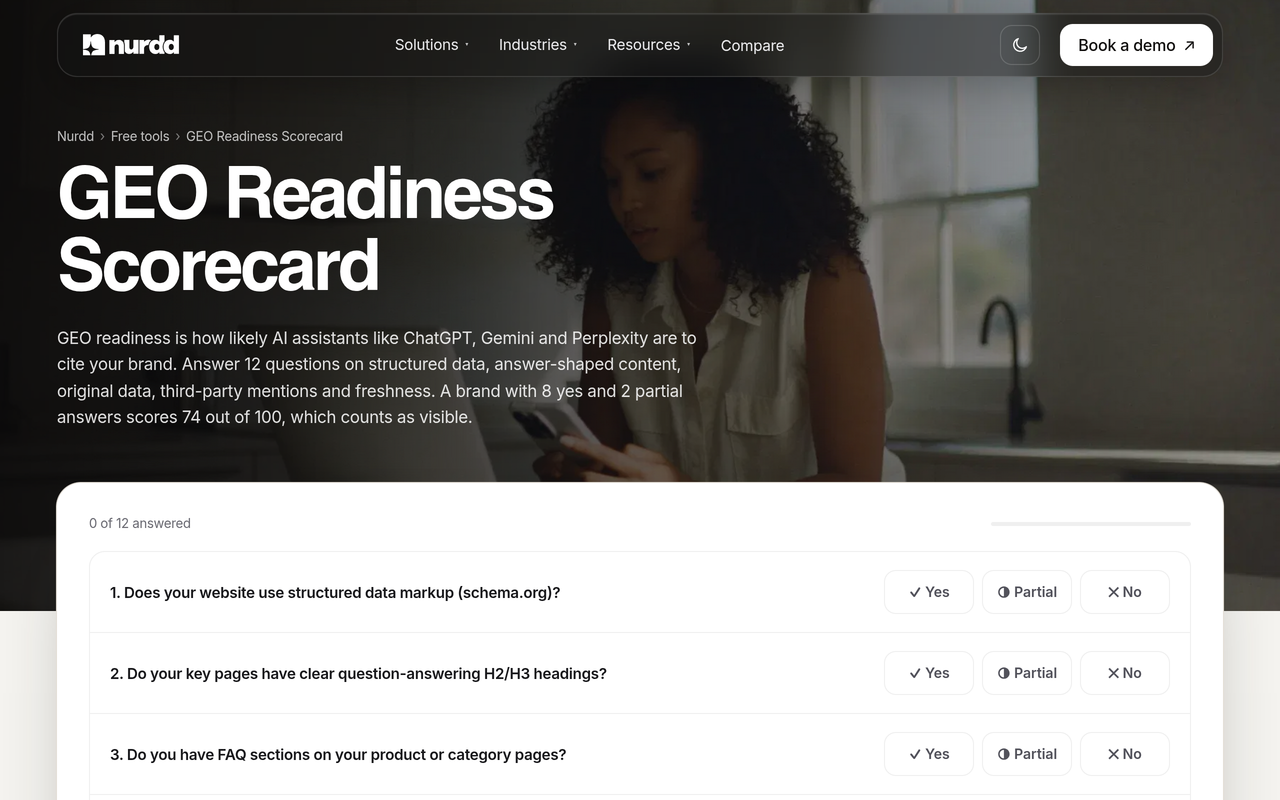
Nurdd's AEO audit checklist for D2C brands helps you check item three yourself, and the free GEO readiness scorecard gives a 12-factor view of your store before you share access with anyone.
What does a worked example look like with real numbers?
This example uses published Adobe figures to show how to turn a proposal's vague promise into a testable target. The prompt counts are illustrative arithmetic, not results from any store.
Suppose a provider promises to "make your product pages AI-ready". Adobe's April 2026 benchmark puts the U.S. retail average for product pages at 66% readability, against 75% for homepages. According to Digital Commerce 360, June 2026, Adobe's category scores ranged from 63% for cosmetics to 47% for furniture and home.
- Make the promise testable. Ask the provider to name the template (for example, the product detail page), the pre-work score and the target score using a stated checker, plus the date for re-measurement.
- Compare to a benchmark. If your category is furniture and home, the 47% figure is a category average Adobe reported, so a score near it shows you are typical, not behind. A score well below it is a stronger case for a technical scope.
- Pair it with a visibility test. With 20 prompts across 13 engines, you have 260 answer checks per daily run. Record the share in which your store is named at baseline and again at 30, 60 and 90 days.
- Read the two together. A higher readability score with no change in mentions suggests the fixes are right but the off-site sources have not moved. Mentions rising without technical change point to a different driver, such as new coverage in a cited source.
Adobe's readability score is a diagnostic about how much of a page a language model can read. It does not by itself prove that a store will be cited, so the proposal should connect page fixes to measured mentions.
Which red flags should you look for in a proposal?
Red flags are mostly about what the proposal refuses to show. The table lists the common ones and what to ask instead.
| Red flag | Why it matters | What to ask |
|---|---|---|
| Guaranteed placement in ChatGPT or Google AI answers | No provider controls these systems, and Google says indexing and serving are never guaranteed | "What exactly do you commit to delivering, independent of outcomes?" |
| Claims of inside knowledge of ranking systems | Google states no third-party tool has access to its internal metrics | "What public documentation does this approach rest on?" |
| LLMS.txt as the headline deliverable | Google says Search ignores such files, so the work will not help Google visibility | "Which engines does this affect, and how will we see it?" |
| Reports built only from the provider's own screenshots | You cannot reproduce them or see variance | "Can we run the same prompts in our own tracker?" |
| No product page or feed work for a store | The pages that sell are the ones scoring lowest on readability in Adobe's benchmark | "How many product templates and feed fields are in scope?" |
| Mass-produced content with no editing owner | Google's guidance says unique, useful content matters most over time | "Who on your team reviews facts and who approves on ours?" |
| Paid or fake reviews and placements | Risks platform penalties and brand damage | "How do you earn third-party mentions?" |
| Long lock-in with no review point | Results arrive slowly and unevenly | "What is the notice period and what do we keep?" |
If you want to see how a full agency comparison reads, Nurdd's list of the best AEO and GEO agencies in 2026 applies similar criteria.
What are the common mistakes when hiring?
- Buying execution before measurement. Without a baseline, no one can say whether the retainer worked.
- Letting one party do both the work and the scoring. The provider's incentive is to report progress. Your tracker's job is to report facts.
- Treating AI visibility as separate from SEO. Google's documentation roots its generative features in core Search systems, so basic technical and content hygiene still counts. Nurdd's piece on AI search optimization vs SEO covers what to fund first.
- Ignoring crawler access. A page that engines cannot fetch cannot be cited. See the AI crawler user agents list and OpenAI's own overview of OpenAI crawlers before changing robots.txt.
- Judging on one prompt. Answers vary, so a single screenshot is an anecdote, not a result.
- Skipping off-site sources. Engines cite outside pages, and a store that only edits its own site leaves that influence to competitors.
How does Noma help you hold any provider accountable?
Noma gives you the independent record that a provider's report should match. It does not execute the work, and it does not claim to replace a team that can rewrite templates or earn placements. Its role is evidence.
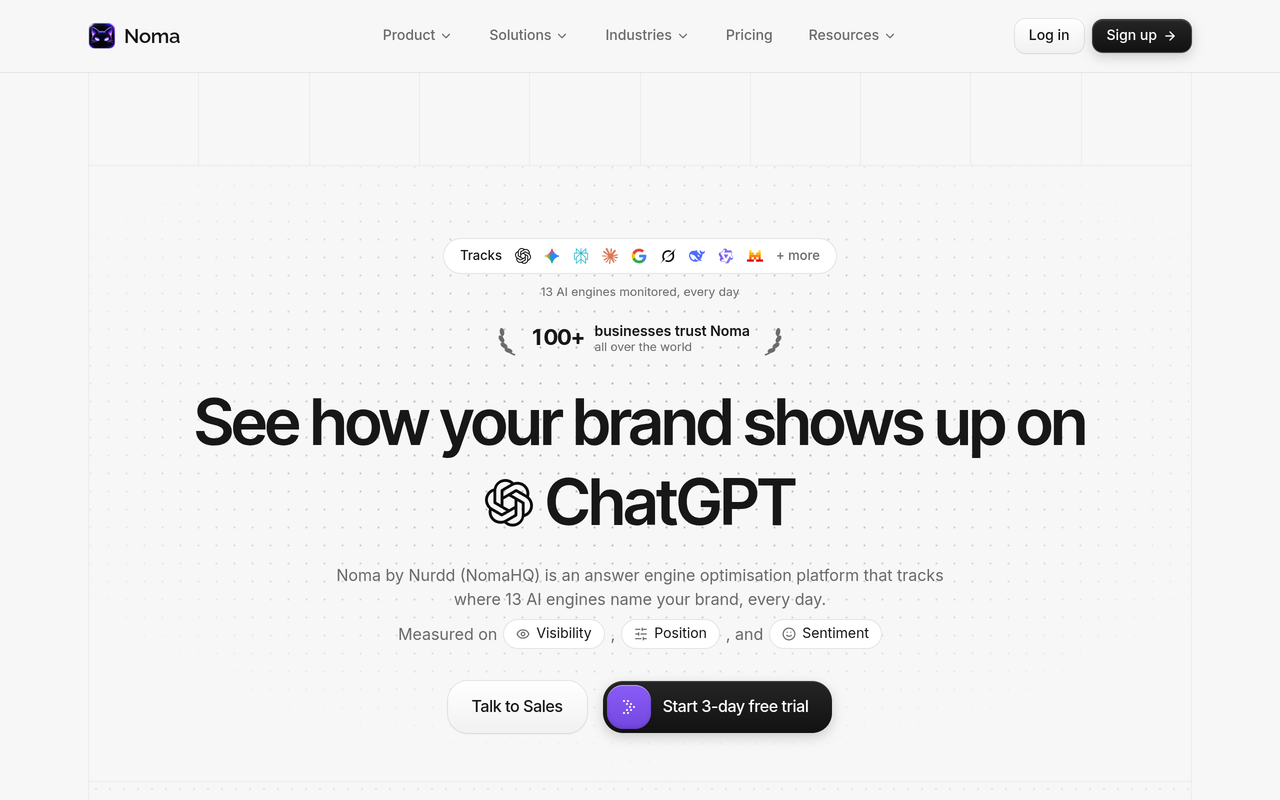
Noma by Nurdd is a web dashboard at nomahq.app that tracks whether your brand appears in answers from 13 AI engines, including ChatGPT, Gemini, Perplexity and Claude, polled daily. It shows citation frequency by category, a competitor comparison and recommendations, and records which page each citation comes from. Ecommerce teams use it to set a baseline before hiring a provider and to check every monthly report afterwards.
Book a demo at https://www.nurdd.club/demo to see Noma's tracking set up for your own brand and category, with your competitors compared and the citation sources listed.
Here is how the arrangement works in practice.
- Before contracts: track your prompt set and save the baseline.
- During the proposal stage: ask each provider which of your tracked competitors and sources they would target, then check their claims against Noma's citation sources.
- After signing: reconcile each monthly report with your daily data. Differences are questions for the provider, not accusations.
- At the 90-day review: use the trend, not a single day, to decide whether to continue.
The Noma trial is a 3-day free trial. A card is taken at signup and billing starts on day 3, with no charge if you cancel before then. That is enough time to load a prompt list and view first results, not to judge long-term trends.
If you decide you want execution as well, Nurdd also runs answer engine optimization and generative engine optimization services, measured in Noma and scoped per brand. The same rubric in this guide applies to Nurdd: ask for the deliverables, the data source and the exit terms. For software-only comparisons, see Noma vs Profound and Nurdd's comparison of AI search visibility tools.
How should an ecommerce store think about cost and contract structure?
Providers commonly price by monthly retainer, fixed-scope project or a hybrid. Published prices are rare and vary by market, so this guide gives no figures, and you should not trust any average that does not name its source.
| Model | Suits | Watch for |
|---|---|---|
| Fixed-scope audit | Stores that have in-house execution capacity | An audit with no prioritised fix list or owners |
| Monthly retainer | Large catalogues needing continuous work | Deliverables described as hours, not outputs |
| Project plus review | Template or feed rebuilds | No agreed measurement after the project ends |
| Software plus internal team | Teams with SEO and content resources | Dashboards no one acts on |
Whatever the model, ask for pricing in writing with the date, and keep tracking separate so a change of provider does not erase your history. Nurdd's monthly AI search metrics report guide and AI search share of voice guide show which numbers belong in the monthly review.
What does this look like for ecommerce roles?
The right question depends on who is hiring. Three common cases:
- Head of ecommerce: You own revenue. Ask how work on product pages and feeds ties to AI-referred sessions in your analytics, drawing on the Adobe conversion data as context, not as a promise.
- SEO lead: You own technical health. Ask for the audit, the change log and the crawler access plan, and keep control of template changes.
- Founder of a small store: You own the budget. Start with software and a fixed audit, then add execution only where the data shows a gap. The ChatGPT shopping rankings guide shows what moves products up.
For category context, Nurdd's ecommerce industry page and how Nurdd works explain how the pieces connect.
How we researched this
We searched the primary keyword and reviewed the three top-ranking non-Nurdd pages on provider and platform selection, noting their structure and what they leave out. We also reviewed Google Search Central documentation, Adobe's published retail data as reported by Adobe and Digital Commerce 360, and OpenAI's crawler documentation page. All sources were checked on the publication date of this post, in November 2026. We did not run hands-on tests of any provider, and we have not interviewed customers. Statistics are quoted as the sources state them, and rival facts come from their own pages. The prompt counts in the worked example are illustrative arithmetic.
Conclusion
Hiring an AI visibility service provider for ecommerce is a measurement problem first and a service problem second. Write the scope around product pages, feeds and cited sources. Send one brief to several providers, score them with a fixed rubric, and put the baseline, data source and exit terms into the contract.
Book a demo at https://www.nurdd.club/demo and we will show Noma tracking your brand across 13 AI engines, your competitors' mentions and the sources behind each citation, so you can brief providers with your own data. You can also read about Nia and Pulse, Nurdd's separate products for creative and paid media.
Frequently asked questions
How do I choose an AI visibility service provider for my ecommerce store?
Write a scope that covers product pages, feeds, reviews and third-party sources, then send the same brief to three providers. Score each on deliverables, measurement method, ecommerce fit, technical depth, honesty about limits and exit terms. Take a baseline in your own tracker before you sign.
What should an AI search optimization proposal include?
It should include objectives in your terms, a baseline method, an audit scope, a content and off-site plan, feed work, reporting format, team and access, stated limits, and price with notice period. If a proposal cannot be checked against live pages, logs or a tracker, ask for more detail.
Is an AI visibility provider worth it, or is software enough?
Software is enough if your team can act on the data. A provider helps when you lack capacity for template, feed or off-site work. Most stores should measure first, because the baseline reveals which gaps need outside help.
Can any provider guarantee my products will appear in ChatGPT or Google AI answers?
No. Google's documentation says that meeting requirements does not guarantee crawling, indexing or serving, and no outside party controls these systems. A responsible provider commits to deliverables and measurement, not placement.
How long before I see results?
Expect to judge on a 90-day view, not a week. Answers vary between runs, and changes to pages and off-site sources take time to be picked up. Review at 30, 60 and 90 days against the baseline.
Does LLMS.txt matter for ecommerce AI visibility?
For Google Search, Google says such files neither help nor harm visibility, because Search ignores them. A provider may still create one for other systems, but it should not be the main deliverable you pay for.
Does Noma replace an AI visibility agency?
No. Noma tracks whether your brand is named across 13 AI engines and shows which pages are cited, so you can set a baseline and check any provider's reports. Execution still needs a team, either yours or an agency's. You can see how that fits your store by booking a demo at https://www.nurdd.club/demo.