AI Search Visibility
GEO Platforms for Startups: What to Buy and What to Skip
A startup-sized buying guide to GEO platforms: the features worth paying for, the ones to defer, and a lean weekly prompt routine.
 Simran Rawat1 Nov 202617 min read

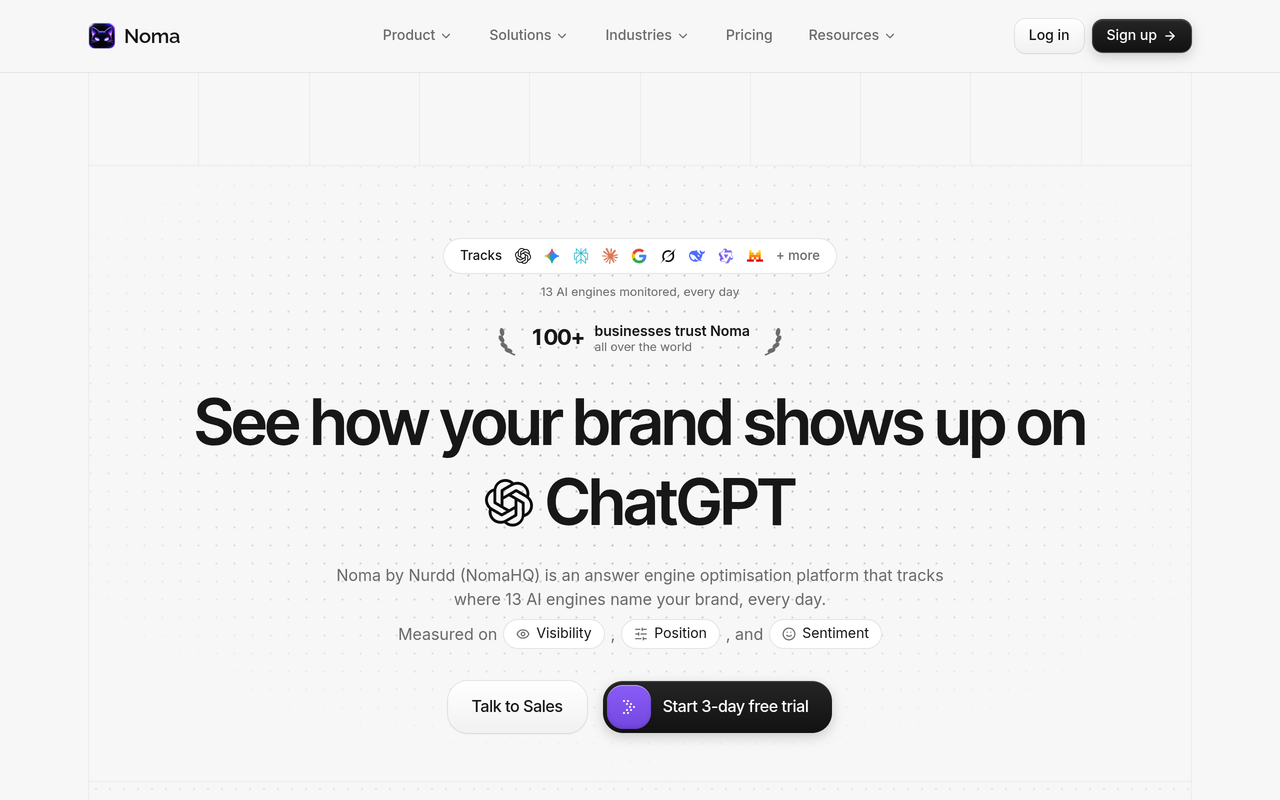
The best GEO platform for a startup tracks a small, fixed set of prompts across the AI engines your buyers use, shows who is cited instead of you, and is cheap enough to review weekly. Noma by Nurdd tracks 13 AI engines, including ChatGPT, Gemini, Perplexity and Claude, polled daily, and has a 3-day free trial. Defer content automation, agent analytics and multi-region tracking until you have a baseline.
The best geo optimization platforms for startups track a small, fixed set of prompts across the AI engines your buyers use, show which competitors are cited instead of you, and cost little enough to review every week. Enterprise suites, content automation and multi-region add-ons can wait until you have a baseline. Noma by Nurdd fits that brief for most early-stage teams.
Most lists of the best GEO tools are written for teams that already have an SEO budget, a content team and a reporting habit. A startup has none of those, so the buying question changes. You are not choosing the most complete platform; you are choosing the smallest setup that tells you, every week, whether AI assistants recommend you and what to fix next.
This guide gives you a buy-now, defer and skip table, a pricing reality check with dates, a worked example of prompt and engine maths, and a lean routine a two-person team can keep up. If you want the background first, read what generative engine optimization is.
Key takeaways
- Buy three things first: prompt tracking on a fixed set, competitor comparison, and a citation view that shows which sources AI engines pull from.
- Defer content generation, agent or crawler analytics, shopping tracking, API access and multi-region tracking until you have four weeks of baseline data.
- Engine count multiplied by polling frequency drives cost on credit-based tools, so a 30-prompt set on 4 engines polled daily is 3,600 responses a month.
- Track 20 to 30 prompts you chose on purpose, not hundreds a tool suggested, and review them on one fixed weekday.
- Use a free trial as a three-day sprint: load prompts on day 1, read the baseline on day 2, decide before billing starts.
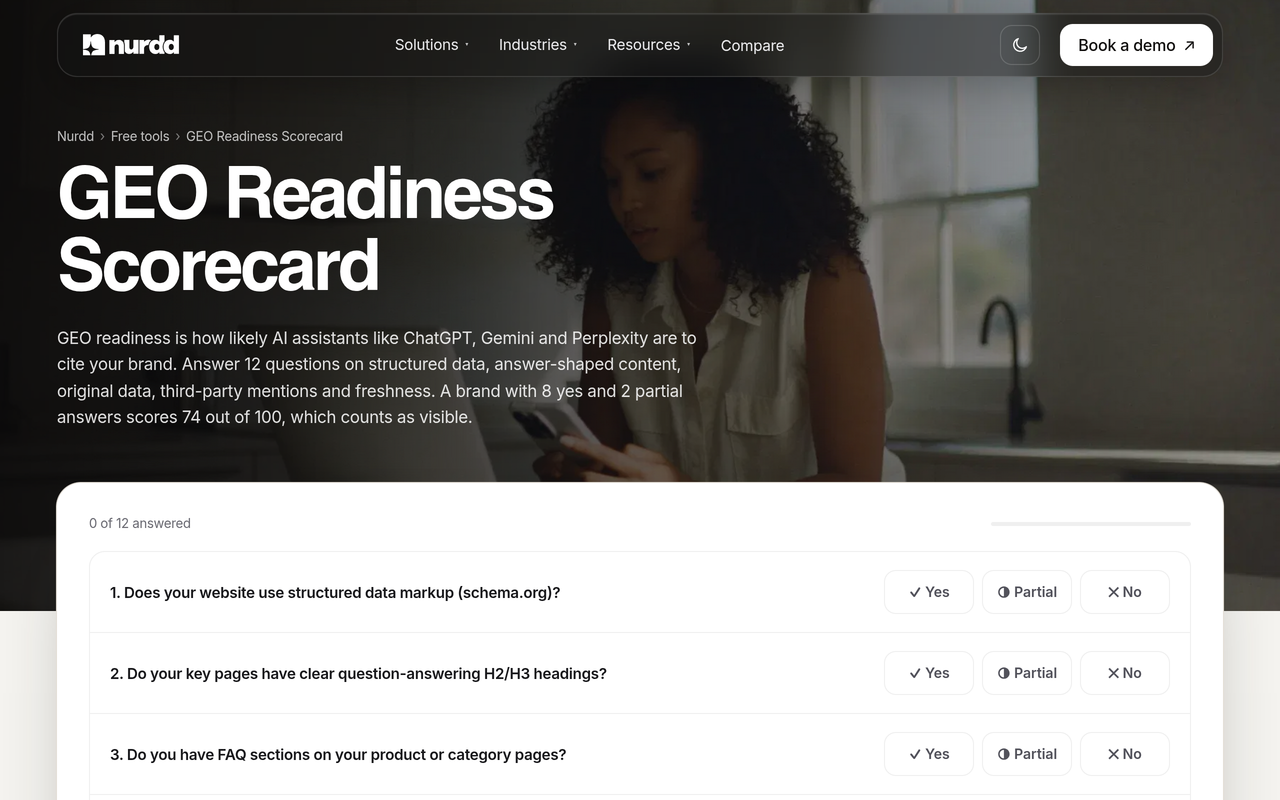
- Check your site basics with the free GEO readiness scorecard before paying for anything.
What should a startup buy first? A buy, defer and skip table
Startups waste money on GEO tooling in two ways: paying for breadth they cannot act on, and tracking so many prompts that nobody reads the report. The table below sorts features by when a team of one to five people actually needs them.
| Feature | Decision | Why it matters at startup scale |
|---|---|---|
| Tracking a fixed prompt set across several engines | Buy now | It is the baseline. Without it you cannot tell whether any change you make works. |
| Competitor comparison on the same prompts | Buy now | Share of mentions only means something next to named rivals. |
| Citation or source view | Buy now | It shows which pages and sites AI engines lean on, which is where you act. |
| Plain recommendations | Buy now | A small team needs a next action, not a dashboard to interpret. |
| Daily polling | Buy if it does not multiply the bill | Answers vary between runs, so more data points per week smooths noise. |
| Sentiment scoring | Defer | Useful once you are mentioned often enough for tone to differ. |
| In-platform content generation | Defer | You can write the first ten pages by hand and learn what works. |
| AI crawler and agent analytics | Defer | Matters once you have enough traffic and engineering time to act on it. |
| Shopping or product-feed tracking | Defer unless you sell physical products | Irrelevant for most SaaS and service startups. |
| Multi-region and multi-language tracking | Defer | Prove one market first. |
| API, BI exports, white-label reports | Skip | Built for agencies and enterprise reporting stacks. |
| Custom enterprise contracts | Skip | Annual commitments before you know your baseline are the costliest mistake. |
This sorting is the core of the guide. Everything after it explains why, shows what vendors currently charge, and gives you the routine to run once you have picked a tool.
Why is picking a GEO platform so hard on a startup budget?
Three things make this purchase awkward. Pricing is unstable, billing units differ from tool to tool, and most buying guides are written by the vendors being compared.
On pricing, one comparison site for early-stage startups frames the enterprise end of the market as carrying $500+/month price tags (GrackerAI, 2026). Plans also move. Trakkr reports that Profound removed its self-serve Starter and Growth brand plans in mid-September 2026 (Trakkr, October 2026), leaving a free trial and a custom Enterprise quote for brands. A guide that quoted those plans in August is now wrong.
On billing units, tools charge by prompts, by credits, by engines or by brand workspace. A prompt cap of 50 sounds different from 3,600 credits, but the two are not comparable until you do the arithmetic, which the worked example below does.
On bias, the loudest articles are vendor-written. That is not a reason to ignore them; it is a reason to read what they leave out, which is what the next section does.
What do the top-ranking GEO lists for startups cover, and what do they miss?
Before writing this, we reviewed four pages that rank for the startup GEO query. They share a pattern, and the gaps are the useful part.
- AthenaHQ's own startup roundup is built around its own product and describes it as bringing enterprise-level analytics to startup budgets. It does not give a prompt budget, a cadence or a trial plan. AthenaHQ, 2026.
- GrackerAI's list names several budget tools, includes a quick comparison table and a free stack for pre-revenue startups, and notes its own 7-day trial requires a card. It sorts tools by name rather than by which features a small team should delay. GrackerAI, 2026.
- Profound's list of 18 tools uses a table with a best-for column and a limits column, and flags weaknesses such as keyword-derived prompts. It ranks a field of tools but does not tell a startup what to switch off. Profound, 2026.
- PCTechMag's roundup lists platforms with pricing, use cases and alternatives, for example a Foundation plan at $129 a month for LightSite AI. It stops at the tool description. PCTechMag, October 2026.
None of the four gives a feature-by-feature defer list, shows how prompt count, engine count and polling frequency combine into a monthly workload, or lays out a day-by-day plan for a short free trial. Those are the three additions in this guide.
Which GEO features matter most at a low budget?
Four capabilities decide whether a startup learns anything from a GEO platform. Everything else is optional until those four work.
1. A fixed prompt set you control
You need to choose the questions. Tools that auto-suggest hundreds of prompts inflate your usage and bury the 20 that map to buying decisions. Our guide on which prompts to track for AI search visibility covers how to pick them.
2. Coverage of the engines your buyers use
Engines answer differently. Which engine matters most depends on your category, and our comparison of Perplexity, ChatGPT and Gemini for brands explains the differences. Tools that include only a few engines on entry plans can miss the one where your buyers research.
3. Competitor comparison on identical prompts
A mention rate of 20 percent is meaningless alone. The question is whether a named rival appears in 60 percent of the same answers. This is the basis of AI search share of voice.
4. Sources and recommendations
Knowing you are absent is step one; knowing which pages the engine cites instead is step two. A source view tells a startup where to publish, get listed or fix a page. For the on-page side, see why a competitor gets cited and you do not.
Noma by Nurdd shows citation frequency by category, compares a brand with its competitors, and gives recommendations to improve AI visibility across 13 AI engines, including ChatGPT, Gemini, Perplexity and Claude, polled daily.
How do the main GEO platforms compare for a startup?
The table compares approaches rather than ranking every vendor, because the approach decides whether a startup can use the tool. Rival statements come from the public pages linked in the sources list or from the review sites named; confirm anything you rely on at the vendor's own pricing page, since plans changed several times in 2026.
Features compared
| Approach | Example | Startup fit | What to check |
|---|---|---|---|
| Visibility monitoring with daily polling, competitor comparison and recommendations | Noma by Nurdd | Covers the four must-haves across 13 AI engines, including ChatGPT, Gemini, Perplexity and Claude | Trial is 3 days, so prepare prompts first |
| Enterprise answer-engine suite | Profound | Built for measured programmes at larger teams; brand plans are a free trial or custom Enterprise | Whether a quote is needed before you can buy |
| Credit-based GEO analytics | AthenaHQ | Self-described as GEO analytics for startups | Credits consumed per AI response |
| Prompt-capped monitoring | Peec AI | Simple plans sized by prompt allowance | Models included per plan and prompt cap |
| Visibility plus site operations | Scrunch | Combines visibility with bot-traffic and page audits | Whether you need the operations layer yet |
| SEO suite add-on | Semrush, Ahrefs | Convenient if you already pay for the suite | Whether prompts come from real AI conversations or keyword lists |
For deeper head-to-heads, see Noma vs Profound, Noma vs AthenaHQ, Noma vs Peec AI, Noma vs Scrunch and Noma vs Semrush.
Pricing as published or reported, checked 30 October 2026
| Tool | Pricing detail found | Trial | Where it comes from |
|---|---|---|---|
| Noma by Nurdd | Plans at nomahq.app | 3-day free trial; card taken at signup; billing starts on day 3; no charge if cancelled before | Noma by Nurdd |
| Profound | Brand self-serve plans reported removed in mid-September 2026; custom Enterprise for brands | Free 7-day trial reported, tracking 50 prompts daily | Trakkr, October 2026 |
| AthenaHQ | Starts at $295 per month with 3,600 credits, one credit per AI response | A free Essential tier of 300 credits is reported | Trakkr, September 2026 |
| Peec AI | Starter $95 per month for 50 prompts; Pro $245 for 150 prompts | Free trial listed | Capterra, 2026 |
| Scrunch | Core reported at $250 per brand per month, 4 models on Core | Not confirmed | Trakkr, 2026 |
All figures other than Noma's trial terms come from third-party listings, not the vendors' own pricing pages, and we could not confirm them there on the date checked. Treat them as price anchors that show the market spread, and verify before you commit. Prices are in USD.
Why is Noma the stronger choice for a startup?
Noma wins or ties on the rows that matter at startup scale. It tracks 13 AI engines, including ChatGPT, Gemini, Perplexity and Claude, polled daily, so you are not choosing a few engines and hoping they are the right ones. It shows citation frequency by category, compares you with competitors and gives recommendations, which covers the four must-haves in the table above without requiring you to buy a content or operations layer you will not use yet.
Noma by Nurdd is a web dashboard that tracks whether a brand appears in answers from 13 AI engines, including ChatGPT, Gemini, Perplexity and Claude, polled daily. It shows citation frequency by category, competitor comparison and actionable recommendations to improve visibility. Startups and marketing teams use it to learn whether AI assistants recommend them when buyers ask category questions.
Want to see this for your own brand? Book a demo and we will show you how your brand and your closest competitors appear across the 13 engines, and which of your prompts to track first.
The comparison rows where Noma wins or ties:
- Engine coverage: 13 engines, including ChatGPT, Gemini, Perplexity and Claude, rather than a handful on an entry plan.
- Freshness: polled daily, so a weekly review sees seven data points per prompt instead of one.
- Trial: 3 days free to evaluate it on your own prompts, with a card at signup and billing from day 3 unless you cancel.
- Competitor comparison and recommendations: included in the product, ties with the other monitoring tools on feature presence.
- Fit: built for brands and marketing teams, without agency or enterprise workflow layers a startup would pay for and not use.
Noma is a separate product from Nia and Pulse, Nurdd's creative studio and ad intelligence products. You do not need either to use Noma. For a wider market view, our comparison of AI search visibility tools and the full comparisons index go further.
How can a small team track AI search visibility cheaply?
A small team can track AI search visibility cheaply by limiting the prompt set, fixing the cadence and reviewing one comparison each week. The routine below takes about 45 minutes a week after setup. Each step names the action, the result and why it works.
- Write 25 prompts in five groups of five. Cover category discovery (best tool for X), comparisons (A vs B), problem queries (how do I fix Y), alternatives to a named rival, and a few branded checks. The result is a set that mirrors the buyer journey. It works because a balanced set stops one question type from skewing your score.
- Choose 3 to 5 named competitors. Add the rivals your sales calls mention. The result is a consistent comparison pool. It works because share of voice needs the same denominator every week.
- Freeze the set for four weeks. Do not add or reword prompts. The result is a clean baseline. It works because changing prompts changes the score for reasons unrelated to your work.
- Review on one weekday and record three numbers. Note the share of prompts where you are mentioned, the same figure for your top competitor, and the top three cited sources. The result is a trend you can read in minutes. It works because a single fixed ritual survives busy weeks.
- Pick one fix per week. Choose the prompt where a rival is cited and you are not, then change the one page or listing the engine cites. The result is a link between action and movement. It works because one change per week is attributable.
- Expand only after week four. Add five prompts where you found a gap. The result is a set that grows with evidence. It works because you spend tracking budget on questions that already produced insight.
For a deeper look at tracking a score over time, see how to track your AI search visibility score week over week. For what weekly tracking looks like in practice, read one brand's weekly ChatGPT tracking experiment.
Weekly review checklist
- Open the same prompt set, unchanged since last week.
- Record your mention share and your top rival's share.
- List the top three cited sources for the prompts where you were absent.
- Pick one page, listing or profile to change.
- Write the change and the date in a shared log.
- Check last week's change against this week's movement.
What does a worked example of prompt, engine and frequency maths look like?
Billing units hide how quickly usage grows. The example uses two facts from public pages: AthenaHQ's Starter plan is reported at 3,600 credits with one credit per AI response (Trakkr, September 2026), and Peec AI's Starter plan is listed with 50 prompts (Capterra, 2026). The rest is arithmetic on a hypothetical 30-prompt set.
| Scenario | Calculation | Responses per month |
|---|---|---|
| 30 prompts, 4 engines, daily | 30 x 4 x 30 | 3,600 |
| 30 prompts, 4 engines, weekly | 30 x 4 x 4 | 480 |
| 30 prompts, 13 engines, daily | 30 x 13 x 30 | 11,700 |
| 30 prompts, 13 engines, weekly | 30 x 13 x 4 | 1,560 |
On a credit model charging one credit per response, a 30-prompt set on 4 engines polled daily consumes exactly 3,600 credits, the whole Starter allowance. Going to 13 engines at the same frequency would need 11,700. On a prompt-capped plan, the same 30 prompts fit inside a 50-prompt cap, leaving 20 for growth, but the number of models included then becomes the constraint to check.
One further caution applies to credit counting. Profound's review of Scrunch says that tracking 100 custom prompts requires 500 prompt credits, because each engine counts toward the limit (Profound, 2026). That is a competitor's description, so confirm it on Scrunch's pricing page, but the lesson holds for any tool: ask what one unit actually buys before comparing sticker prices.
How should a startup run a 3-day free trial?
A short trial rewards preparation. Noma's trial lasts 3 days, a card is taken at signup and billing starts on day 3, so you should decide before then. If you cancel before day 3, you are not charged.
- Before signup: write your 25 prompts and 3 to 5 competitors in a document. Run the free GEO readiness scorecard so you know your own site's gaps.
- Day 1: sign up, add your brand, competitors and prompts, and let the first daily poll run.
- Day 2: read the baseline. Note mention share, rival share, top sources and the recommendations offered.
- Day 3, before billing: decide using three questions. Did it show a gap you can act on this week? Does it cover the engines your buyers use? Would you open it every Monday? Cancel if two of three answers are no.
What can a startup defer, and why?
The defer list matters because it is where budgets leak. Each item below is useful later, but not before you have a baseline and a weekly habit.
- Content generation inside the platform. Writing your first pages by hand teaches you what AI engines quote. Our guide on writing content that AI engines quote shows before and after examples, and the sentence structure that gets cited is a fast way to improve existing pages.
- Bot and crawler analytics. Worth it when engineering time exists to act on it.
- Shopping and feed tracking. Relevant for physical products; see ecommerce GEO tools if that is you.
- Multi-region tracking and API exports. Add after one market is working.
- Annual contracts. Stay on monthly until the baseline is stable.
Profound's own listicle, for example, flags that some budget tools lack real prompt-volume data, so prioritisation leans on intuition (Profound, 2026). That is a fair thing to know, and it is also a reason not to over-invest in prompt volumes at the start: your first 25 prompts come from sales calls and support tickets, which are better evidence for a startup than a volume estimate.
What fixes cost nothing while you track?
Tracking tells you where you are absent; the fixes are mostly free. Start with how you describe yourself. Engines confuse brands whose pages describe them three different ways, so write one clear entity definition and reuse it, as covered in writing a brand description AI engines can cite.
Next, work through the AEO audit checklist and the FAQ page guidance. If your brand is missing entirely, why AI search engines ignore your brand lists the common causes. SaaS founders can also see the B2B SaaS industry page for context on the category.
What are the common mistakes startups make when buying GEO tools?
- Buying on sticker price alone. A low number with a restrictive credit unit can cost more than a higher flat plan.
- Tracking too many prompts. A 300-prompt dashboard nobody reads is worse than a 25-prompt set reviewed weekly.
- Changing prompts mid-month. It breaks the trend line.
- Reading one answer as truth. AI answers vary between runs, so look at patterns across prompts and days.
- Signing an annual plan first. Start monthly until your baseline holds.
- Skipping the free checks. A site that blocks crawlers or lacks a clear entity description will not be fixed by any dashboard.
- Ignoring benchmarks. Compare yourself with your category, as in AI search visibility benchmarks by category.
Conclusion: what should you do this week?
Pick the smallest tool that covers prompt tracking, competitor comparison, sources and recommendations, and run it on a fixed 25-prompt set. Defer everything in the defer column until week four. Review weekly, change one page at a time, and keep the plan monthly until the data justifies more.
Noma by Nurdd tracks 13 AI engines, including ChatGPT, Gemini, Perplexity and Claude, polled daily, with a 3-day free trial. Book a demo and we will walk through your own brand's AI visibility, your closest rivals' mentions, and a starting prompt set built for your category.
How we researched this
We reviewed the top-ranking startup GEO roundups, vendor blog posts and third-party review and pricing listings, plus Noma's own product facts. All pages were checked on the publication date, 30 October 2026. We did not run hands-on tests of competing tools, and we did not confirm rival prices on the vendors' own pricing pages, so the pricing table is labelled as third-party data. The prompt maths is our own arithmetic on a hypothetical set, not a measurement.
Frequently asked questions
What is the best GEO platform for a startup?
The best fit is a platform that tracks a fixed prompt set across the engines your buyers use, compares you with named competitors and shows cited sources. Noma by Nurdd covers those with 13 AI engines, including ChatGPT, Gemini, Perplexity and Claude, polled daily and a 3-day free trial. Startups with agency or enterprise needs may weigh other tools.
How can a small team track AI search visibility cheaply?
Track 20 to 30 prompts you chose from real buyer questions, freeze them for four weeks and review on one weekday. Use a trial to set a baseline, and stay on monthly billing. The routine above takes around 45 minutes a week once running.
How many prompts should a startup track?
Start with 25, in five groups of five: discovery, comparison, problem, alternatives and branded. Add five more after week four where you found gaps. More than that early on mostly adds usage and reading time, not insight.
Is GEO worth it for an early-stage startup?
Yes, if buyers in your category ask AI assistants for recommendations, because absence from those answers is invisible in traditional analytics. The cost can stay small if you limit scope to tracking and a few page fixes. Treat it as a weekly habit, not a project.
Does Noma have a free trial?
Noma has a 3-day free trial. A card is taken at signup and billing starts on day 3, so cancel before then if you do not want to continue. You will not be charged if you cancel in time.
Should I use my SEO suite instead of a dedicated GEO tool?
If you already pay for one, its AI features can be a first look. Check whether its prompts come from real AI conversations or keyword lists, and how often data refreshes. Our Noma vs traditional SEO tools article explains the gaps.
Can I do GEO tracking without any paid tool?
You can sample answers by hand and run the free GEO readiness scorecard, but manual checks are slow and hard to repeat daily. They work for a first look. Once you need a trend line and competitor comparison, a tool saves time.
Where do I start if I am unsure?
Start with the free scorecard, then book a demo. You will see your own brand's visibility across the 13 engines Noma tracks, how your rivals compare, and which prompts to put in your first set.