AI Search Visibility
Enterprise AI Search Pilot: A 30-Day Proof of Concept
A 30-day enterprise AI search pilot plan with success criteria, prompt sets, stakeholder checkpoints and a go/no-go table to use before any contract.
 Sheetal Shakshi17 Nov 202619 min read

An enterprise AI search pilot is a time-boxed test, typically 30 days, that checks whether an AI search visibility tool measures your brand accurately and helps you improve it. Agree success criteria first, track a fixed prompt set across engines, review at set checkpoints, and score the result against a go/no-go table before signing.
An enterprise AI search pilot is a time-boxed proof of concept, usually 30 days, that tests whether an AI search visibility tool tracks your brand accurately across AI engines and gives your team actions it can act on. Write the success criteria before day one, track a fixed prompt set, hold stakeholder checkpoints at days 3, 10, 20 and 30, and score the outcome before you commit to a contract.
Key takeaways
- Decide what "success" means in writing before the pilot starts: accuracy of data, coverage of engines, usefulness of actions and fit with your security review.
- Use a fixed prompt set of 40 to 60 prompts in six groups, so every week of the pilot is compared like for like.
- Judge visibility as a share across many runs, not as a single answer or a "rank". Published research shows the same prompt rarely returns the same brand list twice.
- Hold four stakeholder checkpoints (day 3, 10, 20, 30) with a named owner and a decision at each one.
- Cross-check the tool against a source you already trust, such as Google Search Console and your own analytics, before you believe any dashboard.
- Score the pilot against a go/no-go table. If a criterion fails, the tool does not go to contract, however good the demo looked.
What is an enterprise AI search pilot, and which kind do you need?
The phrase "enterprise AI search pilot" means two different projects, and the top-ranking articles mostly cover only one of them. The first is internal enterprise search: employees ask questions and an AI layer finds answers across Slack, Drive, wikis and other company systems. The second is AI search visibility: customers ask ChatGPT, Gemini, Perplexity, Claude or Google's AI features about your category, and you need to know whether your brand is named and cited.
This guide covers the second. If you came for the first, the sources below are a good start: Earley Information Science describes a 30-day enterprise search proof of concept (Earley, page checked November 2026) that connects one of your systems and ends with a content readiness scorecard, and GoSearch recommends running 25 to 40 real employee questions with known answers over two weeks (GoSearch, November 2026). Those are sound patterns for employee search, but they test a different thing from brand visibility.
| Question | Internal enterprise search pilot | AI search visibility pilot (this guide) |
|---|---|---|
| Who asks the questions? | Your employees | Your customers and buyers, on public AI engines |
| What is tested? | Relevance, permissions, connectors, latency | Whether your brand is named, cited and described correctly |
| Ground truth | Known answers in your own documents | Your own pages, third-party sources and competitor mentions |
| Main risk | Leaking restricted content | Trusting noisy data and acting on it |
| Typical owner | IT, knowledge management | SEO, content, brand and demand generation |
If your question is closer to "what should enterprise teams evaluate?", read Enterprise AI Search Solutions: Questions to Evaluate first, then come back here to turn those questions into a test.
Why does an AI search visibility pilot need its own design?
AI answers are variable, so a pilot built like a normal software trial will produce misleading results. A feature checklist and a demo cannot tell you whether the numbers on the dashboard are stable, comparable week to week, or tied to anything that matters commercially.
Three public findings shape how the pilot should be built.
Answers change from run to run
SparkToro and Gumshoe.ai ran 2,961 prompts across ChatGPT, Claude and Google's AI features. Search Engine Journal, January 2026, reported that ChatGPT and Google's AI returned the same brand list less than 1% of the time across repeated runs, and the same list in the same order less than 0.1% of the time. The same report notes that the visibility percentage across many runs was more consistent than ranking position, and that the study was not peer-reviewed.
SparkToro's research (reported by Search Engine Journal, January 2026) found that the same prompt almost never returns the same brand list twice, so a pilot should measure how often a brand appears across many runs rather than where it ranks in one answer.
The practical consequence is that your pilot should score frequency of appearance over a fixed prompt set and many runs. A tool that reports a single "AI rank" as the headline number deserves a hard question about its method.
Different AI surfaces cite different sources
The same Search Engine Journal report cites Ahrefs data showing that Google's AI Mode and AI Overviews cite different sources 87% of the time for the same query. If your pilot tracks only one Google surface, you may be measuring half the picture. Our guide on Google AI Mode vs AI Overviews explains when to track both.
Commercial queries are now mostly AI-answered
Semrush tracked 400 commercial keywords from September 2025 to August 2026 and reported (Semrush, October 2026) that AI Overview coverage reached 88% in August 2026, up from 45.75% in September 2025. Weighted by search volume, coverage was 97.08%. The keywords in that study came from banking, software and ecommerce, so treat the figure as a signal for commercial queries in those areas rather than a universal rate.
Together, these findings explain why the pilot needs a defined prompt set, repeated measurement and a cross-check. They also explain why a business case for the tool should rest on evidence from your own category. For the budget conversation, see Business Case for AI Search Visibility Software.
What should an enterprise AI search pilot measure?
An enterprise AI search pilot should measure five things: data accuracy, engine coverage, visibility share on your prompt set, the usefulness of recommended actions, and operational fit. Each needs a metric, a method and a pass line agreed in advance.
| Dimension | Metric | How to measure it in the pilot | Example pass line (set your own) |
|---|---|---|---|
| Data accuracy | Agreement between the tool and manual spot checks | Re-run 10 prompts by hand and compare named brands and cited URLs | Tool and manual checks agree on whether your brand appears for at least 8 of 10 prompts |
| Engine coverage | Engines tracked that your buyers use | List the engines your customers use, then check each is tracked daily | All priority engines covered, with no manual work |
| Visibility share | Share of prompt-runs in which your brand is named | Baseline in week 1, then weekly on the same prompt set | Stable baseline (low week-to-week noise) and a measurable change after actions |
| Citation sources | Which pages and third-party domains are cited | Export cited URLs for your top 10 prompts | Every cited URL is traceable to a real page |
| Actionability | Number of recommendations your team ships | Count tasks that are specific enough to assign | At least 3 shipped changes within the pilot |
| Operational fit | Reporting, access control, security review | Run your security and procurement checklist in week 1 | No blockers from security or legal |
The pass lines above are examples for illustration, not published benchmarks. Set your own with your stakeholders, and write them down on day zero. If you want a deeper treatment of the visibility metric, read AI Search Share of Voice: How to Measure It.
How do you run a proof of concept for an AI search tool in 30 days?
Run it in seven steps: charter, prompt set, baseline, cross-check, change, variance test and decision. Each step below states the action, the result you should have, and why it matters.
Step 1: Write the pilot charter and success criteria (day 0)
Action: Write a one-page charter with the business question, the owner, the stakeholders, the prompt set size, the engines in scope, the pass lines from the table above and the decision date. Name one person who can say yes or no to a contract.
Result: A document that every checkpoint refers back to, and a clear definition of what "failed" looks like.
Why: HSO's guide to AI proofs of concept advises defining success criteria upfront, with measurable examples such as accuracy, latency and cost (HSO, November 2026). The metrics differ for visibility work, but the discipline is the same. Pilots that start without pass lines tend to end in a debate about how people felt.
Step 2: Build a fixed prompt set in six groups (days 0 to 2)
Action: Write 40 to 60 prompts split across six groups, using the table below. Freeze the set. Do not add or edit prompts during the pilot except in a logged, dated change.
Result: A prompt set that represents how buyers actually research your category, which you can reuse in later quarters.
Why: SparkToro's team asked 142 people to write their own prompts about the same headphone purchase and found almost no two looked alike, yet the AI tools returned brands from a fairly consistent set (Bose, Sony, Sennheiser and Apple appeared in 55 to 77% of 994 responses), per Search Engine Journal, January 2026. Varied phrasing of one intent is therefore worth covering, but the set must stay fixed once the baseline starts.
| Prompt group | What it tests | Suggested share of set | Example pattern |
|---|---|---|---|
| Category discovery | Are you in the consideration set? | 25% | "Best [category] for [use case]" |
| Comparison | Do you appear against named rivals? | 20% | "[Your brand] vs [competitor]" |
| Problem and how-to | Do your guides get cited? | 20% | "How do I [task your product solves]?" |
| Branded | Is the description of you accurate? | 15% | "What is [your brand] and who is it for?" |
| Alternatives and pricing | Do you show up at the decision stage? | 10% | "[Competitor] alternatives" |
| Risk and objections | Is there anything damaging or outdated? | 10% | "Is [your brand] worth it?" |
For help choosing wording and volume, see Which Prompts to Track for AI Search Visibility and AI Search Prompt Tracking: How Many Prompts You Need.

Step 3: Take the baseline during the free trial (days 1 to 3)
Action: Load the frozen prompt set, add your main competitors and capture the baseline for each engine. With Noma, the first three days are covered by the free trial: a card is taken at signup and billing starts on day 3, with no charge if you cancel before then.
Result: A baseline of visibility share by engine, a list of cited URLs, and a first view of competitors in the same answers.
Why: A short trial is enough to check setup, coverage and whether the output looks plausible, which is the cheapest place to fail a tool. The detail of what to check in those 72 hours is in AI Visibility Tool Trial: What to Test in 3 Days. Be clear internally that the rest of the 30 days runs on a paid plan if you do not cancel by day 3, so the checkpoint on day 3 is a real go or pause decision, not a formality.
Step 4: Cross-check the tool against sources you trust (days 3 to 10)
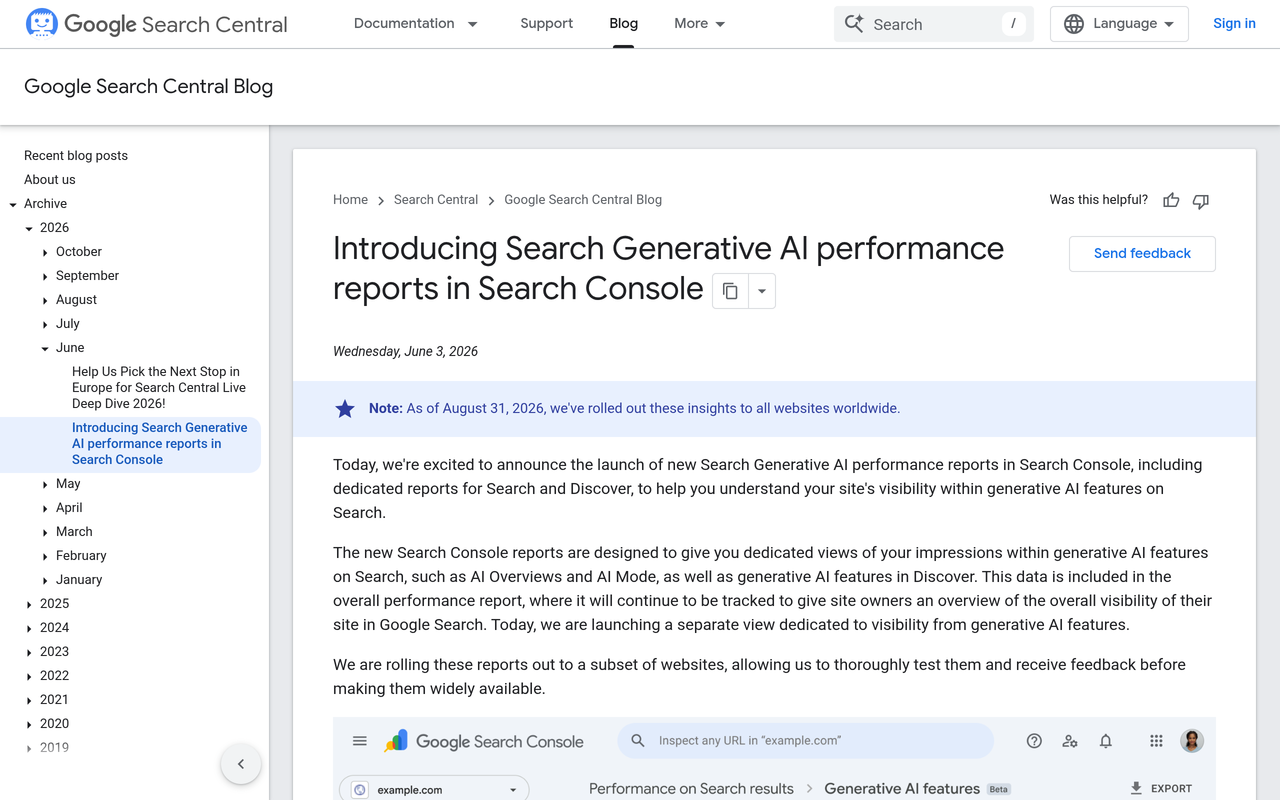
Action: Do two checks. First, re-run 10 of your prompts by hand in the engines your buyers use and compare against the tool. Second, compare the tool's Google data with Google Search Console's generative AI report.
Result: A short accuracy note listing agreement and any disagreements, with the cause of each.
Why: Google's own report is a useful anchor but a limited one. The Google Search Central Blog (June 2026) describes impressions and pages for AI features in Search and Discover. WebFX, in August 2026, notes the report shows impressions only, without clicks, and gives no information on which prompts triggered an appearance. That gap is exactly what a visibility tool should fill, and exactly where you should check it does so honestly. For a longer method, use How to Verify AI Search Tool Data Before You Trust It.
Step 5: Ship three to five changes, one at a time (days 10 to 20)
Action: Choose three to five recommendations the tool surfaces, such as rewriting a comparison page, fixing an outdated pricing statement, or adding a clear definition to a key page. Ship them one at a time, keep your own log of the date and the URL, and leave the prompt set unchanged.
Result: A change log you can line up against visibility share, and proof that the recommendations are specific enough to ship.
Why: A tool that tracks well but offers nothing to do is a reporting product, and your team will find out only after the contract starts. Changing several things at once makes it impossible to say what worked. GEO Experiment Design covers how to isolate a change, and AI Visibility Action Plan shows how to turn data into tasks.
Step 6: Run a variance test (days 20 to 27)
Action: Pick five prompts and record how many times your brand is named across a full week of daily runs. Note which weeks moved and by how much, then separate normal noise from a real change.
Result: A noise band for your category, for example "our share moves by a few points week to week without any change".
Why: Because repeated runs of the same prompt differ so often, a one-week rise may be noise. SparkToro's authors left open how many runs are needed for reliable data (Search Engine Journal, January 2026), so measure the variability in your own category and set your thresholds above it.
Step 7: Score the pilot and decide (days 28 to 30)
Action: Score each criterion from the charter as pass, partial or fail, using the go/no-go table below. Present the result to the decision owner with the change log and the accuracy note.
Result: A recorded decision: sign, extend by two weeks with named conditions, or stop.
Why: A scored decision protects you from the loudest voice in the room, and gives procurement a document to sign against.
What stakeholder checkpoints should a 30-day pilot include?
A 30-day pilot should include four checkpoints, each with a named owner and a decision. The table below shows who should be in the room and what they decide.
| Checkpoint | Who attends | Evidence on the table | Decision |
|---|---|---|---|
| Day 3: Setup gate | Pilot owner, SEO lead, procurement | Engines covered, prompt set loaded, baseline captured | Continue to paid plan, or cancel before billing starts |
| Day 10: Accuracy gate | Pilot owner, SEO lead, analytics lead | Manual spot checks, Search Console cross-check | Trust the data enough to act on it, or escalate to the vendor |
| Day 20: Action gate | Pilot owner, content lead, brand or PR lead | Change log, shipped tasks, early movement | Keep the action plan, or flag recommendations as too vague |
| Day 30: Decision gate | Decision owner, finance, security, SEO lead | Scorecard, noise band, reporting sample | Sign, extend with conditions, or stop |
Keep each checkpoint to 30 minutes. A repeatable agenda helps, and Weekly AI Search Review: A 30-Minute Team Agenda offers one you can adapt. Add security from the start: Enterprise AI Search Tools: Security and Scale Checklist lists what to ask in week 1 rather than week 4.
What does a worked pilot example look like with numbers?
The example below uses invented figures, built only to show the arithmetic. It is not a customer result and not a benchmark. The prompt-set size is a choice you make, and 13 is the number of engines Noma tracks.
Suppose a software brand freezes 40 prompts and tracks them on 13 AI engines, polled daily. That is 40 × 13 = 520 prompt-engine pairs per day, or 15,600 responses over 30 days. In week 1 the brand is named in 120 of the 520 daily pairs, a visibility share of 23.1% (120 / 520).
| Week (days) | Event | Pairs naming the brand (of 520, invented) | Share |
|---|---|---|---|
| 1 (days 1-7) | Baseline | 120 | 23.1% |
| 2 (days 8-14) | No change shipped; variance observed | 112 | 21.5% |
| 3 (days 15-21) | Comparison page rewritten on day 15 | 131 | 25.2% |
| 4 (days 22-30) | Pricing page corrected on day 22 | 148 | 28.5% |
Week 2 shows a drop of 1.6 points with no change shipped, which becomes the noise floor in this example. A rise of 5.4 points from the week 1 baseline to week 4 is larger than that noise, so the team can say the change is likely real but not proven. It then checks the cited URLs to see whether the rewritten pages are now the sources, which is stronger evidence than the share alone. The verdict depends on whether the charter said "a rise of at least 5 points above the noise band", and that is why the charter comes first.
What is the go/no-go table for the pilot decision?
Score each row as pass, partial or fail. Any fail on the first three rows stops the contract until the vendor resolves it in writing.
| Criterion | Pass | Partial | Fail |
|---|---|---|---|
| Data accuracy | Spot checks agree on at least 8 of 10 prompts; cited URLs real | 6 or 7 of 10, with explainable differences | Fewer than 6, or unexplainable results |
| Method transparency | Vendor explains polling, runs and prompt handling | Partial explanation | No clear method for the headline metric |
| Engine coverage | All priority engines tracked daily | One priority engine missing, on a roadmap | Several priority engines missing |
| Actionability | 3 or more changes shipped from recommendations | 1 or 2 shipped | Recommendations too vague to assign |
| Reporting | Weekly and monthly views usable by executives | Needs manual rework | Cannot export or share |
| Security and access | Passes your review | Open questions with dates | Blocked |
For the questions to bring to the final vendor call, use AI Search Visibility Software Demo: 10 Questions to Ask, and for contract terms afterwards, AI Visibility Software Contract Terms to Negotiate.
What is the checklist for the whole 30 days?
Follow this list in order. Tick each item before moving to the next.
- Write the one-page charter with owner, decision date, engines and pass lines.
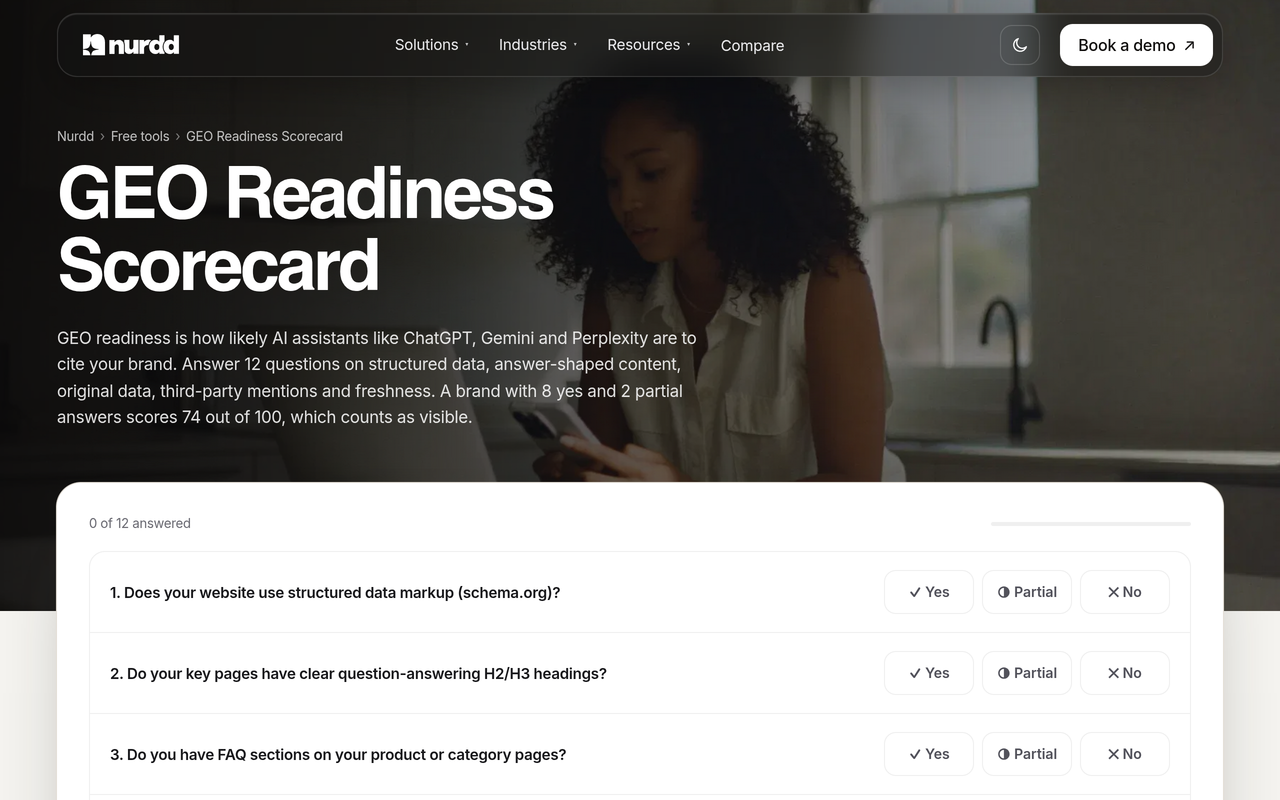
- Run a readiness check on your own site with the GEO readiness scorecard so the baseline reflects your starting point.
- Draft 40 to 60 prompts across the six groups and freeze them.
- List your main competitors and the engines your buyers use.
- Start the trial, load the prompts and capture the baseline by day 3.
- Hold the day 3 setup gate and decide whether to continue to the paid plan.
- Spot-check 10 prompts by hand and compare with the tool.
- Compare Google data with Search Console's generative AI report.
- Send your security and procurement questions in week 1, not week 4.
- Ship three to five changes one at a time and log each with its date and URL.
- Measure week-to-week noise on five prompts for a full week.
- Set up analytics so you can see referral traffic from AI engines (see AI Referral Traffic: How to Measure It in Analytics).
- Score the go/no-go table and write the decision on one page.
What mistakes make an AI search pilot fail?
- Starting without pass lines. Without them, the final meeting becomes an opinion contest.
- Changing the prompt set mid-pilot. You lose the ability to compare week to week.
- Reading one answer as truth. Given how often the same prompt returns different brand lists, one answer proves nothing.
- Ranking-position obsession. SparkToro's researchers, as reported by Search Engine Journal, questioned the value of "AI ranking position" and pointed to visibility across many runs.
- Testing only one Google surface. AI Mode and AI Overviews cite different sources much of the time.
- Skipping the cross-check. Search Console is free and gives an external anchor for Google data.
- Treating a proof of concept as a pilot. Reworked notes that data, information architecture and permissions in a proof of concept may not represent production (Reworked, November 2026). Use your real prompts, pages and competitors from day one.
- Forgetting billing. If the trial rolls into a paid plan on day 3, put the cancel-or-continue decision in the calendar.
How does Noma fit an enterprise AI search pilot?
Noma is built for exactly the visibility pilot described above. Noma, made by Nurdd at nomahq.app, tracks whether a brand appears in answers from 13 AI engines, including ChatGPT, Gemini, Perplexity and Claude, polled daily. It shows citation frequency by category, competitor comparison and recommendations for improving AI visibility, so one tool covers the baseline, citation sources and competitor comparison.
Want to see this for your own brand? Book a demo at nurdd.club/demo and we will walk through your prompt set, your competitors and the engines that matter for your category in Noma.
How Noma maps to the pilot:
- Day 1 to 3: the 3-day free trial covers setup and the baseline. A card is taken at signup, billing starts on day 3, and you are not charged if you cancel before then.
- Coverage: 13 engines polled daily means you do not need to run manual checks to fill gaps, although manual spot checks remain your accuracy test.
- Citation sources: Noma records whether a brand is named and which page each citation comes from, which is the evidence you need to link a shipped change to a result.
- Actions: recommendations help turn tracking into tasks, and you can score them in the day 20 checkpoint.
If your team wants help on the content and source side as well, Nurdd runs answer engine optimization as a managed service, measured in Noma. For a broader picture of the tools you may be comparing, see Best AI Search Visibility Tools 2026: 10 Compared, or read the background in What Is Generative Engine Optimization?
What should you do after the pilot ends?
If the result is a pass, move to a reporting rhythm. Use the pilot prompt set as your standing set, and build the monthly view described in AI Search Metrics: How to Build a Monthly Report. If the result is partial, extend for two weeks with named conditions, such as one more engine or one more verified accuracy check. If it fails, keep the charter and prompt set, because they let you test the next tool on the same terms.
Conclusion
A good enterprise AI search pilot is short, written down and hard to argue with. It uses a frozen prompt set, measures share across runs rather than rank in one answer, cross-checks against Google's own report and ends in a scored decision. Do that, and the contract conversation becomes about evidence.
Ready to run the pilot on your own brand? Book a demo at nurdd.club/demo and we will show you your own visibility across 13 AI engines in Noma, your competitors in the same answers and the pages being cited, so you can write your charter with real data.
How we researched this
We reviewed the top-ranking articles for the primary keyword, including enterprise search proof-of-concept guides from Earley, Reworked, HSO and GoSearch, and noted that they focus mainly on employee-facing search. We then reviewed primary and industry sources on AI answer variability, Google AI feature coverage and Google's own reporting. All sources were checked on the publication date of this post. We did not run a hands-on trial for this article, and the worked example uses invented figures to show the arithmetic.
Frequently asked questions
How do I run a proof of concept for an AI search tool?
Write a charter with success criteria, freeze a prompt set of 40 to 60 prompts, take a baseline, cross-check the tool against manual checks and Search Console, ship a few changes, then score the result. Hold checkpoints at days 3, 10, 20 and 30. The seven steps above give the action, result and reason for each stage.
What should an enterprise AI search pilot measure?
Measure data accuracy, engine coverage, visibility share across many runs, citation sources, the number of actions you actually ship and operational fit, including security. Share across repeated runs is more reliable than a single rank, according to SparkToro's research reported by Search Engine Journal in January 2026.
How long should an AI search pilot last?
Thirty days is enough to capture a baseline, ship a few changes and see a trend, while staying short enough to keep attention. Employee-search vendors such as Earley also describe 30-day proofs of concept. If the data is noisy, extend by two weeks with named conditions rather than starting again.
How many prompts do I need for the pilot?
A set of 40 to 60 prompts across six groups is a workable size for most teams. It is large enough to cover discovery, comparison, problem, branded, alternatives and risk queries, and small enough to review by hand. The right number for your category depends on how many distinct buyer questions you have.
What is the difference between a proof of concept and a pilot?
A proof of concept tests whether the idea works in a controlled setup, while a pilot tests it with real users and real conditions. Reworked warns that a proof of concept may not reflect production data and permissions. For visibility tools, use your real prompts and competitors from the start so the two blend.
Can Search Console replace an AI visibility tool in the pilot?
No, but it is a useful cross-check. Google's report covers impressions and pages in AI features on Google, and WebFX notes it shows no clicks and no prompts. It does not cover ChatGPT, Perplexity or Claude, so you still need a tool for those engines.
Does Noma have a free trial for the pilot?
Yes. Noma offers a 3-day free trial. A card is taken at signup and billing starts on day 3, so cancel before then if you do not want to continue. Use the three days for setup, the baseline and the day 3 checkpoint.
How do I book a demo to plan my pilot?
Go to nurdd.club/demo. In the demo, you will see how Noma tracks your brand and competitors across 13 AI engines, which of your pages are cited, and how a pilot prompt set would be set up for your category.