Influencer Marketing
How to Find Automotive Influencers and Vet Them
A step-by-step method for finding car, bike and EV creators and vetting audience quality, claims, disclosure and local fit before you sponsor anyone.
 Sheetal Shakshi16 Nov 202618 min read
To find automotive influencers, search car, bike and EV content by platform and topic, build a longlist of 15 to 30 creators, then score each on audience authenticity, claim accuracy, disclosure habits and local fit before paying. Nia by Nurdd runs discovery from 10M+ creator profiles and checks followers with TruAI before you agree a rate.
To find automotive influencers, search car, bike and EV content by platform and by topic (reviews, builds, ownership), build a longlist of 15 to 30 creators, then vet each one before you pay: audience location and authenticity, comment quality, claim accuracy, disclosure habits and local fit. Nia by Nurdd puts discovery and vetting in one workflow.
Key takeaways
- Split the niche first: a car reviewer, a motorcycle rider and an EV explainer attract different buyers, so write one audience sentence per vehicle type before you search.
- Build the longlist from three routes (platform search, a marketplace or discovery tool, and lookalike creators), then cut it with a scored checklist, not a follower count.
- Vet audience quality with engagement against a published benchmark for the creator's tier, comment reading and a fake follower check. Never rely on one signal.
- Check claims: ask for proof of use, test conditions and a corrections history, because vehicle content makes statements about safety, range and performance.
- Check local fit for dealers and service brands: a creator whose followers live outside your trade area cannot send showroom traffic.
- Agree disclosure and tracking in the brief before money moves, and give each creator a unique code or link.
Why is finding automotive influencers harder than in other niches?
Cars, bikes and EVs are high-consideration purchases, so viewers research for a long time and ask harder questions than a snack or beauty audience does. Later, in its automotive influencer guide, describes long-form reviews, comparisons and ownership updates as the formats that give buyers the depth they need. That is why creators with real technical credibility matter more here than polished clips.
Three things make the niche awkward. First, a lot of car content is entertainment (revs, drifts, supercar spotting) that earns big numbers but carries little buying intent. Second, buyers are often local, because a dealer, a charging network or a service chain only serves a trade area. Third, the content makes factual claims about range, torque, safety and running costs, so a careless creator becomes your problem.
The vetting steps below address all three. They run in a fixed order so you drop weak candidates early and spend your attention on the few who pass. For a wider view of the same method across niches, see our guide to how to pick an influencer marketing platform.
What do the top guides cover, and what does this one add?
Before writing this, we read three pages that rank for the topic. Modash's guide to finding car influencers walks through searching Instagram hashtags, TikTok, YouTube (using the recommended-videos sidebar), Google roundups and AI assistant prompts, and explains where to find a creator's email. Later's automotive strategy guide covers vetting for audience fit, credibility and trade-area overlap, and flags creators who will not share analytics and sudden follower spikes as red flags. MakeInfluence's dealership guide explains that a dealer targets one local catchment area and measures showroom visits and booked test drives.
This guide covers the same ground (where to search, audience and geography checks, local focus) and adds four things you can use directly: a 100-point scoring table, a seven-question claims checklist, a disclosure review routine, and a worked example with arithmetic you can check.
How do I find automotive influencers, step by step?
The eight steps below take you from a blank page to a signed brief. Each step names an action, the result you should have, and why it matters.
Step 1: Define the vehicle segment and the buyer
Action: write one sentence per segment saying who buys and what they want to learn. Result: a search brief you can paste into any tool. Why: a creator who works for a motorcycle accessory brand rarely works for an EV charger brand, even though both sit under automotive.
| Segment | Creator types to look for | What the audience wants | Typical brand fit |
|---|---|---|---|
| Cars | Reviewers, owner-diarists, detailers, mechanics, car-buying advisors | Honest ownership costs, comparisons, reliability | Dealers, tyres, insurance, accessories, care products |
| Motorcycles and bikes | Riders, touring vloggers, gear testers, custom builders | Gear tests, route ideas, maintenance | Helmets, riding apparel, intercoms, tyres, service |
| EVs | EV owners, road-trip charging vloggers, home-charging explainers | Real range, charging experience, running cost | Chargers, apps, leasing, utilities, EV accessories |
| Performance and modification | Tuners, track-day creators, build channels | Parts that hold up, install walkthroughs | Parts, tools, tyres, fluids, wheels |
| Service and aftercare | Local garages, DIY maintenance channels | Trust, price transparency, how-to | Service chains, tools, oil, batteries |
Writing the segment sentence first is how you filter out entertainment-only clips. It also tells you which platform to start on: long ownership reviews live on YouTube, quick fitment and build clips on Instagram and TikTok.
Step 2: Build a longlist from three routes
Action: collect 15 to 30 candidates using platform search, a marketplace or discovery tool, and lookalikes. Result: a sheet with handle, platform, segment, location and one sample link each. Why: any single route has blind spots, and mixing them catches both established names and smaller specialists.
- Platform search. Use car, bike and EV keywords and hashtags on Instagram, TikTok and YouTube, and sort by recent so you see creators who still post. Add your city to a Google search for local car creators, as Modash suggests, and mine the roundups for profiles.
- Marketplaces and discovery tools. Collabstr's automotive micro-influencer page is an example of a marketplace that lets you browse creators by platform and niche. Discovery databases go further and let you filter by audience location and engagement.
- Lookalikes. Start from a creator whose audience you already like, then use suggested-account rows or a lookalike search to branch out. Read the comments on that creator's posts to spot active followers who run their own channels.
Nia by Nurdd searches a database of 10M+ creator profiles across Instagram and other platforms. You can filter by niche, audience quality, engagement authenticity and brand match score, which suits this step because the filters map to the vetting that follows. Read how to evaluate influencer discovery software if you are comparing tools, or the influencer discovery vendor scorecard.
Step 3: Vet audience quality with three signals
Action: for each candidate, check engagement against a benchmark, read recent comments, and run a fake follower check. Result: a pass, review or reject mark for audience quality. Why: follower count is the easiest number to inflate, and regulators have started to act on fake influence.
The US Federal Trade Commission's August 2024 announcement of its final rule on fake reviews and testimonials states that the rule prohibits selling or buying fake indicators of social media influence, such as followers or views generated by a bot or hijacked account. The FTC's questions and answers on the rule add that the buying provision is limited to indicators you knew or should have known to be fake. For a brand, the practical point is that paying a creator on inflated numbers is both a business risk and a possible compliance risk, so check before you pay.
Signal 1, engagement against a benchmark. Work out engagement rate and compare it with a recent published benchmark for the creator's tier. Benchmarks differ by source, platform and how they define engagement, and general medians are not automotive ones, so treat any figure as a rough yardstick and note which source you used. Nurdd's marketing benchmarks hub lists headline figures with their sources and periods, and the Instagram engagement rate calculator does the arithmetic.
Signal 2, comment reading. Open the last ten posts and read the comments. Real car audiences ask about trim levels, tyre sizes, battery degradation or fitment. Red flags are strings of emoji, generic praise such as "nice pic", and the same few accounts commenting everywhere. Later also lists a creator who is reluctant to share analytics, and follower spikes with no content to explain them, as warning signs. Our guide to fake follower red flags in comments and growth lists patterns to look for, and engagement pods and bought engagement explains why some high engagement is manufactured.
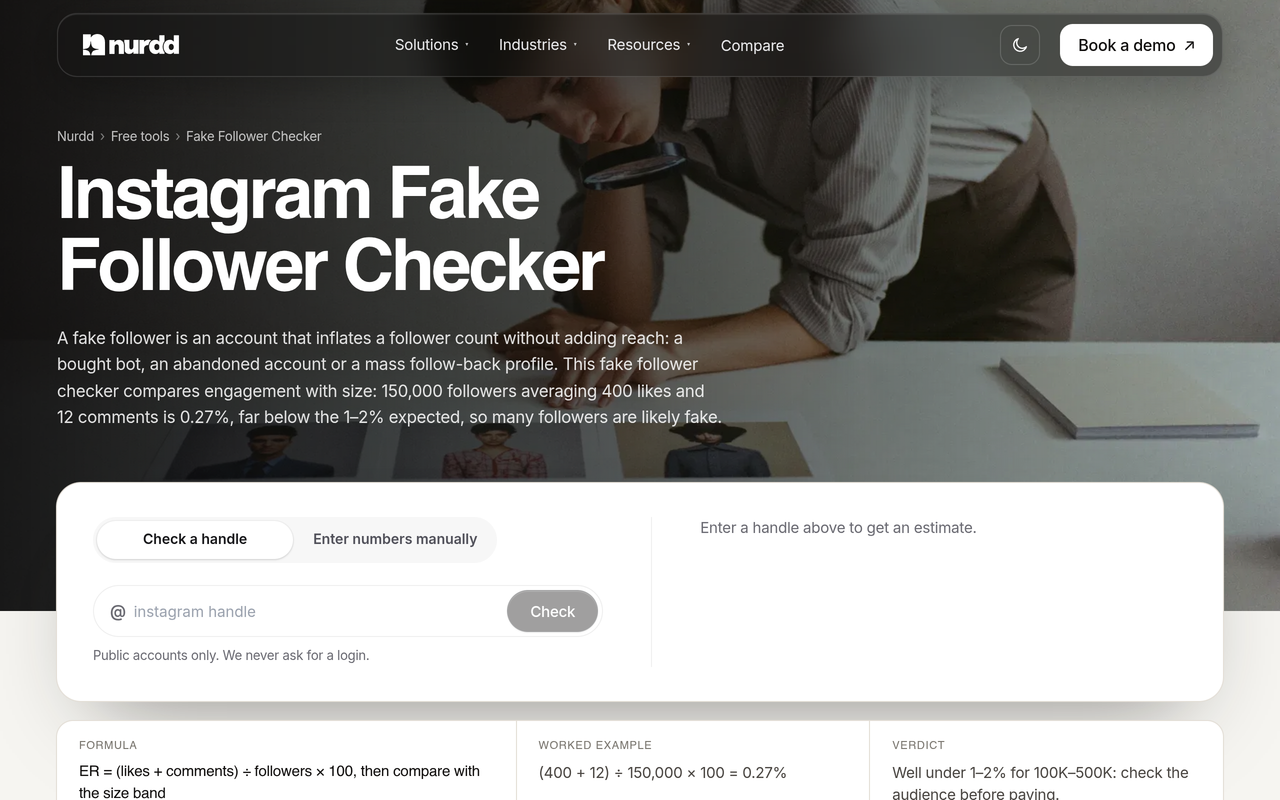
Signal 3, a fake follower check. Run the account through the free Instagram fake follower checker, which estimates fake or inactive followers from engagement. Inside Nia by Nurdd, each shortlisted creator is scored with TruAI, Nurdd's fake follower detection technology, before a rate is agreed. The fake follower audit checklist gives a longer manual routine, and best fake follower checkers compared by method shows how the tools differ.
Step 4: Verify claims, expertise and proof of use
Action: watch two long videos and three short posts per candidate, then ask for proof where claims are made. Result: a note on whether the creator tests what they say and corrects mistakes. Why: a vehicle creator who gets range, safety or fitment wrong damages the brand that sponsored the post.
Use this claims checklist on every shortlisted creator:
- Does the creator show the vehicle, part or bike being used over time, not only unboxed or on a press drive?
- Are test conditions stated (distance, temperature, load, road type) when range, economy or performance figures are quoted?
- Does the creator separate opinion from measurement, and say when something was supplied free?
- Do pinned comments or later videos correct errors, and is there a visible history of doing so?
- Are safety claims limited to what manufacturers or regulators have published?
- Has the creator promoted competing products in the last 90 days, and were those clearly marked?
- Can the creator supply proof of ownership, such as a registration photo with the plate hidden, a service record or a charging history screenshot?
For EV creators, ask how they measure range and cost per mile or kilometre. For motorcycle creators, ask what training or riding experience stands behind safety-gear advice. If a brief requires a statement your own legal team has not substantiated, tell the creator not to make it, because the advertiser can be responsible for misleading endorsements.
Step 5: Test local and regional fit
Action: ask each creator for audience location data and compare it with your trade area or sales markets. Result: a share-of-audience figure for the places you actually sell in. Why: MakeInfluence describes dealer campaigns as aimed at one catchment area and measured by showroom visits and test drives, and Later names trade-area overlap in its vetting heading.
Request the audience country and city breakdown from the creator's native analytics, taken within the last 30 days and shown as a screenshot. Compare it with your sales map. A national car channel with only a small fraction of followers in your region is a weak fit for a single dealer, while a local garage creator with a smaller audience can send more showroom traffic.
| Brand type | Fit test | Pass condition |
|---|---|---|
| Single dealer or service centre | Share of followers in the catchment area | A meaningful share lives within a normal drive of the site |
| Regional dealer group | Audience by city or state | The group's cities appear among the creator's top locations |
| National accessory or parts brand | Audience by country and shipping coverage | Top countries match where you ship and offer support |
| EV charger or energy brand | Home type and market regulation | Audience lives where your product is installable and legal |
A pass condition here is a decision you make yourself, because there is no published universal threshold. Write yours into the scorecard before you look at candidates so you are not tempted to relax it for a big name.
Step 6: Check disclosure habits and legal fit
Action: review how the creator discloses paid and gifted content, and write disclosure into the brief. Result: a creator who labels clearly, plus a brief that sets the rule. Why: unclear sponsorship is the quickest way to turn a good campaign into a complaint.
The US Federal Trade Commission publishes Disclosures 101 for Social Media Influencers, a plain-language guide you can attach to the brief. If you sell outside the United States, check the advertising regulator in each market, because rules and wording differ.
Scroll a candidate's last 20 sponsored posts. Look for disclosures that appear before the "more" fold or on screen in video, not buried at the end of a hashtag block. A creator who never labels any promotion is either not being paid, or is hiding it. Ask which. For the contractual side, see what happens when an influencer you paid gets cancelled.
Step 7: Score each creator and set a price
Action: score every survivor out of 100 using the table below and price against published benchmarks. Result: a ranked list you can defend to a finance lead. Why: a written score reduces the pull of the biggest follower count and gives you a basis for negotiation.
| Criterion | Weight | Full marks when | Zero when |
|---|---|---|---|
| Audience authenticity | 25 | Engagement near or above tier benchmark, real comments, low fake estimate | Bought-looking comments or high fake estimate |
| Claim accuracy and expertise | 20 | Tests stated, errors corrected, proof of use supplied | Unsupported performance or safety claims |
| Local or market fit | 20 | Audience concentrated in your sales area | Audience elsewhere |
| Segment and content match | 15 | Content type matches your segment and buying stage | Entertainment only, no buying intent |
| Disclosure and brand safety | 10 | Clear labels, no recent controversy | Hidden sponsorship or risky history |
| Delivery and rate | 10 | Clear rate card, on-time history, usage rights agreed | Vague terms |
Treat anything under 60 as a reject, 60 to 74 as a paid test only, and 75 or more as a priority. These cut-offs are our own framework, not an industry standard, so adjust them to your risk tolerance. Authenticity, claims and local fit carry 65 of the 100 points because they are the three things you cannot fix after the contract is signed.
For pricing, OpenSponsorship's 2026 pricing data (published July 2026) puts the median paid cost per deliverable at $134 for nano creators and $2,727 for mega creators, based on completed paid campaigns on its marketplace. The influencer rate card estimator gives rates by tier and format, and the rate card negotiation guide shows how to read a creator's quote.
Step 8: Brief, track and attribute
Action: give each creator a unique code, link or booking phrase, then record outcomes per creator. Result: a per-creator view of test drives, leads or sales. Why: a car is often bought at a dealership, so there is no click-to-purchase path, and a code or booking phrase is the simplest way to link a visit to a creator.
Nia by Nurdd forecasts expected return before anyone is briefed, then attributes product-level sales to specific creators after campaigns close. If you track by hand, our UTM naming guide for influencer campaigns and the guide to tracking sales by creator cover the setup. The influencer ROI calculator projects revenue and ROAS from a creator budget.
What does a worked vetting example look like?
This example is illustrative. Both creators are invented, and the interaction counts are round numbers chosen for easy arithmetic, not data from real accounts. The reference engagement rates (2.0% for nano and 1.0% for micro) are assumptions for the example only; in practice, use a recent published benchmark and note its source.
| Check | Creator A (EV road trips, nano tier) | Creator B (car reviews, micro tier) |
|---|---|---|
| Followers | 8,000 | 60,000 |
| Average interactions per post (likes plus comments, last 12 posts) | 200 | 360 |
| Engagement rate | 200 / 8,000 = 2.5% | 360 / 60,000 = 0.6% |
| Assumed reference rate for the tier | 2.0% (nano) | 1.0% (micro) |
| Reading | Above the reference, in range | Well below the reference, ask for more evidence |
| Comments | Questions about charging stops and cost | Mostly emoji, repeating accounts |
| Local fit | Most followers in your market | Mostly abroad |
Now apply the scoring table. Creator A: authenticity 22 of 25, claims 16 of 20, local fit 18 of 20, segment match 12 of 15, disclosure 8 of 10, delivery 7 of 10, which sums to 83 and a priority rating. Creator B: authenticity 8, claims 10, local fit 4, segment match 8, disclosure 6, delivery 7, which sums to 43 and a reject.
Creator B has 7.5 times the followers and still scores lower, because the engagement gap, the comment pattern and the audience location all point the same way. A brand on a limited budget would pay Creator A first, run a code-tracked test, and only reconsider Creator B after asking for 30 to 90 days of Insights screenshots. The OpenSponsorship nano median of $134 per deliverable is a reference point for opening the negotiation with Creator A, not a quote.
Note the limits of the method. Engagement against a benchmark is a signal, not a verdict, and a creator who posts rarely or in a different format can look odd for good reasons. That is why the comment reading and claims checks sit next to it.
What are the green and red flags when vetting a car creator?
| Area | Green flag | Red flag |
|---|---|---|
| Audience | Shares analytics screenshots on request; steady follower growth tied to content | Hesitates to share analytics; sudden spikes with no content to explain them |
| Comments | Specific questions on trims, range, fitment | Emoji strings, generic praise, repeat commenters |
| Claims | States test conditions, corrects errors | Quotes performance or safety figures without a source |
| Disclosure | Labels paid and gifted posts up front | No label on any promotion |
| Local fit | Top cities match your trade area | Audience mostly in markets you do not serve |
What is a pre-payment checklist for car, bike and EV creators?
Use this ordered list for every creator before money moves.
- Write the segment and buyer sentence for the campaign.
- Collect 15 to 30 candidates from platform search, a marketplace or discovery tool, and lookalikes.
- Calculate engagement over the last 12 posts and compare it with a published tier benchmark.
- Read the last ten posts' comments for real questions and repeated accounts.
- Run a fake follower estimate and keep the result with the date.
- Request audience location data from the creator's analytics, dated within 30 days.
- Watch two long videos and three short posts and note any unsupported claims.
- Request proof of ownership or use for the vehicle or product category.
- Review 20 recent sponsored posts for clear disclosure.
- Score the creator out of 100 and apply your cut-offs.
- Agree rate, usage rights, deliverables, disclosure wording and approval steps in writing.
- Issue a unique code or link and set a review date.
How does Nia by Nurdd support finding and vetting automotive creators?
Nia by Nurdd is an AI-native creative studio with influencer marketing built in. It searches 10M+ creator profiles, filters by niche, audience quality, engagement authenticity and brand match score, scores followers with TruAI, forecasts return before spend and attributes sales to creators afterwards. It is priced below comparable plans, and it covers the discovery-to-attribution path described in steps 2, 3 and 8.
Want to see this on your own category? Book a demo at https://www.nurdd.club/demo and we will walk through a creator search for your vehicle segment, show how a shortlisted creator is scored, and show what the forecast and attribution views look like for your brand.
Nia is a separate product from Noma and Pulse, which Nurdd also makes. You can read the Nia overview or see the comparisons with other influencer platforms. If you need the whole campaign run for you, the influencer marketing agency service runs creator campaigns on Nia.
What are the common mistakes when sponsoring car influencers?
- Choosing on follower count. A large car channel with an audience in other countries adds views you cannot use. The scoring table puts local fit and authenticity ahead of size.
- Confusing entertainment with intent. Drift clips and supercar sightings draw viewers who will never buy. Ask about content that answers purchase questions.
- Skipping claims review. Range, safety and performance statements are factual claims. Review scripts and ask for proof before publication.
- Letting disclosure slide. Put the exact wording in the brief and check the first posts the day they go live.
- No tracking for offline sales. If a car sale happens at a dealer, you need booking codes or a way to match visits to creators. Otherwise you cannot tell which creator mattered.
- Hiring the same creators every time. Our post on why brands keep hiring creators who never deliver covers how to break that loop.
Which role-specific questions come up for each team?
The method is the same, but each role reads the results differently.
- Dealer marketing manager: weight local fit higher, ask for city-level audience data and run booking codes. See the auto services industry page for context.
- EV accessory or charger brand: weight claims accuracy higher, since range and charging statements get checked by informed viewers.
- Motorcycle gear brand: weight expertise and safety claims higher, and check that riders show gear in real use.
If you run several brands or dealers, the multi-brand industry page explains how teams handle shared creator lists. For measurement across the whole campaign, start at the influencer marketing measurement hub.
How we researched this
We reviewed competitor guides on finding and working with automotive creators, the US Federal Trade Commission's published announcement and questions and answers on its final rule on fake indicators of influence, its influencer disclosure guide, a creator marketplace page, and OpenSponsorship's published pricing data. We read the pages on the publication date and checked quoted figures against them. We did not run hands-on tests of rival tools, interview creators or use customer data, and the two creators in the worked example and their reference rates are invented for illustration. Legal points are general information, so check your own markets with counsel.
Frequently asked questions
How do I find automotive influencers?
Search car, bike and EV keywords and hashtags on Instagram, TikTok and YouTube, then add creators from a marketplace or discovery tool and from lookalike searches. Aim for 15 to 30 candidates. Nia by Nurdd lets you filter a 10M+ profile database by niche, audience quality and brand match score.
How do I vet a car influencer before sponsoring?
Check engagement against a tier benchmark, read recent comments, run a fake follower estimate, request audience location data, review claims and proof of ownership, and check disclosure on past sponsored posts. Then score the creator out of 100 so the decision is written down before you pay.
How many followers should an automotive influencer have?
There is no single right number. Smaller creators often have tighter local audiences, while larger ones give reach. Pick the tier that fits your goal, and use the scorecard, not the follower count, as the deciding factor.
How much do automotive influencers charge?
Rates vary by tier, format and usage rights. OpenSponsorship (July 2026) reports median paid costs per deliverable of $134 for nano and $2,727 for mega creators. Use the free rate card estimator for figures by tier and format.
How can I tell if a car creator's followers are real?
Compare engagement with a published benchmark for their tier, read comments for real vehicle questions, and run a fake follower estimate. No single check is conclusive, so combine them. Inside Nia by Nurdd, TruAI scores each shortlisted creator before a rate is agreed.
Do car influencers have to disclose sponsorships?
In the United States, the Federal Trade Commission expects a clear disclosure of material connections such as payment or free products, and publishes a plain-language guide for influencers. Rules differ by country, so check each market you advertise in.
How do I measure results when the sale happens at a dealership?
Use unique booking codes or a dedicated phone number, and record the code used at booking so you can match it to the creator. This works because there is no click-to-purchase path to track.
How much does Nia by Nurdd cost?
Nia is priced below comparable plans. To see how it works on your own vehicle segment, book a demo at nurdd.club/demo.
Next step: see your own creator shortlist
Book a demo at https://www.nurdd.club/demo and bring your vehicle segment and market. You will see a Nia by Nurdd creator search for your category, the fake follower and engagement scoring on real profiles, and how pre-spend forecasting and sales attribution work for your campaign.