Influencer Marketing
Traackr Alternatives: What to Compare Before Switching
A criteria-first guide to Traackr alternatives: what to compare on discovery, vetting, reporting and contracts, and where Nia by Nurdd fits.
 Simran Rawat15 Nov 202618 min read

Good Traackr alternatives are the platforms that fix whichever problem is pushing you out, so compare every candidate on discovery depth, vetting, reporting and contract terms, then test it on your own creators. Nia by Nurdd is one option for brands that want discovery, TruAI fake follower detection, pre-spend ROI forecasting and sales attribution in one place, priced below comparable plans.
Good Traackr alternatives are the platforms that fix whichever problem is pushing you out of your current tool: discovery that misses the creators you want, vetting you cannot trust, reporting that does not reach finance, or contract terms that lock you in. Compare every candidate on those four criteria, then test it on your own creators. Nia by Nurdd is one option for brands that want discovery, fake follower detection, forecasting and attribution in one place.
This guide is a switching framework, not a ranked list of rivals. We do not publish rival prices or feature claims here, because those belong on each vendor's own pages. Instead you get the questions to ask, a scorecard to fill in, a migration checklist and a clear view of where Nia by Nurdd fits.
Key takeaways
- Write down why you are leaving before you open any vendor site. The reason decides which criteria carry the most weight.
- Judge every platform on four criteria: discovery depth, vetting, reporting and contract terms. Add migration effort as a fifth.
- Ask each vendor to run a live search and a live vetting check on creators you name, not on a prepared demo list.
- Get contract terms in writing before the demo ends: term length, renewal, data export and what happens to your creator records on exit.
- Export your creator records, campaign history and payment data before you cancel anything.
- Book a demo of Nia by Nurdd with your own creator shortlist to see how it scores them before you commit.
Why do brands look for Traackr alternatives?
Brands move off an influencer platform for a handful of reasons. Naming yours precisely is the most useful thing you can do, because a tool that solves a different problem will still disappoint you after you pay to migrate.
Common reasons include the following, framed as symptoms you can check in your own account:
- Discovery feels shallow. Searches return creators you already know, or the filters do not match how you brief (niche, audience quality, brand fit).
- Vetting is manual. Someone on your team still checks follower quality by hand, in spreadsheets or in a separate tool.
- Reporting stops at reach and engagement. Finance asks for sales by creator and the platform cannot answer.
- The contract no longer fits. The term, the seat count or the renewal terms were set for a different programme size.
- Too much platform for the job. A full-suite platform can be more than a lean team needs.
If none of these apply, switching may not be worth the effort. Fixing your briefs and measurement can deliver more than changing tools. If one or more apply, the criteria below tell you what to test.
What should I compare when switching influencer platforms?
Compare four criteria first: discovery depth, vetting, reporting and contract terms. Then add migration effort, because the cost of moving your data and your team's habits can outweigh the licence difference between two tools.
An influencer platform is worth switching to only if it improves a decision you make every week: who to hire, whether they are real, what to pay and whether it paid back.
That sentence is the test behind each criterion below. For each one you will see what to look at, what a weak answer sounds like and how to test it without relying on the vendor's demo script.
Criterion 1: Discovery depth
Discovery depth is how many creators the platform can surface, and how precisely it can filter them. Size of database matters less than whether the filters match your brief.
- Coverage. Which networks are searchable? Instagram only, or Instagram plus others you actually buy on?
- Filters. Can you filter by niche, audience quality, engagement authenticity and brand fit, or only by follower count and location?
- Freshness. How often are creator profiles refreshed, and can the vendor show the last refresh date for a creator you name?
- Lookalikes. Can you start from a creator who already worked for you and find similar profiles?
Test it: pick five creators you know well, including two niche ones, and ask the vendor to find them live and then find ten similar ones. If the platform cannot find creators you can already name, the database will not serve you.
Nia by Nurdd searches 10M+ creator profiles across Instagram and other platforms, and filters by niche, audience quality, engagement authenticity and brand match score. Other vendors' database sizes should be confirmed on their own pages, and you should ask how many profiles are in your niche and region, not in total.
Criterion 2: Vetting and fraud checks
Vetting is how the platform tells you whether a creator's audience is real and relevant before you pay. This is the criterion where manual workarounds pile up, so it is the easiest to improve.
- Is a fake follower check built in, or is it a paid add-on or a separate tool?
- What does it use as evidence? Ask for the signals behind the score, such as engagement patterns and follower growth.
- Does the score appear at shortlist stage, before you agree a rate, or only after a contract?
- Can you export the vetting result for the creator file?
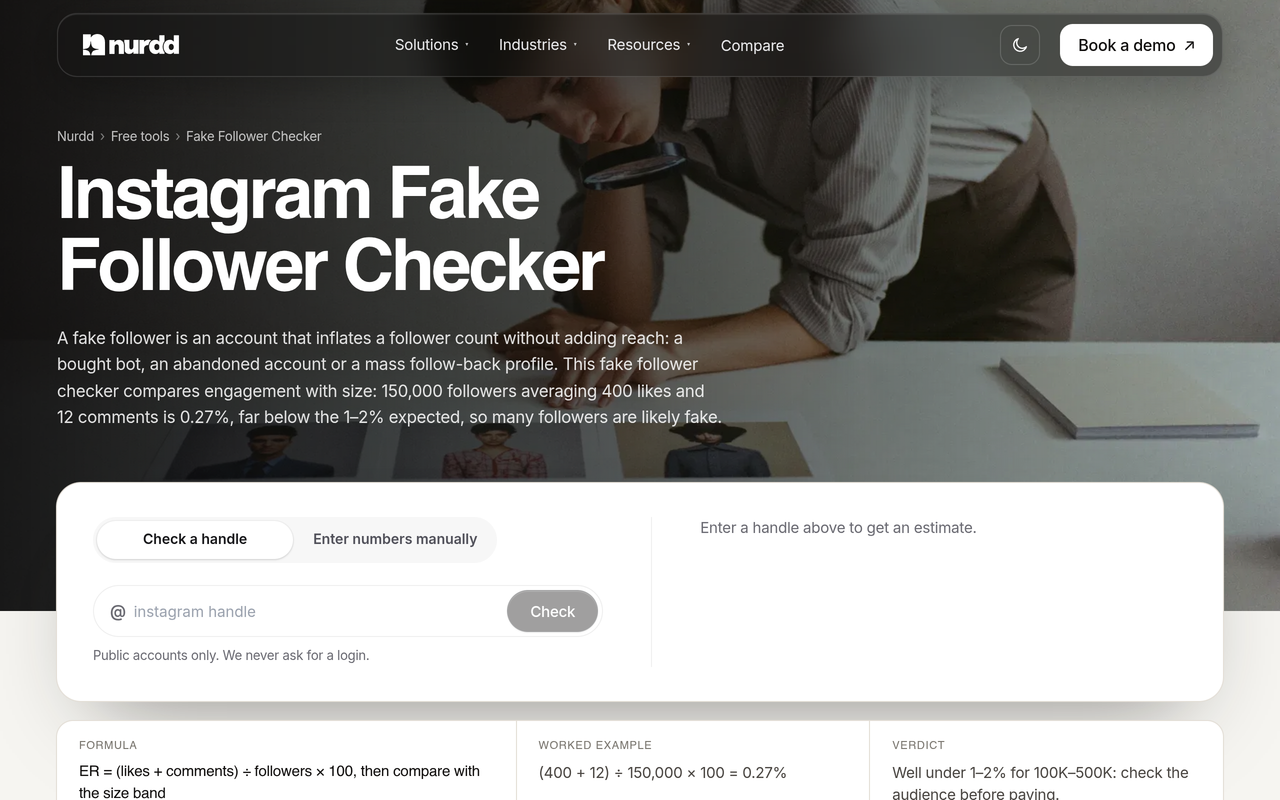
Test it: give the vendor one creator you already suspect and one you trust. A useful vetting layer should separate them and explain why. You can run a quick pre-check yourself with Nurdd's free Instagram fake follower checker and compare it with what the vendor reports, and our fake follower audit checklist covers the manual steps.
In Nia by Nurdd, every shortlisted creator is scored with TruAI, Nurdd's fake follower detection, before a rate is agreed. For a method-level comparison of tools, see Best Fake Follower Checkers 2026: Compared by Method.
Criterion 3: Reporting and measurement
Reporting is where a programme can stall. A platform can show impressions and engagement and still fail the question a CFO asks: which creators drove sales?
- Before spend: does the platform forecast return from a budget, or only report afterwards?
- During the campaign: are posts, links and codes tracked automatically, or do creators send screenshots?
- After the campaign: can you see sales by creator and by product, or only by campaign?
- Export: can you get raw data out, so your analyst or BI tool can use it?
Test it: ask the vendor to show a report built from one real, closed campaign, with the attribution method written out. Ask what the report cannot tell you, such as dark social or word of mouth. Our guides on influencer performance attribution and last-touch versus multi-touch attribution explain what to look for.
Nia by Nurdd generates pre-spend ROI forecasts, returning a projected revenue range with confidence scores from your budget, and attributes product-level sales to specific creators after campaigns close. You can test the forecasting logic with the free influencer ROI calculator, and our campaign ROI forecasting software scorecard lists what to ask any vendor.
Criterion 4: Contract terms
Contract terms decide how painful the next switch will be. They are the least glamorous criterion and are easy to skip in a demo.
- Term and renewal. Is it annual, monthly or multi-year, and does it renew automatically? What notice is needed?
- Pricing structure. Is the price per seat, per creator, per campaign, by database access or a mix? What counts towards a limit?
- Add-ons. Which features you saw in the demo sit in a higher tier or cost extra?
- Data ownership and exit. Can you export creator records, notes, content, contracts and payment history, in what format and at what point?
- Onboarding and support. Is implementation included, and who is your contact after the first month?
Test it: ask for the order form and the terms of service, not just a quote, and read the sections on renewal, termination and data return. Put the questions in writing so the answers are on record.
Criterion 5: Migration effort
Moving platforms means moving relationships. Creator records, past rates, usage rights and tracking links all have to come across, and live campaigns should not be interrupted midway.
- Which records can you export from your current platform, and in what format?
- Will the new platform import them, or will someone re-enter them?
- When does your current contract end, and can you overlap the two for one campaign cycle?
The same questions apply when moving AI visibility tools, which we cover in how to switch platforms without losing data. The principle holds across software categories: export first, cancel last.
How do the main Traackr alternatives compare?
The table below compares the criteria across the category rather than ranking named rivals, because rival features and prices should be read from each vendor's own pages on the day you buy. Use it as a blank scorecard: ask each vendor the same question and record the answer.
The Nia by Nurdd column uses only what Nurdd publishes about its product.
| Criterion | What to ask every vendor | Nia by Nurdd |
|---|---|---|
| Discovery database | How many profiles in my niche and region? Which networks? | 10M+ creator profiles across Instagram and other platforms |
| Discovery filters | Can I filter by audience quality and authenticity, not just size? | Filters by niche, audience quality, engagement authenticity and brand match score |
| Fake follower detection | Built in or add-on? At shortlist stage? | TruAI, built in, applied to shortlisted creators before a rate is agreed |
| Pre-spend forecast | Do I see expected return before I brief anyone? | Pre-spend ROI forecast with a projected revenue range and confidence scores |
| Campaign management | Briefs, approvals, content and payments in one place? | Manages the full campaign workflow without needing an agency |
| Sales attribution | Sales by creator and product, or only by campaign? | Product-level sales attributed to specific creators after campaigns close |
| Creative production | Can the platform also make the content? | Makes product and UGC ads from a link, with real and AI creators in the same production |
The first table is a features view. The second table, below, covers commercial terms. Rival pricing is not reproduced here; collect it from each vendor's own pages or order form and date it.
| Commercial term | What to get in writing | Nia by Nurdd |
|---|---|---|
| Published price | Price in USD, what it covers, date quoted | Priced below comparable plans; see getnia.studio |
| Trial | Length, whether a card is taken, what is limited | Ask in a demo what you can see for your own brand |
| Term and renewal | Length, auto-renewal, notice period | Confirm in your demo and order form |
| Data export | Formats, timing, fees | Confirm in your demo and order form |
| Agency requirement | Is a managed service compulsory? | Runs the full campaign workflow without needing an agency |
Where a cell says to confirm, that is deliberate: we do not publish Nia plans or prices on this page, and any claim about a rival's terms should come from the rival's own order form.
How do I score Traackr alternatives step by step?
Use this seven-step process. Each step names the action, the result you should have and why it matters.
- Write the reason you are switching. Result: one sentence, such as "we cannot attribute sales to creators". Why: it sets your weights and stops a shiny demo from changing your priorities.
- Set weights for the five criteria. Result: five percentages that sum to 100. Why: a team leaving over reporting should weigh reporting highest, and the scorecard should show that.
- Build a test set of creators. Result: about ten creators, including known good, known bad and niche ones. Why: it lets you compare vendors on identical inputs.
- Run the same live tasks with each vendor. Result: a search, a vetting check and a report for each. Why: scripted demos can hide weaknesses that live tasks reveal.
- Score each answer from 1 to 5. Result: a filled scorecard per vendor. Why: numbers stop the loudest voice in the room deciding.
- Request the contract and read the exit clauses. Result: a list of renewal, termination and data return terms. Why: exit terms decide the cost of your next switch.
- Plan the migration before signing. Result: an export list and an overlap date. Why: it protects live campaigns and creator relationships.
Worked example: a weighted scorecard
The numbers below are illustrative and invented to show the method. They are not data about any real platform. A team switching mainly because of reporting might set weights of 35% for reporting, 25% for vetting, 20% for discovery, 10% for contract terms and 10% for migration.
| Criterion | Weight | Platform A score (1-5) | Platform B score (1-5) |
|---|---|---|---|
| Reporting | 35% | 3 | 5 |
| Vetting | 25% | 4 | 4 |
| Discovery | 20% | 5 | 3 |
| Contract terms | 10% | 2 | 4 |
| Migration | 10% | 3 | 3 |
Multiply each score by its weight. Platform A: 3 x 0.35 + 4 x 0.25 + 5 x 0.20 + 2 x 0.10 + 3 x 0.10 = 1.05 + 1.00 + 1.00 + 0.20 + 0.30 = 3.55. Platform B: 5 x 0.35 + 4 x 0.25 + 3 x 0.20 + 4 x 0.10 + 3 x 0.10 = 1.75 + 1.00 + 0.60 + 0.40 + 0.30 = 4.05. Platform A has the better discovery, but Platform B wins because this team weighted reporting highest. Change the weights and the answer changes, which is the point of writing them down first.
What is a decision table for choosing between platform types?
Not every alternative is another full relationship platform. Influencer software falls into a few types, and choosing the type before the vendor narrows the field quickly.
| If your main problem is... | Look at... | Why |
|---|---|---|
| Finding the right creators | Discovery-led tools | Search depth and filters matter most; check what happens after you find someone |
| Trusting creators' audiences | Platforms with built-in vetting | Fraud checks at shortlist stage save paid mistakes |
| Proving revenue | Platforms with forecasting and attribution | Finance needs sales by creator, not only engagement |
| Managing many creators and payments | Workflow and CRM-style platforms | Briefs, approvals and payments need one record |
| Making the content as well | A creative studio with influencer features | Production and creator management stay in one tool |
Nia by Nurdd sits in the last two rows and across vetting and forecasting. It is a creative studio with influencer marketing built in, so a brand that wants films, product ads and UGC ads alongside creator campaigns does not need a second tool.
Where does Nia by Nurdd fit among Traackr alternatives?
Nia by Nurdd is an AI-native creative studio, made by Nurdd, with influencer marketing built in. It is at getnia.studio, with iOS and Android apps listed under "Nurdd". See the Nia overview for the full feature list.
Nia by Nurdd covers the lifecycle in one sequence: discovery, TruAI fake follower detection, ROI forecasting, campaign management and sales attribution. Most marketplaces only help with discovery, whereas Nia covers the whole campaign. It is priced below comparable plans.
Nia by Nurdd is the choice for brands that want one tool to find creators, check their audiences, forecast return and attribute sales, without an agency in the middle. It also makes the creative itself, casting real and AI creators in the same production. The sensible way to judge it is a demo on your own shortlist.
Book a demo and bring five creators you are considering. You will see each one scored for audience authenticity, a projected revenue range for your budget and how attribution would be reported back to you.
How does Nia compare with specific rivals?
Head-to-head pages let you read the specific differences without rebuilding the comparison yourself. Check any rival claim against that company's own site before you act on it.
- Nia vs Traackr
- Nia vs CreatorIQ
- Nia vs GRIN and our GRIN alternatives guide
- Nia vs Upfluence and Nia vs Aspire
- Nia vs Modash and Nia vs HypeAuditor
For a wider view of the market, read Best Influencer Marketing Platforms (2026) and how to pick an influencer marketing platform. The compare hub lists every comparison in one place.
What should the vendor demo include?
A vendor demo is useful only if you control the inputs. Send the vendor your test creators and tasks a few days ahead, then ask them to work through the list live. This checklist is ordered, so you can follow it during the call.
- Search for a creator you already work with and show their profile, audience breakdown and authenticity result.
- Run a search for your niche and region and filter by audience quality, not follower count alone.
- Find ten creators similar to your best past performer.
- Show the vetting result for a creator you suspect has bought followers, and explain the signals.
- Enter a budget and show the forecast, including how the platform expresses uncertainty.
- Open a closed campaign report with sales by creator and the attribution method stated.
- Export that report and a creator list to a file you can open in a spreadsheet.
- Walk through the order form: term, renewal, seats, add-ons and exit.
Our influencer discovery and qualification vendor scorecard and discovery software evaluation guide expand on steps 1 to 4, and the free influencer rate card estimator helps you sanity-check rates a platform suggests.
What are the common mistakes when switching influencer platforms?
- Switching without naming the problem. A new tool will not fix a weak brief or missing tracking links.
- Judging on a scripted demo. Vendors can show their strongest creators and cleanest reports. Use your own test set.
- Treating the database size as the discovery score. A smaller database with better filters can serve a niche brand more usefully.
- Ignoring exit terms. Auto-renewal and limited export can make your next switch as painful as this one.
- Cancelling before exporting. Creator notes, rate history and usage rights are hard to rebuild.
- Moving mid-campaign. Switch between campaign cycles, and overlap contracts for one cycle if you can.
- Not reconciling attribution. Compare old and new reporting on the same campaign so you know whether differences come from the platform or from the method. See our UTM structure guide for influencer campaigns for tracking links that survive a platform change.
How do I migrate without losing creator relationships?
Treat migration as a small project with an owner and a date. This ordered checklist covers the steps in the sequence that avoids data loss.
- Check your current contract end date and notice period.
- List every record type you hold: creator profiles, notes, rates, contracts, usage rights, content, payment history and tracking links.
- Request an export of each and note the format.
- Ask the new vendor which records they can import and which need manual entry.
- Pick a quiet period between campaigns for the switch.
- Tell active creators about any change to briefs, portals or payment process before it happens.
- Run one small campaign on the new platform first, then compare its report with the old method.
- Cancel the old platform only after the export is verified and the first campaign has closed.
If you manage creator work alongside a CRM, our influencer marketing CRM integration guide shows how to keep records consistent between systems.

How does measurement change after you switch?
Measurement can shift after a platform change even when the campaigns do not. Different tools count conversions, windows and creators in different ways, so a lower or higher number may reflect method rather than performance.
Before you compare old and new results, write down the attribution window, the conversion event and what counts as a creator-driven sale in each system. For the wider picture of channels, see the influencer marketing measurement hub and our guide to calculating influencer campaign incrementality, which explains why platform-reported sales and true lift can differ.
Use the campaign benchmarker to check engagement and cost per engagement against published ranges, and the marketing benchmarks hub for current sourced figures. Keep a record of the baseline from your old platform so improvement is real, not a change in counting.
Which team type should choose which approach?
Different teams weight the criteria differently. Use the matrix below as a starting point for your weights rather than a rule.
| Team | Weigh most | Why |
|---|---|---|
| Lean in-house team with no agency | Workflow, forecasting, price | You need one tool that covers the lifecycle without extra staff |
| Brand burned by fake followers | Vetting | Audience quality checks before payment protect budget |
| Performance-led ecommerce brand | Attribution and reporting | Sales by creator and product decide the next brief |
| Large multi-market programme | Contract terms, data export, support | Scale makes exit costs and governance more important |
| Brand that also needs content | Creative production | One tool for films, ads and creators reduces handoffs |
Beauty, fashion and food brands can fall into the third and fifth rows; see Nurdd's pages for beauty, fashion and apparel and ecommerce brands. If you would rather hand the work to a team, Nurdd also runs creator campaigns on Nia as an influencer marketing agency service.
How we researched this
This guide is a criteria-based framework built from the categories that influencer platform buyers evaluate, and from Nurdd's published product facts for Nia by Nurdd. We checked the Nia details against Nurdd's own pages on the publication date.
We did not run hands-on tests of Traackr or any rival, and we did not interview customers. We deliberately do not state rival prices, feature lists or review scores here, because those must come from each vendor's own pages. The weighted scorecard figures are illustrative, invented to demonstrate the method, and are not data about any platform. Verify every rival claim on the vendor's website and in its order form before you decide.
Conclusion
The best Traackr alternative is the one that fixes your specific problem, and you find it by testing, not by reading a ranking. Name your reason for leaving, weight the four criteria, run live tasks on your own creators and read the exit terms before you sign.
If you want discovery, TruAI vetting, pre-spend forecasting and sales attribution in a single creative studio, Nia by Nurdd is built for that sequence. Book a demo and you will see your own shortlist scored, a forecast for your budget and how creator sales would be attributed.
Frequently asked questions
What are good Traackr alternatives?
Alternatives people consider include CreatorIQ, GRIN, Upfluence, Aspire, Modash and Nia by Nurdd. Which is good depends on your reason for leaving. Discovery-led tools, vetting-led tools and full-lifecycle platforms solve different problems, so score them against your own criteria.
What should I compare when switching influencer platforms?
Compare discovery depth, vetting, reporting and contract terms, then migration effort. Test each with your own creators and a closed campaign, and get renewal and data export terms in writing before you sign.
Is Nia by Nurdd an alternative to Traackr?
It can be, for brands that want discovery, fake follower detection, ROI forecasting, campaign management and sales attribution in one place. Nia by Nurdd also makes creative content. See the Nia vs Traackr page for the direct comparison.
How much does Nia by Nurdd cost?
Nurdd does not publish Nia plans on this page and describes Nia as priced below comparable plans. The practical way to judge it is to book a demo and review your own creator shortlist.
How do I check whether a creator's followers are real?
Look at engagement relative to follower count, follower growth patterns and comment quality, and use a dedicated detector. Nurdd's free fake follower checker gives a quick estimate, and TruAI in Nia by Nurdd scores shortlisted creators before a rate is agreed.
How long does it take to switch influencer platforms?
It depends on how much data you hold and how many campaigns are live. Plan for an export, a small pilot campaign and an overlap with your old contract, and ask the new vendor for an onboarding timeline in writing.
Should I switch platforms in the middle of a campaign?
Avoid it. Switch between campaign cycles so briefs, tracking links and payments stay consistent, and let live campaigns close on the old platform.
Can I keep my creator data if I leave a platform?
Only if the contract allows it. Ask about export formats, timing and fees before signing, and export creator records, rates, usage rights and payment history before you cancel.