Paid Media
AI Search Reporting for Paid Media Agencies: What to Add
Yes, a paid media agency should report on AI search. Here are the metrics to ask for, which ones are reliable, and how to read them next to ad data.
 Sheetal Shakshi12 Nov 202614 min read
Yes, your paid media agency should be reporting on AI search, because AI answers now influence which brands people search for and click, and standard ad reports cannot see that. Ask for four things: ad delivery inside Google's AI surfaces, citation and mention rates in AI answers, branded search lift, and AI referral traffic. Treat the first as platform data and the rest as directional.
Should my paid media agency be reporting on AI search? Yes, at a minimum. AI answers now sit between your ads and your buyers, and a report that covers only clicks, cost and ROAS cannot show whether your brand is being named in those answers. This guide sets out what to ask for, what is reliable, and what to ignore.
Key takeaways
- Ask your agency for one AI search page in the monthly report, not a new retainer. Four blocks are enough: ads in Google's AI surfaces, AI citations and mentions, branded search lift, and AI referral traffic.
- Google Ads reports ads shown in AI Overviews and AI Mode only in aggregate, and you cannot opt out of them separately, so do not expect a clean line item.
- AI referral traffic is still a small slice of visits, so judge AI search by brand mentions and branded demand, not by sessions alone.
- Citation and mention data is sampled, so ask your agency to state the prompts, the engines, the dates and the sample size every time.
- Keep AI visibility next to Meta and Google Ads results in one report so changes in one can be read against the other.
Why is AI search a paid media question at all?
AI search is a paid media question because the same people who see your ads are asking AI assistants which brands to trust. When an AI answer names three competitors and not you, your ads start every auction from behind. A paid team that reports only last-click results will credit the final ad and miss the earlier moment that shaped the choice.
Seer Interactive makes this argument directly in a Seer Interactive piece from June 2026: last-click models reward the final touchpoint, and AI search makes the missing attribution worse because the AI influence is invisible in the data. That is the core reason to add reporting rather than wait for a perfect measurement standard.
There is also a click-behaviour reason. A Pew Research Center analysis from July 2025 found that about 18% of the Google searches in its March 2025 study produced an AI summary, and 88% of those summaries cited three or more sources. Your brand either appears among those sources and in the text, or it does not.
What is hard about reporting on AI search from an ad account?
The hard part is that ad platforms were built to report clicks, and AI answers often produce no click. Three problems follow, and your agency should be able to explain how it handles each.
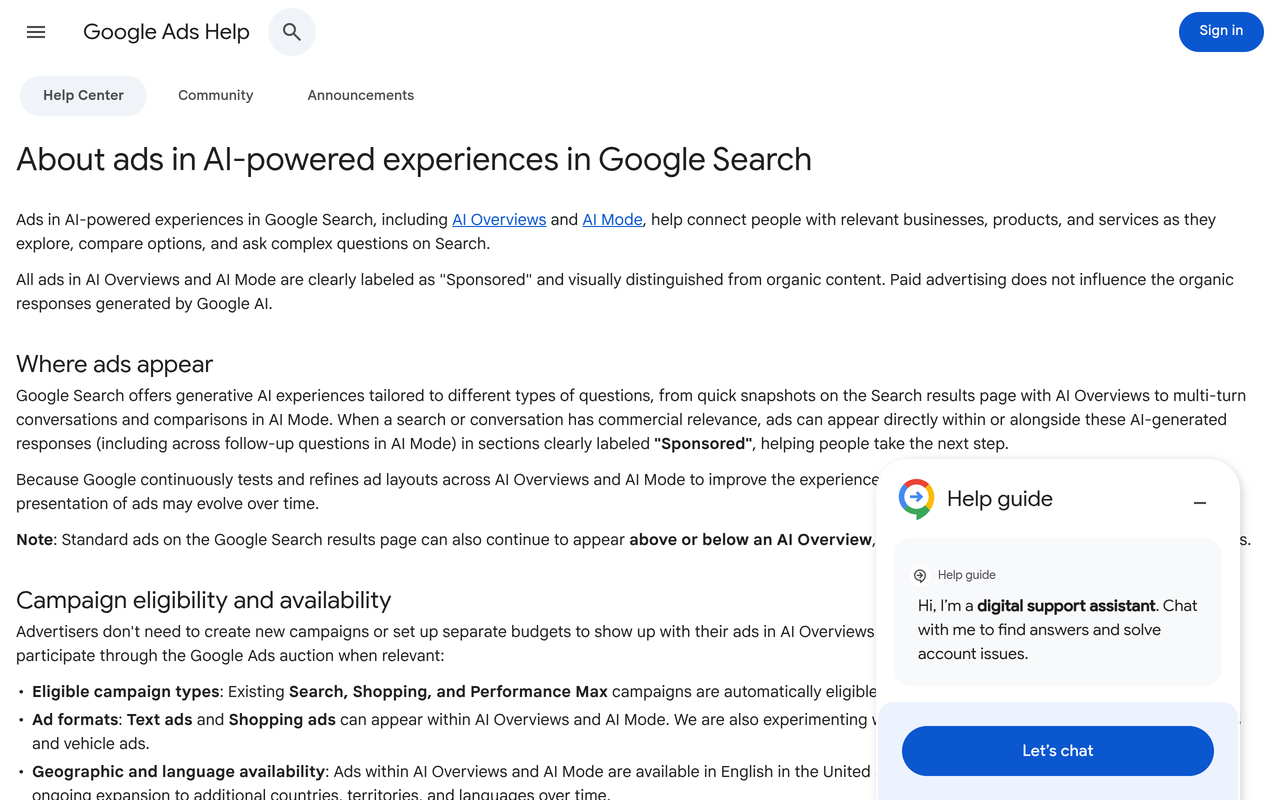
- No separate ad line. Google says performance for ads in AI Overviews and AI Mode is included in aggregate in standard campaign reports, and that advertisers cannot target those placements exclusively or opt out of them separately.
- Search terms hide the change. An analysis of more than 400 Google Ads accounts published by Search Engine Land in 2026 found AI search activity nearly invisible in search terms reports, even though Google says AI Mode queries are three times longer than traditional ones. The author notes the sample is performance-focused and may underrepresent informational queries.
- Referrers are patchy. CMSWire reports that AI Mode traffic blends into standard web search reporting and that referrer data often stays hidden.
The practical consequence is that no single dashboard answers the question. A good agency report combines ad platform data, Search Console data, analytics data and a separate AI answer tracker, and says clearly which numbers are exact and which are samples.
What AI search metrics should agencies include in ad reports?
Agencies should include metrics in four groups, each with a different level of certainty. The table below is a decision aid: it shows what each metric answers, where the data comes from, and how far to trust it.
| Metric | Question it answers | Data source | Reliability |
|---|---|---|---|
| Ad impressions, clicks, conversions and cost on eligible Google campaigns | Are my ads being served in AI-powered Search? | Google Ads campaign report | Exact, but not split by AI surface |
| Site impressions in AI Overviews and AI Mode | Do my pages appear in Google's AI answers? | Search Console generative AI report | Exact impressions; no click data as of the Search Engine Journal report |
| Mention rate and citation rate by engine | Does the brand get named or linked in AI answers? | AI visibility tracker | Sampled; depends on prompts and dates |
| Share of voice against named competitors | Who is recommended instead of us? | AI visibility tracker | Sampled |
| Branded search volume and branded click share | Is demand for our name rising? | Search Console, Google Ads, Google Trends | Exact but indirect |
| AI referral sessions and conversions | Do AI answers send buyers who convert? | Analytics referrer data | Undercounts; some AI visits arrive with no referrer |
| Paid ChatGPT ad results, if tested | Does a new ad surface perform? | OpenAI Ads Manager or partner | Platform-reported; early beta |
Notice that only the first two rows come directly from a platform. The rest are inference or sampling, which is fine as long as the report says so. A report that presents an AI mention rate as a precise figure, with no prompts listed, should be questioned.
Ads in AI Overviews and AI Mode
Ask your agency to confirm which Google campaign types are eligible, because Google's help page ties AI placements to eligible campaign types. Then ask what changed in impressions, conversion rate and cost per conversion after those placements started to serve. Since Google does not break these out, the agency should show a before and after view with the date, not claim a precise AI-only result.
Generative AI impressions from Search Console
Google launched dedicated Search Console reports on June 3, 2026, which isolate site impressions from AI Overviews, AI Mode and generative features in Discover, as CMSWire reported in June 2026. Search Engine Journal reports in 2026 that the reports have rolled out worldwide, group data by page, country and date, and do not include click data. Ask for pages and impressions, then compare them with the pages you push in paid campaigns.
One caution from Search Engine Journal's June 2026 explainer: an AI impression is not the same as a classic impression, because in AI Mode a follow-up question counts as a new query. Do not compare the two as like for like.
Citations and mentions in AI answers
A mention is your brand named in the answer. A citation is your page linked as a source. They are different: a brand can be cited and not named, or named without a link. Your agency should report both, by engine, for a fixed prompt set, and list the pages that earned citations. Our guide to which prompts to track for AI search visibility and the explainer on AI search share of voice show how to define the set.
Branded search lift
Branded search lift is the change in searches for your brand name over a period in which AI visibility or awareness spend changed. It is the closest thing a paid report has to an AI influence signal, because people often hear a brand in an AI answer and then search for it. Ask for branded impressions and clicks from Search Console, branded click share from Google Ads, and the dates of any campaign or content change. Lift is a correlation, so the report should say what else changed.
AI referral traffic
Ask for sessions and conversions from known AI referrers, split by engine. Set expectations first. SE Ranking's 2026 study reports that AI referral traffic reached 0.32% of total website traffic in 2026, up from 0.24% in 2025 and 0.02% in 2024, with ChatGPT accounting for 74.78% of that referral traffic. Our guide to measuring AI referral traffic in analytics covers the setup.
Should the agency report on ChatGPT ads too?
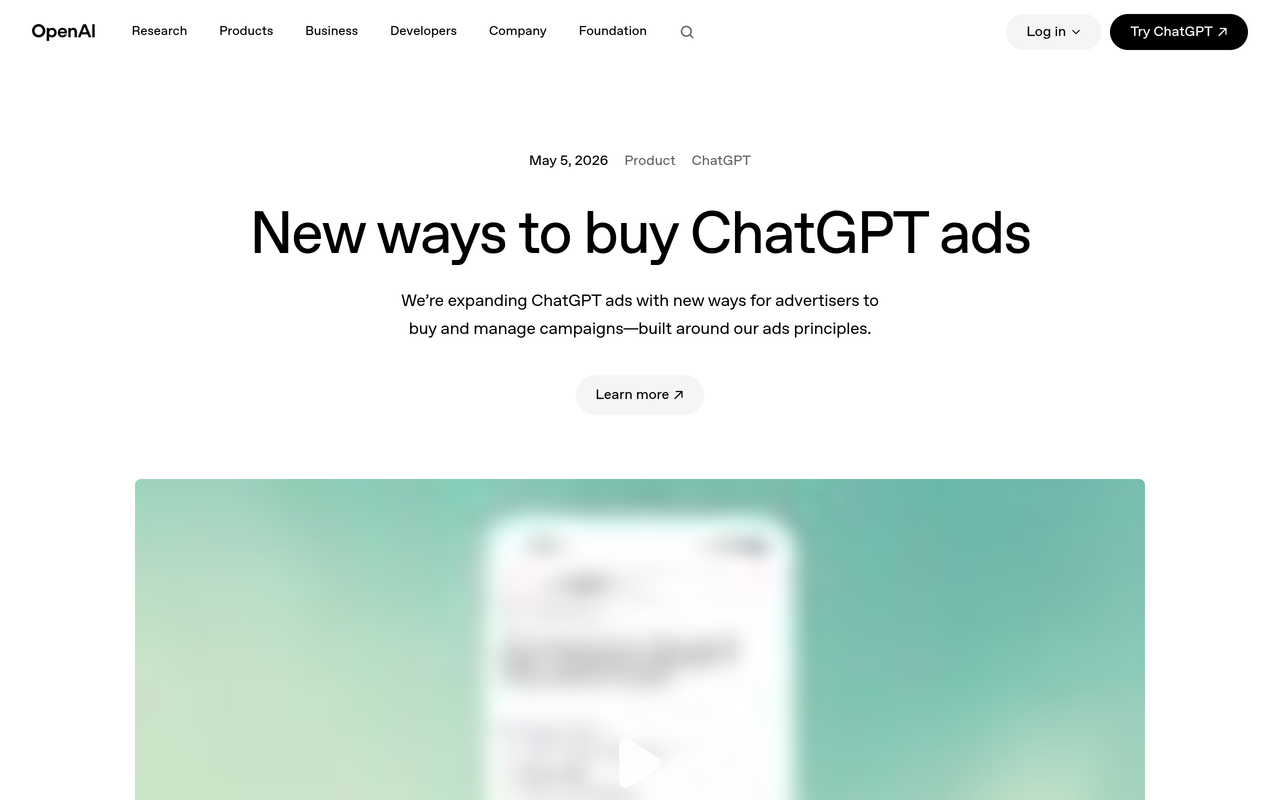
Only if you are testing them, and then separately from organic AI visibility. OpenAI describes its ads as clearly separate from ChatGPT's answers, so paying for an ad does not buy a mention in the answer. The company announced a beta self-serve Ads Manager, CPC bidding and enhanced measurement tools on its OpenAI announcement page, and noted the first phase of the pilot sold ads on a CPM basis.
Reach is still limited. CNBC reported in March 2026 that Sensor Tower estimated ads had rolled out to about 5% of ChatGPT mobile users, up from 1% at the start of that month. A fair report line is spend, impressions, clicks and conversions from the platform, labelled as a test. See our guide to advertising on ChatGPT and measuring results and the piece on AI search ads versus organic AI visibility.
How can you tell whether your agency's AI search report is any good?
A report is credible when you can repeat it. Use this checklist in your next review call. Each step produces something you can ask for in writing.
- Ask for the prompt list. The agency should send the exact prompts, grouped by buying stage. Result: you can see whether they reflect how your customers ask. Why: a mention rate is meaningless without the questions behind it.
- Ask which engines were checked and when. Result: a named list with dates. Why: answers change by engine and by day.
- Ask for the competitor set. Result: three to five named rivals tracked on the same prompts. Why: an absolute mention rate cannot show whether you are gaining or losing ground.
- Ask for the pages cited. Result: a list of URLs and third-party sources. Why: it tells you what content to improve and which outside sites matter.
- Ask for the Search Console AI impressions by page. Result: a table of pages. Why: it is exact data you can compare with the landing pages in your ads.
- Ask for branded search lift with the change log. Result: a trend line with dated events. Why: it separates a real shift from seasonality.
- Ask for one recommended action per finding. Result: a short list with an owner and a date. Why: a report with no action is a status update.
For a broader template, see our guides on AI search reporting for agencies and the monthly AI search metrics report.
What does a worked example look like?
Here is an illustration with arithmetic from a published figure, not a client result. Suppose a brand has 100,000 website sessions a month. At the 0.32% average that SE Ranking reports for 2026, AI referral traffic would be about 320 sessions. If the brand's ads drive most of its conversions, a report that tracks only those 320 sessions would call AI search irrelevant.
Now add the other blocks. The same report shows that the brand is named in some of the tracked prompts and a rival is named in more, that Search Console shows AI impressions for only a few product pages, and that branded search impressions are flat. The finding is not that AI search drives sales. It is that the brand is absent from answers its buyers read, and that paid media is not compensating for that.
The action is also specific: update the pages that earn AI impressions, add the missing comparison content, and test whether branded search moves over the next few months. Note the scale of the number: 320 sessions would be a poor reason to fund work, and a mention gap in buying-stage prompts is a good one.
How do Meta and Google Ads data fit with AI visibility data?
They fit by being reported side by side, with the same dates and the same product or category labels. The ad data tells you what you paid and what happened after the click. The AI visibility data tells you whether the brand was in the conversation before it. Neither replaces the other.
Here is a simple way to read the two together.
| What you see in ads | What you see in AI visibility | Likely reading | First action |
|---|---|---|---|
| Rising CPC or cost per result | Competitors named more often | You may be bidding for attention rivals already won | Audit pages and sources AI engines cite for the category |
| Stable ROAS, flat branded search | Low mention rate | Ads are harvesting existing demand, not adding to it | Plan content and third-party coverage, then watch branded lift |
| Falling click-through rate | Growing AI impressions in Search Console | More answers are resolved without a click | Shift targets to conversions and branded demand |
| Strong ROAS, strong mention rate | Rising branded search | Paid and AI visibility reinforce each other | Protect budget and keep the prompt set stable |
For the paid side of this table, our marketing benchmarks hub and the guide to reading Meta and Google Ads performance give published reference points. For the reporting layer that ties paid media to AI answers, see should a paid media agency report on AI search and paid media reporting for ChatGPT ads and AI Overviews.
How do Pulse and Noma cover this?
Pulse by Nurdd covers the paid side and Noma by Nurdd covers the AI answer side. They are two separate products, and a team can use either one alone. Pulse connects to Meta Ads and Google Ads through read-only OAuth, explains campaign performance in plain language, diagnoses what changed and recommends specific actions without needing a hand-built report. Noma tracks whether a brand appears in answers from 13 AI engines, including ChatGPT, Gemini, Perplexity and Claude, polled daily.
That split matches the table above. Pulse gives the ad-account half of the report: the cost, delivery and conversion changes that happen in Meta and Google Ads. Noma gives the half no ad account contains: citation frequency by category, competitor comparison, and recommendations to improve AI visibility.
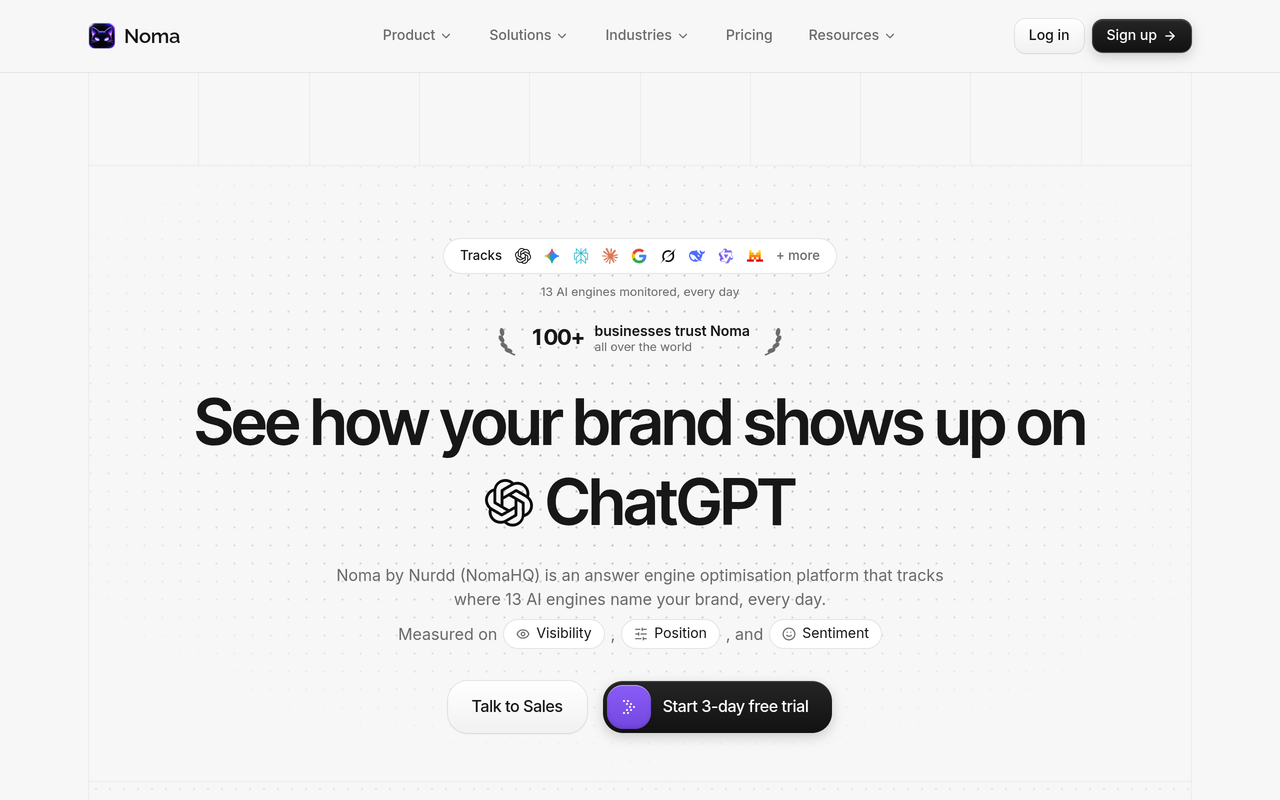
Pulse by Nurdd is the right starting point if your first problem is that nobody on the client side can read the Meta and Google Ads data your agency sends. It explains what changed in plain language, so you can ask better questions about the AI search page that follows. Noma by Nurdd is the right addition when the question becomes whether AI assistants recommend your brand when buyers ask category questions.
Book a demo at https://www.nurdd.club/demo and we will walk through your own Meta and Google Ads accounts in Pulse and show where your brand appears, or does not, in AI answers for your category.
Noma has a 3-day free trial. A card is taken at signup and billing starts on day 3, with no charge if you cancel before then. Pulse is paid and has no trial; it is in private access, so a walkthrough is the way in. You can read more on the Pulse page, and Nurdd also runs this work as a managed service through its answer engine optimization agency and paid social advertising agency services.
Which role needs what from the report?
The in-house marketing lead at a D2C brand
You need to know whether paid spend is masking a visibility gap. Ask for the mention rate on five to ten buying-stage prompts, the same rivals each month, and branded search lift beside ROAS. The ecommerce industry page shows how this applies to online stores, and the Google and Meta ROAS calculator lets you check break-even before you judge the ad numbers.
The founder or CFO of a SaaS company
You care about whether AI answers shape the shortlist before a demo request. Ask for AI referral conversions, branded search trends and a short list of cited pages. Do not ask for a precise attribution figure, because none exists yet. The SaaS industry page and the guide on SaaS content strategy for AI citations are useful starting points.
The agency account manager
You need one page you can defend. Keep AI visibility in a separate section from rankings and traffic, label sampled data, and attach a change log. The agencies industry page and the guide to AI search visibility checking software for agencies cover tool choices when you manage many clients.
What mistakes should you avoid?
- Treating AI impressions as classic impressions. They are counted differently, so keep them in their own line.
- Reporting a mention rate with no prompts. The number cannot be checked or repeated.
- Expecting AI search to show up in last-click. It rarely does, which is why branded lift and mention rate matter.
- Funding ChatGPT ads to earn organic mentions. OpenAI keeps ads separate from answers.
- Changing the prompt set every month. You lose the trend. Add prompts, but keep the core set fixed.
You can also check readiness yourself with the GEO readiness scorecard, and learn the terms in the guide to generative engine optimization.
How we researched this
We reviewed platform documentation, research institution publications and industry press, including Google's help documentation, Pew Research Center, OpenAI's announcement, CNBC, Search Engine Land, Search Engine Journal, CMSWire, Seer Interactive and SE Ranking. Sources were checked on the publication date of this article. We did not run hands-on tests, and we cite no customer data. Figures are quoted as the sources state them, and the worked example is arithmetic, not a measured result.
Frequently asked questions
Should my paid media agency be reporting on AI search?
Yes, as a short, separate section of the monthly report. It should cover ad delivery in Google's AI surfaces, citations and mentions, branded search lift and AI referral traffic. It does not need a new retainer to start.
What AI search metrics should agencies include in ad reports?
Include Google Ads performance on eligible campaigns, Search Console generative AI impressions by page, mention and citation rate by engine, share of voice against named competitors, branded search lift and AI referral sessions. Label which figures are exact and which are sampled.
Can Google Ads show me results from AI Overviews and AI Mode separately?
Not currently, according to Google's help page. Performance for ads in those placements is included in aggregate in standard campaign and search terms reports, and advertisers cannot target them exclusively or opt out of them separately.
Does Search Console show clicks from AI Overviews?
Its generative AI reports show impressions by page, country and date, plus a device breakdown in the Search report. Search Engine Journal reported they did not include click data as of publication, so check the current report before promising click figures.
How much traffic do AI engines actually send?
SE Ranking reports that AI referral traffic reached 0.32% of total website traffic in 2026. Your own share will differ, so read it from your analytics, and remember some AI visits arrive without a referrer.
Is branded search lift proof that AI search is working?
No. It is a signal that fits the pattern, but other campaigns, seasonality or PR can cause it. Ask your agency for a dated change log so any lift can be read against what else changed.
Do ChatGPT ads improve my organic AI mentions?
No evidence supports that, and OpenAI states ads are kept separate from ChatGPT's answers. Report ChatGPT ads as a paid test, with its own spend and conversion lines.
How do Pulse and Noma differ?
Pulse by Nurdd reads Meta and Google Ads data and explains what changed. Noma by Nurdd tracks whether your brand appears in answers from 13 AI engines. They are separate products and can be used together or alone.
Ready to see the full picture for your brand?
A paid report is stronger when ad results and AI answers sit on one page. Book a demo at https://www.nurdd.club/demo to see your own Meta and Google Ads data explained in Pulse and your brand's presence across AI engines in Noma, along with the pages and sources behind each mention.