Influencer Marketing
How to Find YouTube Creators for Product Reviews
A six-step method to find YouTube creators for product reviews, vet their audience and agree deliverables before you send a unit.
 Simran Rawat16 Nov 202619 min read

To find YouTube creators for product reviews, search YouTube for the questions buyers ask about your category, collect channels that already review similar products, then score each one on audience fit, review integrity and past sponsored work. Vet before you ship anything, and agree deliverables, disclosure and usage rights in writing. Nia by Nurdd supports the discovery and shortlist steps.
To find YouTube creators for product reviews, start where your buyers already search: type the questions they ask about your category into YouTube, note which channels answer them, and build a shortlist of reviewers who already cover products like yours. Then vet each channel on audience fit, review integrity and sponsored history before you ship a unit or agree a fee.
Key takeaways
- Search YouTube the way a buyer does ("best [category] for [use case]", "[competitor] review", "[product] vs") and collect every channel that keeps appearing.
- Score each channel on a written rubric before you contact anyone: topic match, review depth, audience fit, comment quality, sponsorship history.
- Read the comments and the older videos, not just the subscriber count. Views relative to subscribers and the quality of the conversation say more than reach alone.
- Check how the creator discloses paid and gifted content, because the brand shares the risk if the disclosure is missing.
- Agree deliverables, review independence, disclosure, usage rights and a fixed publish window in writing before the product ships.
- Use a tool for the repetitive steps (discovery, shortlist, fake-audience checks) and keep the judgement calls for yourself.
Why is finding the right YouTube reviewer harder than it looks?
A YouTube review is a long-form, searchable asset. People watch it to decide whether to buy, and it keeps working long after the upload date. That is exactly why the wrong reviewer is expensive: a video that misdescribes your product, buries it in a list of ten, or sits on a channel whose viewers will never buy in your category stays online for years.
YouTube says so itself. In its YouTube Blog, March 2026 announcement of YouTube Creator Partnerships (formerly BrandConnect), the company states that YouTube is the number one platform viewers turn to when they want to research, vet or decide about a brand or product, citing its own survey. It is a platform claim, so treat it as the vendor's framing, but it explains why review channels are a distinct buying channel and not just another social placement.
The difficulty is that the signals most brands use to shortlist (subscriber count, category tags, a polished media kit) are the weakest predictors of whether a review will move buyers. The method below replaces them with checks you can run from public evidence: what the channel reviews, how it reviews, who watches and how it handles commercial relationships.
How do you find YouTube creators for product reviews? (quick method)
- Write the buyer questions. List ten searches a buyer would type before purchasing your product type.
- Search YouTube and collect channels. Use search, competitor reviews, hashtags, related videos and creator partnership tools.
- Build a scored shortlist. Put every candidate in one sheet with the same columns.
- Vet the audience and the reviews. Read comments, compare views to subscribers, watch older videos and check for fake-audience signals.
- Check disclosure and independence. Look at how the channel labels paid and gifted content.
- Agree deliverables in writing. Fix format, review rights, disclosure, usage rights, timing and what happens if the video is late or negative.
The six steps are detailed below. Each one follows the same pattern: the action, the result you should have at the end, and why it matters.
Step 1: What should you define before searching for reviewers?
Action: Write a one-page review brief with three parts: the buyer questions your product answers, the three to five competitors a buyer compares you with, and the one claim you most need a reviewer to test honestly (battery life, fit, durability, taste, setup time).
Result: A list of about ten search phrases and a clear definition of a "good review" for your product, such as a hands-on test that covers a specific use case.
Why: Without the brief you will shortlist channels by size and vibe. With it, you can reject a famous channel whose reviews are 90-second hauls and keep a small one that runs a proper side-by-side test. The brief also becomes the backbone of your outreach and your contract.
If your category is technical, the vetting questions differ from those of a beauty or fitness product. Nurdd has niche guides for finding tech influencers and finding beauty influencers that apply the same logic to those audiences.
Step 2: Where do you actually find review-focused YouTube creators?
Action: Run the same buyer searches across six sources and log every channel that appears more than once.
Result: A raw list of 30 to 60 channels, with a note on where each was found.
Why: A channel that shows up in several independent routes is genuinely tied to your topic. Channels found by one route only are often noise.
The six discovery routes
| Route | How to run it | What it surfaces | Main weakness |
|---|---|---|---|
| YouTube search with buyer phrases | Search "best [category] for [use case]", "[product] review", "[product] vs [competitor]"; filter by upload date to drop dormant channels | Channels that already rank for the questions your buyers ask | Favours older, larger channels |
| Competitor review mining | Search for reviews and unboxings of rival products and note who made them | Reviewers who already cover your category and are used to brand relationships | The channel may be tied to a rival through an ongoing deal |
| Hashtags and topic tags | Search category hashtags and scan the videos they return | Active creators who label their content for discovery | Tagging is inconsistent, so coverage is patchy |
| Chain through related videos and comments | Open one strong channel, then follow recommended videos, featured channels and who its viewers mention | Adjacent reviewers the algorithm groups together | Slow, and biased toward what you already found |
| Community sources | Check where your buyers discuss the category (forums, subreddits, Discord groups) and see which channels they link | Reviewers the audience already trusts | Hard to systematise |
| Creator partnership tools and databases | Use YouTube's own Creator Partnerships tool or a creator database with niche, audience and engagement filters | Filtered lists at scale, including channels you would not have searched for | Filters describe channels; they do not judge review quality |
The first four routes match the approach the creator platform Popfly describes in its Popfly guide to finding YouTube creators for gear reviews, which covers hashtag search, upload-date filters, chaining outward from a good channel and mining competitor reviews. Its framing is outdoor gear, but the mechanics work for any product category.
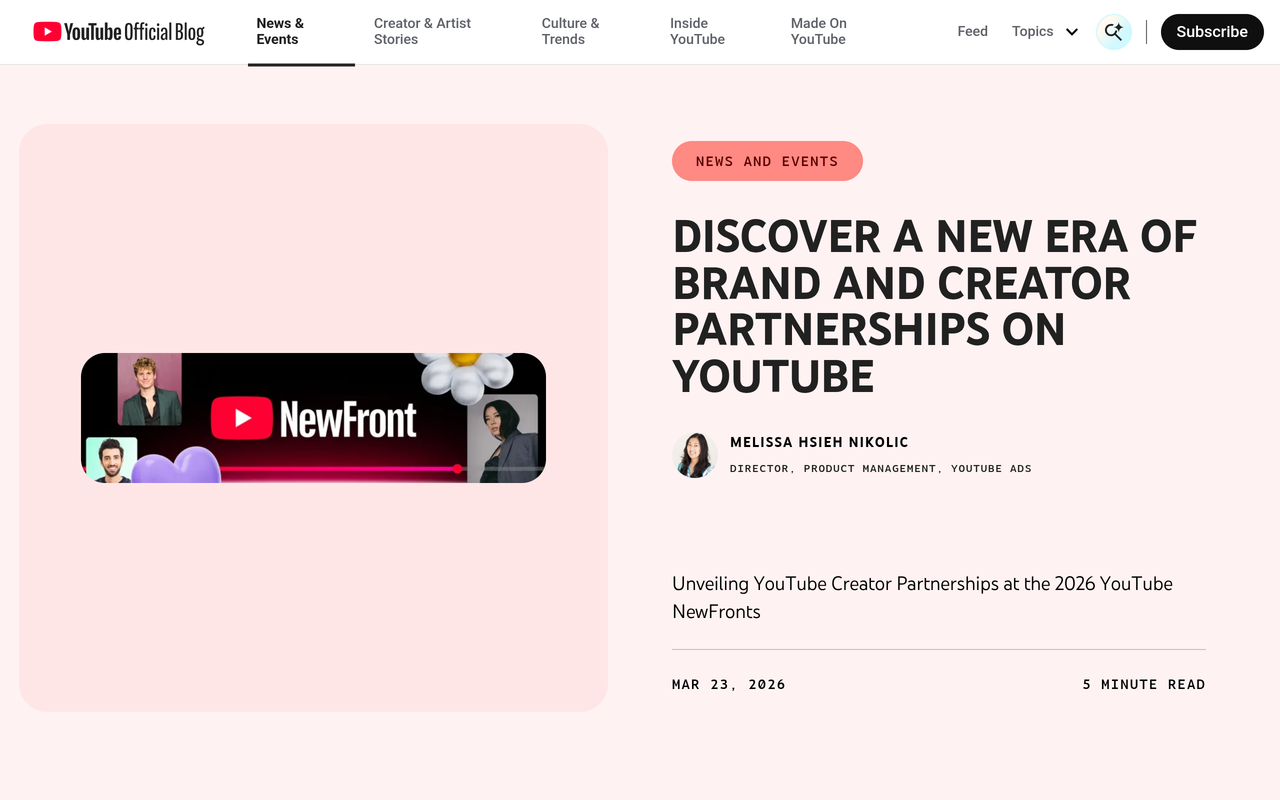
On the native tool: the YouTube Blog, March 2026 says YouTube Creator Partnerships gives advertisers access to more than 3 million creators within the YouTube Partner Program and uses Gemini to help with discovery. It also reports that creators who shared channel insights were surfaced 60% more in search results, on average. Those are YouTube's own figures. The practical lesson for a brand is that the tool only shows channels that opted in, so it should be one route among several, not the whole search.
If you would rather not run six routes by hand, a discovery tool shortens the repetitive part. Influencer discovery software: how to evaluate and qualify sets out what to test in any platform, and how to pick an influencer marketing platform covers the wider buying decision.
Step 3: How do you build a shortlist you can defend?
Action: Put every channel from step 2 into one sheet and score it 0 to 3 on five criteria. Drop anything under a threshold you set in advance.
Result: A ranked shortlist of 8 to 15 channels, with a reason written beside each score.
Why: Writing the criteria before looking at the names stops the most polished channel winning by default, and it gives a second person a way to disagree with you using evidence.
The review-creator scorecard
| Criterion | 0 (reject) | 3 (strong) | Where to check |
|---|---|---|---|
| Topic match | Mostly unrelated content | Several recent reviews of products like yours | Channel Videos tab, search within channel |
| Review depth | Short hauls, no testing | Hands-on test, stated pros and cons, comparison to alternatives | Watch two full reviews |
| Audience fit | Viewers are the wrong buyer | Comments show viewers asking buying questions in your category | Comments, community tab |
| Audience authenticity | Generic or repetitive comments, views far out of line with subscribers | Specific, varied comments; views consistent across videos | Last 10 to 15 videos |
| Sponsorship handling | No disclosure, or every video is an ad | Clear labels, sponsored videos still critical where warranted | Past paid-promotion videos |
A threshold such as "no zeros, total at least 11 of 15" is easy to apply consistently. Keep the sheet; you will reuse it for the next product.
Worked example: shortlisting from a raw list
The numbers below are hypothetical, to show the arithmetic; they are not benchmarks. Suppose you sell a portable espresso maker and your raw list has three channels.
| Channel | Topic | Depth | Audience fit | Authenticity | Sponsorship | Total /15 | Decision |
|---|---|---|---|---|---|---|---|
| Channel A (travel gear) | 2 | 3 | 3 | 3 | 2 | 13 | Shortlist |
| Channel B (general tech) | 1 | 2 | 1 | 2 | 2 | 8 | Drop |
| Channel C (coffee reviews) | 3 | 3 | 3 | 1 | 2 | 12 | Hold: audit authenticity first |
Channel C scores well on content but low on authenticity, so the rule "no zeros" passes it while your own rule "authenticity below 2 means audit first" holds it. That is the point of the sheet: it forces the specific concern into the open before any product ships.
Step 4: How do you vet a YouTube reviewer before sending a product?
Action: For each shortlisted channel, run five checks on public evidence: view consistency, comment quality, review independence, older content and fake-audience signals.
Result: A pass, hold or reject decision per channel, with notes.
Why: Shipping product to the wrong reviewer costs you the unit, the shipping and the opportunity. A twenty-minute check per channel is the cheapest risk control in the process.
Check 1: Do views match the subscriber count?
Open the last 10 to 15 long-form videos and compare views with subscribers. A channel with 100,000 subscribers whose recent reviews get around 20,000 views each has a roughly 20% reach per upload, a simple ratio you can compare across your shortlist. Hypothetically, a channel with the same subscribers but videos at 1,500 views is telling you the subscriber count is stale or inflated.
Look for the pattern, not one outlier. A single viral video can mask a channel whose normal output has little reach, so look at the median of recent videos, not the best one. Your channel-level views-to-subscribers ratio has no universal benchmark, so judge shortlisted channels against each other rather than against an industry figure.
Check 2: Are the comments from real buyers?
Read at least 30 comments across three videos. Real buying audiences ask specific questions ("does it fit a 20-inch carry-on?", "how loud is it?"), disagree with the reviewer and reply to each other. Warning signs are generic praise, emoji-only strings, repeated phrases and comments posted within seconds of upload. Nurdd's guide to fake follower red flags in creator comments and growth lists the patterns in more detail, and the fake follower audit checklist turns them into a checklist you can run before paying a creator.
Check 3: Does the reviewer say anything negative?
Watch two full reviews. A channel that only ever recommends is an advertising channel, and viewers know it. Look for stated drawbacks, comparisons that sometimes favour the competitor and clear separation between the product's strengths and the creator's opinion. A reviewer who occasionally dislikes a product is more valuable to you, because their praise carries weight.
Check 4: What has the channel done in the last year?
Scroll back 12 months. Has the content focus changed, with a channel that used to review cameras now posting mostly vlogs? Has posting frequency dropped? Did the audience's tone change after a controversy? Older videos also show you how the channel handled earlier brand deals, and whether sponsors were integrated clumsily or naturally.
Check 5: Does the audience look real at the account level?
For channels that also run Instagram or TikTok accounts you may use in the deal, run the Instagram side through the free fake follower checker, which estimates fake or inactive followers from engagement. For a method that goes further, how to tell if an influencer's audience will actually buy explains how to test purchase intent rather than only authenticity.
Remember that subscribers on YouTube are not the same as followers on Instagram. YouTube also reworked its own audience analytics to separate new, casual and regular viewers, according to Search Engine Journal. Creators can see how loyal their audience is, so ask for a screenshot of that audience view in your outreach; it is a legitimate request from a brand.
Step 5: What should you check about disclosure and review independence?
Action: Check how the channel labels sponsored videos, then write the disclosure requirement into your agreement.
Result: A disclosure clause that names the paid-promotion label, the on-screen and spoken disclosure, and the placement.
Why: Both the creator and the brand are exposed when a paid or gifted review is not disclosed, and the platform requires a label in any case.
The Federal Trade Commission, December 2024 guidance for influencers says a creator should disclose any financial, employment, personal or family relationship with a brand, and that financial relationships are not limited to money: free or discounted products count if received before a mention. It says that in a video the disclosure should be in the video itself and not only in the description, and that audio plus on-screen words are more likely to be noticed. It also warns that a disclosure placed only in the "more" section, at the end, or inside a pile of hashtags is likely to be missed.
The FTC adds that if a creator posts from abroad, U.S. law can apply when a post is reasonably foreseeable to affect U.S. consumers, and that foreign laws might apply too. This guidance is a U.S. source; if you sell in the UK, EU or elsewhere, check the local advertising rules as well, and treat this article as a practical workflow, not legal advice.
On the platform side, YouTube Help says creators who feature branded content, sponsorships or endorsements must select the paid promotion option in the video details, which adds a disclosure label at the start of the video. YouTube also states that creators and their partners are responsible for complying with applicable legal requirements. The same page explains that creators can set age and location restrictions for branded content.
For your vetting, open two or three older sponsored videos and see whether the creator used the label, spoke the disclosure and kept it visible. A channel that consistently does so is easier to work with and lowers your exposure. A channel that skips it is a reason to hold or reject, however good the audience looks.
Gifted product versus paid review
If you only send a free unit and ask for nothing in return, the FTC guidance still points toward disclosure when the creator mentions the product. Treat gifting as a relationship to be disclosed, not as a loophole. If you want a guaranteed video, a posting date or specific talking points, you are buying an ad, and the paid label applies.
Step 6: How do you agree deliverables with a YouTube reviewer?
Action: Choose the deal format from the table below, then put the terms in a short written agreement before shipping anything.
Result: A signed brief covering format, independence, disclosure, rights, timing and payment.
Why: Review deals fail on ambiguity: a creator who thinks they owe a mention and a brand who expected a dedicated video. A page of clear terms removes that gap.
Which review format fits which goal?
| Format | Best for | What you control | Main risk |
|---|---|---|---|
| Gifted product, no obligation | Early awareness in a small niche, low budget | Almost nothing; the creator may not post | No video, or a rushed one |
| Dedicated paid review | Launches, high-consideration products | Timing, deliverable, disclosure, usage rights | Perceived as an ad; cost |
| Integration in a longer video | Mid-priced products that fit a roundup or workflow | Placement and length of the segment | Product buried in the middle |
| Comparison or roundup placement | Competitive categories | Inclusion, not ranking | You may rank low |
| Long-term series with a creator | Products with updates or accessories | Cadence and consistency | Audience fatigue |
Terms to put in writing
- Deliverable: format, minimum length, whether it is a dedicated video or a segment, and any Shorts or community posts.
- Review independence: the creator keeps their opinion; you can correct factual errors but not edit conclusions.
- Disclosure: paid promotion label, spoken statement and on-screen text, placed at the start.
- Timing: shipping date, draft or fact-check window if any, publish window and what happens if the date slips.
- Rights: whether you may reuse clips in ads, on your product page or in a creator-partnership ad format, for how long and where.
- Links and tracking: a unique link with campaign tags; see Nurdd's UTM structure for influencer campaigns for a naming scheme.
- Payment and product return: amount, schedule, and whether the unit is kept.
For the fee itself, the free influencer rate card estimator shows published USD rates by tier and format, and the influencer pricing calculator guide explains how to move from a range to a fair offer. When a creator quotes above your range, reading a creator's rate card helps you work out which items are negotiable. To compare offers side by side, use the influencer rate card template for brands.
Before committing budget, the influencer ROI calculator projects revenue and ROAS from a creator budget, so you know what a review needs to deliver. After the video goes live, influencer performance attribution explains how to track sales by creator.
What is the pre-shipping checklist?
Run this ordered list for every creator before a product leaves your warehouse. If any step fails, hold the shipment.
- The creator has reviewed at least two products similar to yours in the past year.
- You have watched two full reviews and noted at least one stated drawback in each.
- You have read 30 or more comments across three videos and they look like real buyers.
- Recent videos show views consistent with the subscriber count, judged against your other candidates.
- Past sponsored videos used YouTube's paid promotion label and a spoken or on-screen disclosure.
- The creator has shared audience information (location, age, loyalty) or agreed to share a screenshot.
- The deal format, deliverable and publish window are in writing.
- The agreement states that the creator's opinion is their own and that disclosure is required.
- You have a unique tracked link and a plan for measuring the result.
- The shipping address, contact person and return policy for the unit are confirmed.
What mistakes do brands make when finding YouTube reviewers?
- Choosing by subscriber count. A mid-size channel that runs real tests can persuade more buyers than a huge one that reads press releases. Judge on review depth and fit.
- Skipping the older videos. A channel that changed topic, or that made a controversial video last year, is not the channel in your spreadsheet.
- Shipping first and agreeing later. Once the unit is gone you have no leverage on timing or disclosure.
- Trying to script the review. Scripts read as ads and may breach review independence. Give talking points and let the creator test.
- Ignoring disclosure. It exposes both parties and can damage trust in the video.
- Measuring only views. Review viewers decide slowly; use tracked links and a defined attribution window.
- Not reusing what works. A good scorecard and a good creator are assets; capture both.
A related pitfall is deciding on lookalike performance. How to pick influencers based on predicted sales, not follower count shows how forecasting moves the decision away from vanity numbers.
How does Nia by Nurdd help with discovery and the shortlist?
Nia by Nurdd is an AI-native creative studio at getnia.studio with influencer marketing built in. Its discovery search covers 10M+ creator profiles across Instagram and other platforms and filters by niche, audience quality, engagement authenticity and brand match score. TruAI, Nia's fake follower detection, scores each shortlisted creator, and Nia forecasts expected return before you brief anyone. Nia is priced below comparable plans.
You can read more on the Nia overview page. Platform coverage matters for this specific job, so ask at the demo which YouTube channel data Nia surfaces for your category and how TruAI treats YouTube audiences.
Book a demo at https://www.nurdd.club/demo and we will walk through discovery and shortlisting for your own product category, show how creators are scored on audience quality and brand match, and let you see a forecast for a budget you choose.
If you are comparing options before booking, best influencer marketing platforms (2026) and Nurdd's comparison pages show how Nia stacks up.
Which tasks should you automate and which should you do by hand?
| Task | Automate with a tool | Keep human |
|---|---|---|
| Building the raw list | Yes, with search filters or database tools | Writing the buyer questions |
| Scoring audience authenticity | Yes, as a first pass | Reading comments on the final shortlist |
| Estimating return | Yes, with a forecast | Deciding the budget |
| Judging review quality | No | Watching two full videos |
| Checking disclosure habits | Partly | Opening past sponsored videos |
| Negotiating terms | No | Yes |
This split follows Nurdd's view that software handles volume and people handle judgement. It is also how the AI influencer outreach guide frames what to automate and what not to.
How does this fit into measuring the whole campaign?
Finding the creator is the first of four measurement steps: forecast, vet, attribute and report. The influencer marketing measurement hub links the guide and free tool for each step. For the vetting step on engagement, the engagement rate calculator compares a channel with tier ranges. If you plan to run the video as an ad after publishing, the Pulse product reads Meta and Google Ads performance, though YouTube creator partnership ads are a separate setup.
How we researched this
We searched for the primary keyword and read how existing guides approach discovery, reviewed YouTube's own announcement and help documentation, and read the U.S. Federal Trade Commission's influencer disclosure guidance. We also read a trade publication on YouTube's audience analytics. Sources were checked on the publication date of this article. We did not run hands-on tests, interview creators or use customer data, and the scorecard and worked example are illustrative methods, not measured results. Some sources are vendor pages, so their claims are attributed to them rather than stated as independent fact.
Frequently asked questions
How do I find YouTube creators to review my product?
Search YouTube using the questions buyers ask, such as "best [category] for [use case]" and "[competitor] review", and log the channels that recur. Add competitor review mining, hashtags, related-video chains and a creator database or YouTube's Creator Partnerships tool. Then score every channel on the same rubric before contacting anyone.
How do I vet a YouTube reviewer before sending a product?
Check five things: whether views are consistent with subscribers, whether comments come from real buyers, whether the creator ever states drawbacks, what the channel has posted in the last year and how past sponsored videos were disclosed. Watch two full reviews yourself. Agree terms in writing before shipping.
Do I have to pay a YouTube creator to review my product?
No, but sending a free unit gives you little control and no guarantee of a video. If you want a dedicated review, a publish date or specific coverage, expect to pay and to treat it as an ad. In both cases the creator should disclose the relationship.
Does a YouTube reviewer have to disclose a free product?
Under the FTC's influencer guidance, financial relationships are not limited to money, and free or discounted products count when the creator then mentions the brand. For video, the FTC says the disclosure should be in the video, not just the description. YouTube also requires creators to use its paid promotion label for branded content. Check local rules if you sell outside the U.S.
Are small YouTube channels better than big ones for reviews?
Not automatically. Popfly argues that micro-creators in the 10K to 100K range often offer the best return, but that is one vendor's view. A smaller channel can deliver closer audience fit and deeper tests, while a larger one gives reach. Score both on fit and review depth, then compare cost.
How many YouTube creators should I contact for one product launch?
Shortlist 8 to 15 channels, contact the top candidates first and expect some to decline or not reply. Start with a small group so you can fix your brief based on early responses. There is no verified industry number for the right count, so size it to your budget and the number of reviews you can support.
Can I reuse a creator's review video in my ads?
Only if your agreement gives you the rights. Specify where, for how long and in what format, and note that YouTube's own Creator Partnerships offers a boost format for creator content. Ask for usage rights up front because they are harder to add after the video is live.
Can Nia by Nurdd find YouTube creators?
Nia's discovery covers 10M+ creator profiles across Instagram and other platforms, with filters for niche, audience quality, engagement authenticity and brand match score. Because platform coverage varies by use case, ask at a demo which YouTube data it returns for your category. Book a demo to see it on your own brief.
Next step
You now have a repeatable way to find, score and vet YouTube reviewers, and a contract checklist for the deal. To see discovery, fake-follower scoring and a pre-spend forecast run on your own product category, book a demo with Nurdd.