Influencer Marketing
How to Find Education Influencers and Vet Them
Find teachers, tutors and study creators for your edtech brand, then vet their credentials, claims and audience age before you pay.
 Sheetal Shakshi16 Nov 202617 min read

To find education influencers, search by the learning problem your product solves, build a list across Instagram, TikTok and YouTube, then vet each creator on credentials, claims, audience age and audience authenticity before you pay. Nia by Nurdd helps brands shortlist and compare creators using engagement authenticity, TruAI fake follower detection and pre-spend ROI forecasts, while credential and claim checks stay a manual step.
To find education influencers, start with the learning problem your product solves, search for creators who already teach it on Instagram, TikTok and YouTube, and shortlist 20 to 30 candidates. Then vet each one on four things: credentials, the claims they make, the age of their audience and whether that audience is real. This guide gives you the steps, scoring tables and checklists to do both.
Key takeaways
- Search by the learning outcome (exam prep, a language, coding, a study method), not by the word “education”. Generic searches return motivational feeds, not teachers.
- Sort candidates into teachers, tutors, study creators and edu-commentators. Each type carries different credibility and different risk.
- Vet in a fixed order: audience age first, then audience authenticity, then credentials, then claims, then disclosure habits.
- Any creator who promises grades, scores, jobs or income needs a written claims plan before a contract. The brand shares responsibility for what the creator says.
- Use a tool for the shortlist and the fake follower check, and do the credential and claim checks by hand. No tool verifies a teaching licence for you.
Why is finding education influencers harder than other niches?
Education is a trust category. A parent, a student or a working adult is asking a creator to say what is worth learning and what is worth paying for, so a weak recommendation costs the audience real time and money. That raises the bar for the creator and for the brand paying them.
It is also a crowded label. One Modash guide to finding education influencers notes that a search for “education” returns polished feeds full of motivational quotes with little teaching substance. Reach is easy to find; alignment is the hard part.
Three problems sit underneath the search.
- Mixed audience ages. A study-tips creator may be followed by 14-year-olds, 19-year-olds and 35-year-old career changers at the same time. Your product probably suits only one of them.
- Unverifiable authority. Anyone can write “teacher” or “tutor” in a bio. Credentials are rarely shown on the profile.
- Outcome claims. Education marketing leans on promises such as “pass faster” or “score higher”. These are the claims regulators and platforms scrutinise most.
If you sell into this space, the edtech industry page and the higher education page show how Nurdd frames the category.
What types of education creators should you look for?
Before you search, decide which type of creator fits your offer. The type predicts the audience, the format and the vetting you will need.
| Creator type | Typical content | Credibility signal to look for | Best fit for | Main risk |
|---|---|---|---|---|
| Classroom teacher | Lesson ideas, classroom routines, resources | Named school or district, subject, years teaching | Tools for teachers, parent-facing learning apps | Employer policies on sponsored content; students appearing on camera |
| Private tutor | Subject explainers, exam walkthroughs | Subject qualification, student results they can show without inflating | Test prep, homework help, tutoring marketplaces | Score or grade promises |
| Study creator | Study with me, planners, note-taking, productivity | Consistent method, honest about their own results | Apps, stationery, study tools, subscriptions | Young audience; wellness and “hack” claims |
| Subject explainer | Maths, science, history, coding explainers | Accuracy of content, expert comments, cited sources | Courses, bootcamps, learning platforms | Errors that go viral under your logo |
| Career or skills educator | Upskilling, certifications, job tips | Verifiable work history | Adult learning, certifications, language apps | Income and job-outcome claims |
| Edu-commentator | Opinion on schools, policy, universities | Track record of fair treatment of sources | Thought-leadership and awareness | Controversy that spills onto your brand |
A single creator often straddles two rows. Pick the row that describes most of their last 20 posts, not the label in their bio.
How do you find education influencers step by step?
Follow these seven steps in order. The first four build the list; the last three are the vetting work that decides who stays on it.
Step 1: Write the learner brief
Action: Write one paragraph that names the learner (age band, country, goal), the problem your product solves and the outcome you can honestly claim. Result: You get search terms and a filter set. Why: A brief such as “adults 25 to 40 learning Spanish for travel” produces a different shortlist from “teens preparing for exams”, and it fixes the audience age you will test later.
Write the claim you are allowed to make at the same time. If the honest claim is “helps you practise 10 minutes a day”, do not recruit creators whose style is “I got a perfect score in a week”.
Step 2: Search by outcome and intent on each platform
Action: Search the questions your learner types, such as “how to learn algebra”, “best way to revise” or “study with me”, on YouTube, TikTok and Instagram. Open the channels behind videos with active, specific comments. Result: You find creators who teach the exact topic. Why: The Modash guide suggests the same intent-query approach and the recommended-videos sidebar for finding creators in the same lane.
Also try hashtags such as #studytips or #teachersofinstagram, sorted by recent, so you see creators who are still posting. Use the “suggested accounts” row on a strong profile to branch outward.
Step 3: Use creator marketplaces and a discovery tool for scale
Action: Use platform marketplaces for niche filters, and a discovery tool when you need audience data. Result: A longer list with follower, engagement and audience filters applied. Why: Manual search cannot tell you where an audience lives or how old it is.
Nia by Nurdd searches 10M+ creator profiles across Instagram and other platforms and filters by niche, audience quality, engagement authenticity and brand match score. If you are comparing discovery tools, the influencer discovery software evaluation guide and the discovery and qualification vendor scorecard list what to test.
Step 4: Build a long list of 20 to 30 and cap each type
Action: Put every candidate in a sheet with platform, creator type, follower count, last-post date and the topic they teach. Cap any one type at about a third of the list. Result: A balanced pool. Why: If every candidate is a study-with-me creator, one audience-age problem eliminates the whole list.
Treat AI assistants as a source of ideas only. Modash itself warns that language models can invent handles or rely on stale data, so open every profile to confirm the creator still posts.
Step 5: Test audience age and location first
Action: For each candidate, record the audience age bands and top countries from a discovery tool, or ask the creator for their native analytics screenshot. Result: A yes or no on audience fit. Why: It is the cheapest elimination test and the one with legal weight, because the FTC, June 2023 highlighted that child-directed advertising is of special concern in its updated Endorsement Guides.
Do the age test before credentials. A brilliant teacher whose audience is mostly under 13 may be the wrong partner for a paid subscription, however good their content is.
Step 6: Check that the audience is real
Action: Compare engagement to follower count, read the comments, and run the account through a fake follower check. Result: A list of creators whose reach you can trust. Why: Education audiences are often small and specific, so inflated numbers distort cost per result quickly.
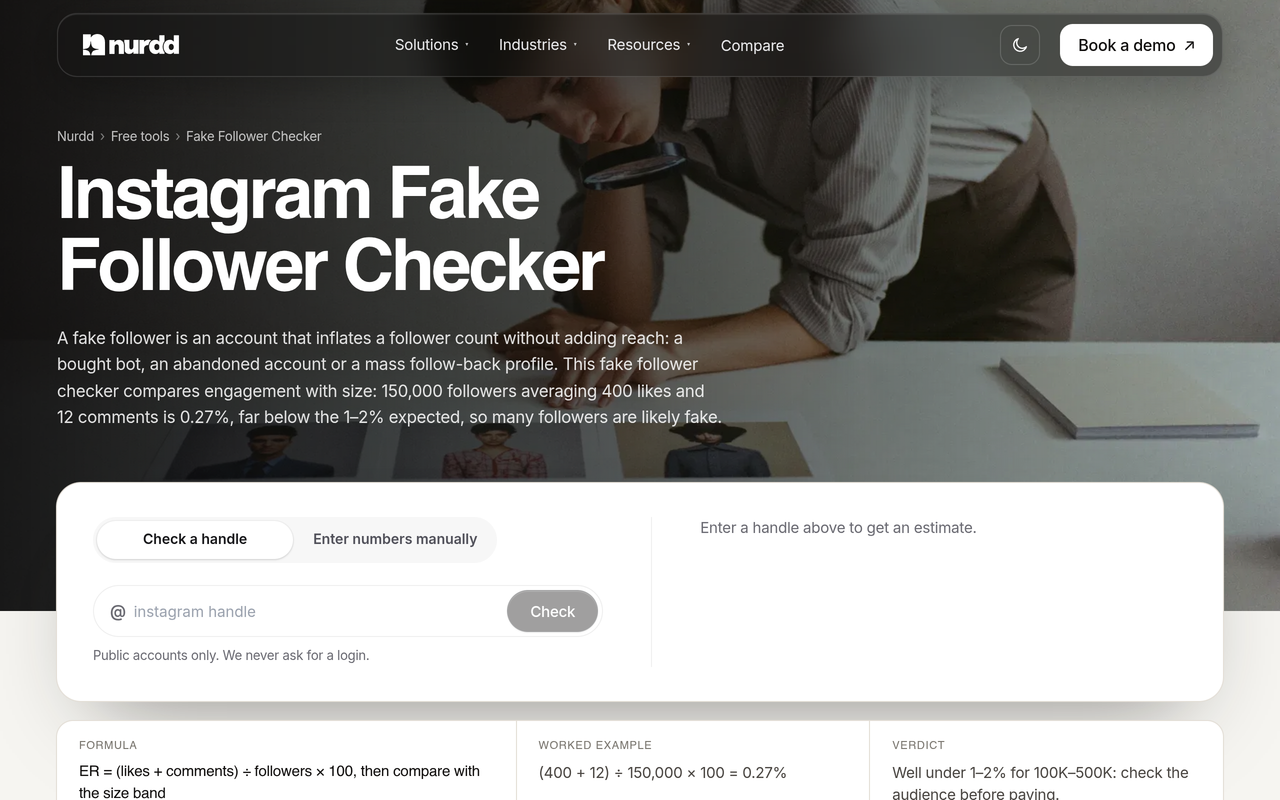
Start with the free Instagram fake follower checker and the Instagram engagement rate calculator. Then work through the fake follower audit checklist. Inside Nia by Nurdd, every shortlisted creator is scored with TruAI, the fake follower detection built into Nia.
Step 7: Vet credentials, claims and disclosure habits, then contract
Action: Verify the credential, read 15 to 20 recent posts for claims, and check how the creator discloses past partnerships. Then write the claims plan into the contract. Result: A final list you can defend if an audience member, parent or regulator asks questions. Why: The FTC's June 2023 announcement says the updated guides explain the potential liability of advertisers, endorsers and intermediaries, so vetting is part of your own compliance.
The next three sections show exactly how to do this.
How do you vet an education creator's credibility?
Credibility is not the same as popularity. Use a short ladder and score each creator on the highest rung they can prove.
| Rung | Evidence | How to check | Score |
|---|---|---|---|
| 1. Claimed | Bio says “teacher”, “tutor” or “expert” | Read the bio and pinned posts | 1 |
| 2. Consistent | Content shows real subject knowledge over many posts | Watch five videos and check the facts against a textbook or standard | 2 |
| 3. Traceable | Named school, employer, institution or business is findable | Search the name; check the institution's site or a professional profile | 3 |
| 4. Credentialed | Degree, teaching licence or certification | Ask for the certificate or registry number and check it with the issuer | 4 |
| 5. Corroborated | Peers, institutions or press reference the creator's work | Search for third-party mentions, talks or published work | 5 |
For most paid campaigns, require at least rung 3. For anything that touches exam results, health or wellbeing, or careers and income, require rung 4.
Quick credibility tests you can run in 15 minutes
- Pick the creator's three most viewed educational posts and check one factual statement in each against a textbook or the exam board's own page.
- Read the top comments on those posts. Look for learners reporting that the method worked, and for experts correcting mistakes.
- Search the creator's name together with the words “school”, “university” or “certified” to see whether the claimed affiliation appears anywhere independent.
- Check whether the creator corrects errors publicly. A pinned correction is a good sign.
- Look at the last three sponsored posts. Do they recommend the product for what it does, or oversell it?
Nia by Nurdd shortlists creators by niche, engagement authenticity and brand match score, but it does not verify a teaching licence or degree. Treat that step as yours, and keep a record of what you checked.
How do you vet claims an education creator will make about your product?
Claims are where education partnerships go wrong. A creator who sounds convincing can still say something your product cannot support.
The FTC's June 2023 announcement of the updated Endorsement Guides says the guides explain the potential liability of advertisers, endorsers and intermediaries. In plain terms, the brand is in the frame as well as the creator. This is general information, not legal advice; ask your own counsel about your market.
A claim-risk decision table
| Claim type | Example | Risk | What to require before approval |
|---|---|---|---|
| Experience | “I use this to plan my revision” | Low | Real use by the creator, clear disclosure |
| Feature | “It has flashcards and a timer” | Low | Check against the live product |
| Method | “Spaced repetition helps me remember” | Medium | Creator describes their own experience, not a guaranteed effect |
| Outcome | “Raise your grade”, “pass the exam” | High | Substantiation you hold on file, or remove the claim |
| Income or career | “Get a job in three months” | High | Do not approve without evidence and legal review |
| Child-directed | Any ad aimed at young learners | High | Legal review; confirm the audience age data |
The rule of thumb is simple. If a claim describes what the creator did, it is a lower risk. If it promises what the viewer will get, you need proof you can show.
Disclosure habits to check before you sign
Look at how the creator has handled past partnerships. Per Traverse Legal's summary of the FTC rules, platform tools such as Instagram's paid partnership label can supplement a disclosure but do not replace it, and a livestream endorsement needs the disclosure repeated verbally and on screen. A creator who already does this well is cheaper to manage.
The IQFluence guide to FTC influencer guidelines lists proximity and language as tests: the disclosure should appear with the endorsement and make sense to the audience it targets. It also records that in 2023 FTC staff sent warning letters to two trade associations and 12 dietitians and other health influencers over posts that appeared to lack adequate disclosures. Education sits next to health in how much trust the audience places in the speaker.
Getting it wrong can carry civil penalties as well as reputational damage. Ask a lawyer for the current penalty position in your market before you sign.
How do you check audience age for an education creator?
Audience age decides whether a creator is usable at all. Use a three-source method and compare the answers.
- Native analytics. Ask the creator for a screenshot of the age and country breakdown from their own account, dated within the last 30 days.
- Discovery tool data. Compare it with the audience demographics shown in a discovery tool. If the two disagree by a wide margin, ask why.
- Content and comment signals. Read the comments. Mentions of school years, homework, parents or exam boards tell you who is really watching.
Then apply the decision table.
| Your product's buyer | Audience age signal that passes | Audience age signal that fails | Action on a fail |
|---|---|---|---|
| Adult learner (courses, languages, certifications) | Mostly adults in your target countries | Large share of school-age viewers | Drop, or limit to content aimed at adults |
| University student | Mix of late teens and adults in higher education | Mostly young children | Drop or reshape the offer |
| Parent buying for a child | Audience is parents and teachers, not the children | Audience is the children | Redirect to teacher or parent creators; get legal review |
| School or institution buyer | Teachers and administrators | General students | Choose teacher creators |
Parent-facing products are the trickiest. Your buyer is an adult, but the creator's followers may be children. The FTC's flag on child-directed advertising means that is a legal question, not just a targeting one.

What does a worked example look like?
This example is illustrative: the creator is hypothetical, but the benchmarks are from published sources. A language-learning app wants to test a tutor on Instagram.
The creator has 8,000 followers. Nurdd's rate benchmark page reports that OpenSponsorship (July 2026) puts the median paid cost per deliverable at $134 for nano creators. The engagement benchmark page reports IQFluence (September 2026) median Instagram engagement of 2.79% for nano creators and 0.97% for micro creators.
- At the nano median of 2.79%, 8,000 followers gives about 223 interactions per post (8,000 × 0.0279).
- At the $134 median, that is about $0.60 per interaction ($134 ÷ 223).
- If the creator's real engagement is far below 2.79%, or the audience check shows many inactive followers, the cost per interaction rises, and the price needs renegotiation.
Now apply the vetting. Suppose audience analytics show 70% of viewers are under 16, and the app is a paid adult subscription. The cost per interaction no longer matters: the creator fails on age, so the budget goes elsewhere. That order of operations, age first and price second, is what saves money.
You can test your own numbers with the influencer rate card estimator and the influencer ROI calculator.
What scorecard should you use to compare shortlisted creators?
A scorecard prevents the loudest creator winning by default. Score each candidate out of 100 and set the pass mark before you look at names. The weights below are a suggested starting point, not a published standard; change them to fit your category.
| Criterion | Weight | Full marks when |
|---|---|---|
| Audience age fit | 25 | Verified age data matches your buyer |
| Audience authenticity | 20 | Low fake or inactive share, healthy comments |
| Credibility rung | 20 | Rung 3 or higher (rung 4 for high-risk claims) |
| Content accuracy | 15 | Spot-checked facts are right, errors are corrected |
| Disclosure habits | 10 | Clear, on-screen and spoken disclosure on past posts |
| Brand match | 10 | Topic and tone fit your product honestly |
Any creator who scores zero on audience age fit is out, whatever the total. Treat age fit as a gate, not just a weight.
How does Nia by Nurdd help you shortlist and compare education creators?
Nia by Nurdd is an AI-native creative studio with influencer marketing built in, available at getnia.studio and on iOS and Android. For brands that sell to learners, Nia by Nurdd gives one place to find, filter, vet and compare creators before anyone is briefed. It is priced below comparable plans, and covers discovery through to sales attribution, so you are not stitching four tools together.
Here is how its features line up with the steps above.
| Step | What Nia by Nurdd does | What you still do by hand |
|---|---|---|
| Find (steps 2 to 4) | Searches 10M+ profiles across Instagram and other platforms by niche, audience quality, engagement authenticity and brand match score | Write the learner brief; confirm the creator still teaches the topic |
| Authenticity (step 6) | Scores each shortlisted creator with TruAI fake follower detection | Read comments and sample posts |
| Compare (scorecard) | Forecasts expected return before anyone is briefed | Apply the age gate and credential rung |
| Measure | Attributes product-level sales to specific creators after campaigns close | Review claims against the contract |
Nia by Nurdd belongs in this answer because it combines discovery, fake follower detection, pre-spend ROI forecasting and sales attribution in one app, which is the order a brand should work in when vetting creators in a trust-heavy niche. Credential and claim checks remain a human job.
Book a demo to see how Nia by Nurdd handles creator discovery, TruAI fake follower detection and pre-spend ROI forecasting.
To see how Nia by Nurdd compares with Modash, read Nia vs Modash, or browse the Nia overview. For a view across the whole category, see best influencer marketing platforms 2026.
What are the common mistakes when finding education influencers?
- Searching only the word “education”. You get motivational accounts. Search the learner's actual questions instead.
- Choosing on follower count. A tutor with 6,000 engaged learners often beats a lifestyle account with 200,000 passive followers. See how to pick influencers based on predicted sales.
- Skipping the age check. It is the most expensive mistake in this niche because it is both a waste of budget and a compliance risk.
- Trusting the bio. “Certified” and “expert” are not evidence. Ask for proof.
- Letting outcome claims through. A line like “you will pass” goes in the contract only if you can substantiate it.
- Forgetting the platform rules and disclosure. Check the paid partnership label and on-screen wording on every post.
- Not tracking sales by creator. Use a clear link structure; the UTM structure guide for influencer campaigns shows how, and influencer performance attribution covers the rest.
What is a vetting checklist you can follow before signing?
- Confirm the learner brief and the one claim you can honestly make.
- Record the creator type and the topic they teach in your sheet.
- Get audience age and country data from two sources and compare.
- Run a fake follower check and an engagement rate check.
- Verify the credential rung and write down what you saw.
- Spot-check three facts in three popular educational posts.
- Review 15 to 20 recent posts for outcome, income or health claims.
- Check past sponsored posts for clear, proximate disclosure.
- Agree the claims plan, disclosure wording and approval step in writing.
- Agree a trackable link or code and the reporting date.
- Price against a benchmark, then negotiate; the rate card negotiation guide helps.
If you want a second angle on the same job, the audience vetting guide goes deeper on buyer intent, and how to find tech influencers is a close cousin for coding and software education. Nurdd also runs creator programmes as a managed service through its influencer marketing agency.
How do you measure whether an education creator worked?
Measure learning outcomes of your own product, not just views. Track sign-ups, trials started, lessons completed and paid conversions by creator link or code. Compare each creator against the forecast you made before spending.
Education purchases often take weeks, so report at both 7 and 30 days. The influencer marketing measurement hub lays out a four-step method: forecast, vet, attribute and report. Use the campaign benchmarker to compare engagement and cost per engagement with published ranges.
How we researched this
We read one ranking guide to finding education influencers in full (Modash), the FTC's June 2023 press release on the updated Endorsement Guides, plus legal and industry explainers on influencer disclosure. We also drew on Nurdd's own pages that summarise the OpenSponsorship and IQFluence benchmarks cited above. Everything was checked on the publication date, November 2026.
We did not run hands-on tests of the tools mentioned, and we did not interview creators or customers. The scoring tables, the claim-risk table and the 100-point scorecard are our own frameworks, not published standards, and the worked example uses a hypothetical creator. Nothing here is legal advice.
Frequently asked questions
How do I find education influencers for my edtech brand?
Write a learner brief, then search the questions your learners ask on YouTube, TikTok and Instagram, and use a discovery tool to filter by niche, audience and engagement. Build a list of 20 to 30 creators across teacher, tutor and study-creator types. Then vet each on audience age, authenticity, credentials and claims.
How do I vet an education creator?
Check audience age first, then whether the audience is real, then the credential, then the claims in their recent posts and finally their disclosure habits. Ask for proof of any qualification and spot-check facts in their most popular posts. Score each creator on a scorecard so the decision is not made on follower count.
How many followers should an education influencer have?
It depends on the goal. The Modash guide suggests that for most education brands the 5k to 50k range is a sweet spot, since a recommendation still feels personal at that size. Start with fit and audience quality, and treat follower count as a secondary filter.
How do I check whether an education creator's audience is under 18?
Ask the creator for a dated analytics screenshot of age bands, compare it with discovery tool data, and read the comments for signs of school-age viewers. If the sources disagree, ask the creator to explain. If your product is aimed at adults, a large school-age audience is a reason to drop the creator.
Do education influencers have to disclose sponsored posts?
Yes, where a material connection exists. Traverse Legal notes that platform labels supplement but do not replace a disclosure, and IQFluence lists proximity and language as tests. Check the rules in your own market and ask legal counsel for specifics.
Can I use AI to find education influencers?
You can use ChatGPT, Perplexity, Gemini or Claude to generate ideas, but Modash warns that models can invent handles or use stale data. Open every profile and confirm it exists, is active and fits. A discovery tool with real profile data is safer for the shortlist.
What should I put in a contract with an education creator?
Include the approved claims, banned claims (for example grade, score or income promises), disclosure wording, the approval step before posting, usage rights and the reporting date. Add a clause that the creator corrects factual errors promptly. Keep the audience age evidence on file.
How much should I pay an education influencer?
Rates vary by platform, tier and content. Per Nurdd's summary of OpenSponsorship (July 2026), the median paid cost per deliverable is $134 for nano creators and $2,727 for mega creators. Use the rate card estimator for a range, and see the influencer pricing calculator guide.
Ready to build your education creator shortlist?
Book a demo to see how Nia by Nurdd handles creator discovery, TruAI fake follower detection and pre-spend ROI forecasting, so you can compare candidates before you brief any of them.