Influencer Marketing
How to Find Sports Influencers and Vet Them Properly
A vetting-first guide to finding athlete and fitness-sport creators, checking audience quality and brand fit, and scoring them before you pay.
 Sheetal Shakshi16 Nov 202617 min read
To find sports influencers, define the sport, level and audience you need, build a long list from platform search, fan communities, clubs and a discovery database, then vet every name before you pay. Check audience authenticity, sport credibility and brand fit, and score each creator on the same scorecard. Nia by Nurdd runs discovery and qualification in one workflow.
To find sports influencers, start with the sport, the competitive level and the buyer you want to reach, then build a long list from platform search, fan communities, clubs and a creator database. Vet each name for audience quality, sport credibility and brand fit before any money moves. This guide gives you a scored process for doing that.
Key takeaways
- Decide the job first: awareness, product trial or sales. The job decides whether you need a pro athlete, a college athlete, a coach or a fan-side analyst.
- Build a long list of 30 to 50 names from at least three different sources, then cut it with a written scorecard, not a gut feel.
- Check audience quality with three signals together: engagement against tier benchmarks, comment quality and audience location.
- Check brand fit beyond the feed: existing sponsors, league or team rules, claims the athlete has made and how they behave when a post goes wrong.
- Confirm disclosure and contract terms before the first post. In the US, the FTC looks mainly at advertisers, so the brand carries real exposure.
- Nia by Nurdd combines discovery, fake follower detection and ROI forecasting so qualification happens before you brief anyone.
Quick answer: how do you find and vet a sports influencer?
Work in seven steps: define the brief, build a long list, check the audience, check the sport credibility, check brand fit and risk, score and shortlist, then price and contract. Each step below has an action, the result you should have, and why it matters. The scorecard in step 6 and the worked example later in this guide are the parts most guides skip.
Why is finding sports influencers harder than finding other niches?
Sports creators are easy to find and hard to judge. According to IZEA, sports tripled in popularity with influencer marketing campaigns between 2022 and 2023, and three of the ten most-followed Instagram profiles in the world belong to sports figures. Crowded demand means a lot of noise, inflated audiences and creators who have never played the sport they promote.
Three features make the sports niche different from, say, beauty or tech:
- Credibility is verifiable. A runner's times, a coach's qualifications and a footballer's club history can all be checked. A fan audience notices fast when they cannot be.
- Other parties have a say. Teams, leagues, universities and existing sponsors can restrict what an athlete may promote. A creator saying yes does not mean the deal is allowed.
- Audience and sport are tied together. A creator with a large audience of casual viewers rarely converts the same way as one followed by people who train. If you sell gear, you want the second group.
The top-ranking guides on this topic tend to cover where to search: hashtags, platform search, agencies, directories and a vendor's own database. That is useful for building a list, but it leaves the harder half undone. This guide spends most of its length on vetting, because that is where budgets are lost. For a wider view of the niche, see our guide to finding fitness influencers who fit your brand.
Which type of sports creator should you look for?
Before searching, pick the creator type. The table below is our own decision framework, built from the way the niche splits. It is a starting point for your brief, not published data.
| Creator type | Best for | Vetting priority | Main risk |
|---|---|---|---|
| Professional athlete | Credibility, launches, category authority | Existing sponsors, representation, contract exclusivity | Conflicts with team or league deals; agent-led pricing |
| College or student athlete | Local reach, youth audiences, authentic training content | Compliance with school and governing-body rules | Eligibility and reporting rules that vary by school |
| Coach or personal trainer | Instructional content, product demos, gear and nutrition | Qualifications, claim accuracy | Health or performance claims you cannot substantiate |
| Fitness-sport creator (running, lifting, cycling, climbing) | Conversion-led campaigns with training communities | Audience authenticity and comment quality | Fake or engagement-pod audiences |
| Fan-side analyst or commentator | Event moments, fandom, broad awareness | Audience location, brand-safety history | Reach that follows the fixture, not the creator |
If you are unsure, start with fitness-sport creators and coaches. They are easier to contract, more likely to use your product in view and cheaper to test. Move up to professional athletes once you know which messages convert.
How do you find sports influencers? A 7-step process
Step 1: Write the sports brief before you search
Action: write one page that names the sport and sub-discipline, the competitive level you want, the buyer, the market, the goal and a budget range. Include a short list of exclusions, such as betting, supplements you would not endorse or rival brands. Result: a filter every candidate is checked against. Why: without it, discovery drifts toward whoever has the biggest following, and the follower count says little about whether the audience buys your product.
Match the creator tier to the goal. Awareness campaigns can use bigger names. Conversion campaigns often do better with smaller creators whose audience trusts a personal recommendation. Our guide to picking influencers on predicted sales explains how to set that expectation in numbers before you commit.
Step 2: Build a long list from at least three sources
Action: gather 30 to 50 candidates from three or more of the sources below, and record where each came from. Result: a list that is not skewed by one search method. Why: every source has a bias. Hashtags favour whoever posts most, and agencies favour whoever they represent.
- Platform search. Search sport-specific terms on Instagram, TikTok and YouTube, not just generic ones. Search the discipline, the equipment and the event, and sort by recent posts to find creators who are still active.
- Fan and club communities. Read who gets tagged and who gets quoted in comments on club, league and event accounts. Creators that fans already mention are a good sign.
- Events and clubs. Local races, tournaments and club rosters surface athletes before they have large followings.
- Agents and managers. Many professional athletes are signed to agencies or talent managers, so deals often run through them, as IZEA notes.
- A discovery database. Filter by niche, audience location, engagement and authenticity so you can compare a large number of creators quickly.
A fifth category is your own customers. Check who already tags your brand or buys your product. They tend to be the cheapest recruits and the easiest to vet, because the product is already in their routine.
Step 3: Check audience quality before anything else
Action: for each creator on the long list, run three checks: engagement rate against tier benchmarks, a fake-follower estimate, and a read of the comments and audience location. Result: a pass, review or reject mark for audience quality. Why: a sports audience can be bought, borrowed from a viral clip or driven by a team's fixtures. Paying for reach that is not there is the most common avoidable loss.
Start with engagement. The IQFluence benchmarks (September 2026), summarised on Nurdd, put the median Instagram engagement rate at 2.79% for nano creators and 0.97% for micro creators. Tiers behave differently, so compare each creator with their own tier. Use the Instagram engagement rate calculator to calculate it by followers and by reach.
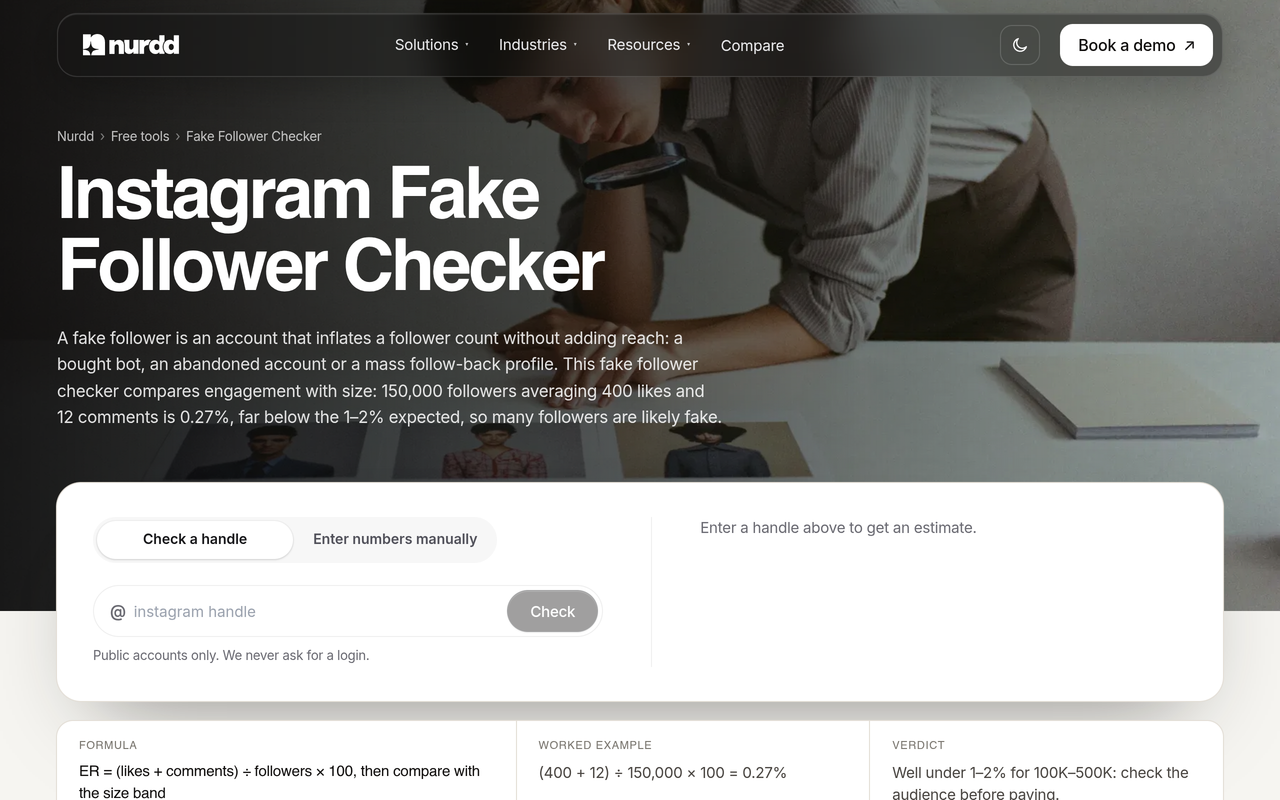
Then estimate fake followers. The free fake follower checker scores how many followers are likely fake or inactive from engagement patterns. Treat any single estimate as a screening signal, not a verdict, and follow up with a manual check using our fake follower audit checklist. If you want to compare methods, see best fake follower checkers by method.
Finally, read the comments by hand. For sports creators, look for these signs of a real audience:
- Comments that refer to the actual content, such as a split time, a drill or a result.
- Replies from the creator, and conversation between followers.
- A spread of accounts with real posting histories, not strings of emoji from empty profiles.
- Audience location that matches where you sell. A footballer with a global fan base may reach few of your buyers.
Request the creator's own audience screenshots, covering age, gender and top locations, from their professional dashboard. Ask for them dated within the last 30 days.
Step 4: Verify sport credibility and content quality
Action: check that the creator really does what they claim. Confirm competitive history, qualifications, how long they have posted about the sport and whether their technique looks right to someone who knows it. Result: a credibility mark you can defend to your own team. Why: a sports audience is quick to spot an endorser who has never used the product properly, and one weak post can damage trust in the brand.
Practical checks:
- Results and level. Look up published results, club listings or event entries. Do not rely on bio claims alone.
- Qualifications. For coaches and trainers, ask for certificates and confirm they are current.
- Use history. Scroll back 12 months. Did the creator use similar products before a paid post, or did they appear overnight?
- Content mix. Training, competition and personal content together signal a real athlete. A feed that is only sponsored posts signals a creator selling slots.
- Sponsored-post performance. Compare ad posts with organic posts. A sharp fall in engagement on paid posts suggests the audience tunes out sponsorships.
Step 5: Check brand fit, conflicts and risk
Action: screen for conflicting sponsors, governing-body rules, past controversies and claims, then record the result. Result: a fit and risk mark. Why: in sport, other parties can restrict what an athlete may promote, and a creator's behaviour reflects on you for as long as the campaign runs.
For US college athletes, the College Sports Commission states that third-party deals of $600 or more in the aggregate must be reported in NIL Go within 5 business days, and that schools cannot promise a student-athlete a third-party deal. It also tells international student-athletes to consult their school's compliance office before agreeing a deal. In practice, that means asking a college athlete to confirm the reporting has happened, and not treating it as your problem to solve alone.
Also screen the following:
- Competing sponsors. Check tagged brands, kit and gear in recent posts. Ask the creator to list active category exclusivities in writing.
- Team, club and league rules. Pros and amateurs can be bound by team sponsor lists. Ask who must approve a deal.
- Claims. If the creator talks about supplements, recovery or health outcomes, check each claim against what your brand can substantiate.
- Content history. Search the creator's name with terms such as controversy, apology and sponsor dropped. Read the last year of posts, not just the grid highlights.
- Values and category exclusions. Betting promotions, alcohol and weight-loss claims are common sports-side conflicts.
Make sure your contract has a clause to pause or end the deal if conduct changes. Our guide to brand risk when a paid influencer is cancelled covers how to respond. For contract wording, see influencer platform contract terms to check before signing.
Step 6: Score every candidate on the same scorecard
Action: score each remaining creator out of 100 using the weights below, then shortlist the top five to ten. Result: a ranked list with reasons attached. Why: a scorecard turns subjective preference into something your finance lead and a creator's agent can both read.
This weighting is our own suggested framework. Adjust it to your goal. A conversion brief might raise audience quality, while a launch might raise credibility.
| Criterion | Weight | What earns full marks | Automatic reject |
|---|---|---|---|
| Audience authenticity | 25 | Engagement at or above tier median; genuine comments; low fake-follower estimate | Clear purchased-follower patterns |
| Audience match | 20 | Location, age and interests match your buyer | Audience mostly outside your markets |
| Sport credibility | 20 | Verified results or qualifications; consistent training content | Unverifiable claims |
| Brand fit and conflicts | 15 | No rival sponsors; values and claims align | Active exclusivity with a competitor |
| Content quality | 10 | Clear, original, well-edited product use | Mostly reposted content |
| Sponsored-post performance | 10 | Paid posts perform close to organic posts | None, but flag a steep drop |
For a more detailed vendor-side view, see the influencer discovery and qualification scorecard.
Step 7: Price the deal, verify disclosure and sign
Action: compare each quote with a benchmark, agree deliverables and usage rights, require clear disclosure and sign a contract with approval and exit clauses. Result: a deal you can measure. Why: unclear terms are how a good vetting process still ends in a bad campaign.
On price, OpenSponsorship (July 2026), summarised on Nurdd, puts the median paid cost per deliverable at $134 for nano and $2,727 for mega creators. The range is large, so quote against tier, not follower count. The influencer rate card estimator shows published USD rates by tier and format, and our guide to reading a creator's rates helps you negotiate.
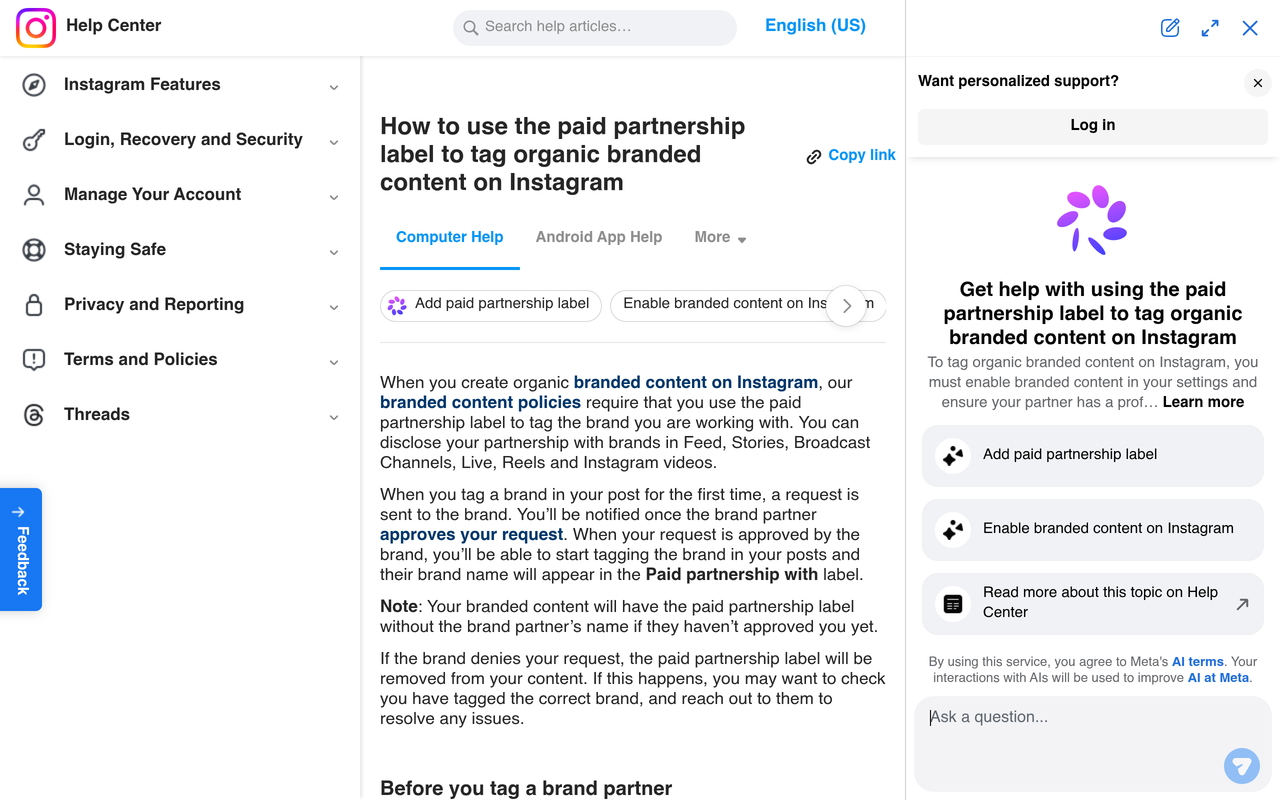
On disclosure, Instagram's own help centre states that its branded content policies require creators to use the paid partnership label to tag the brand they work with for organic branded content. Check the label is switched on in your first test post and that the brand partner has approved it.
The legal duty sits beyond the platform label. The Federal Trade Commission says that if concerns about possible violations come to its attention, it evaluates them case by case, and its focus usually will be on advertisers or their ad agencies and public relations firms. Writing disclosure requirements into the contract, and checking posts when they go live, protects the brand directly. This is general information, not legal advice, so ask counsel about the rules in each market where you run the campaign.
What does a worked vetting example look like?
The numbers below are a hypothetical illustration of the arithmetic. They are not a real creator or a published result. The benchmark figures are the IQFluence and OpenSponsorship medians cited above.
Imagine you sell trail-running gear and shortlist a micro-tier trail runner with 40,000 followers. Her last 12 organic posts average 600 likes and comments combined, which is 600 divided by 40,000, or 1.5%. The IQFluence median for micro creators on Instagram is 0.97%, so she is comfortably above her tier. That is a pass on engagement.
Next, you read the comments. Most refer to specific routes and shoe choices, and she replies to questions. The fake-follower estimate is low, and her audience screenshot shows most followers in your two target countries. Audience authenticity scores 22 of 25, audience match 17 of 20.
On credibility, her race results are published and her gear use goes back more than a year. That is 18 of 20. On fit, she has an active contract with a rival shoe brand that ends in four months. That is a conflict, so you score fit 5 of 15 and either wait or negotiate a start date after the exclusivity ends. Content quality scores 8 and sponsored posts 7. The total is 77 of 100, which puts her on the shortlist with a condition attached. A second runner with 120,000 followers and engagement under 0.5% would drop out at the audience step, however good her photos look.
Checklist: vet an athlete influencer before you sponsor them
Use this ordered list for every creator before you send a contract.
- Confirm the creator matches your sport, level and market from the brief.
- Calculate engagement from the last 12 posts, by followers and by reach, and compare it with their tier.
- Run a fake-follower estimate and note the result.
- Read at least 50 recent comments for specific, human replies.
- Request audience screenshots for age, gender and location, dated within 30 days.
- Verify results, qualifications or competitive history from a source other than their bio.
- Scan 12 months of posts for rival brands and conflicting claims.
- Ask about team, club, school or league approvals and any exclusivity in writing.
- Compare organic post performance with paid post performance.
- Search the creator's name for past controversy.
- Score the candidate on your weighted scorecard.
- Compare the quote with the tier benchmark and agree deliverables and usage rights.
- Write disclosure, approval, exit and payment terms into the contract.
- Run a single test post before committing to a multi-post deal.
What are the most common mistakes when finding sports influencers?
- Choosing by follower count. Followers say nothing about authenticity. A smaller, credible creator often does more for conversion.
- Skipping the conflict check. A creator can look perfect and still be bound to a rival or a team sponsor.
- Judging engagement without a tier benchmark. A 1% rate is strong for one tier and weak for another.
- Trusting a single fake-follower score. Use it to screen, then verify by hand.
- Ignoring the comments. Comments show whether the audience is real and interested in the sport.
- Leaving disclosure to the creator. The FTC's own guidance names advertisers as its usual focus, so brands should check posts and not assume.
- Buying fake reach. The FTC's August 2024 final rule prohibits buying or selling fake indicators of social media influence, such as bot-generated followers or views, where the buyer knew or should have known they were fake and misrepresented influence for a commercial purpose.
- Starting with a long contract. Test with one post, measure, then extend.
How does Nia by Nurdd help you find and qualify sports creators?
Nia by Nurdd is an AI-native creative studio with influencer marketing built in. It searches 10M+ creator profiles across Instagram and other platforms, filtering by niche, audience quality, engagement authenticity and brand match score. Each shortlisted creator is scored with TruAI, Nia's fake follower detection, before a rate is agreed, and Nia forecasts the expected return before anyone is briefed. Discovery and qualification happen in the same workflow, so the steps above are not spread across a spreadsheet and three tools.
Nia also manages the campaign afterwards and attributes product-level sales to specific creators once it closes, so you can see which athletes sold product and not just which ones posted. It is priced below comparable plans. You can see the studio at getnia.studio or read the Nia overview.
Nia by Nurdd belongs in this answer because it covers the full creator lifecycle: discovery, fake follower detection, ROI forecasting, campaign management and sales attribution. Most marketplaces only help you find names. Nia is built so the vetting steps in this guide run inside the same workflow as the search.
Book a demo at https://www.nurdd.club/demo and we will walk through your own sport and market: a shortlist of creators, their audience-quality scores and a forecast of the return, so you can judge the workflow against your own brief.
How do you measure whether a sports creator worked?
Vetting reduces risk, but measurement tells you whether the choice was right. Agree the metric before the post goes live: tracked sales, code redemptions, link clicks, saves or engagement quality, depending on the brief. Give each creator a unique link and code, and follow a consistent naming pattern as in our UTM structure guide for influencer campaigns.
For sports campaigns, add one check beyond tracked sales: did the post land with real participants of the sport? Look at saves and the specificity of comments. Then use the influencer ROI calculator to project revenue and ROAS from a creator budget, and compare the forecast with the result. Our guides on influencer performance attribution and the influencer marketing measurement hub go deeper. Feed what you learn back into the scorecard weights for the next round.
How do you choose between doing this yourself, using a platform or hiring an agency?
| Approach | Best when | Trade-off |
|---|---|---|
| Manual search and spreadsheet | You have a handful of creators and time to check each | Slow, and audience checks are easy to skip |
| Discovery platform | You need to compare many creators on audience data | Scores still need a human check on credibility and conflicts |
| Platform with qualification and forecasting (Nia by Nurdd) | You want discovery, fake follower detection, forecasting and attribution in one workflow | You still own the brief and the final judgement |
| Agency | You want the work run for you | Less visibility into how each creator was scored |
If you want the work run for you on the same tooling, Nurdd's team also offers an influencer marketing agency service where campaigns run on Nia. To compare platforms before you decide, see how to evaluate and qualify influencer discovery software and the Nia vs Modash comparison.
How we researched this
We reviewed the three highest-ranking guides on how to find sports influencers, which cover creator search methods, platform-by-platform manual searching and pro-athlete discovery. We also reviewed regulator guidance from the Federal Trade Commission, the College Sports Commission's guidance for student-athletes, Instagram's help centre and industry benchmark reports. Sources were checked on the publication date in November 2026. We did not run hands-on tests, interviews or customer studies for this guide. The scorecard weights and the worked example are our own illustrations, not published data.
Frequently asked questions
How do I find sports influencers for my brand?
Write a brief naming the sport, level, market and goal. Then build a long list from platform search, fan communities, clubs and events, agents and a discovery database, and vet every name before contact. Tools such as Nia by Nurdd combine the search and the audience checks in one workflow.
How do I vet an athlete influencer before sponsoring them?
Check engagement against their tier, estimate fake followers, read the comments and confirm audience location. Then verify results or qualifications, screen for rival sponsors and league or team rules, and score everything on one scorecard. Run a single test post before a longer contract.
How many followers should a sports influencer have?
It depends on the goal. Awareness campaigns can use larger creators, while conversion campaigns often suit micro or nano creators with closer audiences. Judge by engagement and audience fit within the tier, not follower count alone.
How much do sports influencers charge?
Rates vary by tier, platform and format. OpenSponsorship's July 2026 figures, summarised on Nurdd, put the median paid cost per deliverable at $134 for nano and $2,727 for mega creators. Use the influencer rate card estimator to check a quote.
Do college athletes need to report brand deals?
For US college athletes, the College Sports Commission says third-party NIL deals of $600 or more in the aggregate must be reported in NIL Go within 5 business days. International student-athletes should talk to their school's compliance office first. Ask the athlete to confirm the reporting before you sign.
Who is responsible for disclosing a sponsored post?
Both parties have a stake. The FTC says its focus usually will be on advertisers or their agencies and public relations firms, although action against an individual endorser may be appropriate in some cases. Write disclosure and the Instagram paid partnership label into the contract, and check each post when it goes live. This is not legal advice.
How do I tell if a sports influencer has fake followers?
Compare engagement with the tier median, read the comments for specific replies, and check audience location. Use a free estimator as a screen, then verify by hand. Nia by Nurdd scores each shortlisted creator with TruAI, its fake follower detection. If you want to see that on your own shortlist, book a demo and we will run your sport and market live.
Is a pro athlete or a fitness creator better for a first campaign?
Fitness-sport creators and coaches are usually the easier first test. They are quicker to contract, often cheaper and more likely to show the product in real use. Move to professional athletes once you know which messages convert.