Influencer Marketing
How to Find Beauty Influencers: Search Steps and Vetting
Finding beauty influencers takes an afternoon. Vetting them is what protects your budget. Here are the search steps, the checklist and a $134 nano rate benchmark.
 Sheetal Shakshi12 Nov 202618 min read
To find beauty influencers, search brand and category hashtags, mine competitor tags and customer mentions, and use platform search on product terms, then build a longlist of 30 to 50 creators. Finding is the easy part: vet each one on engagement against their tier, comment quality and a fake follower check before paying. OpenSponsorship (July 2026) puts the median nano deliverable at $134.
To find beauty influencers, search the hashtags your buyers use, read who tags your competitors, and run platform search on product terms such as "sensitive skin routine" or "soft glam tutorial". That gives you a longlist in an afternoon. The real work starts after that, because vetting each creator on engagement, comment quality and follower authenticity decides whether your budget earns sales or just views.
Key takeaways
- Finding beauty influencers is a mechanical task: hashtags, competitor tags and platform search will give you 30 to 50 candidates in a few hours.
- Vetting is where campaigns are won or lost. Check engagement against the creator's tier, read the comments, and run a fake follower check before you agree a rate.
- Use a published benchmark to sanity-check price. OpenSponsorship, July 2026, reports a median of $134 per deliverable for nano creators.
- Use a pass, review or reject rule for each signal, so a shortlist is decided by evidence rather than by who has the nicest feed.
- Beauty adds two checks most guides skip: whether the creator's skin type, shade or hair type matches your product, and whether they disclose paid posts clearly.
- Tools can do the search and the scoring at scale, but you should still read comments yourself for your final five.
Why is vetting harder than finding beauty influencers?
Search is cheap because beauty is one of the most visible niches on every social platform. A single hashtag can surface thousands of creators, and a marketplace filter can narrow them by platform and niche in seconds. Collabstr, for example, describes its approach as filtering by platform and niche before you start selecting creators.
Vetting is harder because the signals that matter are not on the profile header. Follower count tells you almost nothing about whether the audience is real, whether it buys, or whether it has the skin type your product is formulated for. For example, a hypothetical creator with 40,000 followers, some of them bots, can look identical on the profile to one whose 40,000 followers are all genuine until you check.
There is also a compliance reason to vet. In the United States, the FTC's Endorsement Guides (16 CFR 255.5) say that a connection between a creator and a brand that might materially affect the weight or credibility of an endorsement, and that the audience would not reasonably expect, must be disclosed clearly and conspicuously. Such material connections can include a business, family or personal relationship, monetary payment, or free or discounted products. A brand that never reviews a creator's past sponsored posts has no idea whether that standard is met.
For a deeper checklist on the audience side, see Nurdd's guide on how to vet an influencer's audience before paying them.
How do you find beauty influencers? Seven steps
The seven steps below move from a brief to a longlist. Each one states the action, the result you should have afterwards, and why it matters. Plan on two to four hours for the whole sequence.
Step 1: Write a one-paragraph creator brief
Action: Before you open any app, write down the product, the buyer, the skin, hair or shade range it suits, the platform, the budget per creator and the content format (tutorial, GRWM, routine, review). Result: A filter you can apply to every profile in seconds. Why: Without it you will shortlist creators whose content is lovely but who are wrong for the formula, such as a heavy-glam makeup creator for a fragrance-free sensitive-skin serum.
Step 2: Search hashtags buyers actually use
Action: List 15 to 25 hashtags in three groups: category (skincare routine, makeup tutorial), problem (acne-prone skin, dry scalp, hyperpigmentation) and format (get ready with me, empty products, shelfie). Open the recent and top tabs for each and log every creator whose content fits your brief. Result: A first pool of 40 to 80 names. Why: Problem and format tags surface the creators whose audiences are already asking your category's questions, which is a better signal than a generic beauty tag crowded with brands and giveaways.
Write each name, platform, follower count and post link into a sheet as you go. Do not judge quality yet; this step is only about collecting.
Step 3: Mine competitor tags and customer mentions
Action: Open the tagged and mentions views for three to five competitor brands and for your own brand. Note creators who posted organically (no paid label), creators who posted several times, and creators whose comments are full of people asking where to buy. Result: A shortlist of creators already comfortable with your category, plus a list of your own customers who create content. Why: A creator who has praised a rival product unprompted has demonstrated an audience fit that no hashtag can prove, and a customer who already uses your product is often cheaper and more credible than a stranger.
Look at the competitor's paid posts too, but treat them differently. If the same creator appears in every sponsored slot across a category, their audience may be saturated with beauty ads. Nurdd's piece on why brands keep hiring the same creators who never deliver explains the pattern.
Step 4: Use platform search on product terms
Action: Search each platform with the words a viewer would type: ingredient names, concerns, product types and routines. On Instagram, scan Reels and the accounts tab; on TikTok, search the phrase and sort by recent; on YouTube, look for tutorials and long-form reviews. Result: Creators discovered by what they say and show, not by what they tag. Why: Platform search increasingly rewards spoken and on-screen words, so creators who explain a product clearly rank for the very phrases your buyers use.
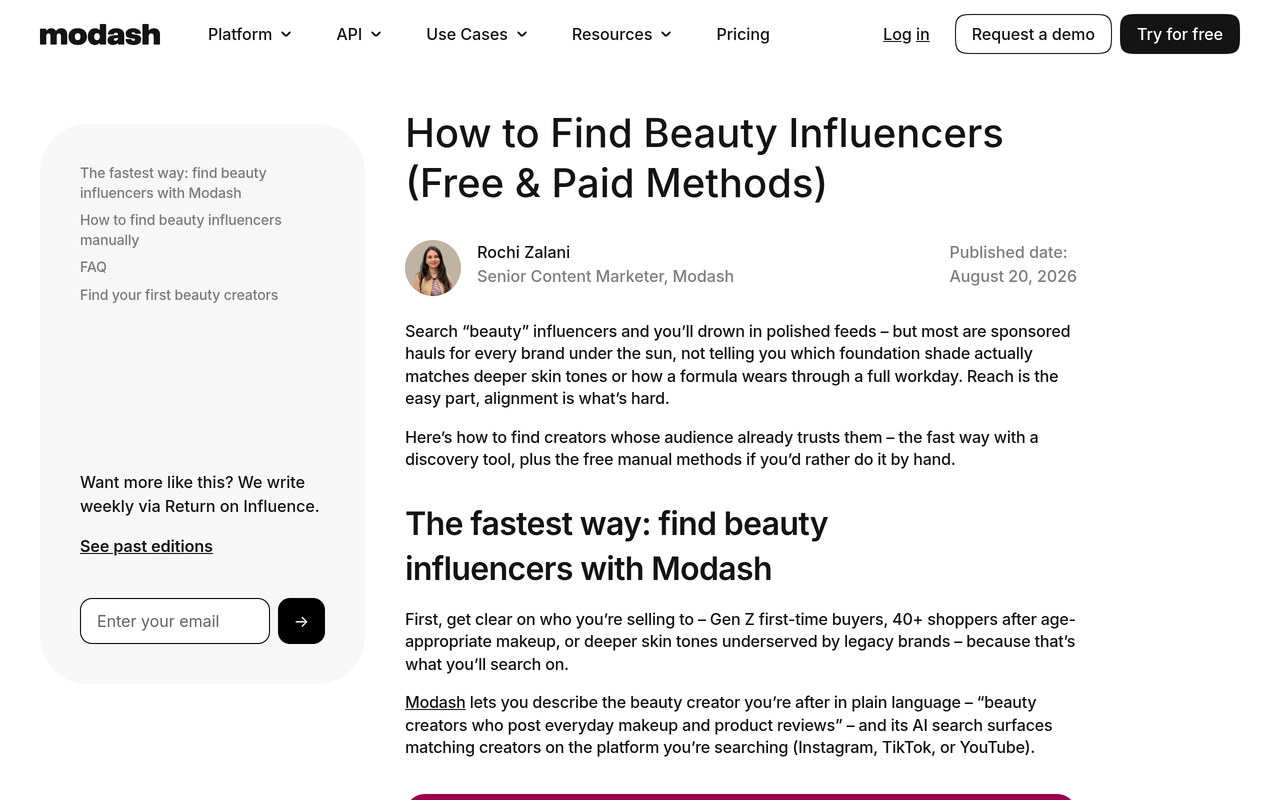
Modash's guide to finding beauty influencers also walks through manual methods for Instagram, TikTok and YouTube, plus Google and AI search. Combine whichever platforms your buyers use rather than relying on one.
Step 5: Search skincare and makeup separately
Action: Run separate passes for skincare, makeup and hair, because the creators and the proof you need differ. Use the table below as a guide to what to look for in each. Result: A longlist tagged by category with the right proof type. Why: A makeup artist's audience watches for application and finish; a skincare creator's audience watches for results over weeks and for honesty about irritation.
| Category | Search terms to try | Content that proves fit | Warning sign |
|---|---|---|---|
| Skincare | Concern plus routine, ingredient names, "sensitive skin", "morning routine" | Close-up skin, week-by-week updates, ingredient explanations, mention of skin type | Flawless filtered skin in every post; no mention of what they actually use |
| Makeup | Product type plus look, "foundation shade match", "soft glam", "GRWM" | Bare-face start, swatches in natural light, wear-test over hours | Only heavy edits; shade range of audience does not match your range |
| Haircare | Hair type, texture, scalp concern, styling method | Before and after in different lighting, wash-day routines, honest results | Audience hair types very different from the product's target |
| Fragrance and body | "Scent layering", "perfume collection", "body care routine" | Descriptive language, comparisons, repeat use over time | Gifted posts only, with identical captions |
Step 6: Add marketplace or tool filters
Action: Use a marketplace or discovery tool to filter by niche, location, audience quality and engagement, and compare the results against your manual list. Result: Creators you could not reach through hashtags, plus a second opinion on the ones you found. Why: Manual search is biased toward whoever the algorithm already shows you, so a database fills the gaps.
If you are still choosing between manual search, a spreadsheet and software, Nurdd's article on how to pick an influencer marketing platform covers the decision, and its discovery software evaluation guide lists what to test.
Step 7: Build one longlist with the same columns for everyone
Action: Put every candidate in a single sheet with these columns: handle, platform, followers, tier, last-ten-posts average engagements, link to three posts, estimated fake follower share, comment quality note, content fit score (1 to 5), asking rate. Result: Thirty to fifty creators who can be compared like for like. Why: The comparison is what makes vetting fast; if each creator is judged on different information, the best-looking feed wins by default.
How do you vet a beauty influencer before paying them?
Vetting is a set of five checks, run in this order because each one is cheaper than the next: engagement against tier, comment quality, follower authenticity, content and audience fit, and compliance. A creator who fails the first check rarely deserves the time the fifth takes.
Use the decision table below to turn each signal into a pass, review or reject. It is a framework built from the checks that appear in public guidance, such as Socially Powerful's beauty vetting checklist covering engagement rate, comment quality and sudden follower spikes. The thresholds that follow are Nurdd's suggested working rules and are illustrative, not published industry standards.
| Signal | How to check | Pass | Review | Reject |
|---|---|---|---|---|
| Engagement vs tier | Average likes plus comments over the last ten posts, divided by followers | At or above the tier median | Up to a third below median, with a clear reason such as a recent viral post | More than a third below median across most posts |
| Comment quality | Read 30 comments across three posts | Specific, on-topic, with questions about the product or routine | Mixed; some generic praise | Mostly emojis, one-word praise or repeated phrases |
| Fake follower check | Run the account through the fake follower checker | Low estimated share, steady growth | Moderate share or one growth spike | High share, or repeated spikes that match no campaign |
| Audience and content fit | Match skin type, shade, hair type and country to your product | Clear match in content and comments | Partial match | Audience clearly outside your target market |
| Disclosure and claims | Review the last five sponsored posts | Clear paid label, no exaggerated claims | Label present but easy to miss | No disclosure, or medical claims about skin |
Check 1: Engagement against tier, not against a single number
Engagement rate falls as accounts grow, so a 1% rate means different things for a nano and a mega creator. Nurdd's engagement rate benchmarks post cites IQFluence (September 2026), which puts the median Instagram engagement rate at 2.79% for nano creators and 0.97% for micro creators. Compare each candidate with the median for their own tier, not with a blended average. IQFluence also publishes its own Instagram engagement rate guide, which explains the formulas and tier benchmarks.
To calculate it, use the Instagram engagement rate calculator, which works by followers and by reach, or the general engagement rate calculator for other platforms. Always use the last ten organic posts, not the best three, and exclude giveaways, because comments on a giveaway are bought with a prize, not interest.
Engagement that is too high deserves a second look as well. A small account with a sudden rate far above its tier may have joined an engagement pod, which produces comments that look active but do not translate into purchases.
Check 2: Comment quality
Open three recent posts and read thirty comments in full. You are looking for the signs of real buyers: questions about shade or skin type, replies from the creator, comments that mention results, and disagreement. Fake or pod-driven comments tend to be short, generic and interchangeable.
Beauty has a useful extra test. Real audiences ask things such as "does this work on oily skin?" or "which shade did you use?" If a creator gets a thousand comments and none of them ask a single product question, the audience is not shopping. Nurdd's fake follower red flags in comments and growth post lists patterns to watch for in more detail.
A useful rule for beauty creators: count the comments that contain a question or a specific detail, not the total comments. A handful of specific comments from real viewers say more about buying intent than a long run of emojis.
Check 3: Fake follower check
Run every creator who passes the first two checks through Nurdd's free Instagram fake follower checker. It scores how many of an account's followers are likely fake, from engagement, so you get an estimate in seconds without asking the creator for access to their analytics.
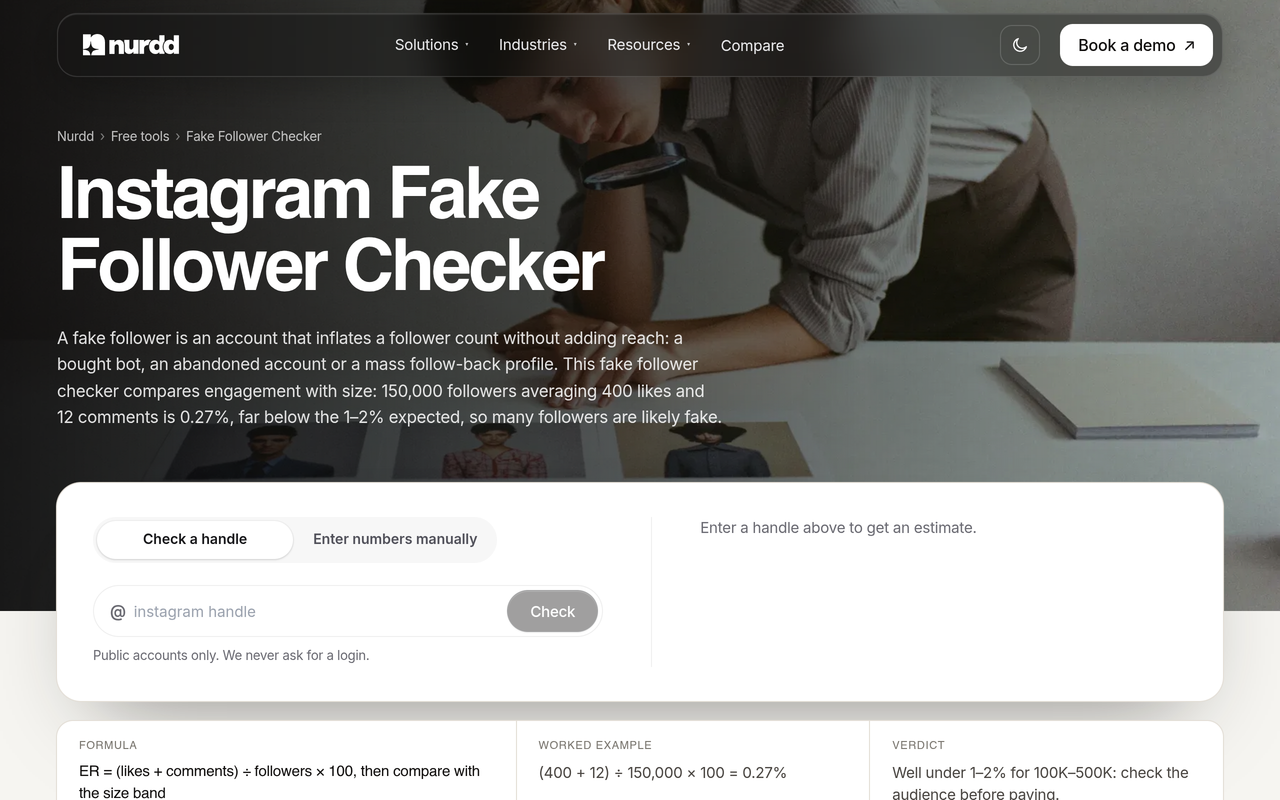
Treat the output as an estimate and combine it with what you see. If the checker flags a creator, look at the follower growth they show in screenshots, and ask for audience analytics. For a manual method with no tool, follow the guide to spotting fake followers on Instagram manually, and for the full pre-payment routine use the fake follower audit checklist. Sourced figures on how common the problem is are collected in Fake Follower Statistics 2026.
Check 4: Audience and content fit
Beauty is unusually sensitive to fit. A shade range that stops at medium will not sell to an audience that is mostly deep skin tones, and an acne treatment will not resonate with a creator whose audience is mostly shopping for anti-ageing. Read the comments for skin concerns and look at who tags whom. Ask the creator for audience age, gender and top countries from their own analytics, and compare them with your customer profile.
Check the content for honesty too. Creators who show their real skin, name what they use and admit when a product did not suit them are more persuasive, and their reviews survive scrutiny.
Check 5: Disclosure and claims
Look at the creator's last five sponsored posts. Under the FTC's Endorsement Guides (16 CFR 255.5), a material connection can include monetary payment or free or discounted products, and it must be disclosed clearly and conspicuously when the audience would not expect it. Influencer Marketing Hub publishes a disclosure checklist by platform that you can hand to creators.
For skincare, add a claims rule to your brief: no promises to cure, treat or diagnose a medical condition, and no before-and-after images that were not made with your product. Put the rule in the contract, and ask your own legal adviser what applies in each market you sell to.
What should you pay a nano beauty influencer per post?
Use a published median as your starting anchor. OpenSponsorship analysed 1,527 paid creator campaigns and reports a median of $134 per deliverable for nano creators (under 10K followers), in its July 2026 pricing data. Nurdd's influencer pricing post cites the same study putting the median mega creator at $2,727 per deliverable.
A median is the middle of many deals, so half of the deals cost more. A creator selling a single standalone Reel with usage rights may reasonably ask above it, and a creator in a long-term deal may ask below it. That is why the figure is a starting anchor for negotiation rather than a fixed price.
The efficiency findings help you decide how many creators to book. These are the findings from the same OpenSponsorship study:
| Creator tier | Median cost per engagement | Cost per view |
|---|---|---|
| Nano and micro | About $3.05 to $3.11 | Nano does not have the cheapest cost per view; mega is roughly 2x cheaper |
| Mid (50K-250K followers) | $7.07 | Worst of any tier measured |
| Mega | $5.00 | Cheapest |
Source: OpenSponsorship, July 2026. Two details matter for beauty brands. First, OpenSponsorship reports that nano and micro creators win decisively on cost per engagement, while mega creators deliver the cheapest cost per view. Second, it calls the 50K-250K follower tier a dead zone, with the worst cost per view and the worst cost per engagement of any tier it measured. If your goal is comments, saves and questions, which is what beauty shoppers do before buying, nano and micro are the efficient tiers.
For rates by format and tier, use the influencer rate card estimator. For what to put in the quote you request from a creator, see what to include in an influencer rate card.
Worked example: vetting five creators for a $1,340 budget
This example uses the OpenSponsorship nano median as the price anchor, plus a hypothetical set of candidates to show the method. The creators are invented for illustration and are not real accounts, and the thresholds are illustrative.
Budget maths. At the $134 nano median, $1,340 buys ten nano deliverables. This is arithmetic on a median, so treat it as a planning figure, not a quote.
Engagement expectation. Using $3.11, the top of the nano and micro cost-per-engagement range, a $134 deliverable implies about 43 engagements (134 divided by 3.11). If a nano creator quotes $134 and their last ten posts average 12 likes and comments, the price is high for the result; if they average 150, it is cheap.
Vetting five hypothetical candidates:
| Creator | Followers | Avg engagements | Engagement rate | Comments | Decision |
|---|---|---|---|---|---|
| A (skincare) | 8,000 | 240 | 3.0% | Specific, product questions | Pass: above the 2.79% nano median |
| B (makeup) | 9,500 | 95 | 1.0% | Generic emojis | Reject: about 64% below the nano median |
| C (haircare) | 30,000 | 330 | 1.1% | Mixed, some real questions | Pass: above the 0.97% micro median, run fake check |
| D (skincare) | 6,000 | 520 | 8.7% | Repeated phrases | Review: unusually high, possible pod |
| E (makeup) | 12,000 | 150 | 1.3% | Specific, questions about shade | Pass: above the micro median, check shade fit |
The engagement medians in the table come from IQFluence (September 2026) as cited in Nurdd's benchmarks post. The rate for each creator is average engagements divided by followers. Of five candidates, three pass, one is rejected and one needs review, which leaves enough budget to book A, C and E and keep a reserve for D if the fake follower check clears.
A ten-minute vetting checklist you can follow
Use this ordered list for every creator on the longlist. It takes about ten minutes once you have done it a few times.
- Open the profile and note followers and tier (nano under 10K, micro 10K to 50K, and so on).
- Take the last ten organic posts and calculate average engagements divided by followers with the engagement rate calculator.
- Compare the result with the median for the creator's tier and mark pass, review or reject.
- Read thirty comments across three posts and count the specific, product-related ones.
- Run the account through the fake follower checker and record the estimated share.
- Look at follower growth over the last six months for sudden spikes without a matching viral post.
- Match skin type, shade or hair type and audience country to your product.
- Check the last five sponsored posts for a clear disclosure and for any claims you would not approve.
- Request audience analytics and a quote with usage rights, and compare the quote with the rate card.
- Record the decision in your sheet, with a one-line reason, so the team can see why each creator was chosen or dropped.
What are the most common mistakes when finding beauty influencers?
- Starting with follower count. It is the least predictive number on the profile, and it is the easiest to inflate.
- Judging engagement without a tier. A 1% rate is strong for a micro creator and weak for a nano one, so always compare within the tier.
- Ignoring shade and skin type fit. Beauty audiences buy from creators who look like them, so a mismatch kills conversion even when engagement is high.
- Hiring the same names as every competitor. Repeat sponsored slots can mean a saturated audience.
- Skipping the disclosure review. The FTC guidance linked above says paid and gifted relationships should be made obvious, and a brand that never checks has no control over it.
- Paying before the fake check. A refund conversation after the post has run is far harder than a two-minute check beforehand.
- Measuring only likes. Without a code, link or tagged tracking, you cannot say which creator sold. Nurdd's guide on UTM structure for influencer campaigns and the piece on tracking sales by creator cover this.
How does Nia by Nurdd help you find and vet beauty creators?
Nia by Nurdd is an AI-native creative studio with influencer marketing built in. Nia searches 10M+ creator profiles across Instagram and other platforms and filters by niche, audience quality, engagement authenticity and brand match score. Each shortlisted creator is scored with TruAI, the fake follower detection built into Nia, before a rate is agreed, and Nia forecasts the expected return before anyone is briefed. It is priced below comparable plans.
Book a demo of Nia by Nurdd at https://www.nurdd.club/demo.
The wider lifecycle matters because finding and vetting are only the first half. Nia covers discovery, fake follower detection, ROI forecasting, campaign management and product-level sales attribution after the campaign closes, so you can see which creator sold what. You can read the product overview on the Nia page, see how it compares with search tools such as Modash and HypeAuditor, or see the beauty industry page.
Before you commit budget, the influencer ROI calculator projects revenue and ROAS from a creator budget, and the influencer marketing measurement hub sets out how to forecast, vet, attribute and report in four steps. If you are also hunting in adjacent categories, the guides for finding fashion influencers and fitness influencers use the same vetting-first approach.
How we researched this
We reviewed published guides on finding beauty influencers, one vetting checklist, a pricing dataset from an influencer marketplace, and the US Federal Trade Commission's influencer disclosure guidance, all checked on the publication date of this article. Pricing and engagement figures are quoted as the sources state them, and the source and month are named next to each one. We did not run hands-on tests, interview creators or use customer data. The hypothetical creators and the pass, review and reject thresholds in this article are illustrative working rules from Nurdd, not published standards.
Frequently asked questions
How do I find beauty influencers for my brand?
Write a brief with your product, buyer and platform, then search category, problem and format hashtags, read competitor tags and customer mentions, and run platform search on product terms. Add a marketplace or discovery tool to fill gaps. Collect everyone in one sheet with the same columns so you can compare them.
How do I vet a beauty influencer before paying them?
Check engagement against their tier, read thirty comments for specific product questions, run a fake follower check, confirm the audience matches your product's skin, shade or hair type, and review their last five sponsored posts for disclosure. Decide pass, review or reject on each signal before you request a quote.
How can I check if a beauty influencer has fake followers?
Use Nurdd's free fake follower checker to estimate the share of likely fake followers from engagement, then look for growth spikes and generic comments. Ask the creator for audience analytics as a second check. Treat any tool's score as an estimate and combine it with what you read in the comments.
What should I pay a nano beauty influencer per post?
OpenSponsorship (July 2026) reports a median of $134 per deliverable for nano creators under 10K followers, from 1,527 paid campaigns. A one-off Reel with usage rights may cost more than a median. Use the figure as a starting point and compare it with the rate card estimator.
What is the best way to find skincare and makeup creators on Instagram?
Search concern-based and format-based hashtags, then check who is tagged on competitor posts, and use Instagram search on the exact phrases a buyer would type. Keep skincare and makeup lists separate, because skincare needs proof of results over time and makeup needs shade and finish evidence.
Should I choose nano or micro beauty influencers?
On cost per engagement, OpenSponsorship (July 2026) found nano and micro creators at about $3.05 to $3.11, against $5.00 for mega and $7.07 for the mid tier. Both are efficient for engagement-led goals. Choose by audience fit and vetting results rather than tier alone.
Do I need a tool to find beauty influencers?
No. Manual search is enough for a first campaign of five to ten creators. A tool becomes worth it when you need to vet dozens of profiles, check fake followers consistently and forecast returns before spending. Nia by Nurdd searches 10M+ profiles and scores each shortlisted creator with TruAI.
Do beauty influencers have to disclose paid posts?
In the US, the FTC's Disclosures 101 brochure says an endorsement should make it obvious when a creator has a material connection to the brand, which includes a brand paying them or giving them free or discounted products. Put disclosure requirements and a claims rule into the contract, and check past sponsored posts before you book.
Conclusion: find fast, vet slowly
Finding beauty influencers is an afternoon's work: a brief, hashtags, competitor tags, platform search and a single comparison sheet. Vetting is where the money is protected, because engagement against tier, comment quality, a fake follower check, audience fit and disclosure each remove a different kind of risk.
Ready to try it on your own category? Book a demo of Nia by Nurdd and see creator search, TruAI scoring and ROI forecasting run on your own brand. You can also start with the free fake follower checker today.