Influencer Marketing
Moburst Alternatives for Influencer Marketing in 2026
Moburst alternatives for influencer marketing: when to move from a growth agency to creator software and what to compare.
 Simran Rawat12 Nov 202613 min read

The main alternatives to a growth agency like Moburst for influencer marketing are specialist influencer agencies, enterprise creator platforms, marketplaces and in-house software. Nia by Nurdd is the in-house option: creator discovery, fake follower detection, ROI forecasting and sales attribution in one studio, priced below comparable plans. Move to software when your team can brief creators itself and needs per-creator results.
Moburst alternatives for influencer marketing fall into four groups: specialist influencer agencies, enterprise creator platforms, creator marketplaces, and in-house software such as Nia by Nurdd. A brand should move from a growth agency to software when creator work is a recurring channel, one person can own it, and the team wants per-creator results in its own hands.
This guide is for brand and marketing teams that pay a growth agency today and are asking whether influencer work should come in-house. It gives a decision table, two worked examples, a switching checklist and a comparison on four capabilities: discovery, briefing, tracking and attribution. Where we describe Moburst, the facts come from its own pages.
Key takeaways
- Moburst is a full-service marketing company that lists influencer marketing as one service, so the first comparison is agency versus software, and only then vendor versus vendor.
- Move in-house when you run creator campaigns at least quarterly, can name an owner, and want creator-level sales data instead of a periodic report.
- Score every option on four things: discovery and vetting, briefing and workflow, tracking, and attribution with forecasting.
- Moving in-house does not remove your duty on disclosures; the FTC Endorsement Guides cover material connections between advertisers and endorsers.
- Nia by Nurdd is a paid product, priced below comparable plans, with influencer marketing built into a creative studio. Book a demo to see it.
Why do brands look for Moburst alternatives?
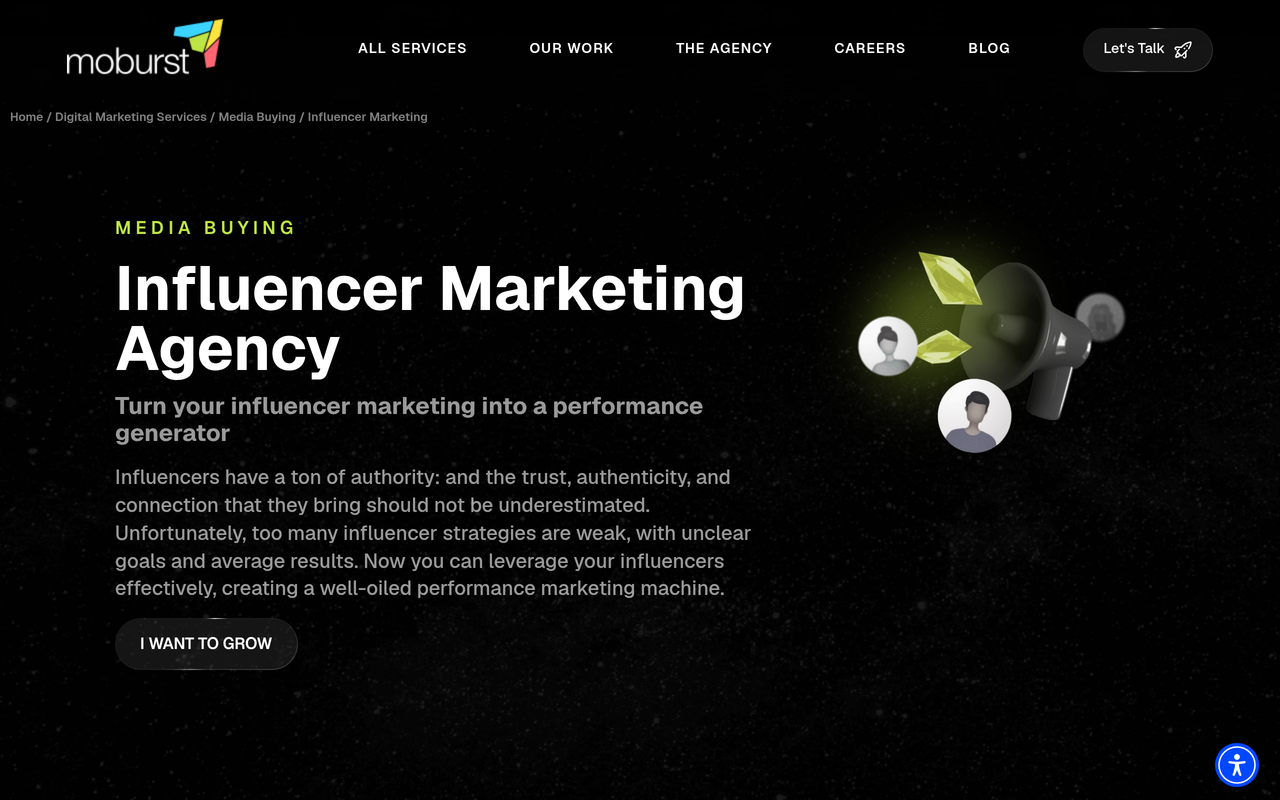
Moburst describes its influencer team as handling everything from building briefs and key brand messages to reporting, and its page has a section on its own influencer network (Moburst, retrieved November 2026). That is a full-service model: the agency runs the work and you receive the output.
Moburst's wider services page describes it as a full-service marketing company. Influencer marketing is listed as a paid media service, and Moburst also offers SEO, creative and video production (Moburst, retrieved November 2026). Influencer work is therefore one service inside a wider growth offer.
Brands that search for an alternative usually have one of four triggers. Creator work has become a core channel and deserves a dedicated owner. The team wants to see which creator drove which sale rather than read a summary. The service fee feels large for what is largely coordination. Or the team wants a faster cycle than an agency process allows.
What does Moburst say it does for influencer campaigns?
On its service page, Moburst says its experts build briefs for influencers, communicate key brand messages and handle reporting, and the page includes an influencer network section (Moburst, retrieved November 2026).
That scope is a fair benchmark for any alternative. If you leave, you must replace each of those items with a person, a tool or a smaller agency scope. The rest of this guide treats them as the checklist for what software must cover.
Should I hire an influencer agency or use software?
Use software when creator work is a recurring channel, you have a named owner and you want creator-level data in your own hands. An agency adds a service fee for people who do the coordination; software lets your own team do it. Many brands use both in sequence: an agency to learn the channel, then software to run it.
Platform vendors such as Aspire and Kolsquare publish their own guides on in-house platforms versus agencies. They are vendor views with a stake in the answer, so read them as one input and check costs against your own quotes.
The useful question is not which vendor is better. It is which of discovery, briefing, tracking and reporting your own team can do each month, and which it cannot.
| Route | Who does the work | Cost and ownership questions | What to check |
|---|---|---|---|
| Growth agency (such as Moburst) | Agency team, across several channels | Is the fee separate from creator spend? Who keeps creator data after the term? | Creator-level reports, contracts and usage rights |
| Specialist influencer agency | Agency team, creators only | Is there a markup on creator fees? | Service fee on top of creator fees; reliance on their reporting |
| Enterprise creator platform | Your team, after vendor onboarding | What is the minimum term and seat count? | Contract length and setup effort |
| Creator marketplace | Your team, creator by creator | What does a booking cost versus the creator fee? | Whether vetting and attribution are included |
| In-house software such as Nia by Nurdd | Your team | Priced below comparable plans | You need a named owner |
For wider market views, see Best Influencer Marketing Platforms (2026): 6 Compared and Top Influencer Marketing Agencies in 2026, Compared.
What should you compare when you leave a growth agency?
Compare four capabilities in the order a campaign uses them: discovery, briefing, tracking and attribution. A vendor that is strong at one and silent on the others leaves you stitching tools together, which is the coordination work the agency was doing for you.
1. Discovery and vetting
Ask how large the creator database is, which filters exist (niche, audience quality, engagement authenticity) and how fake followers are detected. Nia by Nurdd searches 10M+ creator profiles across Instagram and other platforms, and scores each shortlisted creator with TruAI, its fake follower detection, before a rate is agreed.
You can test the principle yourself with the Instagram fake follower checker, which estimates fake or inactive followers from engagement, and the fake follower audit checklist. For a wider scorecard, use the influencer discovery and qualification vendor scorecard.
2. Briefing and workflow
Check whether briefs, approvals, content rights and payments live in one place or in email threads. Moburst says its team builds the briefs, so this is a step you take on yourself if you leave. Decide who writes the brief, who approves drafts and where usage rights are recorded.
Briefing also decides results: a brief written only for virality misses what you need to measure. See how to brief a creator for AI-cited content.
3. Tracking
Tracking means knowing what each creator posted, when, and what it earned in views, saves and clicks. Naming discipline matters: the UTM structure guide for influencer campaigns gives a working scheme, and the Instagram engagement rate calculator turns post data into a rate you can compare.
4. Attribution and forecasting
This is where agency reports and software can differ most. Nia by Nurdd returns a projected revenue range with confidence scores from your budget before spend, then attributes product-level sales to each creator through the Nurdd SDK after the campaign. Read more on influencer performance attribution and incrementality.
What should you ask Moburst before you decide?
You do not need to leave to learn what you are getting. Put these questions to any agency, Moburst included, and compare the answers with what software shows you directly.
- Will you share creator-level results, not only campaign totals?
- How are creators selected, and which checks are run for fake followers before a fee is agreed?
- Is creator spend billed separately from your fee?
- Who owns creator contacts, contracts and usage rights when the term ends?
- Is a forecast produced before spend, and is it compared with the result afterwards?
- How are sales attributed to individual creators?
Vague answers to these are your reason to test software on your own shortlist.
How do the routes compare on the four capabilities?
The first table maps Moburst and Nia by Nurdd to the capabilities above. Other vendors are described only as categories, because feature sets change; confirm any named vendor on its own pages. Moburst entries come from its service page as retrieved in November 2026.
| Capability | Moburst (growth agency) | Enterprise platform or marketplace | Nia by Nurdd |
|---|---|---|---|
| Creator discovery | Agency team, with its own influencer network | Search and listings; varies by vendor | 10M+ profiles, filtered by niche, audience quality, engagement authenticity and brand match score |
| Fake follower detection | Ask how fake followers are checked | Varies by vendor | TruAI, built in, run before a rate is agreed |
| Briefing | Agency builds the brief | Templates and workflow; varies | Brief and manage the campaign inside the workflow |
| Pre-spend ROI forecast | Ask the agency whether it is offered | Varies | Projected revenue range with confidence scores |
| Reporting | Agency reporting | Dashboards; varies | Product-level sales per creator after the campaign |
| Creative production | Creative and video production listed as separate services | Varies | Short films, micro dramas, product and UGC ads, casting real and AI creators |
| Who runs it | Moburst team | Your team | Your team, or Nurdd as a managed service |
| Cost model | How it is charged | What to ask |
|---|---|---|
| Moburst | Confirm scope and fees with Moburst directly | Is creator spend separate from the fee? Who owns the creator data and contracts after the term? |
| Specialist influencer agency | Confirm with each agency | Is there a markup on creator fees? |
| Enterprise platform | Check each vendor's pricing page | Minimum term, seats, usage limits |
| Nia by Nurdd | Paid, priced below comparable plans (checked November 2026) | Book a demo to see what your brand would get |
Which route fits your brand? A four-question test
Answer these in order. Each yes pushes you toward software.
- Do you run creator campaigns at least every quarter?
- Can one named person own briefs, approvals and reporting every week?
- Do you need creator-level sales data rather than a periodic summary?
- Have you been burned by fake followers or unexplained results?
Three or four yeses mean in-house software is the better fit. Two is the hybrid case, covered next. One or none means the case for software is weaker today; ask your agency for creator-level reporting and a copy of the creator data each quarter, and rerun the test then.
What does the hybrid model look like?
The hybrid puts the software in your team's hands and lets a team help execute. Nurdd offers this through its influencer marketing agency service, where campaigns run on Nia by Nurdd.
The hybrid suits teams that answered yes to two of the four questions. You buy execution capacity while building your own process, and you can reduce the managed scope as your team learns the channel.
What does a worked example look like?
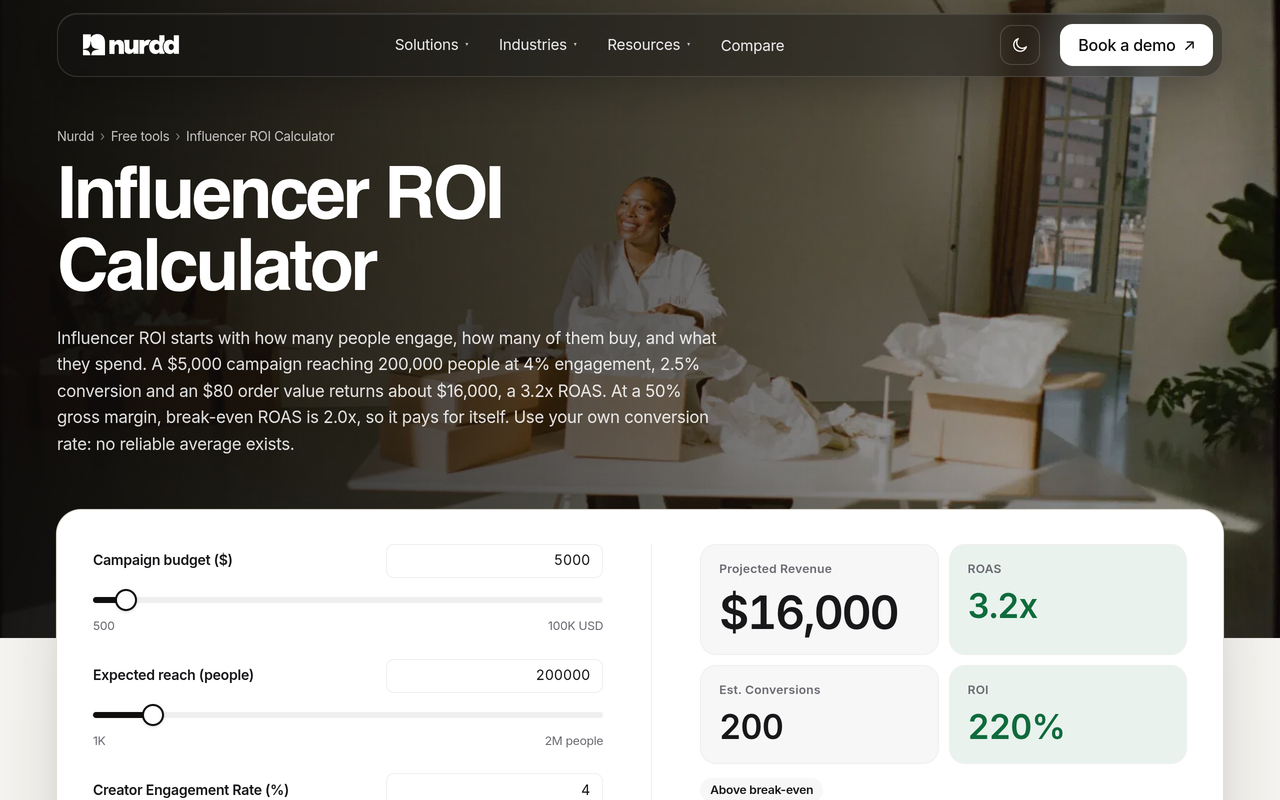
Take a beauty brand with a $5,000 monthly creator budget. OpenSponsorship's pricing data (July 2026) puts the median paid cost per deliverable at $134 for nano creators and $2,727 for mega creators (OpenSponsorship, July 2026). At the nano median the budget buys about 37 deliverables (5,000 ÷ 134 ≈ 37.3). At the mega median it buys fewer than two (5,000 ÷ 2,727 ≈ 1.8).
That arithmetic shows why vetting and tracking matter. With 37 small placements, each vetting mistake is cheap but the volume of briefs, links and reports is high, and software is built to handle that volume. Test your own numbers with the influencer rate card estimator and the marketing budget planner.
A second example: one mega post or many nano posts
Using the same medians, one mega deliverable at $2,727 costs the same as about 20 nano deliverables (2,727 ÷ 134 ≈ 20.4). The question is which spread earns more sales, and that cannot be answered from rates alone.
It needs a forecast before spend and per-creator attribution after. Use the campaign benchmarker on the numbers your agency reports now. If it cannot give you per-creator numbers to feed in, that is itself a finding.

What about disclosure when you move in-house?
Disclosure duty does not go away when the work moves. The US Federal Trade Commission's Endorsement Guides, published at 16 C.F.R. Part 255, include Section 255.5 on disclosure of material connections between an advertiser and an endorser (eCFR, 16 CFR 255.5). Read the full section before you write your brief.
In practice, build disclosure wording into the brief and check posts against it. Keep screenshots and record who approved each draft. Whatever tool you use, a workflow with recorded approvals gives you that trail; an email chain gives you a search problem.
How do you move from an agency to software? A checklist
- Export what you own: creator lists, contracts, content and usage rights, and past reporting.
- Name one internal owner for the channel and block their weekly time.
- Set a break-even target using the influencer ROI calculator.
- Rebuild your shortlist in the new tool and run each creator through fake follower checks.
- Write a brief template with deliverables, disclosure wording, usage rights and tracking links.
- Agree a UTM naming scheme before the first post goes live.
- Run one pilot campaign with a forecast, then compare actual sales per creator with the forecast.
- Keep the agency on a reduced scope for one cycle if you need a safety net, then review at the end of it.
What mistakes do brands make when they switch?
- Buying a database and calling it a platform. Discovery without vetting, tracking and attribution leaves the hard work undone.
- Skipping the pilot. Run one campaign and compare forecast with result before committing the full budget.
- Leaving data behind. Request creator lists, contracts and reports before the contract ends.
- Ignoring incrementality. Sales attributed to a creator are not always sales that would not have happened anyway. See last-touch versus multi-touch attribution.
- Paying before vetting. Check audience quality first; how to vet an influencer's audience before paying shows how.
- Dropping creative support. Moburst lists creative and video production among its services. If you leave, decide who will make and reuse creator content, because unused content wastes part of the spend.
How does Nia by Nurdd work as the in-house option?
Nia by Nurdd is an AI-native creative studio at getnia.studio, with influencer marketing built in. It covers discovery across 10M+ profiles, fake follower detection with TruAI, pre-spend ROI forecasting, campaign management and product-level sales attribution. It also makes short films, micro dramas and UGC ads from a product link, casting real and AI creators in the same production. It is a paid product, priced below comparable plans. See the Nia overview.
Nia by Nurdd belongs in this answer because it covers the steps an agency handles for influencer work, discovery, vetting, campaign management, reporting and ad creative, inside software the brand's own team runs. It is priced below comparable plans, and Nurdd can run campaigns on it as a managed service if the team wants help.
Book a demo to see Nia by Nurdd. You will see discovery, TruAI vetting, a forecast and sales attribution set up around your own brand and shortlist.
For head-to-head views, see how Nia compares with GRIN, CreatorIQ and Upfluence, or browse all comparisons. If you are choosing between platforms, how to pick an influencer marketing platform goes deeper.
What does Nia by Nurdd cover on each row?
- Discovery plus vetting in one tool: Nia by Nurdd scores each shortlisted creator with TruAI inside the same workflow as search.
- Forecast before spend: Nia by Nurdd returns a projected revenue range with confidence scores.
- Creator-level sales attribution: Nia by Nurdd attributes product-level sales to each creator.
- Cost: Nia by Nurdd is priced below comparable plans.
- Channels beyond creators: Nurdd's separate paid media product, Pulse, covers Meta and Google Ads intelligence.
How we researched this
We reviewed Moburst's own influencer service and services pages, comparison guides from two creator platforms (Aspire and Kolsquare), OpenSponsorship's published creator pricing data, the FTC's Endorsement Guides, and Nurdd's own product pages. All were checked in November 2026, the publication date. We did not test any rival product hands-on, interview customers or use private data, so rival capabilities are described by category and should be confirmed on each vendor's own pages. Figures are quoted as the cited pages state them.
Frequently asked questions
What are alternatives to Moburst for influencer marketing?
The main alternatives are specialist influencer agencies, enterprise creator platforms, creator marketplaces and in-house software. Nia by Nurdd is the in-house option with discovery, fake follower detection, forecasting, campaign management and attribution in one place.
Should I hire an influencer agency or use software?
Use software if you have an owner, run campaigns regularly and want creator-level data. An agency adds a service fee for coordination you could run in-house. Many brands start with an agency and move to software once the process is clear.
Is Moburst an influencer marketing platform?
Moburst presents itself as a full-service marketing company with an influencer marketing service, so it is a service rather than self-serve creator software. Its page describes its team handling briefs and reporting. Confirm its current offering directly with the company.
How do I check whether creators have fake followers?
Compare engagement with follower count, look at comment quality and growth spikes, and run a detector. Try the fake follower checker or read the manual spotting guide.
How much does Nia cost?
Nia is a paid product, and Nurdd does not publish plans on this page. It is priced below comparable plans, and a demo shows what your brand would get.
Can software replace an agency completely?
Software replaces coordination, tracking and reporting. It does not replace the person who owns strategy and creator relationships. If you want help, Nurdd also runs creator campaigns on Nia by Nurdd as a managed service.
What should I measure after switching?
Track cost per deliverable, engagement against tier benchmarks, sales per creator and forecast accuracy. The campaign benchmarker compares results with published benchmarks.
Ready to compare Nia by Nurdd with your agency?
If you are weighing Moburst alternatives, the quickest test is your own shortlist. Book a demo to see Nia by Nurdd and set it beside your agency's reporting.