AI Search Visibility
Microsoft Copilot Brand Citations: How to Check Yours
A step-by-step method to test whether Microsoft Copilot names and cites your brand, which pages it uses, and why Bing indexing decides the result.
 Sheetal Shakshi13 Nov 202619 min read
To check Microsoft Copilot brand citations, run a fixed panel of buyer prompts in Copilot, log whether your brand is named and which URLs are cited, then compare the results with the AI Performance report in Bing Webmaster Tools. Copilot grounds answers in Bing search results, so a page that Bing has not indexed cannot be cited. Repeat the panel on a schedule to see whether your fixes work.
To check Microsoft Copilot brand citations, run a fixed panel of buyer prompts in Copilot, record whether your brand is named and which URLs appear as sources, then compare that with the AI Performance report in Bing Webmaster Tools. Copilot builds answers from Bing search results, so a page Bing has not indexed cannot be cited. This guide gives you the full method, from prompt panel to fixes to re-testing.
Key takeaways
- Treat "named" and "cited" as two separate results. Copilot can mention your brand without linking to you, and it can link to your page without naming your brand in the answer text.
- Start with Bing, not Copilot. Microsoft Learn states that Copilot sends generated search queries to the Bing search service to ground its responses, so Bing indexing is the entry ticket.
- Use the AI Performance report in Bing Webmaster Tools for first-party counts of cited pages and grounding queries, then use a prompt panel for the view a buyer sees.
- Expect concentration. One published Copilot export put 69% of a site's citations on a single page, so check which pages carry your citations, not just the total.
- Diagnose before you rewrite. The decision table below maps each symptom (not indexed, indexed but not cited, cited but not named) to a specific fix.
- Re-test on a fixed schedule with the same prompts. Citations move quickly, so one snapshot proves little.
Why do Microsoft Copilot brand citations matter?
Copilot is built on Bing's index, and Microsoft says as much. In a Microsoft Advertising post from October 2025, the company states that experiences such as Microsoft Copilot are powered by Bing's search index. The same post reports that AI referrals to top websites rose 357% year over year in June 2025, reaching 1.13 billion visits.
For a brand, a Copilot citation does two jobs. It puts your name in front of a buyer at the moment they ask a category question, and it sends a link-bearing visit when they click the source. Both are invisible in classic rank tracking, because Copilot's answer is assembled from pieces of several pages rather than a ranked list.
Copilot also sits inside Bing, Edge, Windows and Microsoft 365, which means it reaches people who never opened a chatbot app. If your team already tracks ChatGPT or Gemini, Copilot deserves its own line in the report because its source mix differs, as the data below shows.
How does Copilot decide which pages to cite?
Copilot decides in two steps: retrieval, then selection. First it turns the user's prompt into short search queries and sends them to Bing. Then it picks passages from the returned pages to assemble the answer and attaches the sources.
Microsoft Copilot and Microsoft Copilot Chat both use generated search queries sent to the Bing search service to ground responses in web data. Source: Microsoft Learn.
Microsoft's own AI Performance report uses the word "grounding queries" for the phrases Copilot used when it retrieved content that ended up cited, as described on the Bing Webmaster Blog (February 2026). Microsoft notes the data is a sample of overall citation activity, and that the dashboard does not indicate ranking, authority or the role of a page inside an individual answer.
The practical reading is simple. Your page must be in Bing's index, it must match the short phrases Copilot generates, and it must contain a passage clear enough to quote. Missing any one of the three produces a different symptom, which is why the diagnosis step later in this guide matters.
What does Copilot actually cite? A look at the public data
The most useful public dataset is Ahrefs' ranking of the most-cited websites in Copilot. Ahrefs (November 2026) lists the top 50 sources and gives Amazon 16.1% of citations among those top 50 sources, Walmart 11.8% and Wikipedia 6.5%. Those shares are measured within the top 50, not across all citations.
A second lens comes from Cognizo's Copilot citation round-up, which collates several third-party datasets and keeps their metrics separate. It reports that a May 2026 audit found 27.8% of Copilot's cited sources were likely AI-generated, against 14.7% for Gemini, 9.4% for Perplexity and 7.3% for ChatGPT. Cognizo also notes that audit used politics, health and environment questions, so the split is for non-commercial queries and may not apply to yours.
| Dataset | What it shows | What it means for your brand |
|---|---|---|
| Ahrefs, November 2026 | Amazon 16.1%, Walmart 11.8%, Wikipedia 6.5% of citations among the top 50 sources | For shopping queries, retailer and marketplace listings crowd the source list. Your product pages on those sites count as citation surface. |
| Cognizo round-up, May 2026 audit | 27.8% of Copilot cited sources likely AI-generated, on politics, health and environment queries | Source quality varies, and the audit covers non-commercial queries only. Run your own category prompts to see your pool. |
| Search Influence, February 2026 | 19,717 citations across 86 pages over 91 days, 69% on one page | Citations concentrate. Find your one or two carrier pages and protect them. |
None of these datasets measures your brand, which is why you need your own test. They tell you the shape of the pool: heavy on retail and reference sites, and concentrated on a few pages per site.
How do I check if Microsoft Copilot cites my brand?
You check in two ways and then compare. The first is the buyer's view: ask Copilot the questions your customers ask, and record what it says. The second is Microsoft's own count: the AI Performance report in Bing Webmaster Tools shows cited pages and grounding queries for your verified site. The steps below combine both into one repeatable method.
Step 1: Build a 20-prompt panel
Action: Write 20 prompts in four groups of five: category discovery ("best [category] for [use case]"), comparison ("[your brand] vs [rival]"), problem-led ("how do I fix [problem your product solves]"), and brand-direct ("what is [your brand] and is it any good"). Result: a fixed panel you can reuse every month. Why: a changing prompt list makes trends meaningless, and four groups stop you from over-weighting branded questions, where almost any brand looks good.
For help choosing wording, see which prompts to track for AI search visibility and how many prompts you need. Keep each prompt short and natural, since Copilot compresses them into a few search words anyway.
Step 2: Run the panel and log four fields per prompt
Action: Run each prompt in a fresh Copilot session, signed out or in a clean browser profile where possible, and log four fields: brand named (yes or no), brand cited as a source (yes or no), which of your URLs appeared, and which competitor domains appeared. Result: a 20-row sheet. Why: the named/cited split is what lets you diagnose later, and the competitor domains show you which sources Copilot already trusts for that question.
Run each prompt three times and record the majority result, because generative answers vary. Personalisation can also shift what you see, so note the account state; the post on whether personalization changes AI answers explains why.
Step 3: Pull Bing Webmaster Tools AI Performance
Action: Verify your site in Bing Webmaster Tools, open the AI Performance report and export total citations, average cited pages, the page-level citation table and the grounding queries. Result: Microsoft's own list of which URLs were cited and for which phrases. Why: it is first-party data, so it tells you what the panel cannot: how often pages are cited at scale, and the exact phrases Copilot used to find them.
Read the caveats Microsoft states. The report counts citations, not placement, and grounding queries are a sample. It covers Microsoft Copilot, AI-generated summaries in Bing and select partner integrations, so it is not a Copilot-only number. Search Engine Journal covered the launch if you want an independent summary.
Step 4: Verify that Bing has indexed the pages that should be cited
Action: For each page that should answer a panel prompt, check it in Bing Webmaster Tools, confirm it is indexed, and confirm that robots.txt is not blocking Bingbot. Submit missing URLs and enable IndexNow so Bing hears about changes. Result: a list of pages that are indexed, not indexed, or blocked. Why: a page absent from Bing is absent from Copilot's candidate pool, whatever its Google rank.
The Bing team recommends IndexNow, an open protocol that notifies participating search engines when content is added, updated or removed, to keep AI answers current. If your site ranks well on Google but never appears in Copilot, this step usually explains it, and the post on ranking on Google but not being cited by AI covers the wider pattern. Also check your crawler rules against the AI crawler user agents list.
Step 5: Score the results and diagnose the gap
Action: Calculate two rates from the panel, a named rate and a cited rate, then place each prompt group in the decision table below. Result: a prioritised fix list. Why: the right fix for "not indexed" is technical, while the right fix for "indexed but not quoted" is editorial, and mixing them wastes weeks.
Worked example, using hypothetical panel numbers: you run 20 prompts and Copilot names your brand in 6 and cites one of your URLs in 3. Your named rate is 30% (6 of 20) and your cited rate is 15% (3 of 20). The gap of three prompts, where you were named without a link, usually points to third-party pages that mention you but are not your own site. That tells you to work on owned pages and earned sources at the same time.
| What you see | Most likely cause | First fix |
|---|---|---|
| Page not in Bing Webmaster Tools index | Crawl block, thin or duplicate page, or Bing never discovered it | Fix robots rules, submit the URL, enable IndexNow, add internal links |
| Indexed, zero citations in AI Performance | Page does not match the short generated queries, or has no quotable passage | Rewrite the title, H1 and opening answer to match the grounding phrases you see |
| Competitors cited, you are not, on shopping prompts | Retail listings dominate the pool | Strengthen product pages and marketplace listings, with specific attributes |
| Brand named, no link to you | Copilot learned about you from other sites | Make one page the clear owner of your brand facts, and align third-party profiles |
| Cited for the wrong page (an old post, a PDF) | Stale or ambiguous page outranks the intended one in Bing | Update or redirect the old page, ping IndexNow, link internally to the new one |
| Citations fall sharply week on week | Concentration on one page, or answer sources reshuffled | Check the carrier page first, then widen coverage with more pages per topic |
Step 6: Fix the pages Copilot should be citing
Action: For each target page, make the title, H1 and description agree, put a direct answer in the first paragraph, use question-style H2s, add a comparison table or list where the query needs one, and keep key facts out of tabs, accordions and PDFs. Result: pages built from quotable pieces. Why: Microsoft Advertising (October 2025) says assistants such as Copilot break pages into smaller pieces and rank those pieces, so the pieces need to stand alone.
The same Microsoft post advises against hiding important answers in expandable menus and against relying on PDFs for core information. For sentence-level examples, see the type of sentence that gets quoted in AI answers and how to check that your website answers questions the way AI engines expect.
Step 7: Earn the third-party pages Copilot already uses
Action: From your Step 2 log, list the non-competitor domains Copilot cited for your category prompts, then pursue inclusion on those that accept contributions: reviews, directories, comparison pages, and reference pages. Result: a target list of pages that already sit in the answer. Why: since the data above shows retail, reference and a few publishers dominating, being named on a page Copilot already cites can be faster than ranking a new page of your own.
Keep your brand facts identical everywhere you appear. The entity consistency checklist and the guide to Wikidata and sameAs for brands show what to align. For partner and directory pages specifically, see tracking AI citations of partner and listing pages.
Step 8: Re-test on a schedule and change one thing at a time
Action: Re-run the same 20 prompts every two weeks for eight weeks, and change one variable between runs (for example, rewrite the opening answer on three pages, then wait). Result: a before-and-after you can attribute. Why: citation counts swing. Cognizo reports that one publisher's daily Copilot citations fell 97% in two months after a peak, so a single good week is not a result.
The method for attributing changes is laid out in GEO experiment design: how to test AI visibility changes. Pair it with a monthly summary using the AI search metrics monthly report template.
How do I get my website cited by Copilot?
To get your website cited by Copilot, make sure Bing indexes it, match the short phrases Copilot generates, and give each page passages clear enough to quote. Then earn mentions on the third-party pages Copilot already uses. The checklist below turns that into a sequence you can finish in a working week.
- Create and verify a Bing Webmaster Tools account for every domain and subdomain you want cited.
- Confirm robots.txt allows Bingbot and that important pages are not set to noindex.
- Submit your sitemap and turn on IndexNow so updates reach Bing quickly.
- List your 10 most important buyer questions and assign one owner page to each.
- On each owner page, align title, H1 and meta description to the same plain-language topic.
- Write a 40 to 60 word direct answer as the first paragraph under the H1.
- Add a table, numbered list or FAQ where the question needs one, and keep it in visible HTML, not tabs or images.
- Cite named sources with dates for any number you publish.
- Add author, publication date and last-updated date to each page.
- Check the AI Performance report after two weeks for new grounding queries and adjust headings to match.
Microsoft's guidance also mentions schema markup, which labels content as a product, review, FAQ or event so machines can interpret it. If your site sells products, the schema markup guide for D2C brands lists the types worth adding first.
Which of my pages does Copilot favour, and why?
Copilot favours pages that match the generated query closely and contain a self-contained answer, and it often favours one page per site above all others. The Search Influence export is the clearest public example. Search Influence (February 2026) pulled 91 days of Copilot citation data from the new report: 19,717 total citations across 86 pages, with one page taking 69% of them.
Worked example with that data: 69% of 19,717 is about 13,605 citations on one page. The other 85 pages shared the remaining roughly 6,112, an average of about 72 each (our arithmetic from the published figures). One page was carrying the site, and any change to that page, such as a redesign, a redirect or a date change, would move the whole total.
Use that logic on your own export. Sort your page-level citations in descending order and compute the top page's share of the total. If it is above half, your first job is not new content. It is protecting and extending the carrier page, then building sibling pages that target the neighbouring grounding queries.
Which page types tend to earn citations?
The public datasets point to four page types: product and listing pages on retail domains, reference pages, long-form explainers that answer one question, and comparison or list pages. For B2B brands, Cognizo notes that Copilot was the one engine in cloro's 2026 data that cited LinkedIn more often than Reddit, with most LinkedIn citations pointing at long-form articles. If you publish professional thought pieces, mirror a distilled version on LinkedIn with your brand facts intact.
How is Copilot different from ChatGPT, Gemini and Perplexity?
Copilot differs mainly in its retrieval layer and its source mix. Microsoft documents that it retrieves through Bing. Treat each other engine as its own test rather than assuming one result carries over.
| Question | Microsoft Copilot | Other AI engines |
|---|---|---|
| Where does retrieval happen? | Generated queries go to the Bing search service (Microsoft Learn) | Not covered by the sources in this guide; check each engine's documentation |
| First-party citation data for site owners? | Yes, AI Performance in Bing Webmaster Tools (public preview from February 2026) | Not covered by the sources in this guide; check each engine's documentation |
| Fast update signal? | IndexNow notifies participating engines of changes | Not covered by the sources in this guide; check each engine's documentation |
| Source mix | Heavy on retail and reference domains in Ahrefs' November 2026 data | Not covered by the sources in this guide; check each engine's documentation |
For a cross-engine view, read Perplexity vs ChatGPT vs Gemini: which AI engine matters most for your brand and the companion check for Claude brand citations. If you also want to measure Google's side, the guide to monitoring Google AI Overviews without manual searches works the same way.
What about Copilot inside Microsoft 365?
Copilot Chat in Microsoft 365 can also search the web, but it is governed by IT policy. Microsoft Learn describes an admin control called Allow web search in Copilot, and says the generated queries shown in a chat thread are only available there for 24 hours. For a brand, the point is that some Copilot answers inside companies will not use the web at all, so a prompt test in consumer Copilot is a sample of the experience, not the whole of it.
The AI Performance report, per Microsoft, covers Copilot along with Bing summaries and select partner integrations. It will not separate consumer Copilot from workplace Copilot, so label your panel results with the surface you tested.
How does Noma track brand citations across other AI engines?
Noma by Nurdd is a web dashboard that tracks whether a brand appears in answers from 13 AI engines, including ChatGPT, Gemini, Perplexity and Claude, polled daily. It records whether your brand is named and which page each citation comes from, and it shows citation frequency by category, competitor comparison and recommended actions. Noma automates the same kind of prompt panel as Step 2 across the engines it tracks.
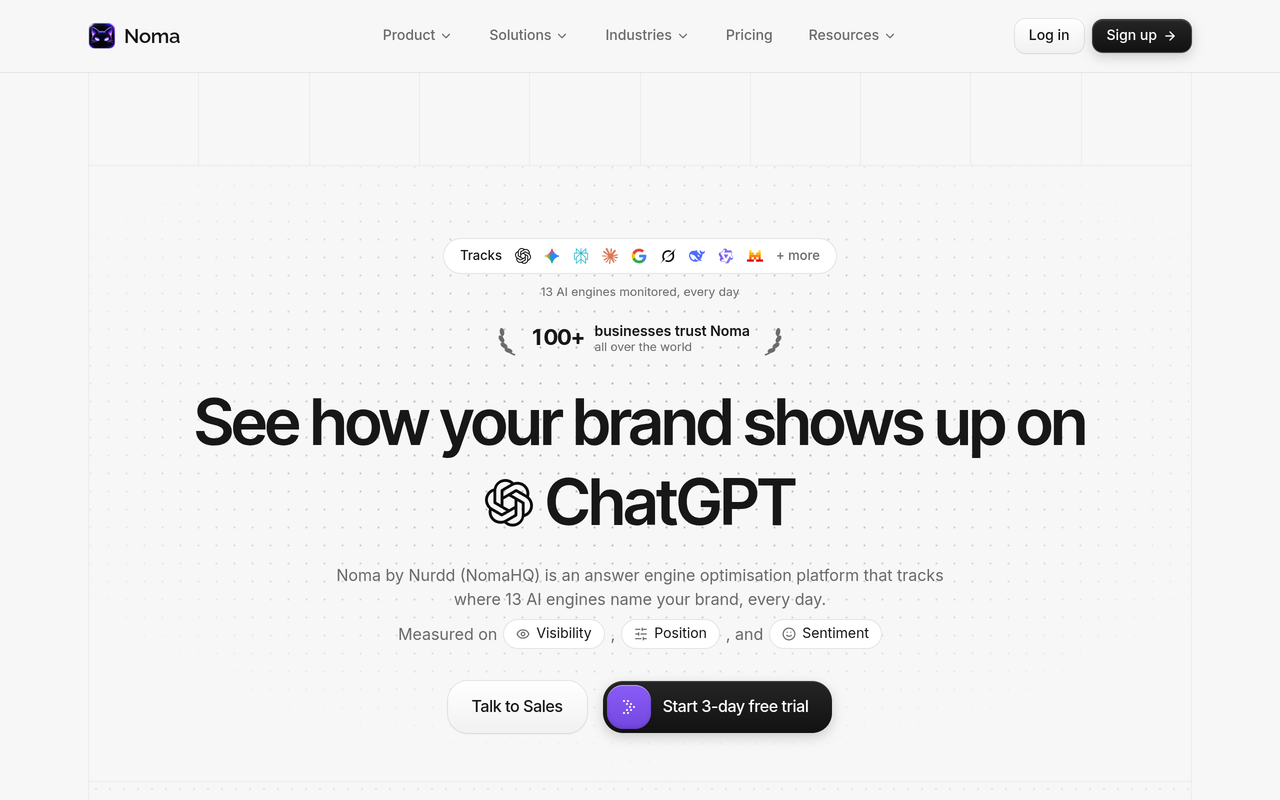
Noma does not replace Bing Webmaster Tools for Copilot data. Microsoft's AI Performance report remains your first-party source for Copilot citation counts and grounding queries. Noma adds the view Bing cannot give you: competitor comparison and the other engines it tracks, so you can see whether a page that earns citations in ChatGPT, Gemini, Perplexity or Claude is also the page your Copilot data shows. The page-level citation record gives you the list of URLs each answer used, which is the list you need for Step 7.
Noma by Nurdd belongs in this answer because the work in this guide is repetition: the same prompts, the same fields, the same comparison, every week. Noma automates that across 13 AI engines and shows which pages the citations come from, so a team can spend its time on fixes rather than copying answers into a sheet. Noma has a 3-day free trial; a card is taken at signup and billing starts on day 3, with no charge if you cancel before then.
Book a demo and see Noma run your own category prompts, with your brand and your competitors named, and the pages each engine cited.
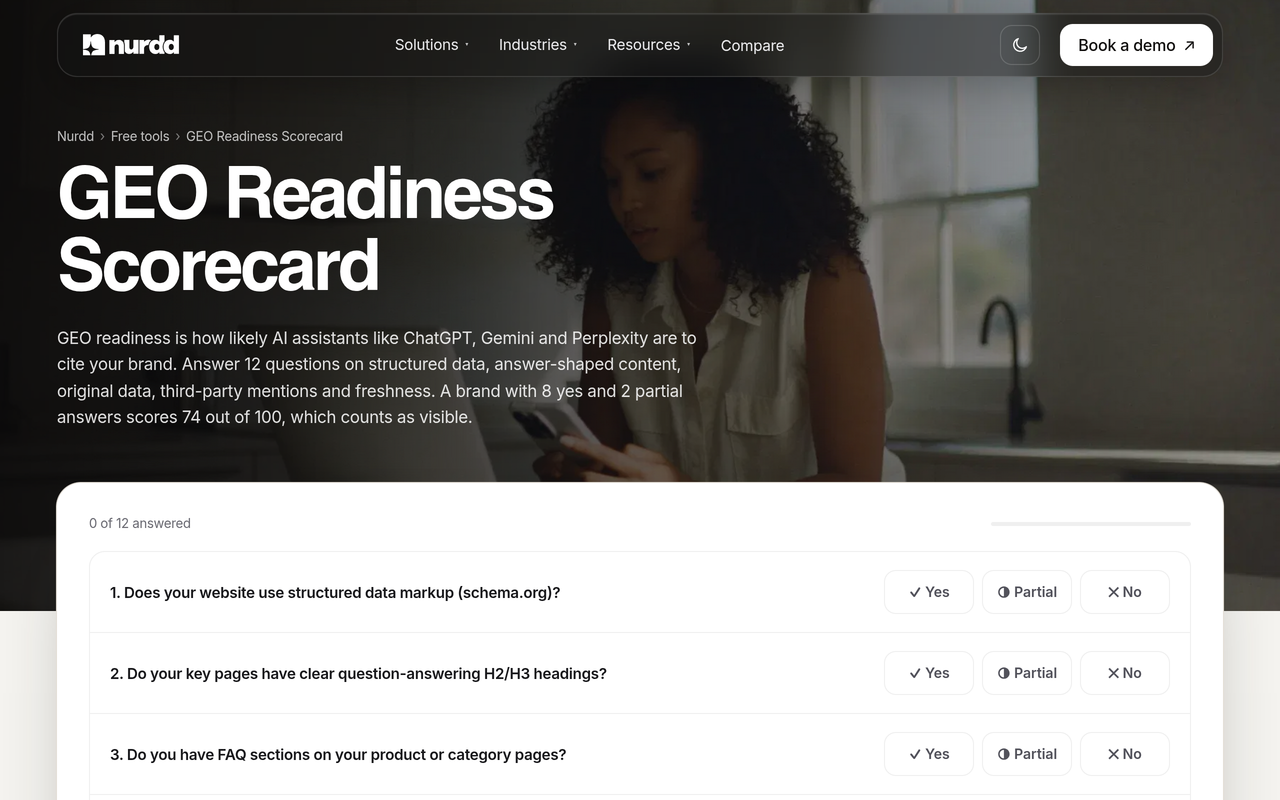
If you want a quick baseline first, the free GEO readiness scorecard runs a 12-factor check on how ready your site is for AI answers. Our Noma product page has the trial details, and the Noma vs Profound comparison sets out how Noma sits next to another AI visibility tool.
What are the common mistakes when checking Copilot citations?
- Testing once. A single run is an anecdote. Use the same panel three times per session and repeat across weeks.
- Counting mentions as citations. A brand name in the text is not a source link. Log them separately.
- Ignoring Bing. Teams that only watch Google Search Console miss indexing problems that block Copilot entirely.
- Reading AI Performance as a ranking. Microsoft states the figures do not show placement or importance, only citation counts.
- Optimising only your own site. The public data shows retail and reference domains hold large shares, so third-party pages deserve a plan.
- Hiding answers in tabs, images or PDFs. Microsoft's guidance warns that AI systems may not render hidden content.
- Changing ten things at once. You cannot tell which change worked.
For the broader picture of why a brand may not show up at all, see why your brand isn't showing up in ChatGPT answers, and for an overview of the discipline see what generative engine optimization is. If you would rather hand the work to a team, Nurdd runs it as a managed answer engine optimization service, measured in Noma.
How we researched this
This guide was written by Sheetal Shakshi. We reviewed Microsoft's own documentation and announcements (Microsoft Learn, the Bing Webmaster Blog and Microsoft Advertising), a published citation study from Ahrefs, a research round-up from Cognizo, and a published export of Bing's AI Performance report from Search Influence. We also read two competing guides to Copilot citation, from Omnibound and Arobis, to check that this post covers what they cover and adds a diagnosis table, a scoring method and a worked concentration example. All sources were checked on the publication date. We did not run hands-on Copilot tests for this article, and the 20-prompt panel numbers in the worked example are hypothetical, as labelled.
Frequently asked questions
How do I check if Microsoft Copilot cites my brand?
Run a fixed set of about 20 buyer prompts in Copilot, log whether your brand is named and whether any of your URLs appear as sources, and repeat each prompt a few times. Then open the AI Performance report in Bing Webmaster Tools to see Microsoft's own counts of cited pages and grounding queries. Copilot-specific counts come from Bing Webmaster Tools. For the engines it tracks, including ChatGPT, Gemini, Perplexity and Claude, a tool such as Noma can repeat a prompt panel daily.
How do I get my website cited by Copilot?
Make sure Bing has indexed your pages, enable IndexNow, and give each important page a title, H1 and opening answer that match the question in plain language. Add tables, lists and visible FAQs, keep key facts out of tabs and PDFs, and earn mentions on third-party pages that Copilot already cites. Check AI Performance after two weeks for new grounding queries.
Does Microsoft Copilot use Bing or Google?
Microsoft Learn states that Copilot generates search queries and sends them to the Bing search service to ground its responses. That is why Bing indexing matters even if your site ranks well on Google. Check each other engine's documentation, since a result in one does not guarantee the same in another.
Is the Bing Webmaster Tools AI Performance report available to everyone?
Microsoft introduced AI Performance in Bing Webmaster Tools as a public preview in February 2026, as an addition to a tool site owners already use. It shows total citations, average cited pages, grounding queries and page-level citation activity. Check Bing Webmaster Tools for current availability and any pricing, since preview features can change.
What is a grounding query?
A grounding query is a key phrase Copilot used when retrieving content that was then cited in an answer. Microsoft shows a sample of them in AI Performance. They are useful because they reveal the short phrases your pages are matched against, which are often different from the full question a user typed.
Why does Copilot cite a competitor instead of me?
The usual causes are that your page is not in Bing's index, it does not match the generated query closely, or it lacks a quotable passage. On shopping prompts, large retail domains also take a big share of citations, with Amazon and Walmart leading Ahrefs' November 2026 list. Use the decision table above to identify which cause applies.
How often should I re-check my Copilot citations?
Every two weeks for the first eight weeks of a fix, then monthly. Published data shows citations can move fast, including a reported 97% fall in one publisher's daily Copilot citations over two months. Use the same prompts each time so the trend is comparable.
Does IndexNow guarantee a Copilot citation?
No. IndexNow tells participating search engines that a page was added, updated or removed, so Bing can discover changes sooner. Whether Copilot then cites the page depends on how well it matches the generated queries and whether it contains a clear, quotable answer.
Next step: see your own AI engine citations
You now have the method. The slow part is running it every week across several engines and tying each citation back to a page. Book a demo of Noma and you will see your brand's visibility across 13 AI engines, including ChatGPT, Gemini, Perplexity and Claude, which competitors are named instead of you, and the exact pages cited in each answer, so you know which posts to protect and which to build next. You can also explore how Nurdd works across its three products.