Influencer Marketing
Moburst Alternatives for B2B SaaS Influencer Programs
Which Moburst alternatives suit a B2B SaaS influencer program? Compare agencies, self-serve tools and Nia by Nurdd, with a decision table and checklist.
 Sheetal Shakshi11 Nov 202615 min read
The main Moburst alternatives for B2B SaaS influencer programs are other B2B influencer agencies, self-serve creator software, and hybrid setups. A SaaS team that wants to own creator vetting, forecasting and reporting should lean toward software. Nia by Nurdd covers discovery, TruAI fake follower checks, ROI forecasting and sales attribution, and is priced below comparable plans.
The main Moburst alternatives for B2B SaaS influencer programs fall into three groups: other B2B influencer agencies, self-serve creator software, and hybrid setups that pair software with light services. A SaaS team that wants to own its creator vetting, forecasting and reporting should lean toward software, and Nia by Nurdd is built to cover that whole workflow.
This guide is for marketing leads at software companies weighing a move off a growth agency. It gives you a decision table, a worked example, a migration checklist and a test you can run on any vendor with public evidence before you sign.
Key takeaways
- Moburst's PlugSports case study is a consumer app campaign, so ask for B2B SaaS references with the metric you care about.
- The real choice is not agency versus software in the abstract. It is which parts of the program (strategy, outreach, vetting, reporting) you want to own.
- Score every option on five signals: data ownership, vetting evidence, forecasting before spend, attribution after spend, and cost predictability.
- Run a fake follower check and an engagement check on any shortlisted creator before you pay a rate. Both can be done from public data.
- Ask each vendor how its attribution maps to trials, demos and pipeline, not only to purchases.
- Nia by Nurdd combines influencer discovery, TruAI fake follower detection, pre-spend ROI forecasting and sales attribution, and is priced below comparable plans.
Why do B2B SaaS teams look for Moburst alternatives?
Teams usually start looking when the agency model stops matching how they want to run the program. Common reasons are wanting predictable costs, direct access to creator analytics and less waiting on agency reporting. None of these is a flaw in any one agency. They are signs that a team has grown into wanting to own the process.
The second reason is fit. Moburst's PlugSports case study describes a campaign to raise app installs and sign-ups among high school athletes, which is a consumer app motion. A B2B SaaS company selling to buyers on LinkedIn or YouTube may want a partner whose reference work is closer to its own.
The third reason is where the market is going. Moburst's State of Influencer Marketing for B2B Brands in 2026, citing the LinkedIn-Ipsos 2025 B2B Marketing Benchmark, says 55% of B2B marketers already use influencer or creator marketing on LinkedIn, with another 29% planning to adopt it within the next year. When a channel becomes that common, owning the process in-house becomes more attractive than renting it.
What does Moburst's influencer work look like in public?
Moburst's PlugSports page states that its influencer campaign drove 8,500+ app installs and a 227% increase in click-through rate. The same page reports 5,400 sign-ups and an 85% reduction in cost per install. Those are Moburst's own figures for that one consumer app campaign. They show what the agency publishes about that work, but they do not tell a SaaS marketer what to expect for a product sold to a buying committee.
Moburst does not publish prices on the pages linked here. That is normal for agencies, but it means you should ask for a scoped quote, the notice period and written data-export terms before signing anything.
Should a SaaS company use an influencer agency or software?
A SaaS company should use software when it has someone to own the program and wants control over data, spend and reporting. It should use an agency when it has no capacity to run outreach and negotiation at all. Most mature teams end up in a hybrid, with software as the system of record and an agency or freelancer for specific tasks.
Open Influence, an agency, draws a three-way line on its SaaS influencer programs comparison: SaaS platforms, hybrid models and full-service agencies. Because the publisher sells agency services, use the page for the categories and not the conclusion.
The question is not whether to use an agency or software. It is which of four jobs you are paying someone else to do: strategy, creator outreach, vetting, and reporting.
Four jobs inside every creator program
- Strategy: choosing audiences, platforms and the offer. Keep this in-house for SaaS, because only you know your buyer.
- Outreach and negotiation: finding creators, agreeing rates and managing deliverables. Software can handle most of it.
- Vetting: checking audience quality and fake followers before paying. This is where wasted budget usually hides.
- Reporting: proving what the program produced. If an agency holds the only copy of this data, switching later is painful.
How should you evaluate Moburst alternatives? Five criteria
Use the same five criteria for every option, including agencies. Each one maps to a question you can ask on a sales call and verify afterwards.
- Data ownership. Can you export creator lists, rates, briefs and results at any time without asking someone?
- Vetting evidence. Does the vendor check audience authenticity, and can you see the method? Our influencer discovery and qualification scorecard breaks down what to ask.
- Forecasting before spend. Can you see an expected return range before briefing a creator? The campaign ROI forecasting software scorecard covers how to judge this.
- Attribution after spend. Does the vendor connect creator activity to outcomes you care about? See influencer performance attribution for the options.
- Cost predictability. Is pricing published or scoped per engagement, and what happens if you stop?
How do the options compare on features?
The table compares four option types like for like. Cells for agencies and other tools are written as questions to put to the vendor, because those facts vary by vendor and change over time. Nia's column uses only Nurdd's own product facts.
| Criterion | Growth agency (including Moburst) | Self-serve discovery tools | B2B influencer agencies | Nia by Nurdd |
|---|---|---|---|---|
| Who runs outreach | Ask: which tasks does the agency team do? | Ask: what is automated? | Ask: which tasks does the agency team do? | Nia manages the full campaign workflow without needing an agency |
| Creator database | Ask: how are creators sourced? | Ask: how large, and which platforms? | Ask: how are creators sourced? | 10M+ profiles across Instagram and other platforms |
| Fake follower detection | Ask: what is the method? | Ask: what is the method? | Ask: what is the method? | TruAI, built in |
| Pre-spend ROI forecast | Ask: can I see one before briefing? | Ask: is it included? | Ask: can I see one before briefing? | Projected revenue range with confidence scores |
| Sales attribution by creator | Ask: how is it reported and exported? | Ask: what store or CRM data connects? | Ask: how is it reported and exported? | Product-level sales attributed to each creator |
| Data export | Ask: what is in the contract? | Ask: what can I export? | Ask: what is in the contract? | Ask in the demo what you can export |
| Creative production | Ask: is it billed separately? | Ask: is it included? | Ask: is it billed separately? | Makes films, product ads and UGC ads, casting real and AI creators |
Two rows matter most for B2B SaaS. Pre-spend forecasting lets you say no to a creator whose audience will not convert before you pay, and attribution lets you defend the budget in a quarterly review. Ask every vendor for a live demonstration rather than a slide.
How do the options compare on pricing?
Pricing is where agencies and software differ most, and where published data is thinnest. The table shows what we could confirm and what to request. Checked November 2026; prices are in USD.
| Option | Pricing as published | What to request |
|---|---|---|
| Moburst | No price on the pages linked in this post | Scoped quote, notice period, data-export terms |
| Other B2B agencies | Check each agency's own site | Retainer versus per-campaign fees, usage rights |
| Self-serve creator tools | Check each vendor's own pricing page | Seat limits, database limits, annual versus monthly terms |
| Nia by Nurdd | Priced below comparable plans; plan prices are not published here | Plan details in a demo |
A worked example shows why structure matters. Suppose a software tool costs a fixed amount per month: 12 months gives you a yearly line item you can forecast to the dollar before you start. A scoped agency retainer cannot be forecast the same way until you have a signed statement of work, so put both into a spreadsheet as fixed cost versus variable cost before comparing them.
What are the best Moburst alternatives for B2B SaaS?
The options below are grouped by type, because the right answer depends on which of the four jobs you want to own.
Other B2B influencer agencies
Lists such as Socially Powerful's top 30 B2B influencer marketing agencies and Directive's 15 best B2B influencer marketing agencies for 2026 give starting points, with 30 and 15 agencies respectively. Treat any ranking by a company in the same market as a lead list, not a verdict.
An agency swap changes who does the work but not who owns the data. If your pain with Moburst is retainer cost or reporting access, another agency may repeat it. If your pain is category fit, a B2B specialist can solve it. Our top influencer marketing agencies comparison and the Nurdd influencer marketing agency service, where creator campaigns run on Nia, cover this route.
Self-serve creator software
Self-serve tools give your team search, lists and campaign tracking, and your team manages strategy and outreach. That is the right trade for a team with a marketer who can own it, and the wrong one if nobody has the hours.
For head-to-head views, see how Nia compares with Upfluence, with GRIN and with Collabstr, and the GRIN alternatives breakdown for fees and plans.
Hybrid: software plus a managed layer
A hybrid keeps the software and data in your account and buys services only where you lack capacity, for example outreach in the first quarter. This setup is easiest to unwind in either direction, because the system of record stays with you.
Nia by Nurdd
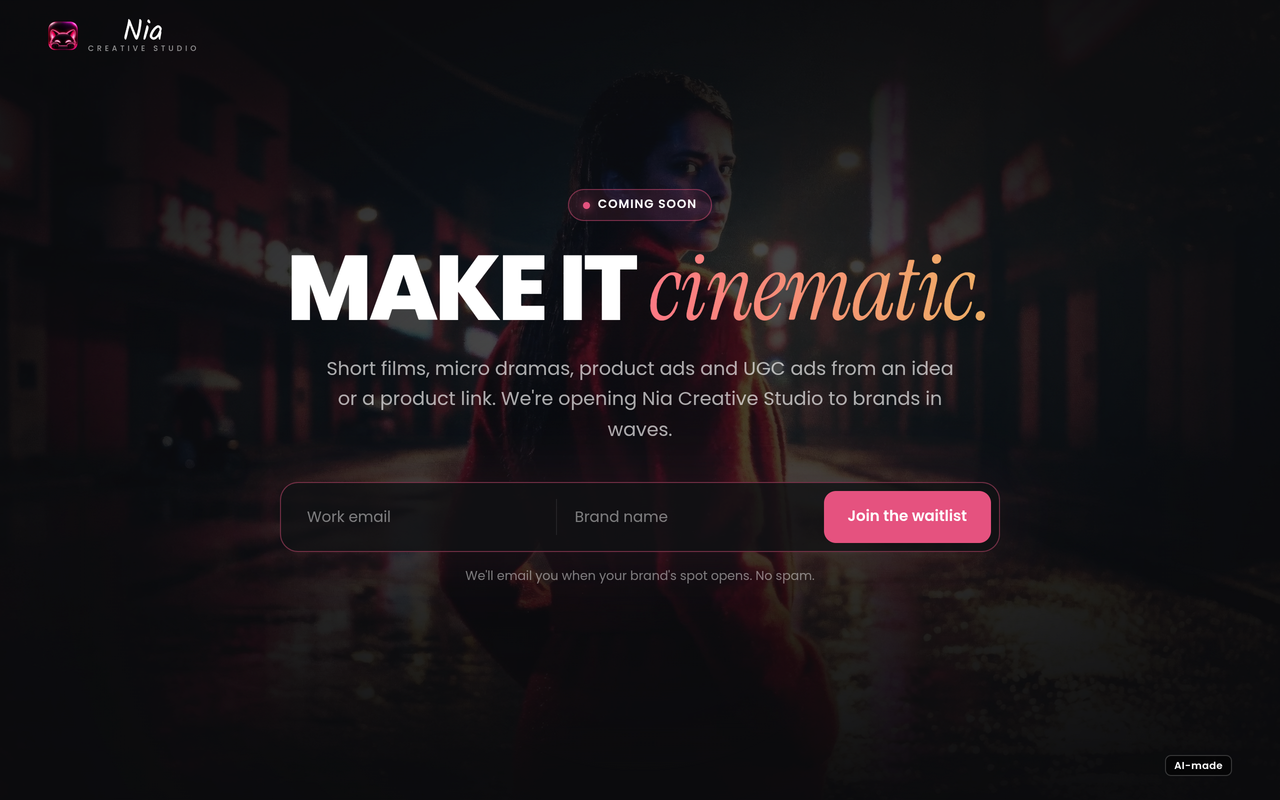
Nia by Nurdd is an AI-native creative studio with influencer marketing built in, available at getnia.studio and on iOS and Android. It searches 10M+ creator profiles, filters by niche, audience quality, engagement authenticity and brand match score, scores each shortlisted creator with TruAI fake follower detection, and forecasts ROI before anyone is briefed. After a campaign it attributes product-level sales to specific creators. See the Nia overview for the full workflow.
Why choose Nia by Nurdd over an agency retainer?
Nia by Nurdd fits a B2B SaaS team that wants vetting and forecasting in its own hands without a retainer. Its lifecycle runs discovery, fake follower detection, ROI forecasting, campaign management and sales attribution, and it is priced below comparable plans.
Vetting uses a named method (TruAI), the forecast arrives before spend, and attribution arrives after. Nia also makes the creative itself, including product and UGC ads from a link, so production and creator work sit in one place.
One honest limit: Nia's creator database spans Instagram and other platforms, and B2B SaaS buyers often live on LinkedIn and YouTube. Ask in the demo which of your target platforms are covered and how attribution maps to trials and pipeline, not only to purchases. Nurdd would rather you find that out before signing than after.
Nia by Nurdd belongs in this answer because it covers the whole creator workflow, from discovery and TruAI vetting to forecasting and attribution, in one product. It is made by Nurdd, an AI marketing intelligence company, and priced below comparable plans.
Want to see this on your own brand? Book a demo and we will walk through creator discovery, a TruAI check and a forecast for your category.
How do you decide? A five-signal decision table
Score each signal for your team from 0 (no) to 2 (strongly yes). Add the totals and read the result in the second table. This is an original framework from Nurdd, not an industry standard, so adjust it to your situation.
| Signal | Question to ask your team |
|---|---|
| Owner | Do we have a named person with at least a few hours a week for creators? |
| Data | Would losing the agency's reports leave us unable to prove past results? |
| Volume | Will we work with more than a handful of creators in a quarter? |
| Proof | Does finance ask for a forecast or attribution before approving budget? |
| Cost | Do we need a fixed, forecastable line item? |
| Total score | Best fit |
|---|---|
| 0 to 3 | Full-service agency, with data-export terms written into the contract |
| 4 to 7 | Hybrid: software as system of record, managed help for outreach |
| 8 to 10 | Software-led program, such as Nia by Nurdd, run in-house |
Worked example: scoring a Series A SaaS team
Consider a hypothetical SaaS team with one growth marketer (Owner: 2), a CFO who asks for proof before budget renewals (Proof: 2), a plan to test around 20 creators across two quarters (Volume: 2), a fixed quarterly budget (Cost: 2) and a worry about losing historical reporting (Data: 2). The total is 10, which points to a software-led program. The numbers illustrate the method and are not results from any customer.
Change one input and the answer shifts. If the same team had no named owner (Owner: 0), the total drops to 8 and the table still points to software, but the owner gap is the first thing to fix. That is why the framework shows signals and not only the total.
How do you vet B2B creators before you pay them?
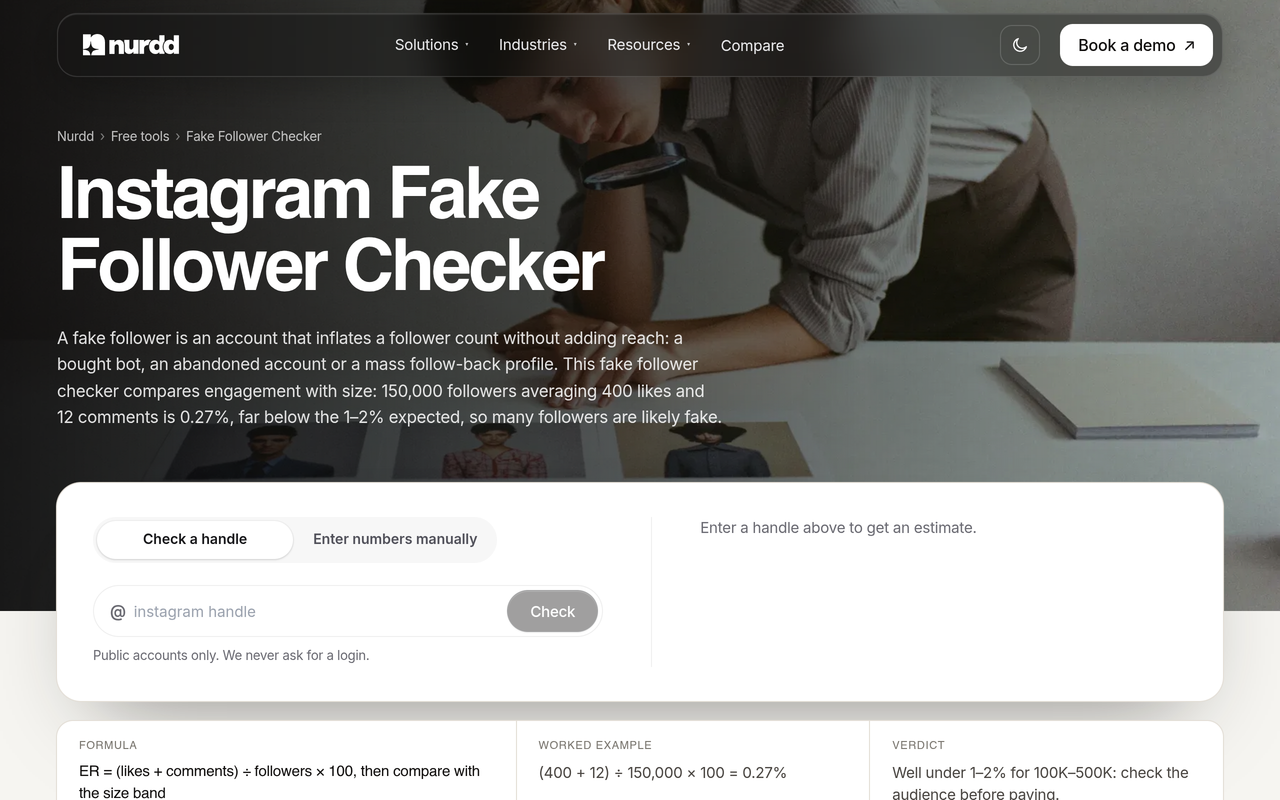
Vetting is the step where software earns its keep, because a rate is only worth paying if the audience is real. Nurdd's fake follower checker estimates fake or inactive followers from engagement, and the engagement rate calculator compares a creator with tier ranges.
Here is a test you can run from public evidence on any shortlist, whichever vendor you choose:
- Pick five creators the vendor or agency recommends.
- Run each through the fake follower checker and note the estimate.
- Calculate engagement on the last ten posts and compare it with the tier range.
- Read comments on two posts for generic or repeated replies; the fake follower red flags guide lists the patterns.
- Ask the vendor to explain any creator whose numbers disagree with their pitch.
A vendor that welcomes this test is showing you its method. For a longer version, use the fake follower audit checklist.
How do you forecast and measure ROI for a SaaS creator program?
Start with an input you control: the budget. The influencer ROI calculator projects revenue and ROAS from a creator budget, and the influencer rate card estimator shows published USD rates by tier and format so you can sanity-check quotes.
For rate context, Nurdd's benchmarks hub reports OpenSponsorship's July 2026 median paid cost per deliverable of $134 for nano and $2,727 for mega creators. B2B rates can differ from these consumer-heavy figures, so treat them as a reference point for negotiation, not a quote.
Define the SaaS outcome before launch: cost per qualified trial, cost per demo booked, or pipeline per creator. Use clean tracking links from day one, following the UTM structure guide for influencer campaigns, and keep in mind that incrementality matters more than last-click for long B2B cycles.
How do you move off an agency in 30 days? A checklist
Follow these steps in order. Each one produces something you can hand to the next owner.
- Request your data. Ask the agency for creator lists, rates paid, briefs, content links and performance exports. Result: a baseline you own.
- Check your contract. Find the notice period, content usage rights and any creator exclusivity. Result: no surprise overlap fees.
- Define three SaaS metrics. For example cost per trial, cost per demo and pipeline per creator. Result: a scoreboard the new setup is judged on.
- Shortlist two options. Use the five-signal table and one hybrid option. Result: a real choice, not a default.
- Run the vetting test. Put five creators through the public-evidence test above. Result: proof of method.
- Run a parallel pilot. Keep the agency on one creator slot and run another through the software. Result: a like-for-like comparison.
- Decide with the numbers. Compare cost per qualified outcome, hours spent and data access. Result: a documented decision for finance.
- Hand over. Move briefs and creator relationships into your system. Result: continuity with no gap.
Teams that also want a view on creator structure can read macro versus micro influencer strategy for B2B SaaS and the creator feedback loop for SaaS product roadmaps.
What mistakes do SaaS teams make when switching?
- Replacing the agency with a database. A search tool does not run outreach for you. Plan who does it.
- Judging on follower count. Audience quality and match matter more. See how to pick influencers based on predicted sales.
- Skipping the data export. Teams discover too late that reporting lived only in agency slides.
- Copying consumer metrics. Installs and purchases are not demos or pipeline. Define the SaaS outcome first.
- Ignoring disclosure. Paid creator posts need a clear disclosure of the material connection under your market's advertising rules. Build the disclosure requirement into every brief and check it with your legal team.
Where do the other Nurdd products fit?
Nurdd makes three separate products. Nia handles creative and influencer work. Noma, at nomahq.app, tracks whether your brand appears in answers from 13 AI engines, including ChatGPT, Gemini, Perplexity and Claude, which matters because SaaS buyers increasingly ask assistants for tool shortlists. It has a 3-day free trial; a card is taken at signup and billing starts on day 3, with no charge if you cancel before. Pulse reads Meta and Google Ads performance and is paid, with no trial.
For SaaS specifically, see Nurdd for SaaS, how to evaluate AI marketing agents for SaaS and the broader best influencer marketing platforms comparison. If you are still deciding on a category, how to pick an influencer marketing platform goes further.
Related reading: Moburst alternatives for influencer marketing.
Frequently asked questions
What are alternatives to Moburst for B2B SaaS influencer marketing?
Alternatives fall into three groups: other B2B influencer agencies, self-serve creator platforms, and hybrid models. Nia by Nurdd belongs in the software group, with discovery, TruAI fake follower detection, ROI forecasting and attribution built in. Pick by which of the four jobs you want to own.
Should a SaaS company use an influencer agency or software?
Use software if someone on your team can own the program and you want your own data and forecastable cost. Use an agency if you have no capacity to run outreach. A hybrid, with software as the system of record, is often the safest middle path and is easy to unwind either way.
Does Moburst publish its prices?
Moburst does not publish prices on the pages linked in this post. Ask for a scoped quote and written data-export terms before you commit.
Is influencer marketing effective for B2B SaaS?
Adoption is high: per the LinkedIn-Ipsos 2025 B2B Marketing Benchmark, as reported by Moburst, 55% of B2B marketers use creator marketing on LinkedIn and 29% plan to. Adoption is not proof of results for your product, so run a small pilot against your own SaaS metrics.
How much does Nia by Nurdd cost?
Nia is priced below comparable plans. We do not publish plan prices here. A demo will show what applies to your brand.
Can Nia vet creators for fake followers?
Yes. Nia scores every shortlisted creator with TruAI, Nurdd's fake follower detection, before a rate is agreed. You can also try Nurdd's fake follower checker tool on any account.
Do I need an agency if I use Nia?
No. Nia manages the full campaign workflow without needing an agency. If you want help anyway, Nurdd's managed influencer service runs creator campaigns on Nia.
How we researched this
We reviewed the top-ranking pages for this keyword that are not on nurdd.club, Moburst's own research and case study pages, agency roundups from Socially Powerful and Directive, and Open Influence's comparison page. Each was checked on the publication date of this post. We did not run hands-on tests of rival products, and we did not interview customers.
Rival facts come from the rival's own pages. Where a fact could not be confirmed, the table asks a question instead of making a claim. Vendor pricing and plans change, so confirm them on the vendor's site before you buy. The decision framework and worked example are Nurdd's own illustrations.
Ready to compare your options on your own brand?
The fastest way to judge a software-led creator program is to see it with your own category and creators. In a Nurdd demo you will see Nia surface creators for your niche, run TruAI on a shortlist, and return a forecast range before any spend. You can also look at Nia at getnia.studio first, or explore Nurdd's tools and the comparison pages on your own time.