Paid Media
Paid Media Agency AI Search Reporting: How to Package It
Package AI search reporting as a scoped, priced add-on with three tiers, a scope table, a margin example and a monthly report built on Noma tracking.
 Simran Rawat16 Nov 202615 min read

A paid media agency can offer AI search reporting by selling it as a defined add-on: a one-time baseline audit, then a monthly monitoring tier, with optimisation work as a separate, higher tier. Published agency guides put monitoring retainers at $1,500 to $5,000 a month and add-on uplifts at 20 to 30% of the existing retainer. Noma by Nurdd is the tracking layer that produces the data behind the report.
A paid media agency can offer paid media agency AI search reporting by treating it as a named, priced add-on with three parts: a one-time baseline audit, a monthly monitoring report, and an optional optimisation tier. Clients are already asking whether their brand shows up in ChatGPT, Gemini and Perplexity answers, and answering for free turns into unbilled hours. The fix is a fixed scope, a fixed deliverable and a tracking tool that does the data collection for you.
Key takeaways
- Sell AI search reporting as a separate line item with three tiers (audit, monitoring, growth) so that measurement never silently becomes optimisation work.
- Published agency guidance puts monitoring retainers at $1,500 to $5,000 a month and add-on uplifts at 20 to 30% of an existing retainer (Similarweb, 2026).
- Keep paid-media numbers (spend, ROAS, CPA) and AI visibility numbers (mention rate, share of voice, cited pages) in one report, but never merge them into one blended score.
- Write down what is out of scope: content rewrites, digital PR, schema work and ChatGPT ad management are separate fees.
- Use a tracking tool that polls engines daily so the monthly report is a review of data, not a manual prompt-testing session.
- Run the 10-step packaging checklist below before you send the first proposal.
Why is AI search reporting hard for a paid media agency to package?
Paid media teams are used to reporting on things they control: budgets, bids, creative and audiences. AI search visibility is different, because no one buys a placement in an AI answer, and the same prompt can return different brands on different days. That makes it easy to over-promise and hard to price.
The second difficulty is scope creep. A client who sees a report saying the brand is missing from ChatGPT answers will ask the agency to fix it, and the fix (content, schema, third-party mentions) is a different discipline from media buying. Without a written boundary, the report becomes the start of an unpaid project. Our earlier piece on whether a paid media agency should report on AI search covers the case for including it; this guide covers how to charge for it.
The third difficulty is that the market is moving. PPC Land, 2026 reports that Pew Research Center found users clicked a link on 8% of Google searches showing an AI summary, against 15% without one, across 68,879 searches, and that Google disputed the study. The same article cites an Ahrefs February 2026 study reporting that AI summaries cut clicks to websites by 58%. Whatever the exact figure, paid media clients are asking where their traffic and their brand mentions are going, and the agency running their paid search and social is the first team they ask.

What does a scoped AI search reporting add-on include?
A scoped add-on has five parts, and each one should appear in the proposal as a line the client can read in ten seconds.
- A prompt set. A fixed list of the questions the client's buyers ask AI engines, agreed at the start. Similarweb, 2026 suggests a baseline of 20 to 50 seed prompts covering core categories, competitor comparisons and buyer research questions.
- An engine list. The AI engines polled for those prompts. Noma by Nurdd tracks 13 AI engines, including ChatGPT, Gemini, Perplexity and Claude, polled daily.
- A competitor set. The same source recommends benchmarking against 3 to 5 direct competitors, which keeps the share-of-voice number meaningful.
- A monthly report. A fixed-format document, delivered on a fixed date, with a stated number of recommendations.
- A boundary. A sentence saying that implementation work is quoted separately.
For help choosing the prompt set, see which prompts to track for AI search visibility and how many prompts you need.
Key takeaways in one table: which tier does which work?
Most agency guides describe tiers, but few say what each tier excludes. This table is the scope document: use it in the proposal and point to it when a client asks for "just one quick fix".
| Tier | Included | Explicitly excluded | Published price range |
|---|---|---|---|
| 1. Baseline audit (one-time) | Visibility across the agreed engines, 3 to 5 competitors, prompt gaps, a prioritised list of fixes | Making any of the fixes | $500 to $5,000 (Similarweb, 2026) |
| 2. Monitoring add-on (monthly) | Daily tracking, monthly trend report, competitor share of voice, one prioritised recommendation, alerts on big changes | Content, schema and outreach work | $1,500 to $5,000 a month (Similarweb, 2026) |
| 3. Growth retainer (monthly) | Tier 2 plus content updates, schema changes, third-party outreach and quarterly review | Paid ad management on AI surfaces | $3,000 to $10,000 or more a month (Similarweb, 2026) |
Price ranges are the vendor's published guidance, not a market guarantee. Similarweb sells AI visibility software, so treat its ranges as one reference point and test them against your own cost base. A second reference: Cognizo, 2026, citing First Page Sage (October 2026), reports a median GEO and AEO retainer of $6,850 in Q3 2026 against $4,740 for traditional SEO, and a one-time audit median of $4,300 within a range of $1,500 to $12,000.
How should agencies package AI visibility services? A decision framework
The two published packaging models are add-on and standalone. Similarweb, 2026 gives a typical add-on uplift of 20 to 30% on the existing retainer value, and a typical standalone retainer of $2,000 to $10,000 a month. Which one fits depends on the client, so use this decision table.
| Client situation | Package | Why |
|---|---|---|
| Existing paid media client, no SEO or content team at the agency | Tier 1 audit, then Tier 2 monitoring as an add-on | You can measure and advise without owning content work |
| Existing paid media client with an in-house content team | Tier 2 monitoring, with recommendations handed to the client team | Their team implements; you supply the data and priorities |
| Client asking you to "get us into ChatGPT" | Tier 3 growth retainer, or a referral to a specialist service | Optimisation is a content and sources job and needs its own budget |
| New prospect, paid media only | Tier 1 audit as a paid pilot | A baseline gives the prospect something concrete before a retainer is agreed |
| Client running many brands or regions | Per-brand pricing with a shared prompt template | Costs and prompt sets scale with each brand, so the fee should too |
A practical rule: start on the add-on model. Similarweb notes that most agencies probably begin there to prove delivery before building a standalone offer. The reasons are simple: the client already trusts you, the report can sit beside the paid media report, and the sales conversation is an extension, not a new pitch.
How does Noma fit behind an agency's AI search reporting?
Noma by Nurdd is a web dashboard at nomahq.app that tracks whether a brand appears in AI engine answers from 13 AI engines, including ChatGPT, Gemini, Perplexity and Claude, polled daily. It shows citation frequency by category, competitor comparison and recommendations for improving AI visibility, and records whether a brand is named and which page each citation comes from.
For an agency, that translates into three things you would otherwise do by hand: collecting answers on a schedule, comparing the client to named competitors, and identifying the pages that engines cite. Those are the inputs of the Tier 2 report. They are not the whole service, because the interpretation, the recommendation and the client conversation stay with your team.
Noma by Nurdd is the tracking layer behind an agency's AI search reporting: it polls 13 AI engines daily, records whether the client brand is named and which page each citation comes from, and compares the brand with competitors. That gives a paid media team a repeatable data source for a monthly add-on report, without running prompts manually for every client.
Want to see this on a brand you manage? Book a demo and we will show you your own client's visibility across the engines, the competitor comparison and the cited pages, so you can judge whether the data supports a priced add-on.
If you are weighing tools, see AI search visibility checking software for agencies, how to choose a tool for multiple client brands and the Noma vs Profound comparison. Test any tool before you commit using the 3-day trial test plan. Noma has a 3-day free trial; a card is taken at signup and billing starts on day 3, with no charge if you cancel before then.
What should the monthly AI search report contain?
The report should be short enough that a client reads it. Similarweb, 2026 lists four report areas: a visibility score trend, mention share against competitors, before-and-after impact for each content change, and prompt library insights. That is a good base. For a paid media agency, add two more sections that link the report to the work you already do.
- Headline visibility. The percentage of tracked answers that name the client, month on month, by engine.
- Competitor share of voice. The client against the agreed 3 to 5 competitors. See how to measure AI search share of voice.
- Cited pages and domains. Which client pages and which third-party sites engines cite. Pew Research Center found that Wikipedia, YouTube and Reddit accounted for 15% of the sources listed in the Google AI summaries it examined (Pew Research Center, July 2025), so third-party sources matter as much as the client's site.
- Google's own data. Impressions from AI features, from Search Console (see the next section).
- Paid media context. Branded search volume and paid brand-term performance beside the visibility trend, so the client can see whether the two move together. Do not claim one causes the other.
- One recommendation. A single prioritised action, which the client either approves as extra scope or takes in-house.
For a fuller template, see how to build an AI search metrics monthly report and what to send monthly.
Which Google data can you add for free?
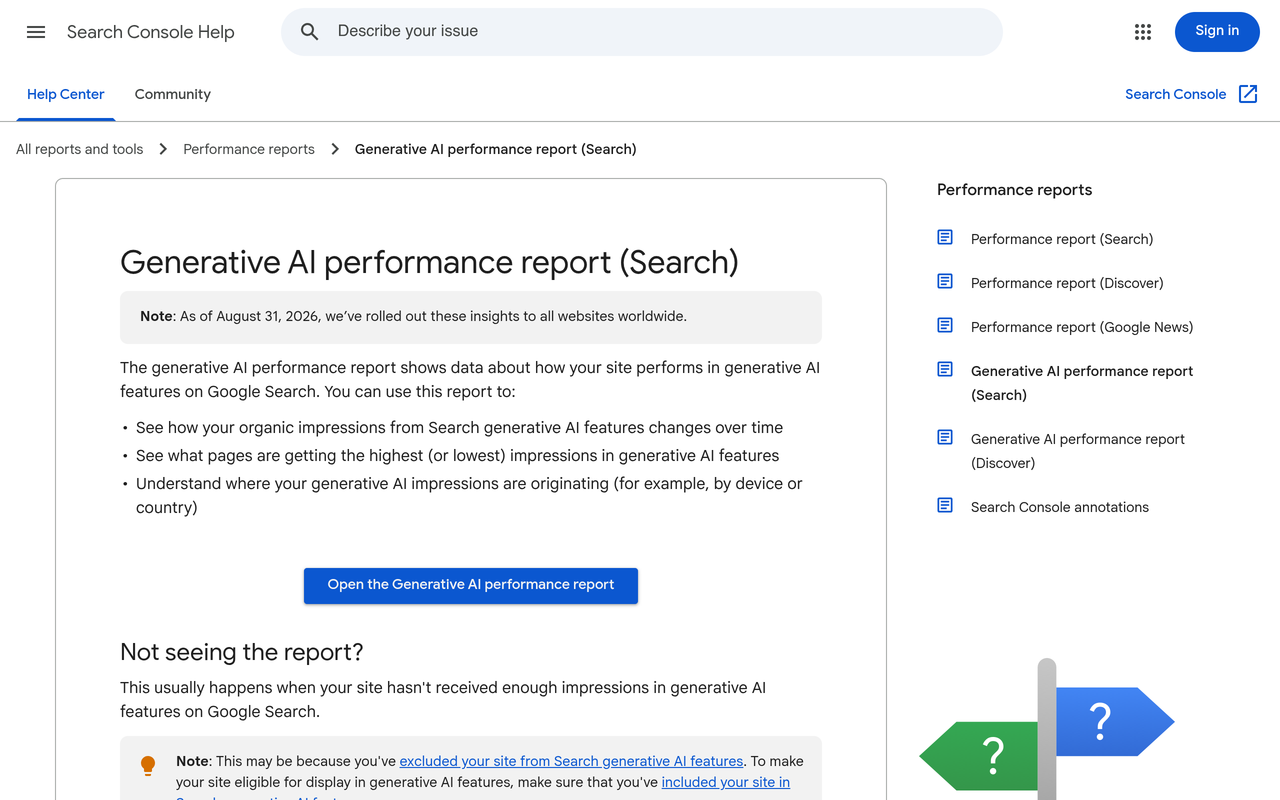
Google's Search Console now has a generative AI performance report. According to Google Search Console Help, it shows how a site performs in generative AI features on Google Search, covering impressions from AI Overviews and AI Mode, with views by page and by where the impressions come from, such as device or country. Google's AI features documentation adds that sites appearing in AI features are included in overall search traffic and reported in the Performance report under the Web search type.
This is the one place where the agency can show first-party Google numbers. It needs the client to give you Search Console access, which is a simple scoping point: put it in the onboarding list. It covers Google only, so it complements, rather than replaces, tracking across other engines.
What does the margin look like? A worked example
Packaging only works if the add-on pays for the hours it takes. The example below uses published ranges from Similarweb and assumptions of our own; it is arithmetic to show the method, not a customer result.
Starting facts from the source: add-on uplifts are typically 20 to 30% of the existing retainer, and a Tier 2 monitoring retainer is $1,500 to $5,000 a month (Similarweb, 2026).
Assumption: a client pays your agency an $8,000 monthly management retainer.
- A 20% uplift is $1,600 a month; a 30% uplift is $2,400 a month.
- Both sit inside the $1,500 to $5,000 Tier 2 range, so the price is defensible against published benchmarks.
- Your costs are the tracking tool, the analyst time to read the data and write the recommendation, and the account manager time to present it. Put your own hourly cost against each, and keep the total below the fee with room for margin.
Now test the alternative. Without a scope, say the account manager spends a few unplanned hours a month answering "why aren't we in ChatGPT?" for a client paying nothing extra. The same hours sold as Tier 2 recover $1,600 to $2,400. The difference is the sentence in the proposal, not the work.
The tooling cost is the line most often underestimated. If you run separate manual checks per client, your analyst hours grow with every new brand. A tool that polls daily and compares competitors keeps analyst time to reading and recommending. Compare it against the pricing logic in AI search agency pricing: what you pay and what to ask.
Three scenarios: how to sell it to different clients
Scenario 1: the performance marketer with a cost-per-acquisition target
The client's head of growth cares about CPA and ROAS. Open with the paid search view: if AI summaries change clicks, branded and non-branded search demand shifts too. Show Tier 1 as a one-time diagnostic that sits next to the ROAS report. Use the Google + Meta ROAS calculator to keep the paid side honest, and use the audit to show which competitor brands AI engines name for the client's category. The sale is "measure first", with no promise of results.
Scenario 2: the brand manager worried about reputation
This client wants to know what AI engines say about the brand. Package Tier 2 with a perception section: which claims engines repeat, and whether they match the client's own pages. Our guide to AI brand perception tracking shows what to measure. Corrections are implementation work and belong to a separate quote, usually Tier 3.
Scenario 3: the agency owner with a dozen clients
Here the issue is repeatability. Build one prompt template per sector, one report template, and price per brand. Use tracking multiple brands in AI search: a setup guide to organise the accounts. Start with the three clients who ask most often, prove the report, and roll out the rest. For implementation help your team does not want to staff, Nurdd also runs answer engine optimization as a managed service, measured in Noma.
What about ads in AI answers?
Keep AI advertising out of the monitoring tier. It is a media buying service with its own billing and platform rules. StubGroup, 2026 reports that ChatGPT ads run through a self-serve platform at ads.openai.com, that OpenAI tells agencies not to create ad accounts on behalf of clients, and that there is not yet a manager account for connecting several advertiser accounts. Those rules affect how you contract and who owns the account, so check the current platform terms before quoting.
If clients ask, price it as managed media with a percentage or flat management fee, and report it in the paid media report. Our guides on how to advertise on ChatGPT and paid media reporting for ChatGPT ads and AI Overviews cover the measurement side.
A 10-step checklist for packaging the add-on
- List the AI visibility questions your clients have already asked you in the last quarter.
- Pick the model per client using the decision table: add-on, standalone or referral.
- Write a one-page scope with the five parts: prompts, engines, competitors, report, boundary.
- Run a baseline on your own agency first, so you can show a real example.
- Choose the tracking tool and run a trial on one client brand before quoting the rest.
- Set the price from your cost base, then check it against published ranges.
- Draft the report template with the six sections above and a fixed delivery date.
- Add the Search Console access request to onboarding.
- List the exclusions in writing: content, schema, outreach, ad management.
- Review after 90 days: what the client acted on, what they ignored, and whether the price held.
A 90-day rhythm helps here. See the 90-day AI search marketing plan template for how to sequence the first quarter. Before the audit, a client can also run the GEO readiness scorecard, a 12-factor free check, to see how ready their site is for AI answers.
What are the common mistakes?
- Giving the report away. A free report is read as a free service. Even a pilot should have a price, however small.
- Promising rankings. No agency controls what an AI engine says. Promise measurement, a recommendation and a review, not placement.
- Blending metrics. A single score that mixes ROAS and mention rate is unexplainable. Keep them side by side.
- Trusting one-off prompts. Answers vary, so a single manual check proves little. See manual prompts vs software and how to verify AI search tool data.
- Ignoring referral traffic. Track what arrives from AI engines in analytics, using AI referral traffic in analytics, so the report ties to site behaviour.
- Underpricing tools. Per-client subscriptions and analyst hours add up. Price them in from day one.
Conclusion
AI search reporting is easy to add and easy to give away. The agencies that make it pay define the scope, name the tiers, keep optimisation separate and use a tracking layer that collects the data daily. The report then becomes a recurring line item rather than a favour.
Noma by Nurdd gives your team the data layer: 13 AI engines, daily polling, citations and competitor comparisons. Book a demo at nurdd.club/demo and bring one client brand: you will see its visibility by engine, how it compares with its competitors and which pages are cited, so you can price the add-on against real data.
How we researched this
We reviewed published agency guides on packaging AI visibility services, Google's own Search Console and Search Central documentation, Pew Research Center's published analysis, and trade press coverage of click data and ChatGPT advertising. We searched for the primary keyword, read the top-ranking guides that are not on nurdd.club, and noted what they covered and left out. All sources were checked on the publication date of this article. We have not run hands-on tests of rival tools or interviewed agencies, and the margin example is arithmetic from published ranges plus stated assumptions. Vendor price ranges come from vendors that sell related software, so treat them as reference points.
Frequently asked questions
How can a paid media agency offer AI search reporting?
Define a fixed scope: an agreed prompt set, a list of engines, 3 to 5 competitors and a monthly report with one recommendation. Sell it as a named add-on to the existing paid media retainer, and put implementation work in a separate quote. A tracking tool such as Noma by Nurdd supplies the daily data.
How should agencies package AI visibility services?
Use three tiers: a one-time baseline audit, a monthly monitoring add-on and a growth retainer that includes content, schema and outreach work. Published guidance from Similarweb gives ranges for each, and describes add-on and standalone models. Start with the add-on model to prove delivery.
How much should an agency charge for AI search reporting?
Similarweb's published guidance puts monitoring retainers at $1,500 to $5,000 a month and add-on uplifts at 20 to 30% of the existing retainer. Cognizo, citing First Page Sage, reports a median GEO and AEO retainer of $6,850 in Q3 2026. Set your own price from your tooling and analyst costs, then compare it with those ranges.
Is AI search reporting different from SEO reporting?
Yes. SEO reports track rankings, clicks and impressions from search engines, while AI search reporting tracks whether a brand is named and cited inside generated answers across several engines. Google's Search Console now reports impressions from AI Overviews and AI Mode, but other engines need a separate tracking tool. See AI search metrics vs SEO metrics.
Should the report include paid ads on AI platforms?
Report them in the paid media report, not in the monitoring tier. Ads on AI surfaces are a media buying service with their own account rules. StubGroup reports that OpenAI tells agencies not to create ad accounts for clients, so check platform terms first.
Can I promise clients more mentions in AI answers?
No. Promise measurement, a prioritised recommendation and a review, because no agency controls what an AI engine says. If the client wants optimisation work, quote it as a separate tier and report before-and-after changes for each piece of work.
How many prompts should a monitoring tier track?
Similarweb suggests starting with 20 to 50 seed prompts that cover core categories, competitor comparisons and buyer research questions. Agree the list in writing and review it quarterly. More prompts raise the tracking cost, so tie the prompt count to the price.
Does Noma have a free trial?
Noma offers a 3-day free trial. A card is taken at signup and billing starts on day 3; if you cancel before then, you are not charged. It is a short window, so prepare one client brand and its prompt set before you start.