AI Search Visibility
AI SEO Tactics That Also Earn AI Citations
Which AI SEO tactics help Google rankings and AI citations, which only add volume, and how to verify the difference with Noma.
 Simran Rawat13 Nov 202617 min read
The AI SEO tactics that work for both Google and AI engines are the ones that make a page more useful, crawlable and credible: original content, clear page structure, current facts, consistent brand details and real third-party mentions. Tactics that only add volume, such as mass-produced pages or llms.txt files, have no verified effect on Google and weak evidence for citations. Noma lets you test each change against 13 AI engines instead of guessing.
AI SEO tactics that work are the ones that improve both Google rankings and AI citations: original, useful content, a clean technical structure, accurate and current facts, consistent brand details and genuine mentions on other sites. Tactics that mainly increase page count or add special files do not have evidence behind them. You can check any change by tracking your brand across AI engines before and after.
Key takeaways
- Treat Google rankings as the base layer. Google says its AI features are built on its core ranking and quality systems, so ordinary SEO fundamentals still apply.
- Sort every tactic by two questions: does it help a Google ranking, and does it help a model name you? Keep what passes both, test what passes one, drop what passes neither.
- Do not rely on volume. Google's spam policy treats content produced at scale to manipulate rankings as abuse, whether automation or people produced it.
- Ranking alone does not guarantee citations. One Ahrefs analysis of 15,000 prompts found only 12% of links cited by ChatGPT, Gemini and Copilot appeared in Google's top 10 for the same prompt.
- Verify with a controlled test: fix a prompt set, change one thing, and watch citation frequency across engines for four weeks in Noma.
- Skip tactics that Google says it ignores, such as llms.txt, until you have a measured reason to try them for other engines.
Which AI SEO tactics actually work, in short?
Five groups of tactics earn their place because they help a human reader, a Google ranking system and an answer engine at once. They are: content that adds something new, pages that state the answer plainly, technical access and clear structure, consistent facts about your brand across the web, and real mentions from other publishers. Everything else is either unproven or a volume play.
The rest of this guide shows how to sort tactics with a two-signal table, how to run each tactic as a test, and how Noma, the AI search visibility product from Nurdd, records the result. If you want the definitions first, read what generative engine optimization is and how GEO, AEO and SEO differ.
Why is it hard to tell which AI SEO tactics are real?
The advice market is noisy because almost every tactic is easy to sell and hard to test. Vendors recommend llms.txt files, question-style headings, FAQ blocks, key-takeaway boxes, Reddit campaigns and AI-specific schema. A Grow and Convert article on AI SEO strategy lists these exact tactics as things it has seen AI visibility companies and consultants recommend, and then argues that teams should prioritise by evidence rather than by what is popular.
Meanwhile the platforms speak plainly. Google Search Central's guide to optimizing for generative AI features says that Google's AI features rely on techniques such as retrieval-augmented generation and query fan-out, which draw on its core ranking systems. In practice that means a page has to be indexable and relevant before any AI-specific tactic matters.
There is a second problem: the two systems do not behave identically, and the numbers move. Ahrefs data reviewed by Digital Applied shows that 38% of AI Overview citations now come from pages in Google's top 10, down from 76% in mid-2025 (Digital Applied, 2026). In a separate Ahrefs analysis of 15,000 prompts, only 12% of links cited by ChatGPT, Gemini and Copilot appeared in Google's top 10 for the same prompt (Ahrefs, 2025). These are different measurements on different surfaces, and both say that ranking alone is a weaker guide to citations than it used to be.
What does Google itself say about optimizing for AI features?
Google's own documentation is the most reliable starting point because it describes what its systems do. On its AI features page, Google states that no special optimization is required for AI Overviews and AI Mode, and that the existing SEO fundamentals remain worthwhile. It lists examples: allowing crawling in robots.txt and through any CDN, making content findable through internal links, giving a good page experience, keeping important content in text, and making structured data match the visible text (Google Search Central, checked November 2026).
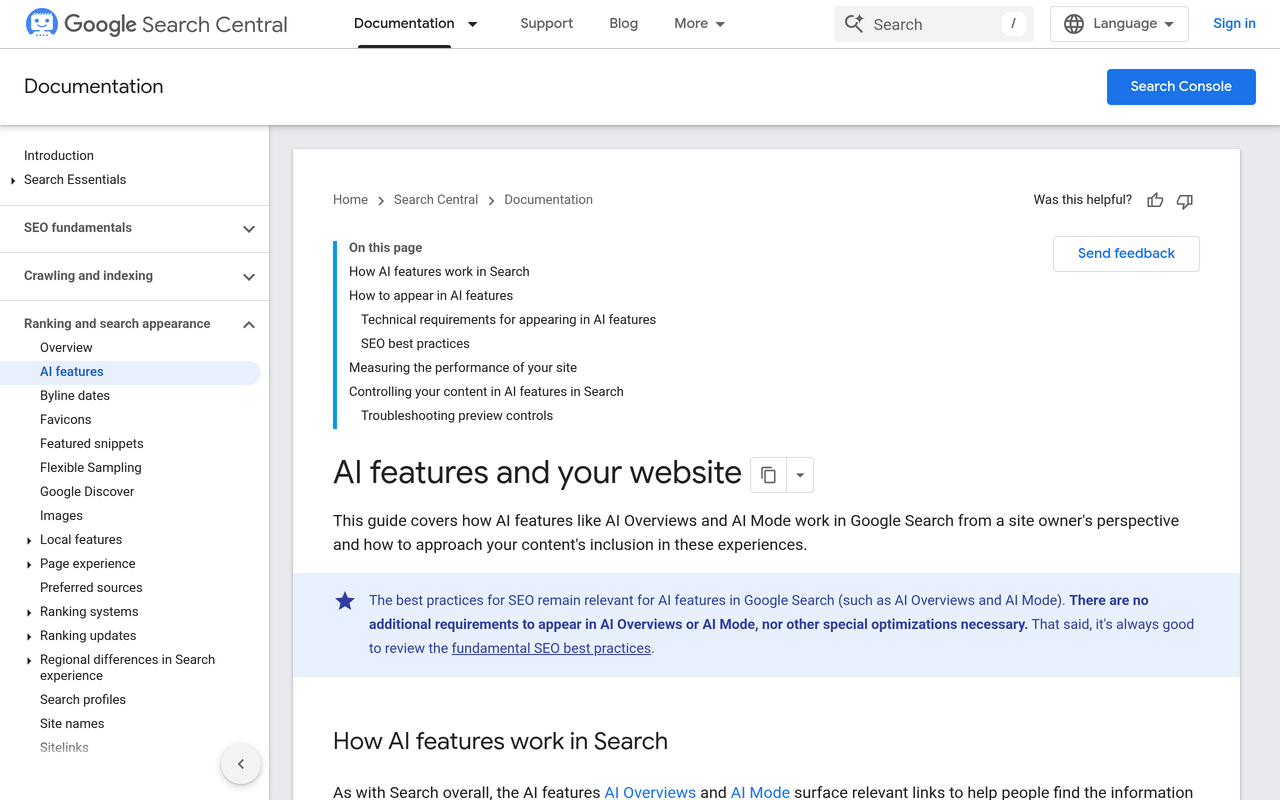
Google's optimization guide also has a mythbusting section. It says Google Search ignores llms.txt files and other special markup, that there is no need to break content into tiny chunks, no need to rewrite content only for AI systems, and no special schema.org markup required. It adds that chasing inauthentic mentions is less useful than it looks. Structured data is still worth using for rich results, but it is not a lever specific to AI answers.
Google Search Central's guidance, in short: the same helpful-content and spam systems that govern ordinary results also govern its generative AI features, so there is no separate shortcut for AI answers.
Note the scope. Those statements describe Google Search. ChatGPT, Perplexity, Claude and other engines have their own retrieval systems, which is exactly why measurement across engines matters more than any single rule.
How do I optimise for Google and AI engines at once?
Use one page, one purpose and one test. Build the page to rank, make the answer easy to extract, keep the facts verifiable, and measure whether engines cite it. The framework below sorts tactics using two signals: evidence of help for Google rankings, and evidence of help for AI citations.
The two-signal tactic sorter
| Tactic | Google ranking signal | AI citation signal | Verdict |
|---|---|---|---|
| Original, non-commodity content | Google's guide asks for valuable, non-commodity content | Engines need something specific to quote | Do first |
| Direct answer in the first paragraph | Helps readers and snippets | Gives a model a self-contained passage | Do |
| Crawl access and clean internal linking | Documented requirement | Bots cannot cite what they cannot fetch | Do first |
| Refreshing facts and dates honestly | Supports accuracy and freshness | Cited content skews fresher, effect moderate | Do on key pages |
| Consistent brand facts across profiles | Supports entity clarity | Reduces conflicting answers about you | Do |
| Earned third-party mentions | Links and reputation | Brand mentions correlate with AI Overview visibility in Ahrefs data | Do, slowly |
| Schema that matches visible text | Rich result eligibility | No special AI markup needed per Google | Keep, do not oversell |
| Mass-produced programmatic pages | Risk under scaled content abuse policy | Thin pages give nothing to quote | Avoid |
| llms.txt files | Google says Google Search ignores them | No credible evidence in one 2026 review | Low priority |
| Chunking content into tiny pieces | Google says it is not required | Unproven | Skip unless tests show lift |
The table is a decision aid, not a ranking of importance. The right-hand column changes as evidence changes, which is why the last step in this guide is a test you can repeat.
How do I apply the tactics? Seven steps
Step 1: Fix access before anything else
Action: check that Googlebot and the AI crawlers you want can fetch your key pages, in robots.txt and at your CDN or host. Result: a list of pages that are reachable, indexable and rendered as text. Why: Google's documentation names crawl access as a fundamental, and no tactic downstream works if a bot is blocked. The guide to AI crawler user agents, what to allow and what to block shows the decision for each bot.
Step 2: Choose pages where a citation would matter
Action: list the 10 to 20 questions a buyer asks before choosing a product like yours, and map each to one page. Result: a short list of pages that deserve effort, rather than a content calendar. Why: Grow and Convert argues that product-related, bottom-of-funnel prompts deserve first priority. That is a sensible rule because a citation on a buying question is worth more than one on a general topic. Use this guide to choosing which prompts to track to build the list.
Step 3: Rewrite the top of each page as a direct answer
Action: put a 40 to 60 word answer to the page's question in the first paragraph, naming the entity in full. Result: a passage that makes sense when lifted out of the page. Why: readers and Google's snippet systems reward it, and an answer engine can quote it without losing context. Google says you do not need to write only for AI systems, so this is clear writing, not a trick. The article on the sentence structure that gets quoted in AI answers has before and after examples.
Step 4: Add something original
Action: add one thing a competitor page lacks: your own data, a worked example, a decision table, a checklist or a first-hand process. Result: a page with a reason to be cited. Why: Google's guide asks for non-commodity content, and an engine choosing between ten near-identical pages has no reason to pick yours. See how publishing original data earns citations.
Step 5: Make the facts match everywhere
Action: compare how your brand is described on your site, social profiles, directories and partner pages, and fix contradictions. Add visible author and update information. Result: one consistent description of who you are and what you sell. Why: models assemble answers from many pages, and conflicting details produce vague or wrong mentions. The entity consistency checklist and the guide to author and dateModified signals walk through the fields.
Step 6: Earn mentions where engines already look
Action: find which third-party pages are cited for your category prompts, then pursue honest coverage there: reviews, comparisons, forums and trade press. Result: a target list of real publishers rather than a link-buying plan. Why: Google warns that inauthentic mentions are not as helpful as they seem, while a Digital Applied review of Ahrefs data reports a 0.664 correlation between brand web mentions and AI Overview visibility. Correlation is not cause, but it points to reputation as a durable lever.
Step 7: Refresh key pages with real changes
Action: update statistics, screenshots, prices and examples on your highest-value pages, and change the visible date only when the content changed. Result: pages that stay accurate. Why: the same Digital Applied review reports that AI-cited content averages about 25.7% fresher than organic top-10 results across nearly 17 million citations, and it warns against a viral multiplier claim that traces to no primary study. Freshness helps, but moderately.
Which AI SEO tactics only produce content volume?
Volume tactics make more pages without making any single page more useful. Google's spam policy announcement from March 2024 says that producing content at scale is abusive when the purpose is to manipulate search rankings, and that this applies whether automation or humans produce it (Google Search Central, March 2024). The same page says automation, including generative AI, is spam if its primary purpose is ranking manipulation.
HubSpot's article on AI for SEO makes a related point from the practitioner side: AI makes it easier to produce mediocre work at scale, which means mediocre work no longer earns visibility (HubSpot). Its list of challenges also includes handing the thinking to the tool and weak research accuracy.
- Programmatic page sets with swapped nouns. They add URLs, not answers. The guide on avoiding programmatic SEO pages that AI ignores explains the pattern.
- AI-written rewrites of existing articles. The page has the same facts in new words, so no engine has a new reason to cite it.
- Question-heading rewrites across an entire site. Useful on pages that really answer those questions; useless as a site-wide find and replace.
- Bulk FAQ blocks. A FAQ helps when each answer is something readers ask. Twenty padded questions are noise.
- Special files for AI. Google says Google Search ignores llms.txt files. The Digital Applied review found no credible evidence that they influence citations.
None of these is banned for every engine, and some may do something somewhere. The point is that they sit in the pass-neither or pass-one rows of the sorter until a test shows otherwise.
How do I verify an AI SEO tactic with Noma instead of guessing?
Noma, the AI search visibility product from Nurdd at nomahq.app, tracks whether a brand appears in answers from 13 AI engines, including ChatGPT, Gemini, Perplexity and Claude, polled daily. It shows citation frequency by category, competitor comparison and recommendations. That gives you a before and after record for each tactic, which neither Google Search Console nor a rank tracker provides for assistants.
The method is a small experiment. It borrows from the approach in GEO experiment design for testing AI visibility changes, and you can adapt it to any tactic in the sorter.
- Pick one page and one tactic, for example adding a direct answer and an original table to a comparison page.
- Write 10 to 20 prompts a buyer would ask that this page should answer. Record them and do not change them during the test.
- Run the prompts for at least a week before you change anything, to set a baseline for how often your brand is named and which pages are cited.
- Make the one change, publish it, and request indexing in Google Search Console.
- Keep a matched control: a similar page you do not touch, with its own prompts.
- Compare citation frequency and cited URLs for the test and control prompts after four weeks. Note which engines moved.
- Keep the tactic if the test prompts improved more than the control. Otherwise revert or try a different change.
A prompt set of 20 prompts across 13 engines is 260 prompt and engine pairs checked per daily poll, which is why a tracker beats checking by hand. The guide on how many prompts you need covers the sample-size question, and a four-week ChatGPT test plan gives a lighter version for one engine.
Worked example: reading the overlap numbers before you plan
Suppose you want to know whether ranking in the top 10 is enough. Take the figures as published. In Ahrefs data reviewed by Digital Applied, 38% of AI Overview citations now come from top-10 pages, so out of every 100 AI Overview citations, 38 are pages in the top 10 and 62 are not. The same review dates the earlier figure to mid-2025, when it was 76%, so the share has roughly halved.
In the separate Ahrefs assistant analysis from 2025, 12% of cited URLs ranked in Google's top 10 for the same prompt, so out of every 100 citations by ChatGPT, Gemini and Copilot, 88 did not.
The planning consequence is concrete. Top-10 rankings still matter because they remain a large share of AI Overview sources, but on neither surface are they enough. You also need the mention, structure and freshness work, and a tracker to see which pages engines pick instead of yours. Because the share moved by half within a year, treat each percentage as one study's result on its own dataset, not a law, and re-test on your own prompts.
What is the quick checklist for a page that serves Google and AI engines?
- The page is indexable, reachable by the crawlers you want, and linked from at least one relevant internal page.
- The first paragraph answers the title question in 40 to 60 words and names the subject in full.
- Headings reflect real questions readers ask, and each section answers its heading directly.
- The page contains at least one thing competitors lack: original data, a table, a worked example or a process.
- Every number is attributed to a named source with a link and a date.
- Structured data, if used, matches the visible text exactly.
- Author, publisher and update date are visible and accurate.
- The brand description matches what your other profiles say.
- The page has been added to a Noma prompt set, with a baseline recorded before changes.
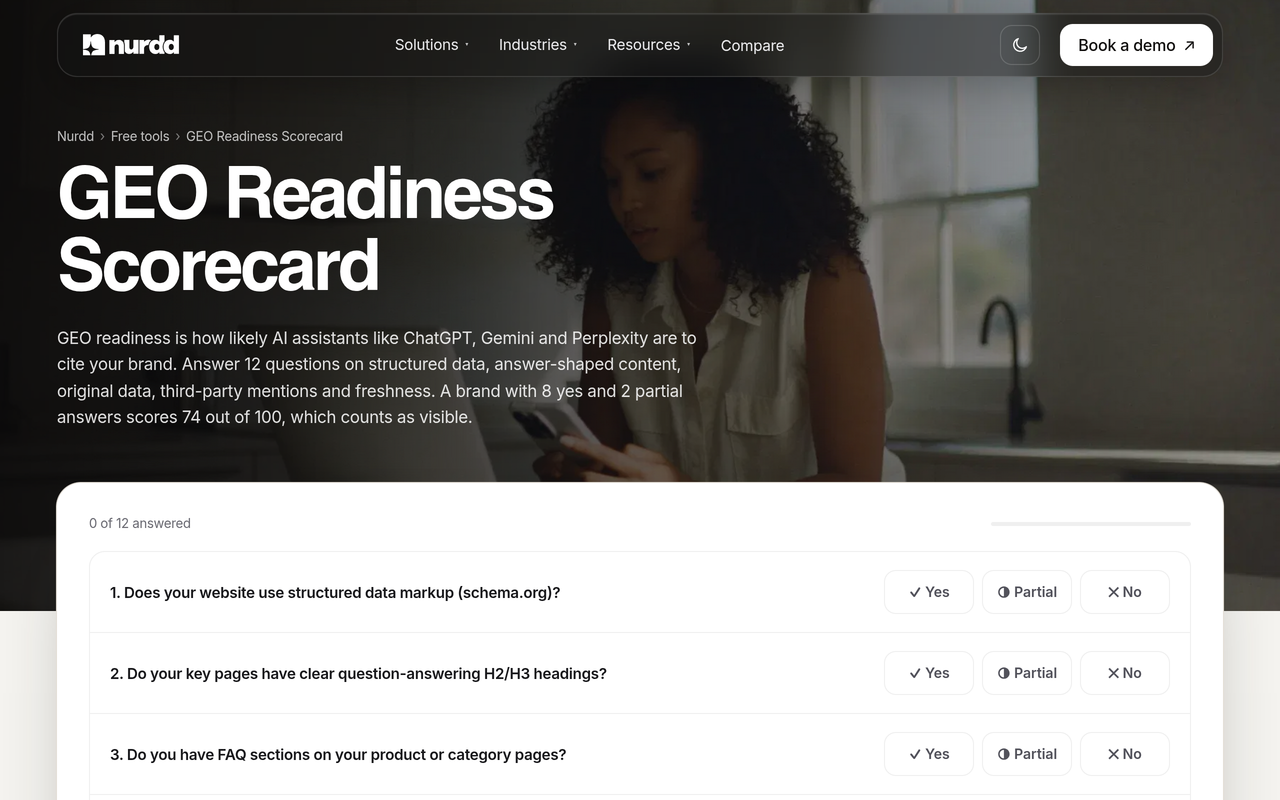
For a full audit version of this list, the AEO audit checklist for D2C brands goes page by page, and the free GEO readiness scorecard gives a 12-factor first read in a few minutes.
What do competitor guides leave out?
Reviewing the top-ranking guides on this topic shows a pattern. The HubSpot article focuses on using AI inside an SEO workflow: topic clustering, auditing, briefs and drafting help. The SEO.com article lists 11 ways to use AI for tasks such as research, outlines and schema generation. The Grow and Convert article lays out a tiered strategy and questions the popular on-site tactics. All three are useful, but none gives a decision table that scores each tactic against both Google and AI-citation evidence, and none gives a repeatable test with a control for checking a tactic on your own pages. That gap is what the sorter and the seven-step test above fill.
| Question | AI used to do SEO tasks | SEO done to be cited by AI |
|---|---|---|
| What it means | Using AI tools for research, briefs and drafts | Changing pages and brand signals so engines name you |
| Main risk | Mediocre output at scale | Following tactics with no evidence |
| How you check it | Editorial review and ranking data | Citation tracking across engines |
| Where Noma fits | Not its job | Measures the result |
What are the common mistakes with AI SEO tactics?
- Changing five things at once. You cannot tell which one mattered. Change one variable per test page.
- Measuring only Google. A page can rank well and still not be named by assistants. The article on ranking on Google but not being cited by AI covers the fixes.
- Treating one study as a rule. The Ahrefs overlap numbers and the freshness figure are measurements on specific datasets, and the AI Overview share has already changed once. Re-test on your own category.
- Counting mentions without reading them. A mention that gets your product wrong is a problem, not a win. Read the answers.
- Judging too early. Give a change a few weeks to be indexed and re-polled before concluding it failed.
- Ignoring AI referral traffic. Citations matter most when they lead to visits. See how to measure AI referral traffic in analytics.
How does Noma help with AI SEO tactics?
Noma by Nurdd is an AI search visibility dashboard that tracks 13 AI engines, including ChatGPT, Gemini, Perplexity and Claude, daily. It records whether a brand is named for category prompts, shows citation frequency, compares competitors and recommends actions. For AI SEO, that means each tactic in this guide can be judged by what engines actually do after the change.
Noma sits beside, not in place of, your SEO tools. Keep Google Search Console for rankings and clicks; use Noma for the assistant side. For a full reporting rhythm, see the monthly AI search metrics report and the guide to AI search share of voice. If you are comparing tools, the page on Noma vs Profound sets out the differences.
Noma has a 3-day free trial. A card is taken at signup and billing starts on day 3, so you are not charged if you cancel before then. If you would rather have a team run the content and sourcing work, Nurdd also offers generative engine optimization services, measured in Noma.
Book a demo at https://www.nurdd.club/demo and we will walk through your own brand in Noma: which category prompts you are named for across the 13 engines, which competitors appear instead, and which pages are cited, so you can set up your first tactic test.
How we researched this
We reviewed Google Search Central documentation on AI features, optimization for generative AI and spam policies, a published study on citation overlap between AI search and Google, a secondary review of AI citation ranking factors that reports newer Ahrefs data, and three competing guides on AI SEO. We checked all sources on the publication date of this post. We did not run hands-on tests, interview anyone or use customer data; the test design above is a method to apply to your own pages, not a reported result. Where a number appears, it is the source's own figure and is attributed.
Frequently asked questions
Which AI SEO tactics actually work?
The ones with support in both Google's documentation and citation research: original content, direct answers, crawl access, consistent brand facts, honest freshness updates and earned mentions. Treat everything else as a hypothesis until you test it on your own prompts.
How do I optimise for Google and AI engines at once?
Build each page to rank first, because Google says its AI features rest on core ranking systems. Then make the answer extractable, add original material, align your brand facts and measure citations. One page can do both jobs.
Is AI SEO different from traditional SEO?
The fundamentals are shared. The difference is the extra surfaces: assistants such as ChatGPT, Gemini and Copilot may cite pages that do not rank in Google's top 10, so you need citation tracking as well as rank tracking. The comparison of AI search optimization and SEO explains what to fund first.
Does llms.txt help AI SEO?
Google says Google Search ignores llms.txt files. A 2026 review of citation factors found no credible evidence that they influence citations. Creating one is low effort, but do not prioritise it above content, access and mentions.
Is it safe to use AI to write content for SEO?
Google's position is that automation, including generative AI, becomes spam when its main purpose is manipulating rankings, and that scaled content is abusive whether people or tools produce it. Use AI to assist research and drafting, and have an expert add the original substance and check every fact.
How long before an AI SEO change shows up in citations?
It depends on crawling, indexing and each engine's refresh cycle, and no source we reviewed gives a reliable universal time. Use a four-week window with a baseline and a control, and extend it if pages have not been re-crawled.
How do I know whether a tactic worked?
Compare citation frequency and cited URLs for your test prompts against a control page before and after the change. Noma polls 13 engines daily, so the comparison does not depend on manual checking.
Do I need structured data for AI citations?
Google says structured data is not required for its generative AI features and that no special markup exists for them. Keep accurate schema for rich results, and make sure it matches the visible text.
Conclusion: keep what passes both tests
Good AI SEO is mostly good SEO with a measurement layer added. Fix access, answer questions plainly, add something original, keep facts consistent and current, earn real mentions, and test every other idea before scaling it. Volume without any of those is cost, not strategy.
To see this for your own brand, book a Noma demo. You will see your brand's current mentions across 13 AI engines, the competitors named in your place and the sources engines cite, then leave with a prompt set and a first test to run.