AI Search Visibility
Visibility in AI Search Engines for B2B SaaS
How B2B SaaS companies get named in ChatGPT and other AI answers, and the prompts and sources to track every week.
 Sheetal Shakshi16 Nov 202616 min read

A B2B SaaS company improves visibility in AI search engines by tracking category, comparison and alternatives prompts, letting search crawlers reach its pages, publishing pages that answer those prompts, and earning consistent third-party mentions. Measure weekly with repeat samples across engines. Noma tracks 13 AI engines, including ChatGPT, Gemini, Perplexity and Claude, to show where a brand is named and cited.
To improve visibility in AI search engines, a B2B SaaS company needs to be named for the prompts buyers actually type: category questions, "X vs Y" comparisons and "alternatives to X" queries. That takes crawlable, specific pages on your own site, consistent third-party mentions on review sites and community pages, and a weekly measurement routine across engines. This guide gives you the prompt set, the source map and the weekly checklist.
Key takeaways
- Buyers now shortlist with AI: G2's 2026 AI Search Insight Report says 51% of B2B software buyers start their research with an AI chatbot more often than with Google.
- Build your prompt set from five SaaS prompt types (category, comparison, alternatives, use case, integration) before you touch any content.
- Third-party mentions carry weight: in the Ahrefs 75,000-brand study, as LSEO summarises it, branded web mentions had the strongest correlation (0.664) with brand visibility in Google's AI Overviews.
- Allow the search crawlers (OAI-SearchBot, PerplexityBot, Googlebot) before anything else; a blocked page cannot be cited.
- Measure weekly, with repeat samples, and track four things: named or not, cited page, position in the list and the wording used about you.
- Fix the gaps in order: access, then answer pages, then entity consistency, then off-site sources.
Why is visibility in AI search engines now a SaaS pipeline question?
Software is one of the categories where AI answers have moved furthest into the buying process. G2's 2026 AI Search Insight Report polled over 1,000 B2B software buyers and reports that 51% now start their software research with an AI chatbot more often than with Google, and that 71% rely on chatbots somewhere in the research process.
The same report says buyers rank AI chatbots as the number one source influencing their shortlist. That is the opportunity and the risk in one line. A SaaS brand that is absent from the answer is not just missing a click; it is missing the shortlist.
Visibility is also not the same as traffic. Many answers name a vendor without sending a click, so a brand can influence a shortlist and never appear in referral reports. That is why the measurement section below tracks mentions and citations, not sessions alone. When you do want to measure the sessions that do arrive, see our guide to measuring AI referral traffic in analytics. For background on how the terms relate, see our explainer on generative engine optimization versus AEO and SEO.
What does "visibility" mean in an AI answer?
Visibility in AI search engines is how often, and how favourably, an AI answer names your brand or cites your pages for a defined set of prompts. HubSpot describes tracking it by capturing mentions, citations, sentiment and share of voice across a defined set of prompts. Definition describes the outcomes in plain terms: being recommended, being cited and being represented accurately.
For a SaaS team those outcomes behave differently, so keep them separate in your reporting.
| Outcome | What it looks like in a SaaS answer | What usually drives it | How to log it |
|---|---|---|---|
| Named | Your product appears in a "best tools for…" list | Third-party lists, reviews, community threads | Yes/no per prompt, per engine, per run |
| Cited | A link to your pricing, docs or comparison page is shown as a source | Crawl access, a page that answers the question directly | Cited URL, not just domain |
| Positioned | You appear first, third or ninth in the list | Strength and consistency of mentions | List position, number of rivals named |
| Described accurately | The answer states your category, ICP and pricing model correctly | Consistent entity facts across the web | Note each wrong claim and the source behind it |
Quick answer: how do SaaS brands get recommended by ChatGPT?
SaaS brands get recommended by ChatGPT when three things line up. The engine can crawl and read the brand's pages, the brand is described the same way on many independent sites, and the brand's pages answer the comparison or category question directly. OpenAI's publisher FAQ tells site owners to make sure they are not blocking OAI-SearchBot, so access is the first gate (OpenAI Help Center).
Beyond access, the evidence points off-site. The Ahrefs study of 75,000 brands, as summarised by LSEO, found a 0.664 correlation between branded web mentions and AI Overview visibility, and reported that 26% of the brands examined had no AI Overview mentions at all. That study covers Google's AI Overviews, not ChatGPT, and correlation does not prove cause, so treat it as directional for other engines. Our deeper walk-through is in How to Get ChatGPT to Recommend Your Brand.
What do the top guides on this topic cover, and what do they miss?
Before writing this we read the pages that rank for the phrase. HubSpot's guide gives a clear mention, citation, sentiment and share-of-voice model plus optimisation tactics, written for marketers in general. Frase's guide defines AI visibility as a citation model and compares it with SEO visibility, again across all industries. Definition's guide frames visibility as recommended, cited and represented, from a PR agency angle.
None of the three gives a B2B SaaS prompt taxonomy, a source map by buying stage, a worked weekly scorecard or a test for whether a content change moved visibility. Those are the additions in this guide.
How do you improve visibility in AI search engines, step by step?
Step 1: Build a SaaS prompt set from five prompt types
Action: write 8 to 12 prompts for each of the five types below, using your buyers' words from sales calls and support tickets. Result: a fixed list of 40 to 60 prompts you can re-run weekly. Why: a tracking programme is only as good as its prompts, and SaaS buyers ask in predictable shapes.
| Prompt type | Example pattern | Buying stage | Page that should answer it |
|---|---|---|---|
| Category | "best [category] software for [company size]" | Discovery | Category landing page, third-party lists |
| Comparison | "[Your product] vs [rival]" | Evaluation | Honest comparison page, review-site profiles |
| Alternatives | "alternatives to [rival]" | Switching | Alternatives page, roundup articles |
| Use case | "how to [job] with [category]" | Education | How-to guide, docs |
| Integration and fit | "[category] that integrates with [tool]" | Validation | Integration pages, marketplace listings |
Our guides on which prompts to track and how many prompts you need go deeper on sizing the set. Keep branded prompts (your name in the question) in a separate bucket, because they flatter your numbers.
Step 2: Open the door for the right crawlers
Action: check robots.txt and your firewall for OAI-SearchBot, PerplexityBot and Googlebot. Result: your key pages can be fetched by the engines that cite. Why: OpenAI's publisher FAQ says that for your content to be included in ChatGPT summaries and snippets, you should not block OAI-SearchBot, and that you may need to update robots.txt to give it access.
Google's AI features run on Googlebot, so the same page must be indexed and eligible to show with a snippet; the Google Search Central guide states that requirement. Perplexity and other vendors publish their own crawler pages, so check each one before you edit robots.txt. See our AI crawler user-agent list for what to allow and block.

Step 3: Write answer pages for comparison and category prompts
Action: for each comparison and alternatives prompt, publish a page whose first paragraph states who the product is for, what it costs in plain terms and where it is a weaker fit. Result: a page an engine can lift accurately. Why: a page that answers the question in its opening lines is easy to quote without distortion.
The Google Search Central guide also says there is no requirement to break content into tiny pieces for AI and no ideal page length; it advises making pages for your audience, not only for generative AI search. For page-level examples, see our SaaS content strategy guide and the sentence structure that gets quoted.
Step 4: Make your entity facts identical everywhere
Action: write one 40-word description (category, audience, core use, pricing model) and use it on your site, LinkedIn, review profiles, marketplace listings and press boilerplate. Result: engines meet the same facts from many sources. Why: inconsistent descriptions are a common reason an answer places a product in the wrong category.
Use the entity consistency checklist to audit names, categories and dates, and consider Wikidata and sameAs links if your company qualifies for an entry.
Step 5: Earn the off-site sources engines read
Action: run your category and comparison prompts, list every domain cited, and rank them by how often they appear. Result: a target list of review sites, roundups and communities. Why: HubSpot notes that off-site signals matter more for AI search visibility than for organic search, so the places that name you matter as much as your own pages.
Be careful about manufacturing mentions. Earn them with real customer reviews, partner pages and useful community answers. Our guide on getting mentioned in AI answers without ads covers tactics.
Step 6: Measure weekly with repeat samples
Action: run the full prompt set on a fixed day each week on every engine you care about, more than once per prompt. Result: a trend line instead of a screenshot. Why: answers vary between runs, so one capture can mislead; a repeated, fixed set is the only fair comparison week to week.
Done by hand, 50 prompts across several engines and several runs each is hundreds of queries a week. That is where software earns its place; see manual prompts versus software.
Step 7: Change one thing, then test it
Action: pick one page or one source, change it, and watch the prompts tied to it for four weeks, with an untouched group of prompts as the control. Result: evidence about what moved the number. Why: without a control group, normal run-to-run variation looks like progress. The design is in GEO experiment design.
Which sources should a SaaS company prioritise? A decision table
Not every source type pays back equally at every stage. Use this table to choose where to spend the next month. It is a working framework built from the sources above, not a measured ranking.
| If your weekly tracking shows… | Likely cause | First fix | Evidence to check |
|---|---|---|---|
| Not named on any engine for category prompts | Weak third-party presence | Reviews and roundup inclusion | LSEO's summary of the Ahrefs study on web mentions; G2's 2026 report on buyer reliance on chatbots |
| Named on Gemini but not ChatGPT | Crawler access or source mix differs | Check OAI-SearchBot access, then the cited domains | OpenAI Help Center |
| Named, but never cited | No page answers the prompt directly | Publish or rewrite the answer page | Google Search Central on making pages for your audience |
| Named, but described wrongly | Inconsistent entity facts or stale third-party pages | Align descriptions, correct source listings | Entity consistency checklist |
| Named only for branded prompts | Brand known, category association weak | Category pages, "best for" language on partner sites | Category prompt set |
| Cited by Google AI features, unclear traffic | Measurement gap | Use Search Console's Generative AI performance report | Google Search Central |
If you rank well on Google but still go uncited, the problem often sits in the second or third row; our guide on ranking on Google but not cited by AI walks through it.
What should you track weekly? A worked example
The numbers below are a hypothetical illustration of the arithmetic, not a benchmark or a customer result. Suppose a SaaS company tracks 40 non-branded prompts on 13 engines, which is 520 prompt-engine pairs, and runs each three times per week.
- Mention rate: count the pairs where the brand is named in at least two of three runs. If 78 of 520 pairs qualify, the mention rate is 78 / 520 = 15%.
- Citation rate: of those 78 named pairs, count where one of the brand's own URLs is a listed source. If 31 qualify, the citation rate is 31 / 78 = about 40%.
- Share of voice: across all named brands in the answers, divide your mentions by total mentions. If rivals and you were named 600 times and you account for 90, share of voice is 15%.
- Accuracy flags: count answers that misstate category or pricing. Even a count of 6 is worth a ticket.
- Source gaps: list the five most-cited domains where you are absent.
The "two of three runs" rule is a design choice that smooths out run-to-run variation; pick a rule and keep it fixed. The point is the trend, week over week, per prompt type. Our guides on AI search share of voice and building a monthly report show how to present it.
Weekly checklist
- Run the 40 to 60 prompt set on every tracked engine, with repeat samples.
- Log named, cited URL, list position and wording for each pair.
- Compare against last week by prompt type, not just in total.
- List new or lost citations and the domains behind them.
- Flag inaccurate descriptions and trace each to a source.
- Check crawler access and the AI bot traffic in your server logs.
- Choose one change for the coming week and record the control group.
- Review AI-referred sessions in analytics, noting the engine and landing page.
How do the engines differ for SaaS prompts?
The same prompt can produce different brands on different engines, which is why a single-engine check misleads. The table lists what the vendors document themselves; it is not a ranking of which engine matters most.
| Engine | Documented control or signal | What to do | Source |
|---|---|---|---|
| ChatGPT | Not blocking OAI-SearchBot keeps content eligible for summaries and snippets in ChatGPT search | Allow OAI-SearchBot in robots.txt and at the firewall | OpenAI Help Center |
| Google AI Overviews and AI Mode | Page must be indexed and eligible to show with a snippet | Keep pages indexable; use the Search Console Generative AI report | Google Search Central |
| Perplexity, Gemini, Claude and others | Each vendor documents its own crawler and source habits | Check each vendor's page; measure each engine on its own | Vendor documentation |
Our guides cover Gemini and Claude separately. The practical lesson is to measure each engine on its own and not average them away.
What are the most common mistakes SaaS teams make?
- Checking one prompt on one engine. One answer is a sample of one. Use a fixed set and repeat runs.
- Tracking only branded prompts. Being named when your name is in the question proves little. Category and comparison prompts are the new-buyer prompts.
- Ignoring wrong descriptions. Being named as the wrong kind of product can cost more than not being named.
- Chasing format tricks. Google's guide says there is no need to chunk content; spend the time on content and sources.
- Buying mentions. Mentions that are not earned are unlikely to be the kind of third-party signal engines are reading.
- Skipping the control group. Without one, you cannot tell a content win from noise.
- Trusting every vendor metric. Ask any tool how its data is collected and how often it re-runs prompts; our guide on verifying AI search tool data lists the questions.
How does Noma measure visibility in AI search engines?
Noma by Nurdd is an AI search visibility dashboard at nomahq.app. It tracks whether a brand appears in answers from 13 AI engines, including ChatGPT, Gemini, Perplexity and Claude, polled daily. It shows citation frequency by category, competitor comparison and recommendations for improving visibility, and it records whether a brand is named and which page each citation comes from.
Noma belongs in this answer because the weekly routine above is a measurement job. Noma runs the prompts on a schedule across 13 engines, so a SaaS team sees named-or-not, cited pages and competitor presence in one place instead of in hundreds of manual checks.
Book a demo at nurdd.club/demo and we will show you your own brand: which category and comparison prompts name you or a rival, and which pages are cited, across the engines Noma tracks.
Noma has a 3-day free trial; a card is taken at signup and billing starts on day 3, with no charge if you cancel before then. A short plan for using those days is in what to test in the 3-day trial. If you are weighing tools, the Noma vs Profound and Noma vs AthenaHQ pages compare them side by side.
Where Noma sits among the options
| Need | Do it by hand | Noma |
|---|---|---|
| Cover many engines | One engine at a time, repeated by hand | 13 AI engines, including ChatGPT, Gemini, Perplexity and Claude |
| Check frequency | Whenever someone remembers | Polled daily |
| See which page is cited | Read each answer's sources | Records the page behind each citation |
| Compare with rivals | Tally in a spreadsheet | Competitor comparison by category |
| Decide what to do next | Interpret manually | Recommendations to improve visibility |
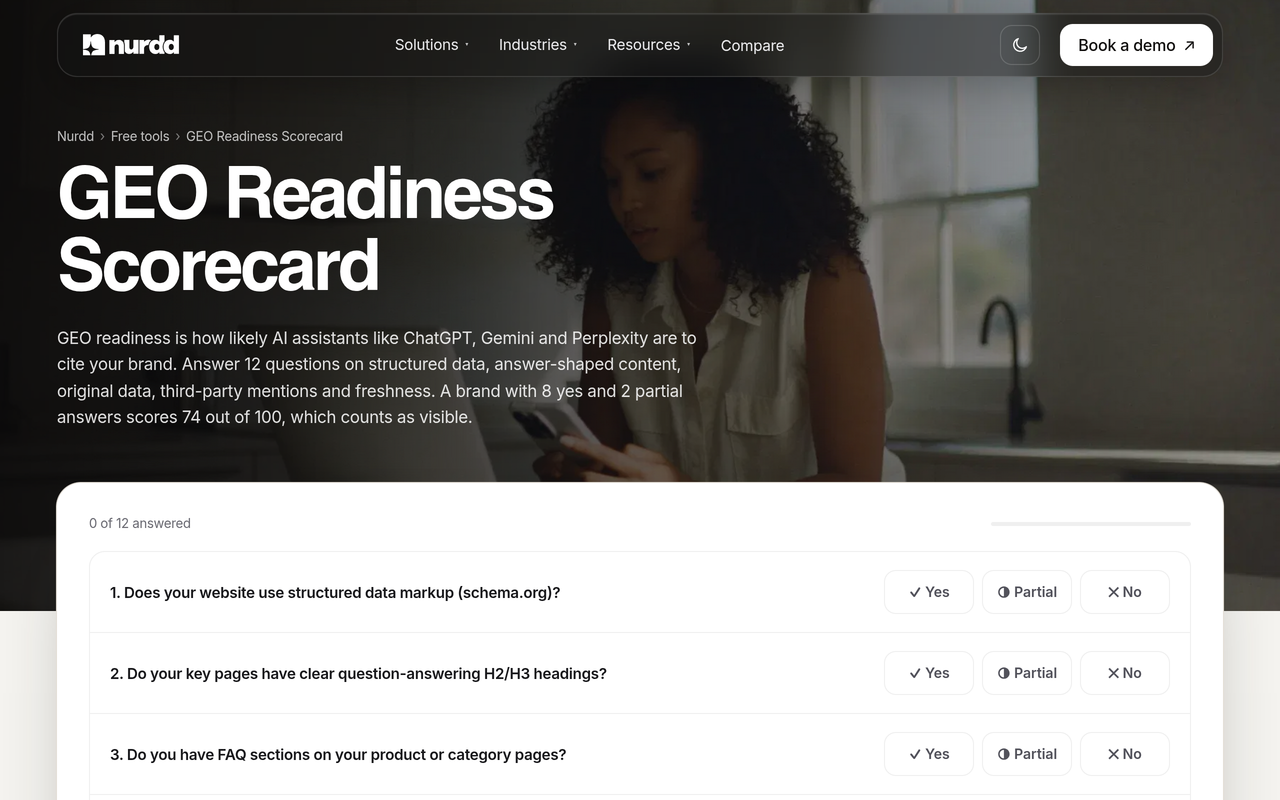
If you want a team to act on the findings, Nurdd also runs generative engine optimization services, measured in Noma. You can check your site's baseline first with the free GEO readiness scorecard.
Three scenarios: who does what
The founder at a seed-stage SaaS company
With no budget for a tracking programme, the founder starts with 20 prompts, checks crawler access and writes one honest comparison page against the most-named rival. The first aim is simply to be named once for a category prompt. The 30-day GEO and SEO starting plan fits this stage.
The head of marketing at a mid-market SaaS company
This team already has content and reviews. The job is the source map: which review sites and roundups engines cite for the category, and where the brand is missing. Weekly reporting by prompt type goes to the CMO. See the SaaS industry page for how Nurdd frames this work.
The SEO lead who already ranks on Google
Rankings are healthy, yet AI answers name rivals. The SEO lead adds AI citations to the monthly report next to organic metrics, using AI search metrics alongside SEO metrics. Because Google's AI features sit on the same index as Search, the gap is usually off-site presence and answer clarity.

How we researched this
Written by Sheetal Shakshi. We searched the primary keyword and read the top-ranking guides that are not on nurdd.club, noting their sections and gaps. We then reviewed platform documentation from OpenAI and Google, a buyer-behaviour report from G2, a write-up of the Ahrefs 75,000-brand study and published guides from HubSpot, Frase and Definition. Sources were checked on the publication date of this post, and figures are quoted as those pages state them. We did not run hands-on tests or interviews for this article, and the worked example is arithmetic, not data. Brand facts about Nurdd products come from Nurdd.
Frequently asked questions
How can a B2B SaaS company improve visibility in AI search engines?
Build a fixed set of category, comparison and alternatives prompts, allow the search crawlers, publish pages that answer those prompts directly and keep your company description identical across the web. Then earn mentions on review sites and communities that engines cite, and measure weekly with repeat samples. Change one thing at a time so you can see what worked.
How do SaaS brands get recommended by ChatGPT?
ChatGPT needs to be able to reach your pages, which means not blocking OAI-SearchBot, and it needs to meet your brand described consistently on independent sources. No one can guarantee a recommendation, so track outcomes rather than promising them. Our guide on why a brand does not show up in ChatGPT answers lists the usual causes.
Do I need llms.txt or special schema to appear in AI answers?
Google's guide says there is no requirement to chunk content and that pages should be made for your audience first. We did not find a vendor page that promises a file or markup will earn recommendations. Structured data remains useful for rich results, but it should not replace good content and mentions.
How often should I check AI search visibility?
Weekly is a sensible rhythm for most SaaS teams, with repeat runs per prompt because answers vary. Daily monitoring helps if you are shipping changes or want alerts when a citation is lost; see AI search monitoring alerts. Monthly reports then summarise the trend for leadership.
How many prompts should a SaaS company track?
Start with 40 to 60 non-branded prompts spread across five types: category, comparison, alternatives, use case and integration. Keep branded prompts in a separate bucket. Add prompts as sales calls reveal new questions, but keep the core set fixed so trends stay comparable.
Is AI search big enough to matter for SaaS?
G2's 2026 report says 51% of B2B software buyers start research with an AI chatbot more often than with Google. Many answers shape a shortlist without sending a click, so track mentions as well as sessions.
Do backlinks still matter for AI visibility?
Links still support classic search, but in the Ahrefs 75,000-brand study, as summarised by LSEO, branded web mentions had the strongest correlation (0.664) with AI Overview visibility. That is correlation, not proof of cause. Aim for authentic mentions in places your buyers read.
How does Noma track AI search visibility for SaaS brands?
Noma tracks 13 AI engines, including ChatGPT, Gemini, Perplexity and Claude, polled daily. It records whether your brand is named, which page each citation comes from and how you compare with competitors by category. It has a 3-day free trial with a card taken at signup; billing starts on day 3.
Next step: see your own prompts in Noma
Visibility in AI search engines comes down to being reachable, being described consistently and being measured every week. The fastest way to find your gaps is to see real answers for your own category. Book a demo and Nurdd will walk through Noma with your brand, your competitors and your category prompts, so you leave with a list of the pages and sources to fix first. You can also read how Nurdd works.